
How Prevailing Wage Laws Actually Work — and Why Enforcement Determines Whether They Mean Anything
The Davis-Bacon Act requires contractors on federal construction projects to pay locally determined wage rates. It has done so since 1931.

How Prevailing Wage Laws Actually Work, and Why Enforcement Determines Whether They Mean Anything
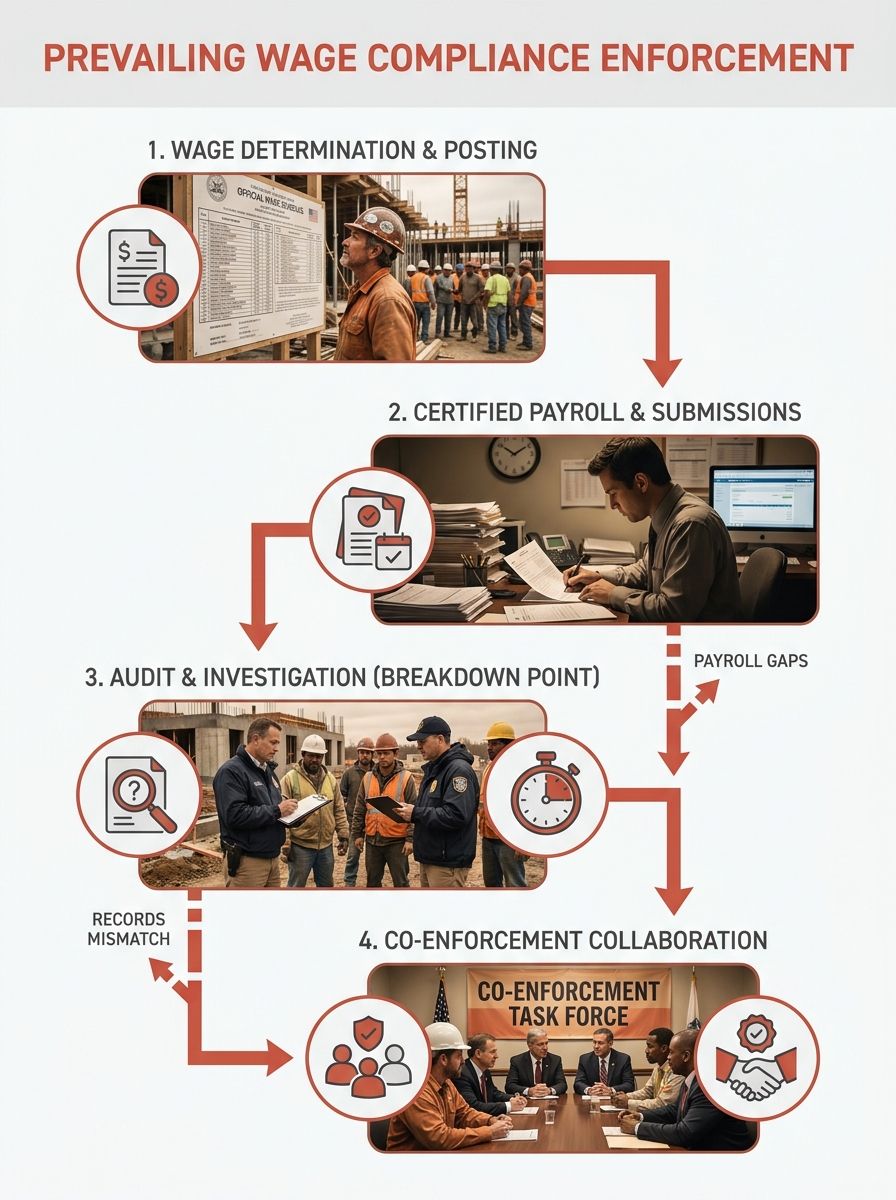
The Davis-Bacon Act requires contractors on federal construction projects to pay locally determined wage rates. It has done so since 1931. Whether any given electrician, plumber, or ironworker actually receives those wages depends on a chain of enforcement steps that breaks down at predictable points. These six rules cover where the breakdowns happen and what workers can do about each one.
Every year, public agencies award hundreds of billions of dollars in construction contracts for roads, schools, water systems, and bridges. Each of those contracts triggers public works labor standards that set minimum pay floors well above state minimums. California's State Water Resources Control Board requires Davis-Bacon documentation to stay available for review by the EPA, the Department of Labor, and state auditors for at least 3 years after a project finishes. That documentation is supposed to prove workers got paid correctly. The gap between what's on paper and what's in a worker's pocket is where enforcement lives.
The Department of Labor's 2023 updates to the Davis-Bacon Act introduced a three-step calculation method (majority rule, 30% threshold, or weighted average) for setting prevailing rates. A June 24, 2024 court injunction paused enforcement of some specific provisions affecting material suppliers and delivery drivers. But for the core trades, the updated rules remain in effect. Here's how to make them count.
Know the posted rate before you pick up a tool
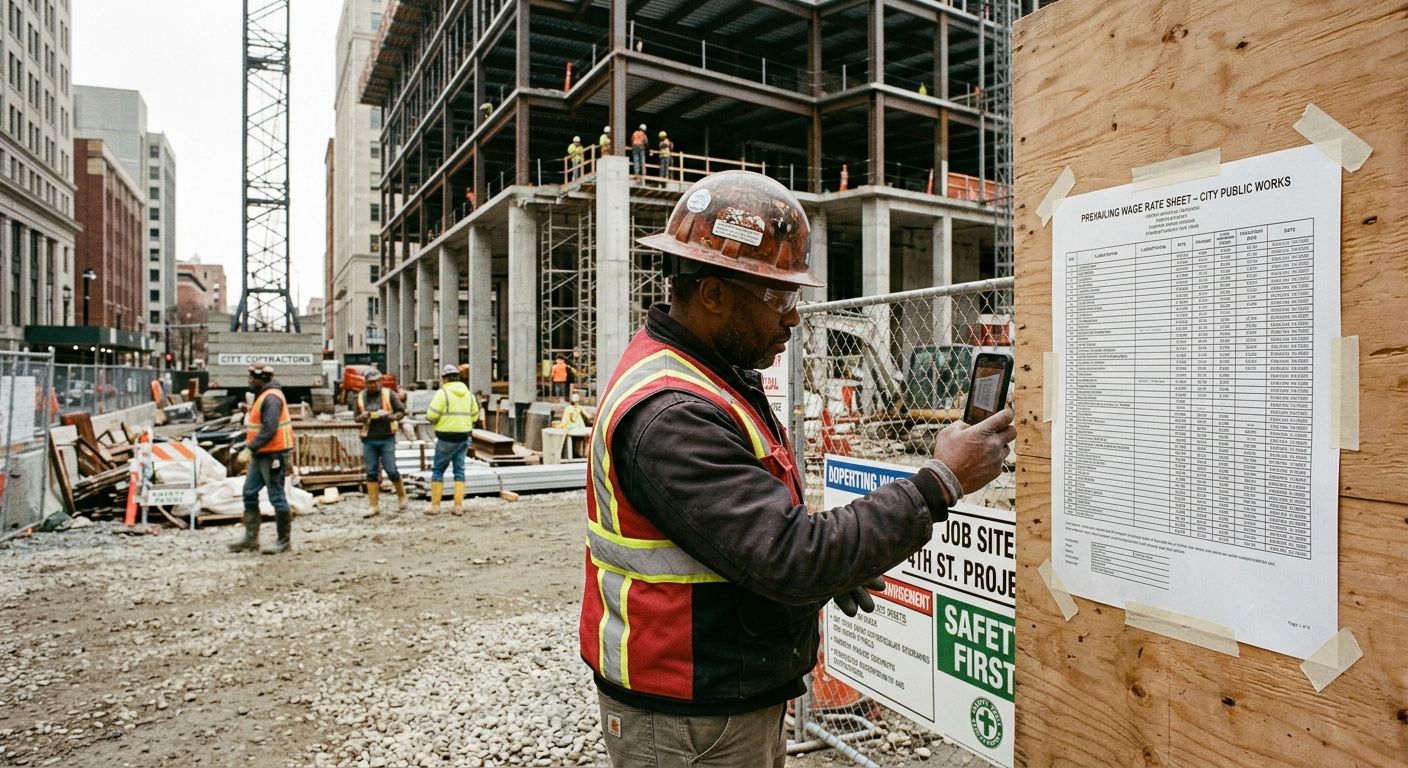
Every prevailing wage law in the country requires contractors to post the applicable wage rates at the job site. The federal Wage Poster (form WH-1321) must be displayed in a spot protected from weather and readable in all relevant languages, including English and Spanish. Massachusetts law requires posting the rate sheet at the project site and submitting certified payroll records to the awarding authority. The New York State Department of Labor maintains a searchable database of prevailing rates broken down by county, trade, and project type.
If you don't see a posted wage schedule when you walk onto a public works job site, that's your first red flag. Federal wage determinations are published on a county-by-county basis through the Department of Labor's online system. Your local's business agent or steward should verify the posted rates match the DOL determination before work begins. The Inflation Reduction Act of 2022 expanded these requirements further: projects where construction began after January 29, 2023, must meet prevailing wage and apprenticeship standards to qualify for increased federal tax incentives.
Demand certified payroll records, then read them
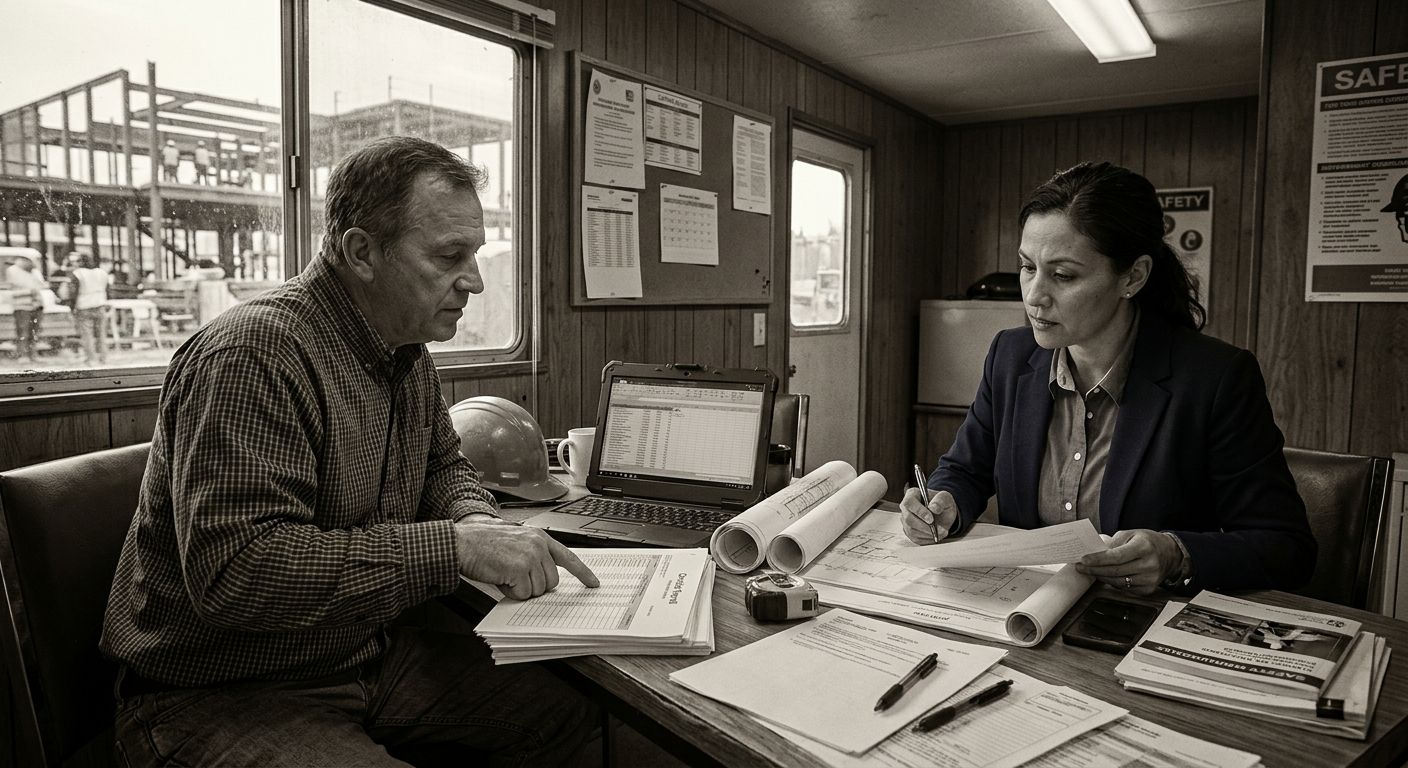
Certified payroll is the single most important enforcement document in the Davis-Bacon Act enforcement system. Contractors must submit weekly reports listing every worker by name, classification, hours worked, and wages paid, including fringe benefits. According to the NYC Comptroller's Office, the most common violations they investigate include failure to pay prevailing wages, misclassification of workers, and falsification of payroll records. In fiscal year data from the Comptroller's office, investigators recovered over $11 million in wages from violating contractors, including a $400,000 settlement against Secured 24, LLC for withholding wages from school security guards.
The problem is that certified payroll is self-reported. A contractor fills out the forms. A contractor signs the certification. The awarding authority (the city, the school district, the state DOT) is supposed to review those records. But with dozens or hundreds of active projects at any time, many awarding authorities do little more than check that the paperwork exists. The Center for American Progress has documented that co-enforcement programs, where unions partner with agencies to audit payroll, are the most effective known approach to catching falsified records. That brings us to rule five below.
Workers who suspect payroll fraud should compare their own pay stubs and hours against the certified records. If the hours don't match, or if your classification looks wrong, that discrepancy becomes the basis for a formal complaint.
Track your hours by classification, not by job title
Misclassification on prevailing wage projects is one of the most profitable forms of wage theft in construction. The way prevailing wage law works, each trade classification (electrician, plumber, cement mason, ironworker, carpenter) carries its own hourly rate and fringe benefit package. A cement mason who spends 3 hours setting rebar and 2 hours building forms in the same day is owed ironworker rates for the rebar hours and carpenter rates for the form-building hours. If the employer pays the entire day at the cement mason rate (typically the lowest of the three), the worker loses money on every misclassified hour.
This kind of misclassification prevailing wage violation is hard to detect from payroll records alone, because the contractor controls how hours get coded. Worker classification under prevailing wage rules determines the correct wage and fringe benefit rate for each employee, and misclassification is one of the most common and costly errors in construction payroll. It triggers back-wage liability, audit flags, and potential debarment.
Keep a personal log. Every day, write down what tasks you performed and how many hours you spent on each. If you set rebar for 3 hours, poured concrete for 4 hours, and built forms for 1 hour, note the classification each task falls under. This log becomes critical evidence if you file a complaint or if your union pursues a wage compliance audit on the project. The practice parallels the kind of documentation approach we've covered in guides on how to file an unfair labor practice charge: detailed, contemporaneous records win cases.
File complaints with the right agency, not just any agency
Prevailing wage enforcement is split across federal, state, and local agencies, and filing with the wrong one wastes months. For Davis-Bacon Act enforcement on federally funded projects, the U.S. Department of Labor's Wage and Hour Division runs investigations. The DOL protects workers who cooperate in investigations or testify in proceedings from retaliation. For state-funded projects, each state has its own enforcement body. In Massachusetts, the Attorney General's Office handles prevailing wage complaints. In New York, the Bureau of Public Work and Prevailing Wage Enforcement within the state DOL takes the lead. In New York City, the Comptroller's office runs a separate enforcement operation that levied a $650,000 penalty against 160 Madison Ave LLC for repeat prevailing wage violations.
Know which pot of money funded your project. Federal dollars trigger Davis-Bacon. State dollars trigger state prevailing wage law. Some projects draw from both, meaning both sets of rules apply. If you're unsure, your union rep or a prevailing wage attorney can check the project's funding sources. Prevailing wages are predetermined rates higher than the state minimum wage and apply to most public works construction, alteration, demolition, or repair work paid for with public funds.
This matters because the remedies differ. New York's Bureau of Public Work can order repayment of wages plus interest and penalties. Willful violations can result in debarment from bidding on future public work projects. The federal DOL can withhold contract payments to cover back wages owed. Filing in the right place gets you to the right remedy faster.
Push for co-enforcement between your union and public agencies
The longest-running co-enforcement program in the country operates in Los Angeles County, where the unified school district partners with building trades unions to monitor prevailing wage compliance on district construction projects. Workers report violations directly to their union, which coordinates with the district's compliance office to investigate. The Center for American Progress found that these initiatives have been effective at improving both compliance rates and enforcement outcomes. Multnomah County in Oregon runs a similar program.
The logic is straightforward. Government inspectors can't be everywhere. In a parallel situation, we've seen how six OSHA inspectors trying to cover 60,000 workplaces in West Virginia leaves massive gaps. Prevailing wage enforcement faces the same math problem. Unions have stewards and members on the ground every day. They see which workers are getting paid, which classifications are being used, and whether the posted rates match reality. Pairing that ground-level visibility with the agency's subpoena power and penalty authority creates a system stronger than either side could run alone.
If your local doesn't have a co-enforcement agreement with your city, county, or school district, this is worth bargaining for. The model works in jurisdictions of all sizes. New York City and Baltimore have extended sectoral pay standards to private security guards at approximately $18 per hour plus benefits, showing that prevailing wage concepts can reach beyond traditional construction trades. Coverage is expanding, and co-enforcement should expand with it.
Treat debarment as the enforcement mechanism that actually changes behavior
Back-wage orders matter. Penalties matter. But debarment, the power to bar a violating contractor from bidding on future public work for a set period, is the penalty that changes contractor behavior. A $50,000 fine on a $12 million project is a rounding error. Losing the ability to bid on public work for 3 years can shut a company down.
New York's prevailing wage enforcement framework authorizes debarment for willful violations. The federal Davis-Bacon system allows the DOL to place contractors on an ineligible list, blocking them from all federally funded contracts. When workers and unions push for debarment in complaint proceedings (rather than settling for back-wage payments alone), they raise the cost of cheating for every contractor in the market.
This connects to a broader pattern in labor enforcement. As we've documented with employers spending $1.7 billion fighting unions, companies calculate whether breaking the rules is cheaper than following them. Debarment changes that calculation because it threatens future revenue, not past profits. Unions should name debarment explicitly in every prevailing wage complaint where the evidence supports willful misconduct. Agencies that rarely use their debarment authority need political pressure from labor councils and building trades to start.
When These Rules Have No Teeth
Every rule above assumes something that isn't always true: that an enforcement agency exists, is funded, and is willing to act. In states that have repealed their prevailing wage laws entirely (Indiana did so in 2015, West Virginia in 2016, Kentucky in 2017), there is no state-level prevailing wage law to enforce. Workers on state-funded projects in those states have no wage floor above the standard minimum. Federal Davis-Bacon protections still apply to federally funded work, but state and locally funded projects are unprotected.
Even where prevailing wage law exists on the books, political pressure can hollow out enforcement. Budget cuts to state labor departments, unfilled investigator positions, and political appointees who slow-walk complaints all erode the system without repealing a single statute. Dane County, Wisconsin proposed a $15 living wage floor for public workers and contractors, but even ambitious local standards depend on local enforcement capacity.
The defense against this erosion is organized political power. Building trades councils that lobby for enforcement funding, unions that testify at budget hearings for state labor departments, and workers who file complaints (creating a paper trail that justifies more investigators) all strengthen the system. A wage compliance audit that catches $400,000 in stolen wages pays for multiple investigator salaries. The economics of enforcement favor workers, but only when someone insists on doing the math out loud.
The Union Edge Staff
Related Articles

What Is Prevailing Wage? Legal Definition & Requirements
A prevailing wage is the minimum hourly rate, including fringe benefits, that contractors and subcontractors must pay workers on government-funded projects, as determined by the U.S. Department of Labor or a state equivalent.

California Prevailing Wage: Complete Legal Guide
California's Director of Industrial Relations sets prevailing wage rates for every county and trade classification in the state, drawing primarily from collectively bargained union agreements.
Prevailing Wage for California: Complete Guide
Prevailing wage for California is the legally mandated minimum hourly compensation, base pay plus fringe benefits, that every worker on a qualifying public works project must receive, as determined by the Director of the Department of Industrial Relations (DIR).
Also in the paper