
Trump Administration Proposes Ending Federal Workers' Right to Impartial Discrimination Hearings
The Trump administration has proposed eliminating the automatic right for more than 2 million federal and D.C.

Trump Administration Proposes Ending Federal Workers' Right to Impartial Discrimination Hearings
The Trump administration has proposed eliminating the automatic right for more than 2 million federal and D.C. government employees to have workplace discrimination claims reviewed by neutral administrative judges, according to Kendrick Roberson, National Vice President of the American Federation of Government Employees. Under the proposed rule change, agencies accused of discrimination would initially decide whether discrimination occurred, with workers able to appeal to the Equal Employment Opportunity Commission and request a hearing only at the commission's discretion.
Current System Guarantees Neutral Review
For the past 40 years, federal workers who believed they faced discrimination based on race, color, sex, national origin, disability, age, religion, genetic information or retaliation have held an automatic right to request a hearing before an EEOC administrative judge. The process begins when an agency investigates a discrimination complaint within 180 days and produces an investigation report. Workers can then choose to have the case decided by their employer or request a hearing before an administrative judge, representing the first time a neutral party reviews the claim.
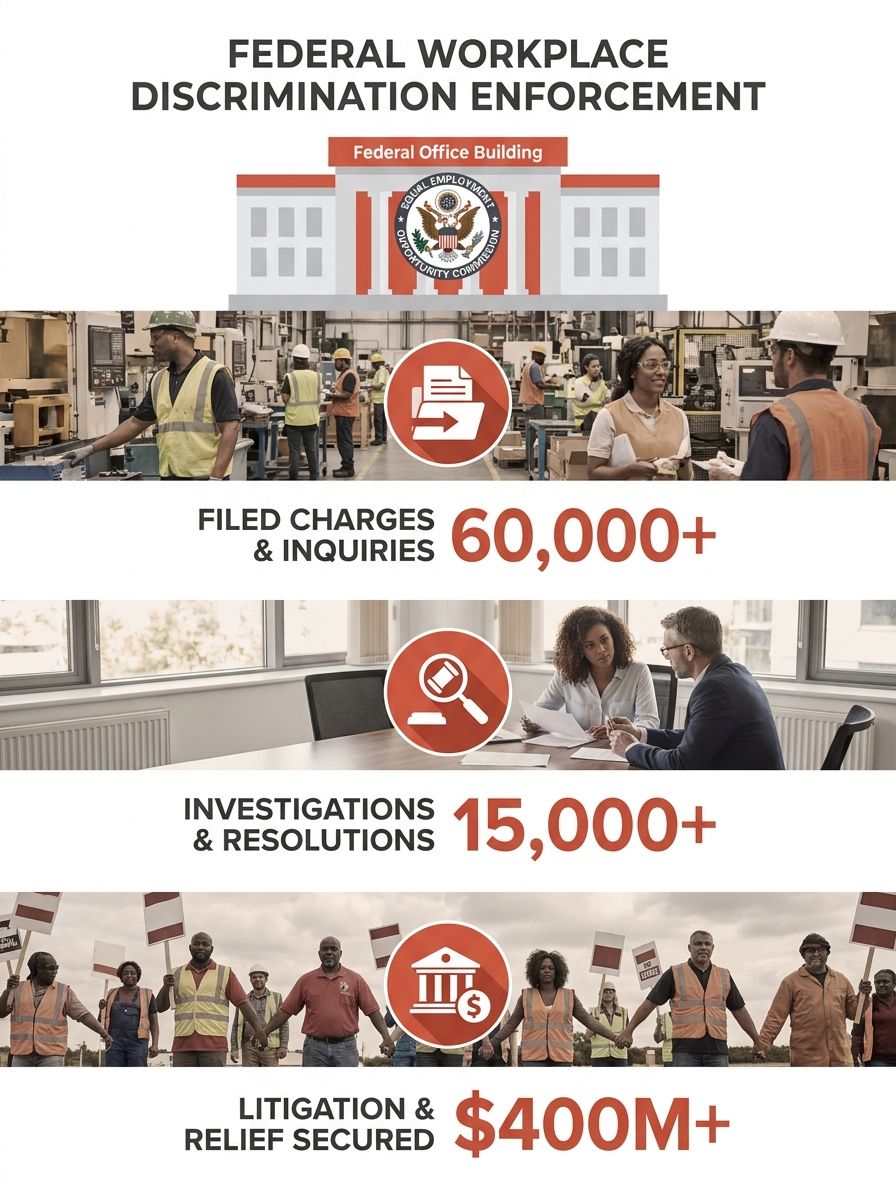
The proposed change would require the employing agency to issue a final decision on whether discrimination occurred before a worker could appeal to the EEOC. Workers could then request that the commission refer the case to an administrative judge, but such referrals would become discretionary rather than automatic.
Data Shows Administrative Judges Find More Discrimination
In fiscal year 2021, federal agencies issued 5,604 final decisions without involving an administrative judge, finding discrimination in 109 cases, according to the EEOC's annual report cited by Roberson. By comparison, 3,821 final orders implementing administrative judge decisions included 112 findings of discrimination. Administrative judge decisions accounted for more than half of all discrimination findings that year despite representing a smaller share of total cases.
The same FY 2021 data showed that agencies completed 86.4% of discrimination investigations within the required 180-day deadline, meaning thousands of investigations exceeded the statutory timeframe. Under the current system, workers can request an administrative judge hearing once the investigation period ends, regardless of whether the agency completed its work on time.
"The same agency accused of discrimination would investigate the complaint and initially decide whether discrimination occurred," Roberson wrote, describing the conflict of interest the proposed rule would create. The Trump administration's related effort to terminate 60 years of workplace discrimination data collection has drawn similar criticism from labor advocates who argue the changes undermine civil rights enforcement.
AFGE Official Cites Harassment Cases
Roberson described scenarios where the proposed system would fail workers, including cases where immediate supervisors engage in sexual harassment and upper management fails to intervene. Under the proposed rule, the agency that employed both the harassing supervisor and the management officials who ignored the behavior would make the initial determination on whether harassment occurred, whether management responded appropriately, and what damages, if any, the worker deserves.
The Civil Rights Act of 1964 created Title VII protections specifically to shield workers from discrimination and established the Equal Employment Opportunity Commission to enforce those protections. The EEOC's stated mission is to "eliminate unlawful employment discrimination."
Federal workers who face discrimination currently follow a structured process: the employer receives and investigates the complaint, then the worker chooses between accepting the agency's proposed resolution or requesting an administrative judge hearing. The proposed change would insert an additional agency decision-making step before workers could access neutral review.
Policy Implications
The proposal represents a structural shift in how 2 million federal workers can challenge workplace discrimination, moving initial decision-making authority from neutral administrative judges to the agencies facing discrimination allegations. The FY 2021 data suggesting administrative judges find discrimination at slightly higher rates than agencies deciding their own cases underscores why advocates view the automatic hearing right as critical to enforcement. Workers in agencies that miss investigation deadlines would face particular vulnerability under the discretionary referral system.
Labor organizations representing federal workers have historically defended administrative hearing rights as essential counterweights to agency power, especially in cases involving retaliation or management misconduct. The proposal's success would depend on whether the EEOC interprets "necessary or efficient" referral criteria broadly or narrowly when workers request administrative judge review. If the commission rarely grants such requests, the practical effect would mirror eliminating the hearing right entirely, leaving federal workers dependent on their employers' willingness to find against themselves in discrimination disputes.
The Union Edge Staff
Related Articles

Trump Administration Plans to Terminate 60 Years of Workplace Discrimination Data Collection
The Equal Employment Opportunity Commission is preparing to terminate its EEO-1 reporting program, which for six decades has required U.S. companies to disclose workforce demographic data used to enforce federal anti-discrimination laws, according to a Guardian investigation.

Supreme Court to Decide Trump Removal Authority in Twin Cases With Direct Impact on NLRB Protections
The Supreme Court will rule on President Donald Trump's authority to remove federal officials in two separate cases involving FTC Commissioner Rebecca Kelly Slaughter and Federal Reserve Governor Lisa Cook, according to Fox News. Legal experts say the Court may draw sharp distinctions between the ag

When AI Safety Tools Become Union-Busting Weapons: What Workers Need to Know About Algorithmic Surveillance
AI-powered surveillance systems sold to employers as workplace safety monitoring tools are being repurposed to track union sympathizers, suppress organizing conversations, and algorithmically discipline workers who exercise their legal right to collective action.
Also in the paper