
North Carolina Minimum Wage: 2024 Guide
North Carolina's minimum wage is $7.25 per hour, locked to the federal floor under the Fair Labor Standards Act, and it hasn't moved by a single penny since July 24, 2009.

North Carolina Minimum Wage: How the Rate Works, Why It's Stuck, and What Workers Actually Need
North Carolina's minimum wage is $7.25 per hour, locked to the federal floor under the Fair Labor Standards Act, and it hasn't moved by a single penny since July 24, 2009. That 17-year freeze means a full-time minimum wage worker in the state earns roughly $15,080 a year before taxes, while research shows a single adult needs at least $93,766 annually to live comfortably in the state.
How the Minimum Wage in North Carolina Is Defined
The North Carolina Department of Labor requires every employer doing business in the state to pay at least $7.25 per hour to all covered employees. Agricultural and domestic employees fall under separate federal minimum wage provisions, but the practical rate is the same: $7.25. The state rate matches the federal minimum because North Carolina's legislature adopted the federal floor as its own standard and has declined to set an independent, higher rate.
This puts North Carolina in a group of roughly 20 states that default to the federal minimum. States like Maryland, Michigan, and Arizona have broken away from that baseline by enacting their own higher rates, you can see how those compare by reading about the minimum wage structure in Arizona or Maryland's approach. North Carolina has taken the opposite path: its legislature hasn't passed a minimum wage increase since 2006 (which took effect in stages through 2008, landing at $6.55 before the federal rate caught up in 2009).
The state's Wage and Hour Act governs enforcement. Employers who violate it face penalties from the NC Department of Labor, including back-pay orders and civil fines. But the enforcement mechanism only operates on the $7.25 threshold, and that threshold is where it has been for nearly two decades.
The Federal Floor Lock: Why the Rate Mirrors Washington
North Carolina's minimum wage mechanism works through what labor economists call "federal floor dependence." The state statute ties its minimum to the federal rate, meaning the only way North Carolina's minimum wage rises is if Congress acts. The state has no automatic adjustment mechanism, no cost-of-living indexing, no inflation formula, no scheduled annual increases.
This design has a specific consequence: when Congress itself freezes the federal minimum, every floor-dependent state freezes with it. The federal $7.25 rate has been in place since July 2009, making it the longest period without a federal increase since the minimum wage was established in 1938. According to the National Conference of State Legislatures, more than 30 states and the District of Columbia have now enacted rates above the federal floor, but North Carolina isn't among them.
The political arithmetic in the NC General Assembly explains why. Republican supermajorities have controlled both chambers for most of the period since 2010, and leadership has consistently blocked minimum wage bills from reaching committee votes. Senate Bill 440, which proposed raising the state rate to $15 per hour, stalled in committee without a floor vote. Senate Bill 447, a separate attempt, met the same fate. Advocacy groups like Raising Wages NC have pushed for increases, but no proposal has gathered the legislative votes needed to advance.
Tipped, Youth, and Subminimum Rates
The $7.25 figure is the standard minimum, but North Carolina's wage floor has several sub-levels that affect specific worker categories. The tipped minimum wage is $2.13 per hour, provided that tips bring total compensation up to at least $7.25 per hour. If they don't, the employer is legally required to make up the difference. That's the law, but enforcement depends on workers knowing their rights and employers keeping honest records.
Tip pooling is permitted under state rules, but employees must retain at least 85% of their tips. The remaining 15% can be distributed to other eligible staff, though managers and supervisors are excluded from tip pools under federal rules.
Youth workers face a separate sub-tier. Employers can pay $4.25 per hour to employees under 20 years old during their first 90 consecutive calendar days of employment. After that window closes, the standard $7.25 rate kicks in. Full-time student learners and apprentices can be paid 90% of the minimum wage, $6.53 per hour, under special certificates.
Workers with disabilities may receive a subminimum wage as low as 50% of the standard rate if their employer obtains a certificate from the NC Wage and Hour Bureau. This practice mirrors the federal Section 14(c) program and has drawn significant criticism from disability rights organizations nationally, though it remains legal in North Carolina.
Worker Category | Hourly Rate | Conditions |
|---|---|---|
Standard employee | $7.25 | All covered employers |
Tipped employee | $2.13 (cash wage) | Tips must bring total to $7.25+ |
Youth (under 20) | $4.25 | First 90 days only |
Student learner/apprentice | $6.53 (90% of minimum) | Requires special certificate |
Worker with disability | As low as $3.63 (50%) | Requires Wage & Hour Bureau certificate |
The Preemption Wall
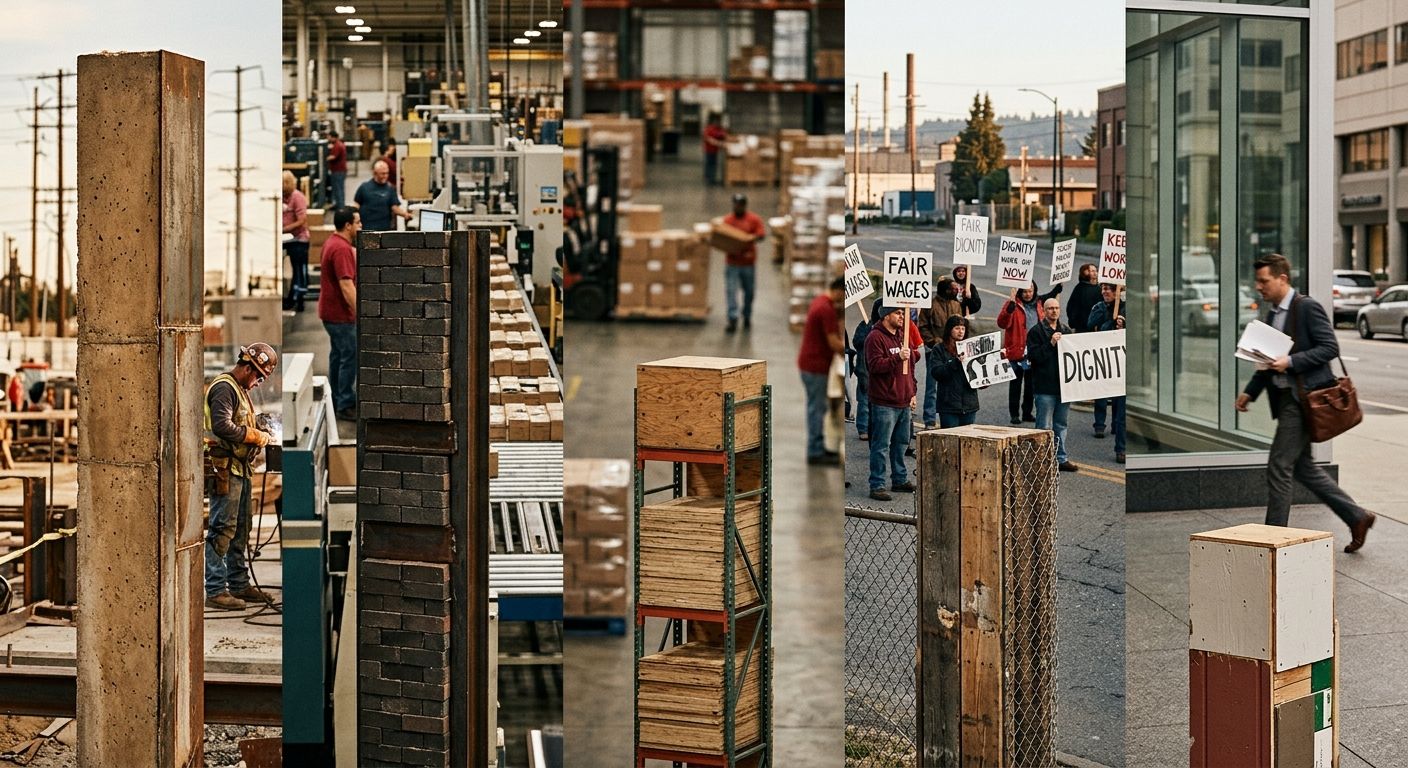
Here's the mechanism that makes North Carolina's minimum wage situation structurally different from states where local organizing can push wages up city by city. North Carolina state law prohibits cities and towns from enacting their own higher minimum wage rates. This preemption clause means that Durham, Charlotte, Raleigh, Asheville, none of them can set a local wage floor above $7.25, no matter how high their cost of living climbs.
Preemption laws like this exist in roughly 25 states and represent a deliberate structural choice. They remove the most accessible pressure valve that workers and local governments have for responding to regional economic conditions. In states without preemption, cities have acted as laboratories, Seattle's $15 minimum, Denver's graduated increases, Minneapolis's employer-size-tiered system. North Carolina's preemption wall ensures that the state legislature holds monopoly control over the wage floor, and the legislature has chosen not to move it.
The practical effect is that a hotel housekeeper in downtown Charlotte and a farm worker in rural Robeson County are both covered by the same $7.25 rate, despite living in areas with dramatically different costs of housing, transportation, and childcare.
The Gap Between $7.25 and What Workers Actually Need
MIT's Living Wage Calculator, updated in February 2026, estimates the basic costs that go into a living wage for North Carolina residents. The figures vary by county, household size, and number of working adults, but the statewide picture is stark. A single adult with no children needs substantially more than $7.25 per hour to cover housing, food, transportation, healthcare, and other necessities before any discretionary spending enters the picture.
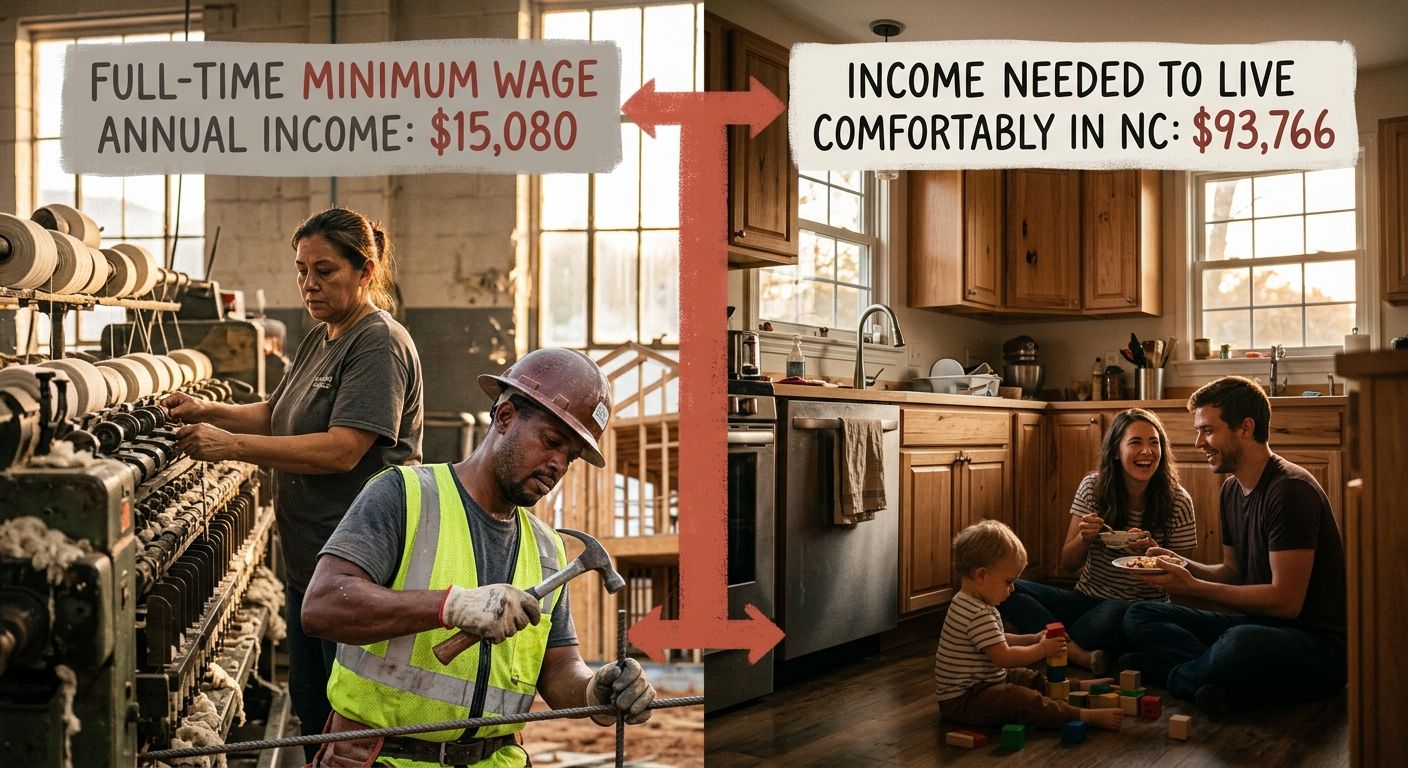
The Raleigh News & Observer reported that North Carolina workers need at least two times the minimum wage to live comfortably. A WCNC analysis placed the comfortable-living threshold for a single adult at $93,766 per year, more than six times what a full-time minimum wage job pays annually ($15,080 at 40 hours per week, 52 weeks).
This gap isn't an abstraction. It shows up in patterns we've documented across other states where the minimum wage sits at or near the federal floor. Pennsylvania faces a nearly identical structural problem, and Georgia's wage floor presents similar challenges for workers. In each case, the gap between the legal minimum and actual living costs pushes workers into multiple jobs, longer commutes, and greater reliance on public assistance programs.
Bills That Have Died in Committee
The North Carolina General Assembly has seen multiple minimum wage increase proposals over the past decade. None have become law. The two most prominent recent attempts tell the story:
Senate Bill 440 proposed raising the minimum wage to $15 per hour. It did not receive a committee hearing and died without a floor vote. Senate Bill 447, a companion effort, suffered the same fate. Neither bill attracted bipartisan support sufficient to move through a Republican-controlled legislature.
House Bill 353, titled the Fair Minimum Wage Act, took a different approach, a graduated increase schedule. Under HB 353, the minimum wage would have risen to $10 per hour by 2026, $12 by 2027, $14 by 2028, $16 by 2029, and $18 by 2030, with automatic inflation indexing afterward. The bill's phased structure was designed to ease the transition for small businesses, but it also failed to advance.
No minimum wage increases are currently scheduled in North Carolina. The rate will remain $7.25 per hour unless future federal or state legislation changes it. Given the current composition of the General Assembly, a state-level increase would require either a significant shift in legislative seats or a successful ballot initiative, and North Carolina's constitution makes citizen-initiated ballot measures extremely difficult compared to states like Missouri, where voters have directly approved wage increases.
Where the Mechanism Breaks
North Carolina's minimum wage framework operates on an assumption that markets and employer competition will push actual wages above the legal floor for most workers. And in sectors like tech, healthcare, and skilled trades, that assumption holds, employers in the Research Triangle or Charlotte's financial district pay well above $7.25 because they have to compete for labor.
The framework breaks down in three specific conditions.
High market-power employers in low-density labor markets. When a single employer dominates hiring in a rural county, a poultry processing plant, a distribution warehouse, a single hospital system, the competitive pressure that's supposed to push wages above the floor weakens or disappears. Workers in these settings often face a choice between the offered wage and no wage at all.
Tipped workers whose employers don't track shortfalls. The $2.13 tipped minimum wage assumes employers will monitor whether tips actually bring compensation to $7.25 and make up any deficit. In practice, the NC Department of Labor lacks the inspection staff to audit every restaurant and bar. Workers who don't know they're entitled to the difference, or who fear retaliation for asking, absorb the loss silently.
Inflation erosion without indexing. The $7.25 rate has lost roughly 30% of its purchasing power since 2009 due to cumulative inflation. Without an automatic adjustment mechanism, the real value of the minimum wage drops every year Congress and the state legislature decline to act. The longer the freeze continues, the wider the gap grows between the nominal rate and what it can actually buy.
Common Questions
Does North Carolina have its own minimum wage, or does it just follow the federal rate?
North Carolina has a state minimum wage statute, but the rate is set at $7.25 per hour, identical to the federal minimum. The state adopted the federal floor as its own and has not enacted an independent higher rate. The practical effect is the same as having no state minimum wage law at all, though the state statute does provide a separate enforcement mechanism through the NC Department of Labor.
Can cities in North Carolina set a higher minimum wage?
No. North Carolina state law preempts local minimum wage ordinances. Cities and counties are legally prohibited from enacting their own higher wage floors. The $7.25 rate applies uniformly across every municipality in the state, regardless of local cost-of-living differences.
How much do tipped workers earn in North Carolina?
Tipped employees in North Carolina can be paid a cash wage of $2.13 per hour, but their total compensation (wages plus tips) must reach at least $7.25 per hour. If tips don't make up the difference, the employer is required by law to cover the shortfall. Tip pooling is allowed, but employees must retain at least 85% of their tips.
Is there any scheduled minimum wage increase in North Carolina?
No increases are currently scheduled. The rate will stay at $7.25 per hour unless the state legislature passes new legislation or Congress raises the federal minimum wage. House Bill 353 proposed a phased increase to $18 per hour by 2030 with inflation indexing, but it has not advanced through the legislature.
How does North Carolina's minimum wage compare to a living wage?
A full-time minimum wage worker in North Carolina earns approximately $15,080 per year. Research from MIT's Living Wage Calculator and reporting by the Raleigh News & Observer indicates that a single adult needs at least twice the minimum wage to cover basic living expenses in the state. One analysis placed the comfortable-living salary for a single adult at $93,766, more than six times the minimum wage annual income.
The Union Edge Staff
Frequently Asked Questions
- What is the current minimum wage in North Carolina?
- North Carolina's minimum wage is $7.25 per hour, which matches the federal minimum wage and has remained unchanged since July 24, 2009.
- Can cities and counties in North Carolina set their own higher minimum wage?
- No, North Carolina state law prohibits cities and towns from enacting their own minimum wage rates higher than $7.25 per hour, regardless of local cost-of-living differences.
- What is the tipped minimum wage in North Carolina?
- Tipped employees in North Carolina can be paid $2.13 per hour in cash wages, provided that tips bring their total compensation to at least $7.25 per hour; employers must make up any shortfall if tips don't reach this threshold.
- How much do you need to earn annually to live comfortably in North Carolina?
- According to research cited in the article, a single adult in North Carolina needs at least $93,766 annually to live comfortably, which is more than six times what a full-time minimum wage worker earns ($15,080 per year).
- Is North Carolina planning to increase its minimum wage?
- No minimum wage increases are currently scheduled in North Carolina; the rate will remain $7.25 per hour unless future federal or state legislation changes it. Recent bills proposing increases, including House Bill 353 which would have raised it to $18 by 2030, have failed to advance through the legislature.
- What is the minimum wage for workers under 20 in North Carolina?
- Employers in North Carolina can pay workers under 20 years old $4.25 per hour during their first 90 consecutive calendar days of employment; after that period, the standard $7.25 rate applies.
- How much purchasing power has North Carolina's minimum wage lost since 2009?
- The $7.25 minimum wage has lost approximately 30% of its purchasing power since 2009 due to cumulative inflation, with no automatic cost-of-living adjustment mechanism in place.
Related Articles
minimum wage in the state of north carolina
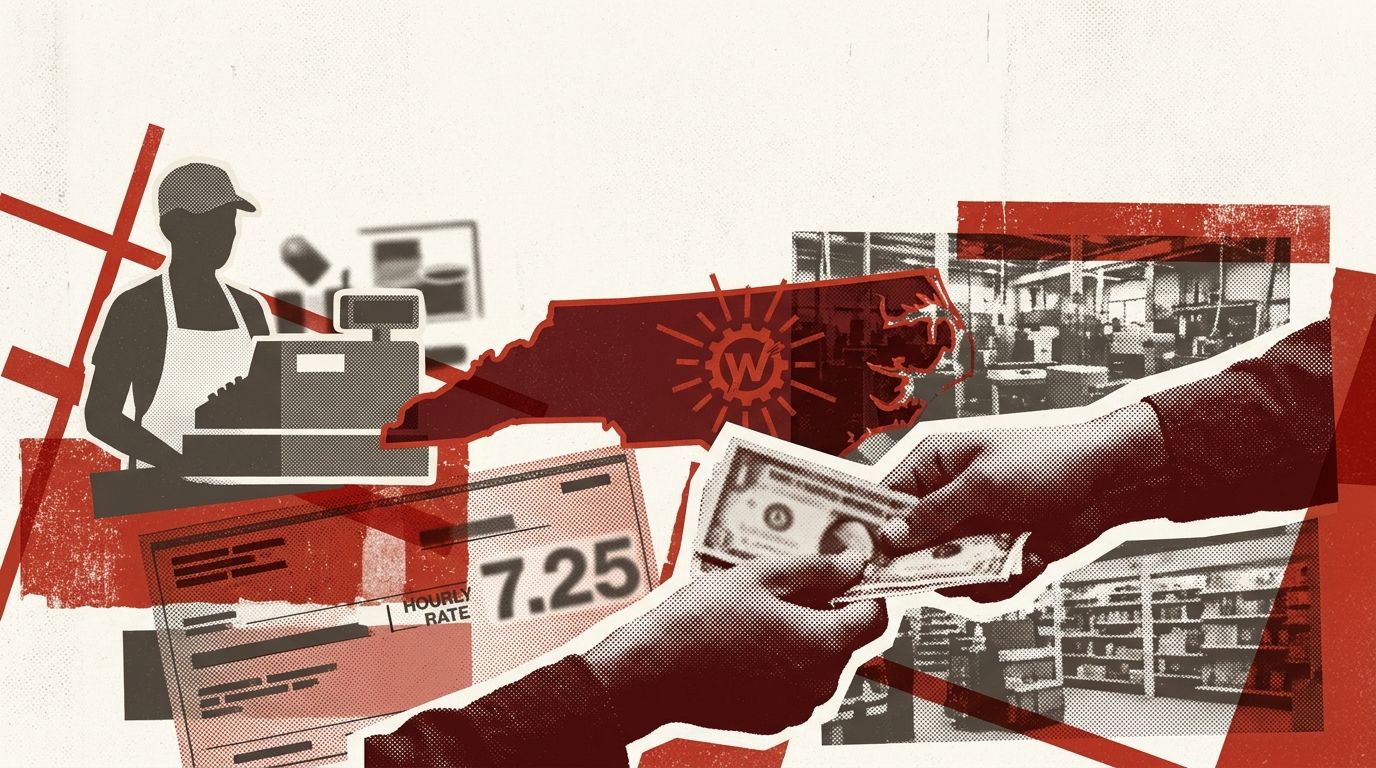
North Carolina is one of 25 states where the minimum wage sits at the federal floor of $7.25 per hour, unchanged since July 2009, with a preemption law that blocks every one of its 553 municipalities from setting a higher rate for private-sector workers.

Minimum Federal Wage: Current Rates & Policy
Congress sets the minimum federal wage; it does not update it. The $7.

State of Georgia Minimum Wage: 2024 Guide
Two minimum wage rates operate in the state of Georgia simultaneously: $5.15 under state statute and $7.25 under the federal Fair Labor Standards Act.
Also in the paper