
California Minimum Wage 2025: What's Changed
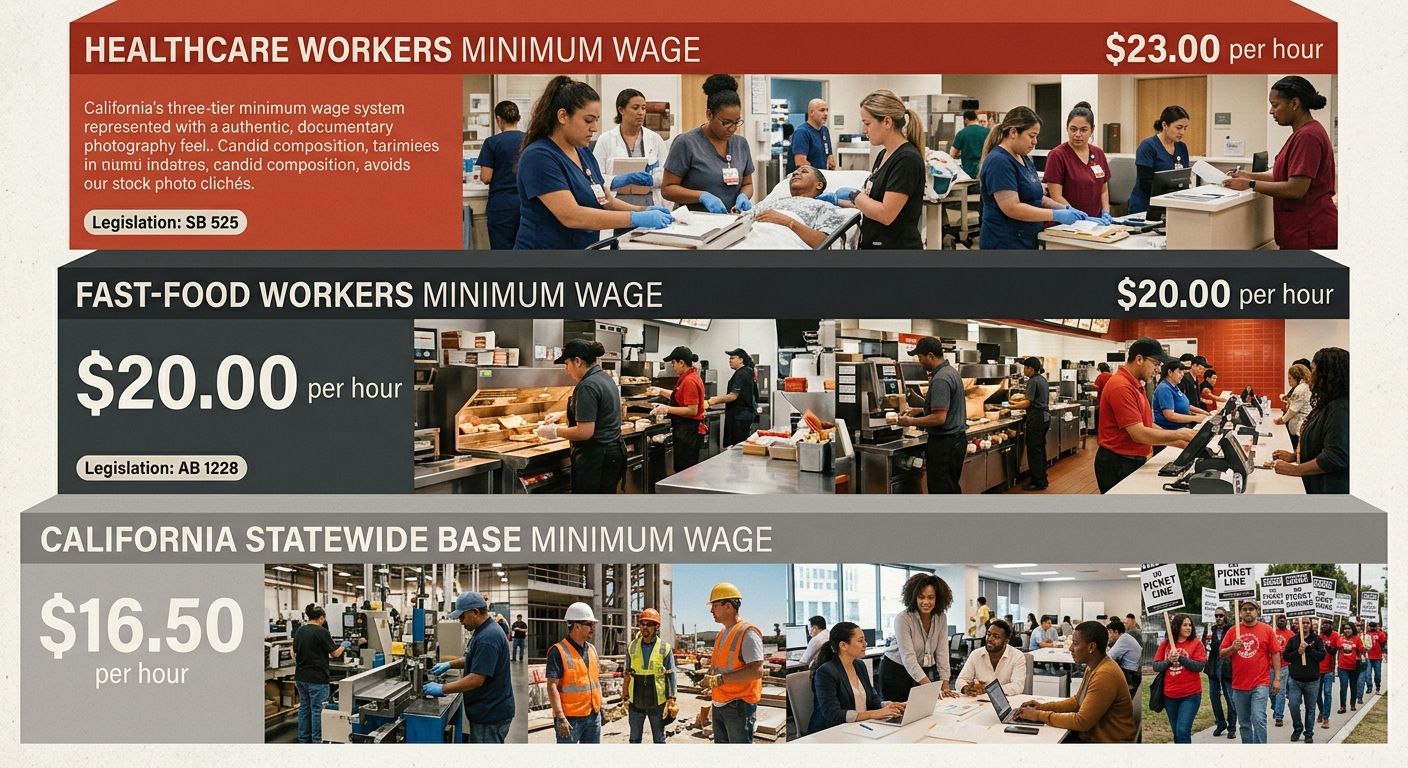
Three separate legal floors governed what California employers owed their workers during 2025: a $16.50 statewide baseline, a $20.00 fast-food sector rate, and a healthcare scale climbing as high as $23.00 per hour at large hospital systems.

California Minimum Wage 2025: What's Changed and How the System Actually Works
Three separate legal floors governed what California employers owed their workers during 2025: a $16.50 statewide baseline, a $20.00 fast-food sector rate, and a healthcare scale climbing as high as $23.00 per hour at large hospital systems. Understanding which floor applies to a given job requires knowing the machinery underneath, because the common assumption that California has "a minimum wage" stopped matching reality in April 2024.
The Statewide Floor: $16.50 Per Hour and How It Got There
California's base minimum wage for 2025 was $16.50 per hour for all employers regardless of size. That "regardless of size" part matters. As Heidari Law Group's analysis documented, the unified rate eliminated a prior system where smaller businesses faced a lower wage requirement than larger ones. Every employer in the state, from a five-person taco shop to a corporation with 40,000 employees, owed the same $16.50 floor.
The rate didn't arrive through annual legislative negotiation. California locked in a schedule of increases years ago that brought the wage from $15.00 to $15.50, then $16.00, then $16.50. Once those scheduled increases were complete, the state transitioned to an automatic adjustment mechanism pegged to inflation. That mechanism is now the engine running the whole system.
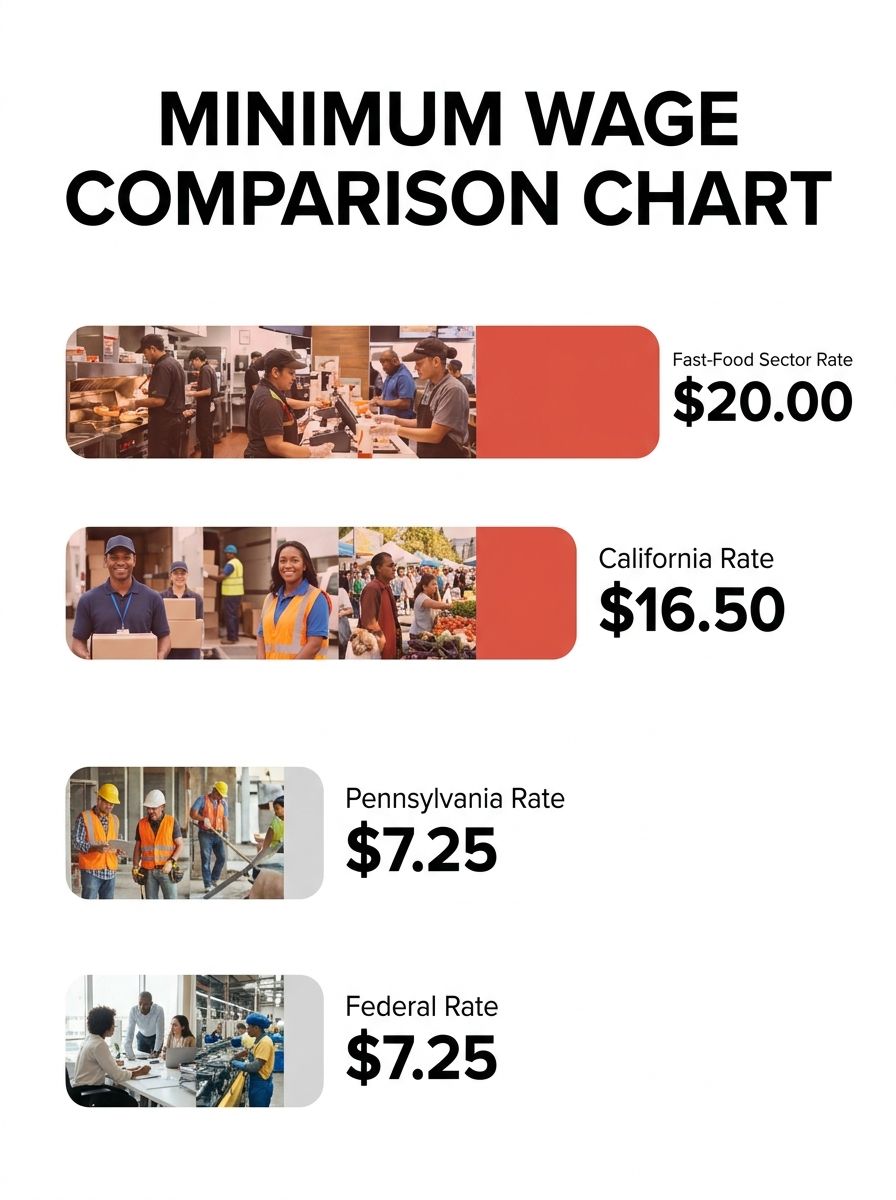
For context, states like Pennsylvania still sit at $7.25 and North Carolina remains pinned to the same federal floor. California's $16.50 was more than double the federal minimum wage, which hasn't moved since 2009.
The CPI-W Escalator: Why the Rate Changes Without a Vote
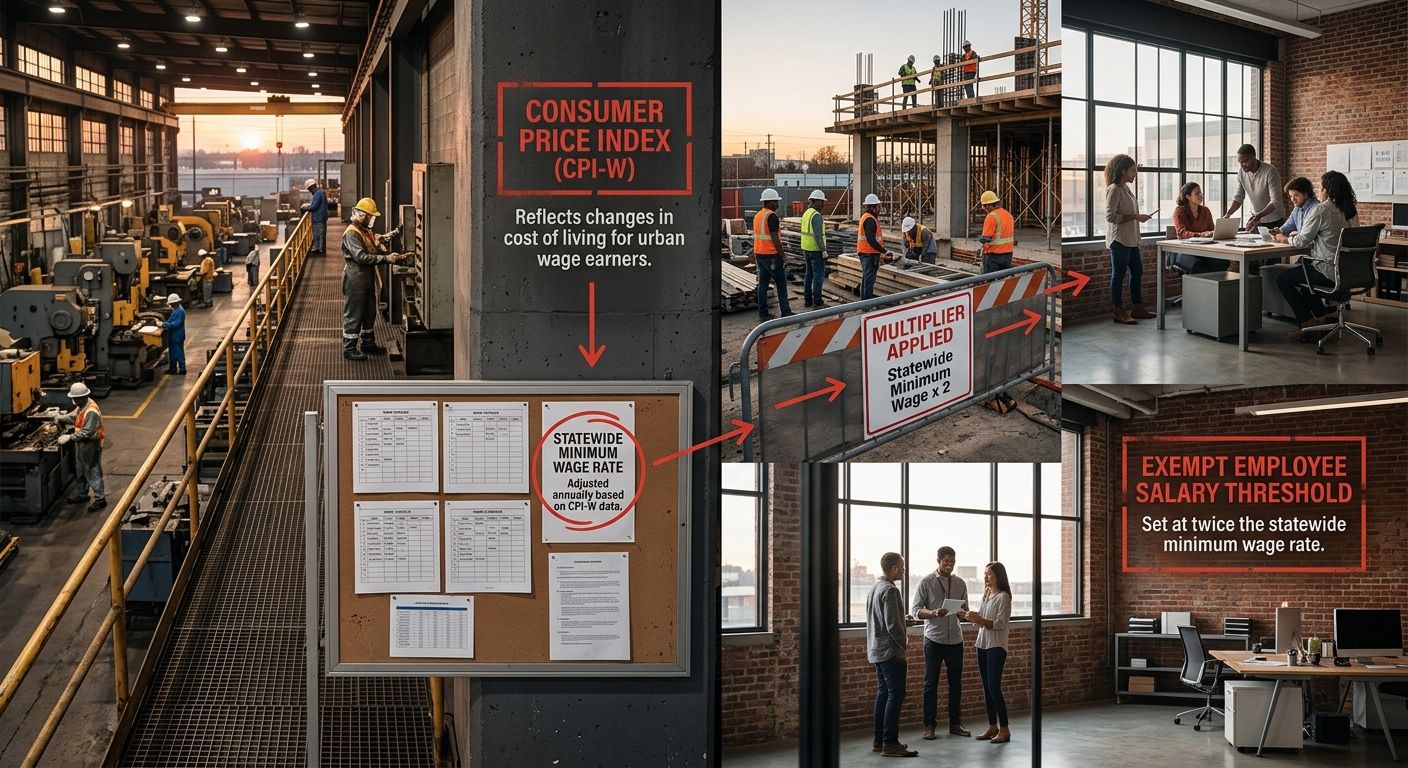
The statewide minimum wage now adjusts each January 1 based on the Consumer Price Index for Urban Wage Earners and Clerical Workers, abbreviated CPI-W. This index tracks price changes in goods and services purchased by hourly wage earners and clerical workers across the country. When the CPI-W rises, California's minimum wage follows.
The California Department of Industrial Relations confirmed on December 5, 2025, via News Release 2025-118, that the statewide minimum wage will increase from $16.50 to $16.90 per hour on January 1, 2026. That $0.40 increase translates to roughly $832 per year for a full-time worker logging 2,080 hours annually.
The CPI-W mechanism has a critical feature workers should understand: it contains a floor but no ceiling on annual increases. If inflation runs hot, the wage adjustment runs hot. If deflation occurs, the wage holds steady at its current level and doesn't decline. The state legislature built asymmetry into the formula, wages go up with prices but never drop with them. That design protects workers from the whipsaw effect of deflationary cycles, though employers have argued it creates a ratchet that compounds costs regardless of economic conditions.
The Fast-Food Floor: $20.00 Under AB 1228
AB 1228, signed into law in 2023, created the Fast Food Council and established a $20.00 per hour minimum wage for fast-food workers effective April 1, 2024. The law targets employees of national fast-food chains operating 60 or more locations nationwide. A worker at a local burger joint with three locations isn't covered. A worker at a McDonald's franchise is.
The $20.00 rate represented a $4.00 jump above the statewide $16.00 floor when it took effect and remained $3.50 above the $16.50 base through 2025. Research tracking the law's impact found that the $20.00 fast-food wage led to a 3–4% increase in menu prices at covered restaurants, with minimal net job loss documented in the sector.
The Fast Food Council has authority to raise the rate by up to 3.5% annually, with the next potential increase capped at $20.70. That council, composed of worker representatives, employer representatives, and state appointees, functions as a kind of sectoral bargaining body, a model that organized labor has pushed to expand into other industries.
The Healthcare Scale: SB 525's Tiered Approach
SB 525 established minimum wages for healthcare workers that vary by facility type and size. Large health systems and hospitals with 10,000+ full-time equivalent employees hit the $23.00 per hour mark. Smaller facilities, rural hospitals, and certain clinics operate on slower phase-in schedules with lower initial rates.
The law covers a broad range of healthcare occupations beyond nurses and doctors: janitorial staff, food service workers, laundry employees, medical coders, and patient transport workers at covered facilities all qualify. The $23.00 top-tier rate exceeds the statewide floor by $6.50 and the fast-food rate by $3.00. For a full-time healthcare worker at a large system, the annual gross comes to approximately $47,840 at that rate.
The gap between the statewide $16.50 floor and the healthcare $23.00 ceiling illustrates why knowing which tier covers your workplace matters so much. A custodian cleaning offices in a commercial building earns the statewide floor. The same custodian, doing the same work, at a qualifying hospital earns $6.50 more per hour. Same broom, same mop, different paycheck. The distinction is the employer's classification under SB 525, determined by the facility's role in the healthcare delivery system. This has already been a focal point for tech and healthcare workers building organizing momentum across California's large institutional employers.
Local Ordinances That Stack on Top of Everything
California's three-tier state system is the foundation. Dozens of cities and counties then build higher. Davis Wright Tremaine's analysis of the 2026 landscape documented the patchwork: West Hollywood's minimum wage reached $20.25 per hour, and Los Angeles has been debating a $30.00 per hour wage for hotel and airport workers targeted for implementation by 2028.
The Los Angeles County Department of Consumer and Business Affairs specifies that anyone working at least two hours in a one-week period within the unincorporated areas of the county earns the county minimum wage for those hours, regardless of where the employee lives or where the business is headquartered. That geographic trigger creates compliance headaches for employers with workers who split time between jurisdictions.
A delivery driver based in Pasadena who spends three hours per week dropping packages in unincorporated LA County territory owes county-rate wages for those three hours, even if the rest of the week is spent in a city with a different rate. Multiply that scenario across a workforce of 200 drivers covering overlapping jurisdictions, and the payroll math gets genuinely complex.
The Exempt Employee Cascade
California's minimum wage doesn't affect only hourly workers. State law requires exempt employees, salaried workers classified as exempt from overtime protections, to earn at least twice the state minimum wage for full-time employment. When the statewide floor was $16.50, that meant exempt employees had to earn a minimum annual salary of $68,640, as Holland & Knight's 2025 employment law analysis detailed.
When the floor rises to $16.90 on January 1, 2026, the exempt salary threshold jumps to $70,304 per year. That's a $1,664 annual increase for any exempt employee currently sitting at the minimum threshold. Employers who don't adjust these salaries face a specific and punishing consequence: the employee loses their exempt classification, becomes entitled to overtime pay for every hour over 40 in a week (or over 8 in a day under California law), and the employer owes back wages plus penalties.
Troutman Pepper Locke's analysis of California's 2025 employment law changes flagged enhanced penalties for wage and hour violations, expanded pay data reporting requirements, and stronger pay equity measures. Those enhanced penalties raise the stakes for misclassification triggered by failure to meet the rising salary threshold.
Where the Three-Tier System Breaks Down
The mechanism works cleanly on paper. In practice, the layered structure creates gaps and ambiguities that hurt the workers it's designed to protect.
Misclassification pressure increases. As sector-specific floors rise, employers have financial incentive to argue their workers don't fall under the covered category. A fast-food franchise owner might restructure operations to serve fewer than 60 locations nationally, dropping below AB 1228's threshold. A healthcare facility might outsource custodial staff through a third-party contractor, potentially removing those workers from SB 525 coverage.
Local ordinance awareness is low. Workers in cities with rates above the state floor often don't know the local rate applies to them. A worker in Emeryville earning $16.50 when the local ordinance requires more has a valid wage theft claim, but only if they know the ordinance exists. The enforcement burden, in practice, falls disproportionately on workers who can least afford to navigate it.
The CPI-W escalator doesn't respond to housing. The index tracks consumer prices nationally, not California-specific shelter costs. In a state where median rent consumed more than 30% of income for minimum-wage workers even at $16.50, a $0.40 annual adjustment calibrated to national price movements doesn't close the gap between wages and the cost of staying housed. The formula maintains purchasing power against general inflation. It doesn't address California's structural housing affordability crisis, which erodes real wages faster than the escalator can compensate.
Common Questions
Does the $20.00 fast-food wage apply to all restaurant workers in California?
No. AB 1228 covers workers at fast-food chains operating 60 or more locations nationally. Independent restaurants, regional chains below that threshold, and sit-down restaurants with table service are generally excluded and fall under the statewide $16.50 floor (rising to $16.90 on January 1, 2026).
What happens if my city's minimum wage is higher than the state rate?
The highest applicable rate always controls. If you work in West Hollywood, where the local minimum wage is $20.25, your employer owes you $20.25 regardless of the statewide floor. This applies based on where the work is performed, not where the business is headquartered or where you live, according to local enforcement guidance from LA County's Department of Consumer and Business Affairs.
How is the annual increase calculated?
The California Department of Industrial Relations adjusts the statewide minimum wage each January 1 based on the percentage change in the national CPI-W from the prior year. The wage rises with inflation but never falls during deflation. The 2026 increase of $0.40, from $16.50 to $16.90, reflects the CPI-W change through the measurement period.
Does the minimum wage increase affect salaried workers?
Yes. California requires exempt (salaried, overtime-ineligible) employees to earn at least twice the state minimum wage for full-time work. That threshold was $68,640 in 2025 and rises to $70,304 on January 1, 2026. An employer who doesn't adjust salaries to meet the new threshold risks reclassification of those employees as non-exempt, triggering overtime obligations and potential back-pay liability.
Can my employer pay me the federal minimum wage of $7.25 if I work in California?
California law overrides the federal rate wherever the state rate is higher. Every covered employer in California must pay at least $16.50 (and $16.90 starting January 2026), regardless of the federal floor. The federal $7.25 rate, unchanged since 2009, has no practical effect on California workers.
The Union Edge Staff
Frequently Asked Questions
- What is the California minimum wage for 2025?
- California's statewide minimum wage for 2025 is $16.50 per hour for all employers regardless of size. However, fast-food workers at chains with 60+ locations nationwide earn $20.00 per hour, and healthcare workers at large facilities earn up to $23.00 per hour.
- Will California minimum wage increase in 2026?
- Yes, California's statewide minimum wage will increase to $16.90 per hour on January 1, 2026, representing a $0.40 increase based on the Consumer Price Index for Urban Wage Earners and Clerical Workers (CPI-W).
- Does the $20 fast food minimum wage apply to all restaurants in California?
- No. The $20.00 fast-food minimum wage under AB 1228 only applies to workers at national fast-food chains operating 60 or more locations nationwide. Independent restaurants, regional chains below that threshold, and sit-down restaurants with table service fall under the statewide $16.50 floor.
- How does California minimum wage adjust annually?
- California's statewide minimum wage automatically adjusts each January 1 based on the Consumer Price Index for Urban Wage Earners and Clerical Workers (CPI-W). The wage rises with inflation but never declines during deflation, creating a floor that only moves upward.
- What is the exempt employee salary requirement in California 2026?
- California requires exempt (salaried) employees to earn at least twice the state minimum wage for full-time work. This threshold rises to $70,304 per year on January 1, 2026, up from $68,640 in 2025.
- Which California cities have minimum wages higher than the state rate?
- Several California cities set higher local minimum wages, including West Hollywood at $20.25 per hour and Los Angeles, which is debating a $30.00 per hour wage for hotel and airport workers targeted for 2028 implementation.
- What healthcare workers are covered by California's $23 minimum wage?
- SB 525's $23.00 minimum wage applies to healthcare workers at large systems with 10,000+ full-time equivalent employees and covers a broad range of occupations including janitorial staff, food service workers, laundry employees, medical coders, and patient transport workers.
Related Articles

Minimum Wage California: 2024 Updates & Rates
AB 1228, SB 525, Labor Code Section 1182.12, and at least 38 local ordinances all set binding minimum wages in California, and the highest rate that applies to a given worker is the one the employer must pay.
Minimum Wage in California 2026: What to Know
California's minimum wage in 2026 operates as a three-tier system: a CPI-indexed statewide floor of $16.90 per hour, local city and county rates reaching $20.34 in Emeryville, and industry-specific mandates pushing healthcare workers to $25.00 per hour.

Minimum Wage in California: 2024 Rules & Requirements
California's minimum wage is a formula-driven system that recalculates every January 1 based on changes in the Consumer Price Index, capped at 3.5% annually. The statewide floor rose from $16.00 per hour in 2024 to $16.
Also in the paper