
Trump Administration Plans to Terminate 60 Years of Workplace Discrimination Data Collection
The Equal Employment Opportunity Commission is preparing to terminate its EEO-1 reporting program, which for six decades has required U.S. companies to disclose workforce demographic data used to enforce federal anti-discrimination laws, according to a Guardian investigation.

Trump Administration Plans to Terminate 60 Years of Workplace Discrimination Data Collection
The Equal Employment Opportunity Commission is preparing to terminate its EEO-1 reporting program, which for six decades has required U.S. companies to disclose workforce demographic data used to enforce federal anti-discrimination laws, according to a Guardian investigation. The majority-Republican commission is expected to approve the measure this fall, eliminating the federal government's only systematic collection of workplace demographic statistics broken down by race, ethnicity, sex, and job title.
What the EEO-1 Reports Track
EEO-1 reports capture the demographic composition of workforces at companies with 100 or more employees. The filings break down staff by race, ethnicity, sex, and job category, creating a database that reveals patterns such as the concentration of white men in executive roles—who represent 29 percent of the U.S. workforce but hold 57 percent of executive positions—and the racial makeup of lower-wage positions within corporations.
The EEOC has collected these reports annually since the passage of the Civil Rights Act of 1964. The data serves as the agency's initial screening mechanism when evaluating which of its nearly 90,000 yearly discrimination complaints warrant deeper investigation, according to Karla Gilbride, former general counsel at the EEOC and now deputy director of litigation for the ACLU's Disability Rights program.
"If you see a particular employer really stands out because they have fewer women in management or fewer Black people in management compared to their peer employers in the same industry or in the same area, it's more likely the case that where there's smoke, there's fire, and there's something going on here," Gilbride said.
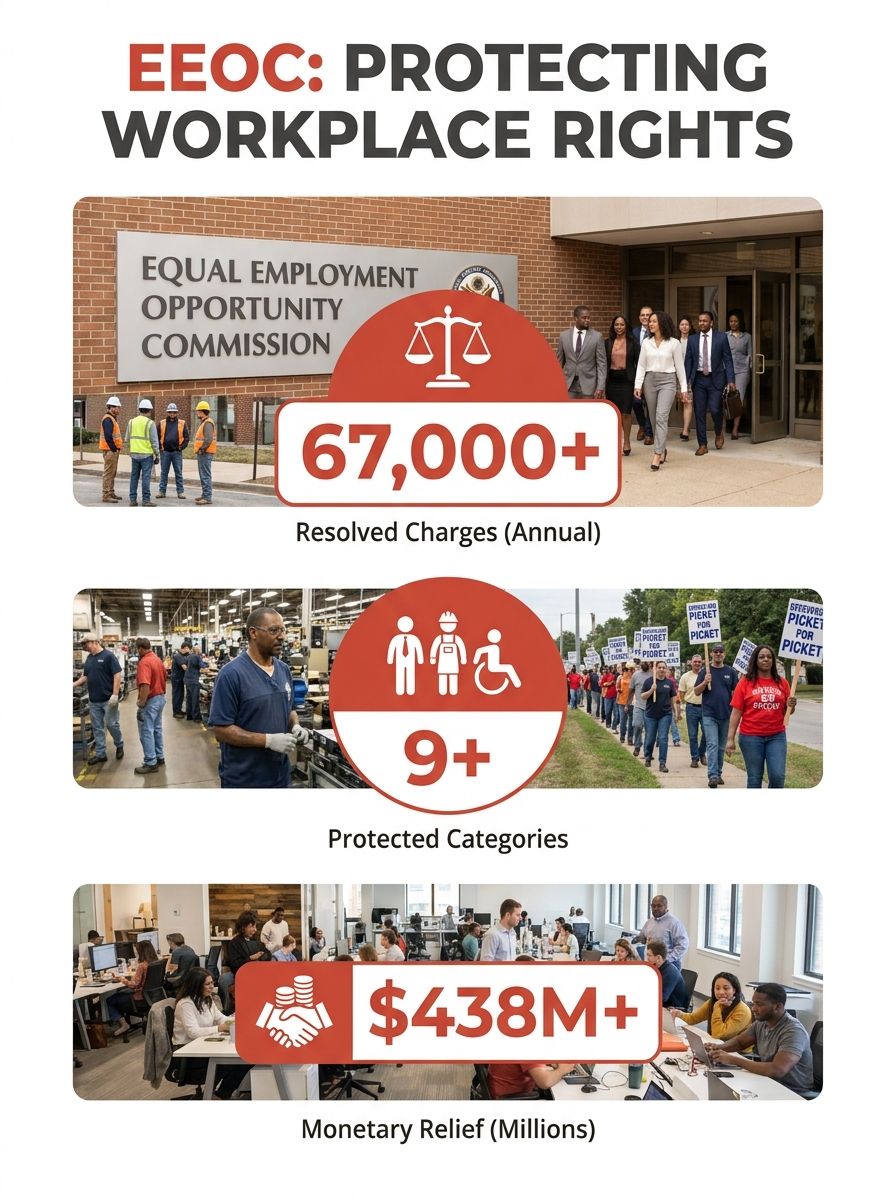
The Commission's Rationale for Elimination
Andrea Lucas, the EEOC commissioner appointed by President Trump, advanced the proposal at a July 2026 hearing. Lucas argued that demographic data collection violates constitutional principles, creates excessive administrative burdens for employers, encourages diversity programs, and incentivizes discrimination against white workers.
"I believe the Commission's proposed rescission of the annual reporting requirement will not hinder the Commission's law enforcement work to investigate specific charges of discrimination," Lucas stated in her remarks on the proposal. The EEOC did not respond to inquiries about how the agency would replace EEO-1 data when investigating systemic discrimination cases.
The proposal arrives as the Trump administration's second term has deleted or altered nearly 400 federal datasets across public health, education, and civil rights domains. Since Trump returned to office in January 2025, the EEOC has rewritten its strategic enforcement priorities to emphasize discrimination claims filed by white men, dropped pending cases on behalf of transgender workers, launched investigations into corporate diversity practices, and rescinded anti-harassment guidance issued under previous administrations.
How Investigators Use the Data
The EEO-1 database functions as a triage system for an agency operating at its lowest staffing level in 45 years while processing a complaint volume that has remained near 90,000 annually. Investigators compare a company's demographic profile against industry benchmarks and regional norms to identify outlier patterns that suggest possible discrimination in hiring, promotion, or pay practices.
The data also supports litigation when the EEOC cannot resolve complaints through settlement. In a 2016 case, Cassandra Coleman applied for a trucking position at Central Transport's Phoenix office and was discouraged by a male employee who told her the application would be futile. EEOC investigators pulled EEO-1 records showing Central Transport employed zero women in driver roles across several facilities, data that bolstered the agency's subsequent lawsuit against the company.
Beyond enforcement, the EEOC has maintained data-sharing agreements with social scientists since the late 1990s, enabling independent research into workforce equity trends. Donald Tomaskovic-Devey, founding director of the Center for Employment Equity at the University of Massachusetts Amherst, reported that the EEOC abruptly terminated all academic data-sharing agreements in summer 2025 and ceased communication with research partners.
"Getting rid of this data collection is part of a larger effort to weaponize civil rights enforcement and flip the laws that we have on their head," said Katie Sandson, senior counsel on the education and workplace justice team at the National Women's Law Center, which is currently suing the EEOC for refusing to enforce workplace protections for transgender employees.
Timeline and Expected Impact
The commission is scheduled to vote on the termination during the fall 2026 session, though no specific date has been announced. If approved, the final EEO-1 reporting cycle would likely conclude with 2026 data, ending a program that has generated six decades of longitudinal records tracking workforce integration since desegregation.
Aggregated EEO-1 data is published publicly without identifying individual employers, creating a resource that researchers, civil rights advocates, and worker organizations have relied on to evaluate policy interventions and document equity gaps. The termination would leave no federal replacement for systematic demographic workforce tracking.
The proposal has drawn opposition from civil rights organizations and former EEOC staff, who argue that removing demographic oversight will make it nearly impossible to detect patterns of systemic discrimination—cases that typically affect large numbers of workers but may not generate individual complaints. Pattern-or-practice investigations, which the EEOC pursued regularly in prior administrations, require comparative data to establish that disparities exceed what random variation would produce.
Reading Between the Lines
The EEOC's pivot from collecting demographic data to investigating diversity programs marks a reversal of the agency's founding mandate. For 60 years, EEO-1 reports created a baseline for measuring whether corporate hiring and promotion practices complied with Title VII of the Civil Rights Act. Eliminating that baseline doesn't erase discrimination; it erases the ability to measure and prove it systematically.
Union members and workplace organizers should recognize this move as part of a coordinated strategy to shift civil rights enforcement away from structural inequality and toward individual grievance resolution—a model that favors employers who can handle complaints one at a time rather than address systemic practices. The data that once helped unions demonstrate industry-wide pay disparities or promotion bias will no longer exist in federal hands.
For workers considering discrimination claims, the practical effect is immediate: EEOC investigations will rely more heavily on anecdotal evidence from individual complainants and less on pattern analysis that can prove a company's practices violate the law at scale. That shift advantages employers and makes class-action discrimination cases significantly harder to build.
The Union Edge Staff
Related Articles

Trump Administration Proposes Ending Federal Workers' Right to Impartial Discrimination Hearings
The Trump administration has proposed eliminating the automatic right for more than 2 million federal and D.C.

When AI Safety Tools Become Union-Busting Weapons: What Workers Need to Know About Algorithmic Surveillance
AI-powered surveillance systems sold to employers as workplace safety monitoring tools are being repurposed to track union sympathizers, suppress organizing conversations, and algorithmically discipline workers who exercise their legal right to collective action.

LaborLab Releases Tools to Track Union-Busting Campaign Costs as Employers Evade Disclosure Law
LaborLab, a workers' rights watchdog organization, released a search tool and cost estimator on September 8 designed to expose the spending patterns of the $1.7 billion union-busting industry, according to The American Prospect.
Also in the paper