
Intersectionality in Union Organizing: Why Treating Migrant Workers as a Monolith Weakens Campaigns
Los Angeles now hosts dozens of worker cooperatives organized along lines of trade, geography, and cultural identity.

Intersectionality in Union Organizing: Why Treating Migrant Workers as a Monolith Weakens Campaigns
Los Angeles now hosts dozens of worker cooperatives organized along lines of trade, geography, and cultural identity. The Black Workers Center, the Clean Carwash Campaign, Koreatown's restaurant worker collectives: each serves a distinct community with distinct labor conditions, distinct vulnerabilities, and distinct relationships to immigration enforcement. As High Country News has documented, these cooperatives are typically governed by the workers themselves, with money flowing from foundations and large national unions like the AFL-CIO. They are defined by collective decision-making and the specific needs of the particular industry they represent. None of them could be swapped for one another. A strategy that works for Central American carwash workers in South LA would misfire if dropped wholesale into a campaign targeting Filipino home care aides in the San Fernando Valley.
And yet, across the labor movement, organizers still routinely lump migrant workers into a single demographic bucket when planning campaigns. They assume a shared language, a shared set of fears, and a shared relationship to the workplace. This assumption weakens campaigns at every stage, from initial outreach to contract negotiation. If unions want to win in workplaces where migrant labor is concentrated, they need to abandon the monolith and start designing campaigns that account for the real, layered differences among the people they're trying to organize.
How the Monolith Got Built
The American labor movement has a long, well-documented history of treating immigrant workers as either a threat or an afterthought. As a Harvard Law Review analysis of union success with immigrant communities notes, the nation's strongest unions are nearly a century old, and their leadership does not reflect the current diversity of the working class. Unions have been traditionally hostile to workers of color, with members often viewing immigrant labor through a lens of competition rather than solidarity. This institutional history didn't disappear when the AFL-CIO reversed its anti-immigration stance in 2000. The reversal changed policy. It didn't change culture, staffing, or organizing methodology overnight.
What happened instead, in many unions, was a surface-level pivot. Campaigns started translating flyers into Spanish. Some hired bilingual organizers. A handful adopted "immigrant worker" as a category in their outreach plans, as though a Guatemalan poultry plant worker and a Senegalese cab driver and an Indian IT contractor on an H-1B visa all face identical barriers to collective action. The differences in legal status alone make this absurd: a DACA recipient, an undocumented worker, and someone on a temporary agricultural visa have radically different exposure to employer retaliation, different access to legal remedies under the National Labor Relations Act, and different stakes when a campaign becomes public. Folding them all into one strategy guarantees that the strategy will fail some of them badly.
The concept of intersectional organizing addresses this directly. The term, borrowed from critical race and feminist theory, insists that workers' identities don't stack neatly into one column. A migrant woman working night shifts in a meatpacking plant doesn't experience her working conditions as a "migrant issue" separate from a "gender issue" separate from a "safety issue." All of those realities press on her simultaneously, shaping what she's willing to risk, who she trusts, what she needs from a union, and whether she'll sign a card. Research on intersectionality, trade unions, and precarious work argues that unions must grapple with the particular vulnerability and diversity of migrant workers in the labor market rather than collapsing those differences into a single organizing frame.
The Real Fractures Inside "Migrant Worker" Campaigns
Consider the range of conditions captured under the phrase migrant worker precarity. An H-2A agricultural visa holder's precarity looks nothing like the precarity of an undocumented restaurant worker in the same county. The H-2A worker is tied to a single employer, which means that any organizing activity risks not only firing but deportation. The undocumented restaurant worker faces deportation too, but their mobility between employers gives them a different kind of agency and a different kind of fear. A naturalized citizen from Haiti working in a nursing home faces none of these immigration-specific threats, but may confront racial discrimination and language barriers that shape their workplace experience just as powerfully. Treating all three as interchangeable "immigrant workers" leads organizers to pitch the wrong message, plan the wrong actions, and build committees that don't actually represent the workforce.
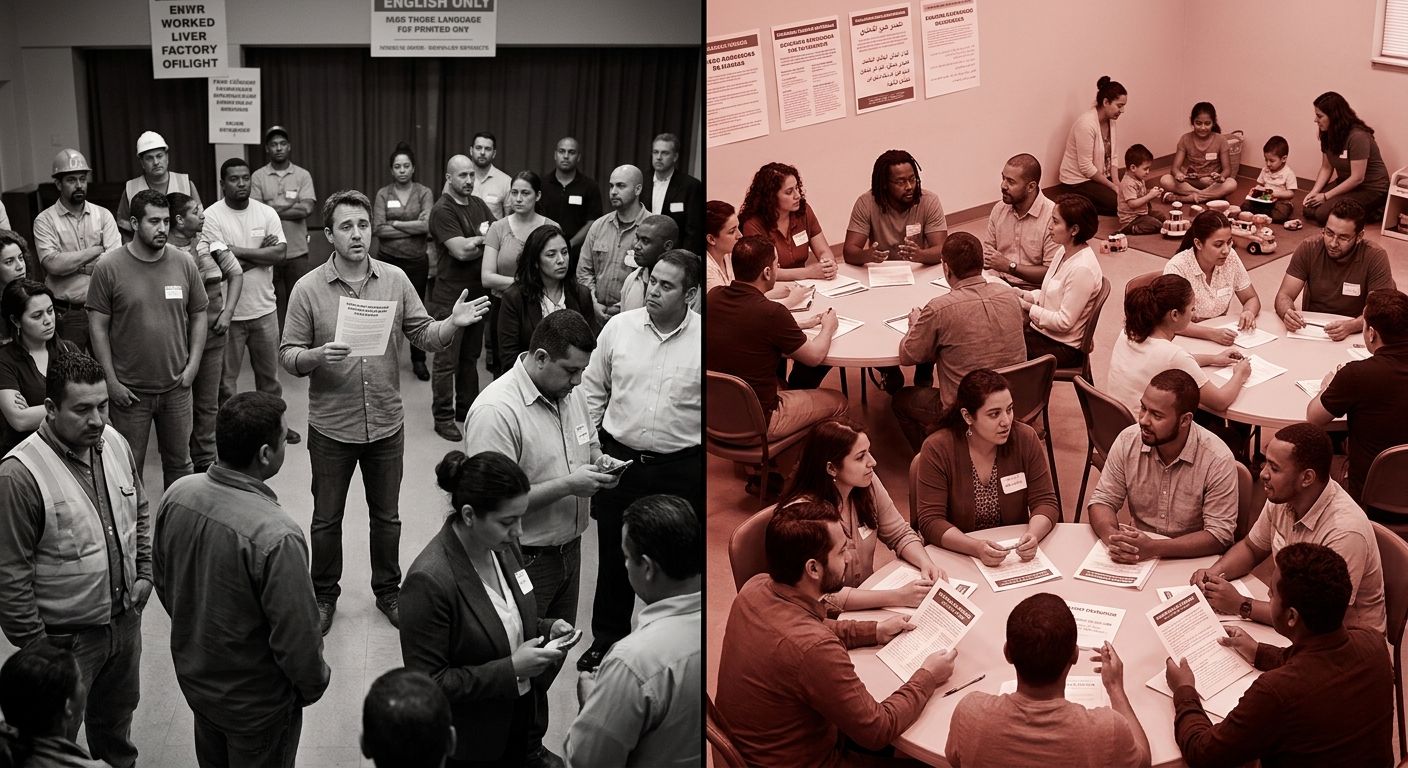
This is where campaigns fracture. We've seen it happen repeatedly: a union runs a strong drive in a warehouse or food processing facility, secures strong initial interest, and then watches participation collapse because the organizing committee doesn't reflect the internal divisions of the workforce. Haitian Creole speakers don't feel heard because all meetings happen in Spanish. Workers on temporary visas stay away because the campaign's public-facing tactics feel too risky for people whose legal status depends on employer sponsorship. Women don't attend evening meetings held in locations where they feel unsafe, or where childcare responsibilities make attendance impossible. Each of these gaps represents a failure of intersectional analysis, and they accumulate until the campaign can't sustain the participation it needs to win. We've written previously about how standard union tactics fail without cultural and legal adaptation, and the pattern holds across industries and regions.
The International Labour Organization has recognized this fracture at the global level. Their migrant worker organizing programs now emphasize training migrant worker leaders in destination countries and supporting the establishment of migrant associations and networks, rather than simply absorbing migrant workers into existing union structures. Pre-departure training in countries of origin is part of the approach, equipping workers to understand their rights before they arrive in a new labor market. This two-stage model acknowledges something many domestic unions still resist: that effective organizing of migrant workers requires infrastructure built specifically around their conditions, not a one-size-fits-all recruitment pitch appended to an existing campaign.
Cultural Competency as Organizing Infrastructure
When we talk about cultural competency in labor organizing, we don't mean sensitivity training or a diversity statement on the union's website. We mean structural changes to how campaigns are designed, staffed, and run. The Migration Policy Institute's research on cultural competency with immigrant and refugee communities demonstrates that successful service organizations build cultural responsiveness into their core operations, hiring staff from the communities they serve, adapting their intake processes, and creating feedback mechanisms that allow community members to shape programming. The parallel to union organizing is direct. A campaign that wants to reach Burmese poultry workers in Mississippi needs Burmese-speaking organizers who understand the specific community networks, religious institutions, and informal communication channels that connect those workers outside the plant. Posting a translated flyer in the break room doesn't meet that bar.
Building union inclusivity strategies means rethinking who sits on organizing committees, who speaks at actions, who sets the campaign's priorities, and who decides what risks are acceptable. It means asking whether the union's digital tools work for workers who primarily use WhatsApp or WeChat rather than email, a question we've explored in the context of community engagement as an organizing strategy. It means training organizers to listen for the issues that specific migrant communities care about, which may not be the same issues the union's leadership assumed would drive the campaign. Workers from countries with strong labor movements may be eager to strike. Workers from countries where organized labor is suppressed by the state may view any public collective action as existentially dangerous. An organizer who can't distinguish between those orientations and adjust accordingly will lose one group trying to reach the other.
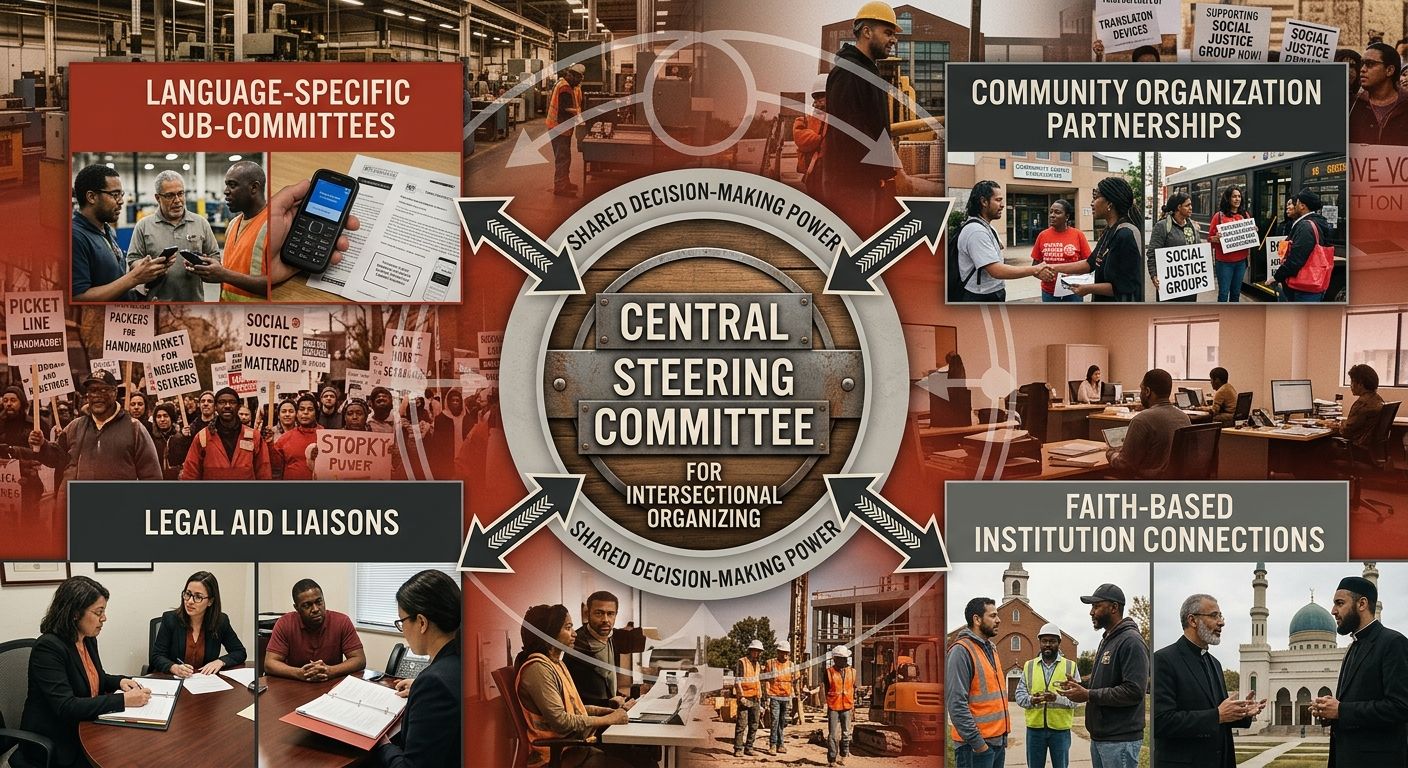
This doesn't mean every campaign needs a dozen separate strategies. It means the overarching strategy must be built on a foundation of real intelligence about the workforce, gathered through the kind of deep, patient listening work that moves organizers beyond assumptions about workers' needs. The practical shape of this work varies by context. In some workplaces, it means forming sub-committees organized by language group or nationality, each with genuine decision-making power within the broader campaign. In others, it means partnering with community organizations that already have trust and access, like the worker cooperatives in LA that are organized precisely along the cultural and geographic lines that matter to their members. In all cases, it means refusing to treat "immigrant worker outreach" as a box to check rather than a structural challenge to solve.
And the investment pays measurable dividends. Campaigns that take migrant worker precarity seriously at the design stage tend to achieve higher card-sign rates, stronger participation in actions, and more durable bargaining units after the election. The reason is straightforward: workers who feel seen and understood by a union are more likely to take risks for it. Workers who feel reduced to a demographic talking point know they're being used, and they respond accordingly. The distinction between organizing that preserves worker identity and organizing that erases it is often the distinction between campaigns that win and campaigns that stall.
Where Solidarity Still Falls Short
Even the best-designed intersectional campaigns run into limits that no organizing strategy can fully resolve. Immigration enforcement creates a floor of fear that persists regardless of how culturally competent a union becomes. When ICE conducts workplace raids, the chilling effect reaches every undocumented worker in the region, including those in shops where organizing has never been discussed. Unions can build rapid-response legal networks, train workers on their rights during enforcement actions, and lobby for legislative protections, but they can't eliminate the structural power that immigration law gives employers over their most vulnerable workers. That asymmetry shapes everything, and organizers who pretend otherwise are selling a solidarity they can't deliver.
There's also an internal tension the labor movement hasn't fully reckoned with. Building campaigns around the specific identities and experiences of migrant sub-groups risks fragmenting the very solidarity that makes collective bargaining work. If the Haitian Creole speakers have their committee and the Guatemalan workers have theirs and the Indian tech workers have theirs, what holds the bargaining unit together when management starts making divide-and-conquer offers at the table? The answer has to be a shared set of material demands that all groups helped shape, but getting there requires a level of internal democratic process that many unions, accustomed to top-down campaign management, struggle to sustain. The organizing model requires patience, messiness, and a willingness to let workers lead even when their priorities don't match the union's institutional preferences. As Mingwei Liu's research on local variation in union organizing strategies demonstrates, even within a single labor federation, the most effective organizing happens when local leaders adapt to local conditions rather than applying a uniform national template.
The labor movement's next decade will be defined in large part by whether unions can build institutions flexible enough to hold genuine diversity without dissolving into incoherence. The migrant workforce in the United States and across the global economy is growing more heterogeneous, not less. Workers are arriving from more countries, speaking more languages, holding more varied immigration statuses, and carrying more complex relationships to collective action than at any point in modern history. A union that can organize a multilingual, multi-status, multi-cultural workforce into a functioning democratic body capable of bargaining real power from an employer will have accomplished something genuinely difficult. Whether the existing labor movement is structurally capable of that kind of transformation, or whether new formations like the LA cooperatives will increasingly fill the gap, remains an open and urgent question.
The Union Edge Staff
Also in the paper