
Leadership Density Over Card Counts: Why Union Authorization Metrics Fail and What Actually Predicts Organizing Success
Authorization cards measure interest, not resilience.

Leadership Density Over Card Counts: Why Union Authorization Metrics Fail and What Actually Predicts Organizing Success
Authorization cards measure interest, not resilience. Campaigns that track leadership density across every shift, department, and job classification win elections at dramatically higher rates than those relying on card-count percentages alone, with one documented campaign growing from 60% card support to 72% yes votes by building leadership coverage across 95% of the bargaining unit.
The Card-Count Illusion at Minnesota, 2012
Workers at the University of Minnesota held what looked like a strong majority of signed authorization cards going into their 2012 representation election. The numbers suggested a win. They lost by 62%.
The collapse followed a familiar sequence: university administrators launched anti-union emails, held captive-audience meetings with department heads, and applied sustained pressure through supervisors who controlled scheduling and performance reviews. Under the National Labor Relations Act, workers cannot legally face punishment for expressing interest in union representation, but the legal protection and the lived experience diverge sharply. Card signers who had no relationship with an organizing committee leader in their own department folded under pressure. Workers who'd signed cards weeks earlier simply stopped showing up to meetings.
The organizing committee itself was concentrated in a handful of departments. When employer pushback targeted the 70% of the unit with no direct OC contact, those workers had nobody they trusted to walk them through the fear. The cards had measured a moment of sentiment. They hadn't measured infrastructure.
This pattern repeats across healthcare, higher education, and service sectors with alarming consistency. A card signed in a break room conversation captures one data point: "I'm interested." It says nothing about whether that worker will hold through 6 weeks of employer opposition, whether they'll talk to coworkers on their shift, or whether they even know who to call when management starts pulling people into one-on-ones.
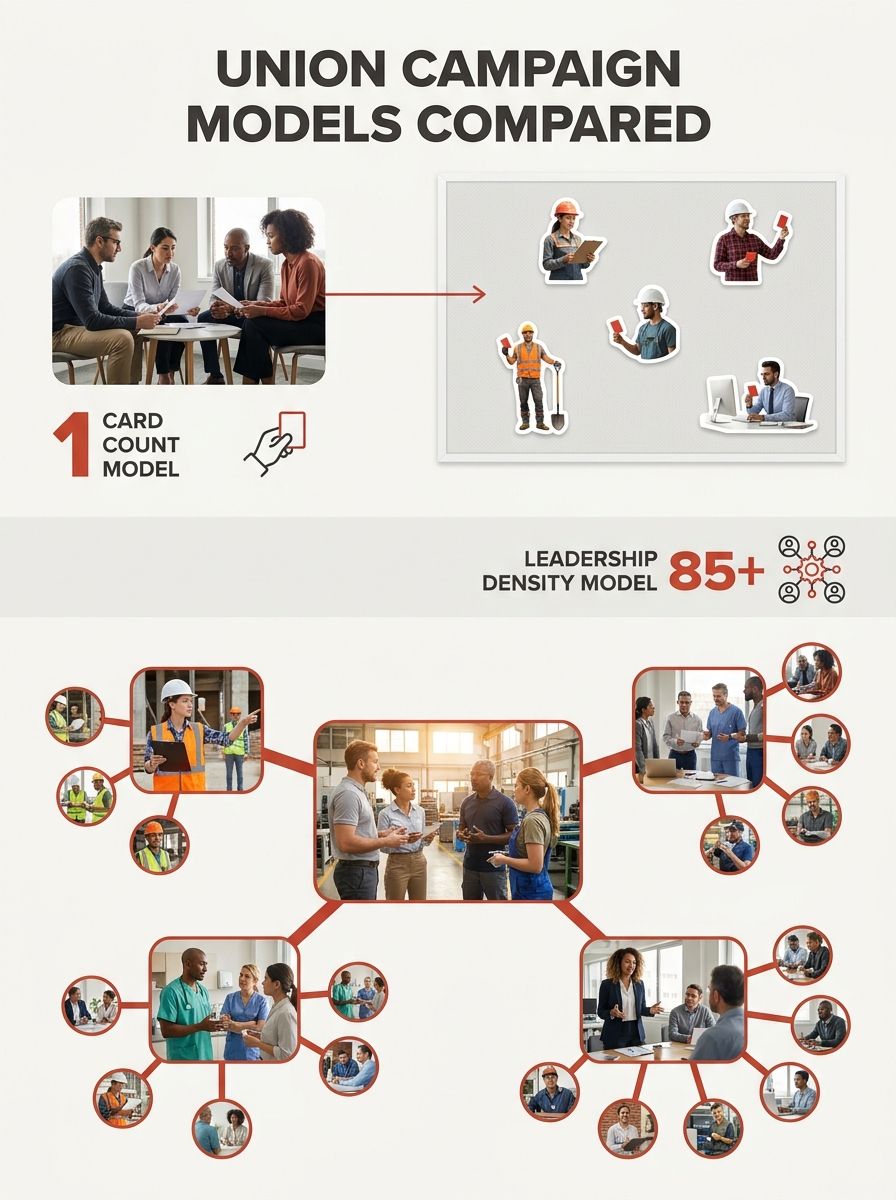
How Authorization Cards Work (and What They Don't Tell You)
Card check, also called majority sign-up, requires that 50% or more of employees in a bargaining unit sign authorization forms stating they wish to be represented by a union. If a majority signs, it becomes mathematically impossible for another union to organize that facility via card check for one year. The legal threshold is clear: 50% plus one.
But the 50% threshold creates a dangerous false confidence. Organizers who hit 65% or even 70% on cards often assume they've banked enough support to absorb losses during the employer campaign. The assumption treats each card as a fixed unit of commitment. It treats worker commitment as static rather than dynamic, as though signing a card at week 3 predicts behavior at week 9 when the hospital CEO sends a personal letter to every employee's home address.
The National Labor Relations Board's own election data tells a different story. Win rates track far more closely with the depth of the organizing structure than with the raw card percentage. A 2016 study by Caroline Murphy published in SAGE Open documented how fear operates as the central mechanism in employer opposition campaigns, finding that public sector workers maintain far higher union density precisely because employer hostility is largely absent. In private healthcare systems, where anti-union campaigns routinely spend between $2,000 and $3,000 per worker on consultants, fear is the primary tool. Cards don't inoculate against fear. Leaders do.
Cornell University's ILR School, which trains union leadership nationally, frames the challenge directly: organizers must develop the skills to "lead with labor's values, think strategically, and build collective-bargaining skills," according to the school's union leadership program description. That development process happens person by person across the unit. No volume of signed cards replaces it.
Columbia UAW Builds the Counter-Model
The Columbia University graduate worker campaign, organized under UAW, took a fundamentally different approach. Instead of measuring progress by card percentages, organizers employed what they called a modified leadership density approach. The goal: build leadership coverage for 95% of the entire bargaining unit, not 95% of cards signed, but 95% of workers with a trained leader in their immediate work environment.
The distinction matters enormously. At Minnesota, the OC had concentrated in friendly departments. At Columbia, organizers mapped every lab, every department, every floor and identified organic leaders who could hold one-on-one conversations with coworkers when the opposition campaign arrived. They started with 60% of cards on file. By election day, 72% voted yes. Support grew under pressure rather than collapsing.
The university's administration didn't sit idle. International students received targeted communications about visa implications. Faculty advisors were coached to express "concern" about unionization's effect on academic relationships. The playbook was familiar. The outcome was different because the structure was different.
Every anti-union tactic the administration deployed became, in the organizers' framing, an opportunity to recruit and develop new leaders. When a department chair held a captive-audience meeting, the OC leader in that department followed up with every attendee within 24 hours. When HR circulated a misleading FAQ, the leader on each floor had already been briefed on how to respond. The 95% coverage number meant there were almost no orphaned workers, no one left alone to process employer messaging without a trusted peer nearby.
This model helped UAW become the dominant union in higher education, organizing over 150,000 workers across the sector.
Why Healthcare Campaigns Are Especially Vulnerable
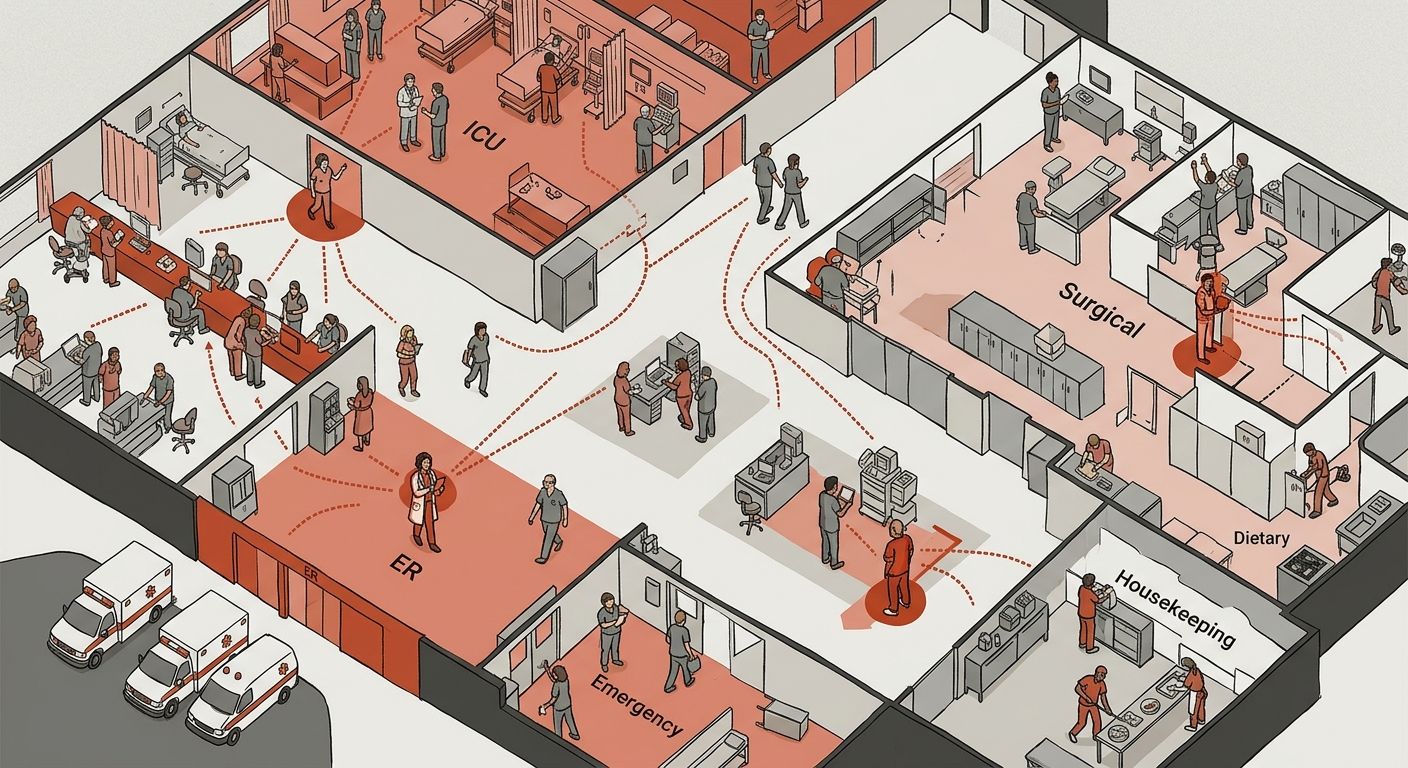
Hospital and clinic organizing campaigns face structural conditions that make card-count metrics particularly unreliable. A facility running 24/7 operations across 3 shifts with 8 to 15 distinct departments creates natural silos. A nurse in the ICU night shift may never interact with a dietary worker on days. A respiratory therapist floats between units. Per diem staff cycle in and out weekly.
When organizers track authorization cards as their primary union campaign strategy metric, they often discover too late that 80% of their cards came from 3 of 12 departments. The remaining departments, which may represent 60% of the bargaining unit, have signed some cards but have no leadership structure at all. Under employer pressure, those departments become the margin of defeat.
The Emergency Workplace Organizing Committee has stated plainly that "labor organizers must prioritize developing new leaders in order to grow union density and winning new workplace fights." In healthcare settings, this means identifying leaders on every shift in every department, including departments like environmental services and dietary where workers face the lowest wages, the least schedule stability, and often the most intense management surveillance.
Healthcare systems also deploy a specific variant of the anti-union campaign that exploits patient care concerns. Administrators frame unionization as a threat to patient safety, a message that resonates deeply with workers who entered the field out of genuine commitment to care. Without a trained leader on each unit who can redirect that conversation toward how short staffing and mandatory overtime actually harm patients, the employer message lands unopposed. Worker commitment to patient care becomes, perversely, a weapon against worker commitment to organizing.
We've written before about how building leadership density is what actually wins campaigns, and the healthcare sector illustrates the principle most starkly. The path from first contact to first contract in hospital campaigns typically runs 18 to 24 months, far longer than the 8 to 12 month average in other sectors. Cards signed in month 3 have limited predictive value for an election in month 14.
Organizing Metrics That Actually Predict Outcomes
Why does leadership density predict success where card counts fail? The answer lies in what each metric actually captures about the state of a campaign.
Authorization cards capture a single behavioral data point: a worker was willing to sign a document at a specific moment. Union Impact's guidance on tracking organizing metrics recommends measuring "contacts made vs. commitments kept for each action," a formulation that distinguishes passive interest from active participation. A card is a contact. Showing up to a committee meeting, talking to a coworker about the election, attending a practice session for responding to captive-audience meetings: those are commitments kept.
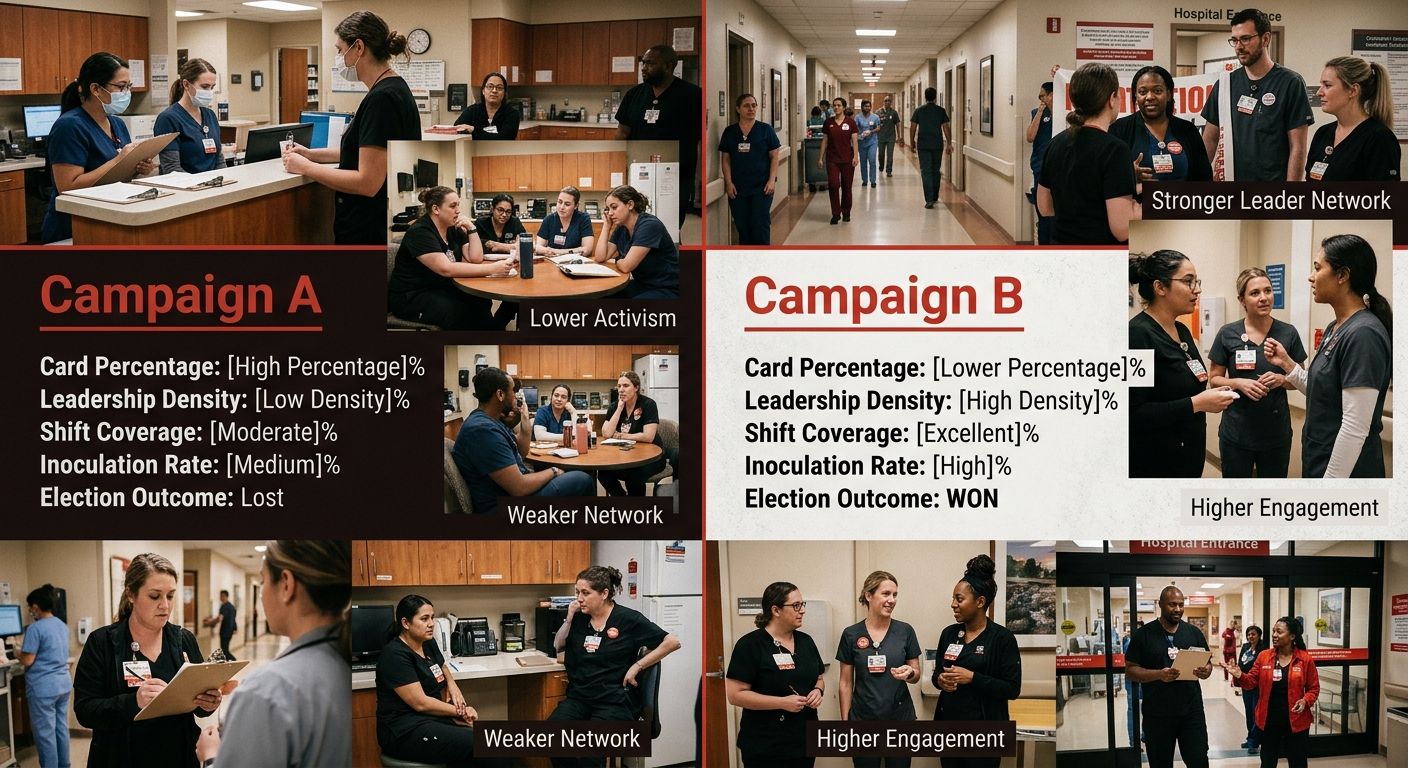
Leadership density captures something closer to organizational capacity. A unit with 90% card support and 20% leadership coverage has a fragile supermajority. A unit with 65% card support and 85% leadership coverage has a resilient, growing base. The 65% campaign will likely outperform the 90% campaign at the ballot box because leaders convert undecided coworkers and reinforce wavering supporters in real time, during the weeks when employer pressure is highest.
Three metrics matter more than card percentages for predicting election outcomes:
Leader-to-worker ratio by department: The target is 1 trained leader for every 10 workers in each distinct work area. Falling below 1:15 in any department signals a gap that employer campaigns will exploit.
Shift coverage percentage: What percentage of shifts in the facility have at least one active OC member present? In healthcare, where night and weekend shifts often operate with minimal management oversight but also minimal organizer access, gaps here correlate directly with vote losses in those shift cohorts.
Inoculation completion rate: What percentage of unit workers have had at least one structured conversation about anticipated employer tactics? Workers who've been walked through the captive-audience meeting script before they experience it are 3 to 4 times more likely to maintain their support afterward. This metric tracks directly against the fear dynamics that Murphy's 2016 research identified as the central mechanism of employer opposition.
The W.K. Kellogg Foundation's research on grassroots leadership development reinforces this at the community level, calling leadership development "an essential strategy for changing communities." The principle scales directly to workplace organizing: the capacity to sustain collective action lives in the density of leaders, not the volume of signatures. Cornell's ILR School builds its entire union leadership curriculum around developing skills in "strategic planning, decision making, developing a vision, styles of leadership, rank and file participation, [and] communications," according to its program overview. Every one of those skills lives in people, not on cards.
Where This Lands Now
The shift from card-count organizing metrics to leadership density models is accelerating across healthcare and higher education unions, driven partly by UAW's documented results and partly by the hard math of lost elections. Campaigns that built rank-and-file leadership depth consistently outperformed those that chased card numbers, and the pattern has become difficult for even skeptical international unions to ignore.
Several healthcare unions have begun requiring organizers to report leadership density by department and shift alongside card counts in their campaign tracking systems. The dual reporting creates accountability: an organizer who reports 75% cards signed but only 40% leadership coverage gets flagged for structural weakness, regardless of how the raw number looks. Some campaigns now refuse to file for election until leadership coverage reaches 80% across all shifts, a discipline that extends timelines but dramatically improves win rates.
The legal landscape around how labor law constrains and enables organizing remains complex, and employer opposition campaigns grow more sophisticated each cycle. Anti-union consultants increasingly target the specific departments and shifts where they detect leadership gaps, using social mapping techniques to identify isolated workers. The only reliable defense against this targeting is the absence of gaps.
Authorization cards remain a legal necessity. The NLRA requires them for both card-check recognition and NLRB election petitions. Nobody is arguing that campaigns should stop collecting them. The argument is about what campaigns should measure to predict whether they're ready to win. Cards tell you where you've been. Leadership density tells you where you're going and whether you'll survive the fight to get there. The campaigns that understand this distinction are the ones filing for elections they actually win.
The Union Edge Staff
Related Articles

The Organizing Committee Trap: Why Worker Committees Fail and How to Build Leadership Density That Actually Wins
Organizing committees at VW Chattanooga failed twice before the plant's 2024 election finally succeeded. The difference was structural: the winning campaign built trained leadership at a ratio of one worker-leader for every twenty-five employees, covering 90 percent of the plant by election day.

The 30% Authorization Card Threshold: Why This Legal Checkpoint Determines Your Organizing Campaign's Fate
The National Labor Relations Board requires signed authorization cards from at least 30% of workers in a proposed bargaining unit before it will schedule an election. That threshold appears in every organizing manual, on every union website, and in every introductory labor law course.

Beyond the Union Office: Why Organizers Fail When They Wait for Workers to Come to Them
Campaigns that file for an NLRB election with 60–70% worker support win 78% of the time. Campaigns built primarily on walk-in interest at a union hall rarely come close to that success rate.
Also in the paper