
Taft-Hartley's Ban on Solidarity Strikes Marks 79th Anniversary as Labor Researchers Examine Continuing Impact on Union Use
The Taft-Hartley Act's prohibition on solidarity strikes, enacted June 23, 1947, continues to restrict union use nearly 79 years later, according to analysis published this week by labor researcher Hayley Brown examining how the ban prevents cross-employer collective action that proved effective in

Taft-Hartley's Ban on Solidarity Strikes Marks 79th Anniversary as Labor Researchers Examine Continuing Impact on Union Use
The Taft-Hartley Act's prohibition on solidarity strikes, enacted June 23, 1947, continues to restrict union use nearly 79 years later, according to analysis published this week by labor researcher Hayley Brown examining how the ban prevents cross-employer collective action that proved effective in pre-1947 organizing campaigns. The Labor Management Relations Act, passed over President Truman's veto, substantially narrowed federal labor law protections for collective action and remains largely in effect today.
The anniversary arrives as the Trump administration removes collective bargaining rights and civil service protections from thousands of federal workers, creating conditions where solidarity strikes—if legal—would allow private-sector unions to support public-sector colleagues facing direct attacks on organizing rights.
What Taft-Hartley Prohibits
The Act's secondary action provisions make it illegal for workers at one company to strike, picket, or boycott in support of workers at another employer. Before 1947, workers across supply chains could coordinate pressure campaigns that made it harder for struck employers to reroute work or maintain operations, Brown noted in the analysis published on CounterPunch. Congress added Section 8(e)—the "hot cargo" provision—in 1959, blocking unions from negotiating contract language that would require their employer to avoid doing business with companies involved in labor disputes.
The prohibition confined legal strike protections to actions directed at the "primary employer" in a dispute. This restriction separated workers by employer and industry, weakening the broader class solidarity that had characterized labor organizing in the 1930s and early 1940s.
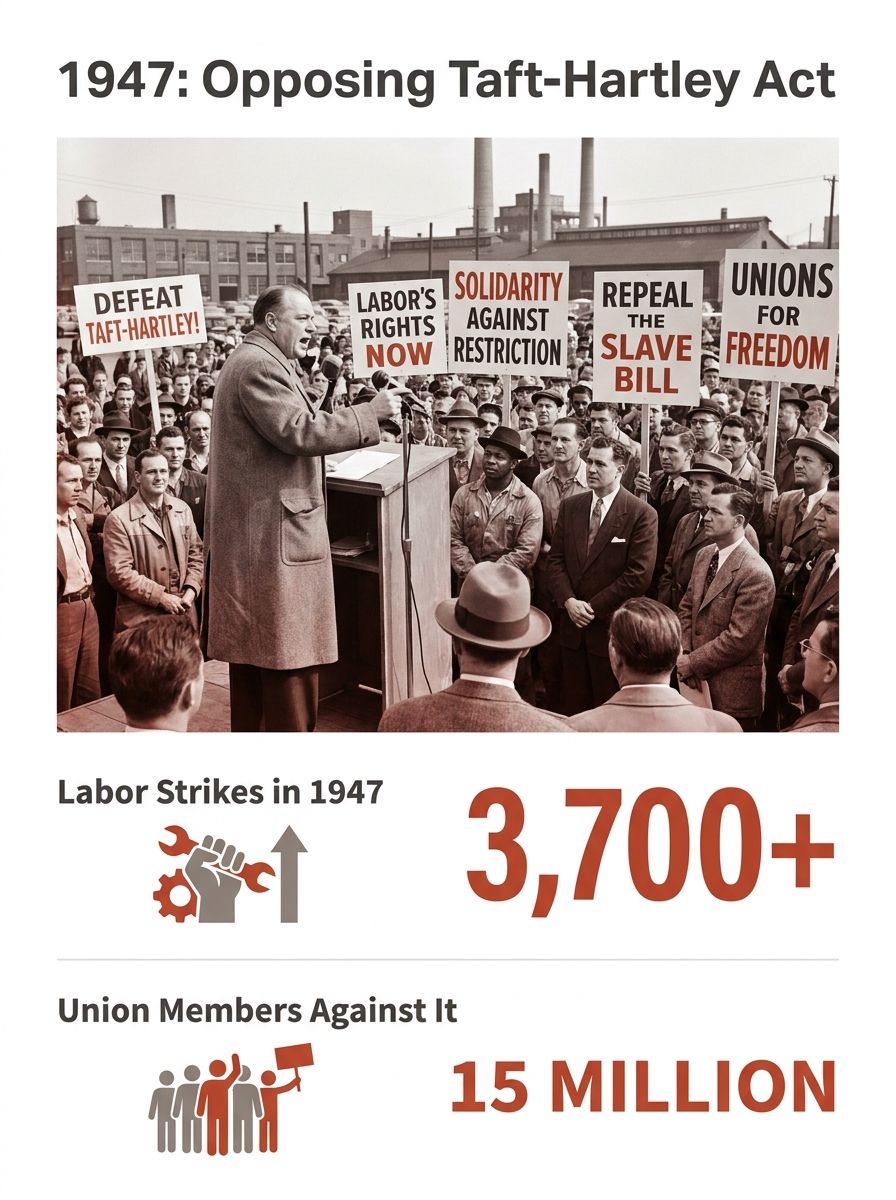
Secondary actions had enabled employees across different workplaces to pool use. Finnish postal workers demonstrated this approach in recent strikes when rail, aviation, ferry, bus, and port workers coordinated solidarity actions that disrupted transportation networks until postal workers secured an agreement preserving pay and conditions, according to Brown's account of the campaign.
Historical Context and Legislative Intent
The National Labor Relations Act, passed during the New Deal era, contained no prohibition on solidarity strikes. The 1947 Taft-Hartley amendments represented a political response to a labor movement that had demonstrated capacity to disrupt entire industries through coordinated action.
The Act provided employers with new legal weapons while suppressing what Brown described as "some of organized labor's most powerful tactics." Strike action of all kinds correlates with growth in union membership, making the solidarity strike ban particularly significant for union density over subsequent decades.
The restrictions on secondary actions contributed to weakening organized labor by isolating workers within individual bargaining units. Employers gained the ability to operate during strikes by shifting work to non-struck facilities, an option that solidarity actions had previously foreclosed. The regulatory framework also undermined the class consciousness that powered pre-1947 cross-industry organizing, Brown argued.
Current Relevance to Federal Worker Disputes
The Trump administration has attempted to remove collective bargaining rights from thousands of federal workers, moves currently being contested in courts. An executive order issued by President Trump removed civil service protections for approximately 8,000 federal employees, effectively converting them to at-will status, according to the analysis.
Federal workers constitute an outsized share of the US labor movement. The administration's actions create conditions where solidarity strikes—if permitted under federal law—would allow private-sector unions to defend public-sector organizing infrastructure through coordinated work stoppages. The Taft-Hartley prohibition prevents such cross-sector support.
Brown, a Research Associate at the Center for Economic and Policy Research, noted that unions remain broadly popular in the US and that strong majorities agree that declines in unionization have hurt both the country and working people. The regulatory framework established in 1947, however, continues to constrain the tactical options available to unions facing attacks on organizing rights.
The ability to withhold labor forms the backbone of worker organizing use. Solidarity strikes expand that use by preventing employers from isolating single bargaining units or maintaining production during disputes. International examples show effectiveness: coordinated Finnish transport strikes gave postal workers negotiating power they would not have possessed acting alone.
What Happens Next
The Taft-Hartley Act's core provisions show no signs of legislative revision despite union popularity and public support for organized labor. The ban on solidarity strikes remains federal law, limiting how private-sector unions can respond to the Trump administration's attacks on federal worker protections. No pending legislation proposes removing the secondary action prohibition.
Labor historians and legal scholars continue examining how historical labor movement organizing shaped current regulatory constraints. The anniversary has prompted renewed discussion among union strategists about tactical options within Taft-Hartley's limits, though no legal path exists for coordinated cross-employer strikes without risking unfair labor practice charges and damages.
The 79-year-old framework continues shaping organizing outcomes. As federal workers face conversion to at-will status and loss of bargaining rights, private-sector unions confront legal barriers that prevent the solidarity actions used effectively by labor movements in countries where such tactics remain protected under law.
The Union Edge Staff
Related Articles

New Deal NLRB: History & Modern Impact
Every major rollback of American labor rights has exploited the same structural weakness that Senator Robert Wagner left in his 1935 statute.

The American Labor Movement: A Complete Historical Overview
The anthracite coal strike of 1902 ran 163 days, according to the U.S. Department of Labor, and became the first major dispute where a president mediated instead of sending troops. That pattern (federal action only after economic crisis) defines the entire arc of the American labor movement.
Steelworkers Oppose Federal Labour Code Changes That Would Grant Minister Power to End Strikes
The United Steelworkers union declared the right to strike "a red line" on September 22, opposing proposed Canada Labour Code amendments that would grant the federal labour minister discretionary power to end legal strikes without Parliamentary approval, according to a statement from USW National Di
Also in the paper