
The 30% Authorization Card Threshold: Why This Legal Checkpoint Determines Your Organizing Campaign's Fate
The National Labor Relations Board requires signed authorization cards from at least 30% of workers in a proposed bargaining unit before it will schedule an election. That threshold appears in every organizing manual, on every union website, and in every introductory labor law course.

The 30% Authorization Card Threshold: Why This Legal Checkpoint Determines Your Organizing Campaign's Fate
The National Labor Relations Board requires signed authorization cards from at least 30% of workers in a proposed bargaining unit before it will schedule an election. That threshold appears in every organizing manual, on every union website, and in every introductory labor law course. It is also the single most dangerous number for new organizers to fixate on, because treating 30% as a campaign target instead of a legal floor is how elections get lost before ballots are ever printed.
The mechanism behind this checkpoint involves overlapping legal, strategic, and psychological layers. Understanding how each layer works, and where the whole system can buckle, is essential for anyone running a real campaign.
What the 30% Threshold Actually Does
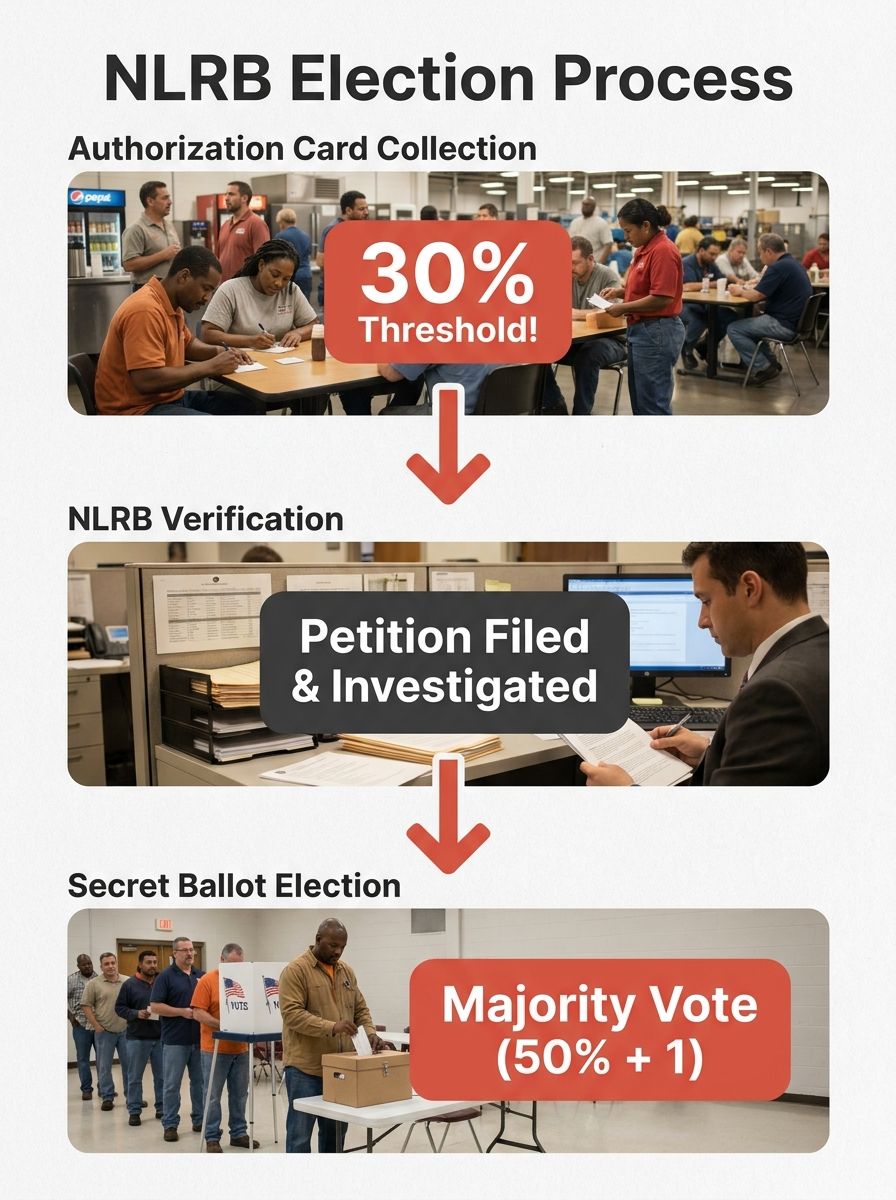
Under Section 9 of the National Labor Relations Act, workers have the right to organize and select a union to represent them. When they decide to exercise that right through the formal NLRB election process, the Board needs evidence that enough workers are interested to justify the administrative cost and disruption of running a secret-ballot vote. That evidence is called a "showing of interest."
The showing of interest requires signatures on authorization cards or petitions from at least 30% of the eligible employees in the proposed bargaining unit. Once organizers collect those signatures and submit their NLRB election petitions, Board agents verify the count against the employer's payroll records. If the math checks out, the NLRB schedules an election.
But here's what trips up first-time organizers: the Board doesn't care whether the campaign is likely to win. It only cares whether enough workers expressed enough interest to warrant a vote. Thirty percent is a procedural gate, not a prediction of the outcome.
The Anatomy of an Authorization Card
An authorization card is a written statement, signed by an individual employee, indicating that they want a specific union to represent them for purposes of collective bargaining. The language on the card matters enormously, because the card's legal effect depends on what it says.
Single-purpose cards state that the signer wants an NLRB election. They function as a petition: "I want a vote." Dual-purpose cards contain broader language: "I authorize [Union Name] to represent me for purposes of collective bargaining." Dual-purpose cards can serve as both election petitions and evidence of majority support under a card-check framework.
The distinction matters because, since the NLRB's Cemex Construction Materials Pacific decision, signed authorization cards have become the preferred method for unions to gain recognition. If a union collects dual-purpose cards from a majority of workers and demands recognition, the employer must either recognize the union or file its own petition for an election. If the employer commits unfair labor practices during the ensuing campaign, the Board can skip the election entirely and certify the union based on the card majority. Under the old rules, the union always had to petition for an election unless the employer voluntarily recognized it.
This makes the type of card you use a strategic decision with real consequences. Organizers who don't educate their committee members about these distinctions leave themselves exposed.
What Makes a Card Valid
The NLRB requires that each card be signed voluntarily, without coercion or material misrepresentation. An organizer who tells a coworker "this card is just to get more information" when the card's language authorizes representation has potentially tainted that signature. Employers routinely challenge cards on exactly these grounds during pre-election hearings.
Every card must also come from an eligible employee within the proposed bargaining unit. Supervisors, independent contractors, and workers outside the unit don't count. A campaign that collects 40 cards from a 100-person unit, only to discover that 12 signers are classified as supervisors under the NLRA, has fallen below the threshold overnight.
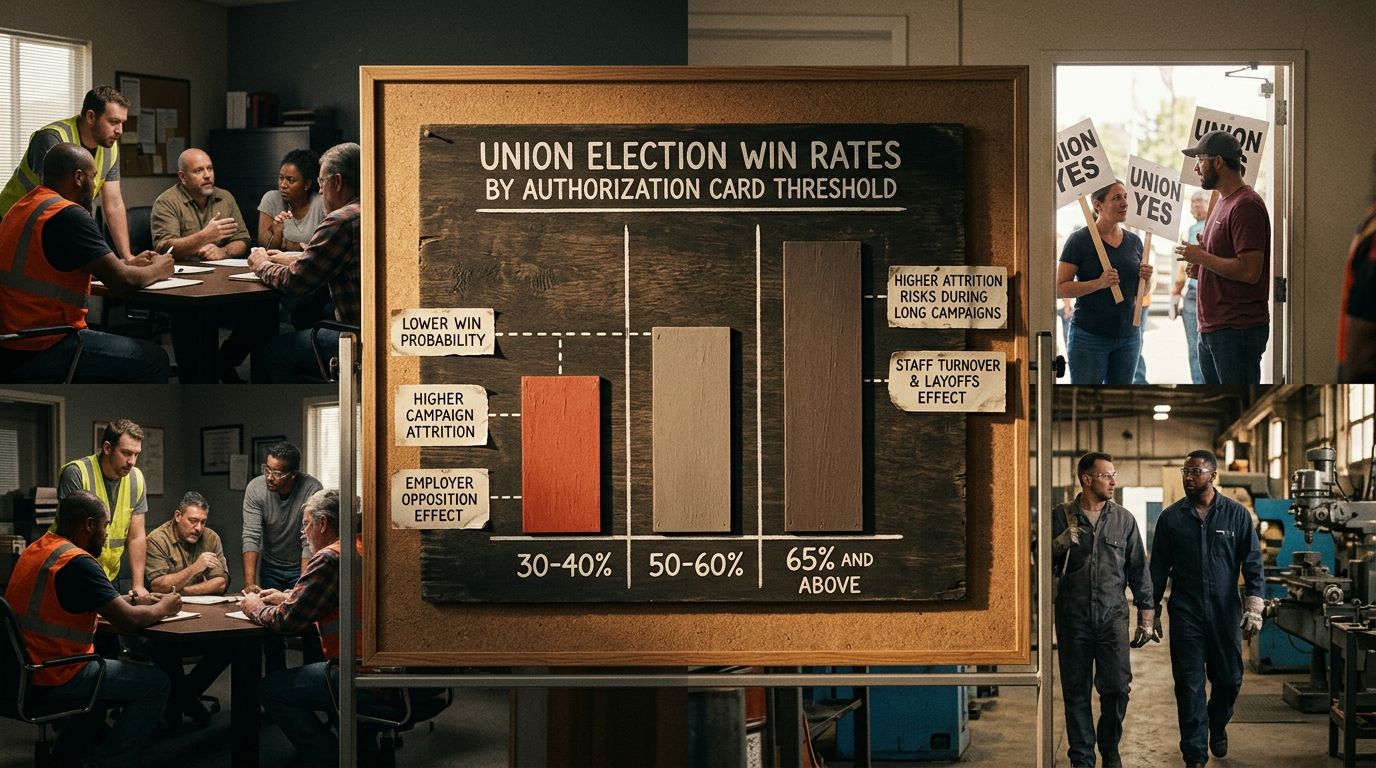
Why 30% Is the Legal Floor But 65% Is the Practical Floor
Experienced organizers treat the 30% figure the way a pilot treats minimum fuel requirements: technically sufficient to get airborne, wildly insufficient for the actual flight.
The reason is straightforward. Between the day cards are filed and the day the election happens, the employer will campaign aggressively against the union. Anti-union consultants (the industry prefers "labor relations consultants") will hold mandatory captive-audience meetings. Supervisors will have one-on-one conversations with every worker they can reach. Delays will bleed momentum. Workers who signed cards out of curiosity or frustration may waver under sustained pressure.
As one Reddit discussion among organizers put it bluntly: "You never want to file for a union election with only 30% support." The consensus among practicing organizers is that you want at least 65% of the unit to sign cards before you file. Some campaigns aim for 70% or higher. The extra margin absorbs attrition during the employer's counter-campaign.
This is where campaign strategy metrics become essential. Organizers need to track not just how many cards they've collected, but which departments, which shifts, and which demographic groups within the workplace are represented. A campaign with 65% overall support that has zero cards from the night shift is a campaign with a hole the employer will find and exploit.
The Bargaining Unit Question
Before you can calculate whether you've hit 30% or 65% or any other number, you need to know the denominator. And the denominator is the bargaining unit, which is one of the most contested elements in any organizing drive.
The proposed bargaining unit defines who is "in" and who is "out" of the group the union seeks to represent. The NLRB evaluates whether the proposed unit constitutes a "community of interest," meaning the workers share enough in common (similar working conditions, supervision, skills, job functions) to be grouped together for bargaining purposes.
Employers frequently challenge the proposed unit. Their goal is usually to expand it, pulling in workers who are less likely to vote for the union, thereby diluting support. If your proposed unit is 50 warehouse workers and you've collected 35 cards, you're at 70%. But if the employer successfully argues that the unit should include 30 office staff who weren't part of the organizing effort, your 35 cards now represent 44% of an 80-person unit. Still above 30%, but your support has been diluted and you're scrambling to reach workers who may never have heard from an organizer.
This is why identifying and recruiting leaders across every segment of your workplace has to happen before the petition lands on the Board's desk. The bargaining unit will almost certainly be challenged. Campaigns that have only organized one part of the workplace are the most vulnerable to this tactic.
E-Signatures and the Expansion of What Counts
For decades, authorization cards meant physical paper with ink signatures. Organizers carried stacks of cards in folders, collected them in break rooms and parking lots, and stored them in locked filing cabinets. The NLRB's acceptance of electronic signatures changed the logistics considerably.
Under the NLRB General Counsel's guidance, there is now no need for union organizers to solicit actual physical signatures from employees. Workers can sign authorization cards electronically, which means organizers can reach coworkers through email, text, or secure digital platforms without ever meeting face-to-face.
This development matters most in workplaces where workers are geographically dispersed, work irregular schedules, or face surveillance that makes in-person card signing risky. Gig workers, remote employees, and workers at multi-site employers all benefit from the ability to authorize representation digitally. The success of digital-first organizing strategies in recent campaigns owes a debt to this procedural shift.
But e-signatures introduce their own risks. The NLRB still requires that each signature be voluntary and that the signer understood what they were authorizing. A poorly designed digital form that buries the authorization language below a fold, or a mass-text campaign that pressures workers to click without reading, could produce challenges during the verification process. The legal organizing requirements haven't changed. The medium has.
The Cemex Framework and What Happens After Filing
The traditional path was linear: collect cards, file petition, wait for election, hope you win. The Cemex decision restructured this process in a way that gives authorization cards far greater weight.
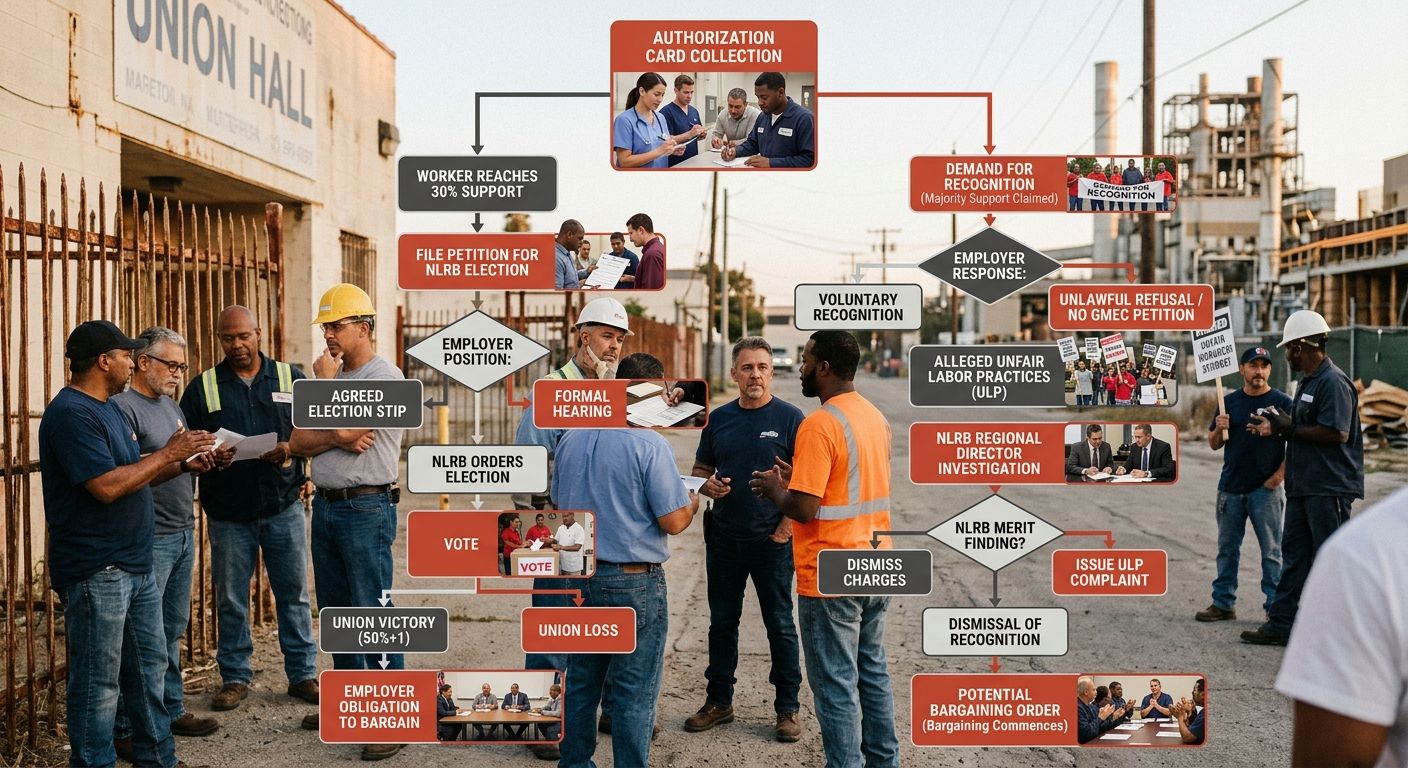
Here's how the current framework operates. A union collects dual-purpose authorization cards from a majority of workers (that's 50%+1, not 30%). The union then demands that the employer recognize it as the workers' representative. At that point, the employer has a choice: recognize the union voluntarily, or file an RM (employer-initiated) election petition with the NLRB.
If the employer files for an election and runs a clean campaign, the election proceeds normally and workers vote by secret ballot. But if the employer commits unfair labor practices during the campaign period, the NLRB can order the employer to recognize and bargain with the union without ever holding a vote. The Board's reasoning: the employer's own misconduct contaminated the election environment, so the card majority should stand.
This framework has made union organizing thresholds function differently depending on which path a campaign takes. At 30%, you can file for an election. At 50%+1 with dual-purpose cards, you can demand recognition and put the burden on the employer to either accept or trigger an election it must run without violating the law. Campaigns that understand this distinction plan their card drives accordingly.
Protecting the Cards You've Collected
Collecting cards is only half the battle. Keeping them valid through the petition and pre-election period requires discipline.
Employers will seek to invalidate cards through several tactics. They'll argue that organizers misrepresented the card's purpose. They'll challenge the bargaining unit to knock signers out of the eligible pool. They'll claim that cards were signed under duress. And they'll delay, because authorization cards can become stale if too much time passes between signing and the election.
The NLRB doesn't impose a formal expiration date on authorization cards, but Board agents and hearing officers look at the totality of circumstances. A card signed two years before the petition may carry less weight than one signed two weeks before, especially if the signer's circumstances have changed (transferred to a different department, promoted to supervisor, quit).
Organizers protect their card counts by maintaining careful records of when and where each card was signed, training every person who collects cards on what they can and cannot say, and continuing to organize new signers even after crossing the filing threshold. Campaigns that convert workplace complaints into sustained organizing activity tend to maintain their card numbers better than campaigns that treat card signing as a one-time event.
Where the Mechanism Breaks Down
The 30% threshold assumes a relatively stable, identifiable workforce. It assumes workers can be counted, classified, and verified against an employer's records. It assumes the employer will provide an accurate list of eligible employees (the Excelsior list) within a reasonable timeframe.
These assumptions strain or collapse in several common scenarios.
High-turnover workplaces present the most obvious problem. If a warehouse employs 200 people but turns over 40% of its workforce every quarter, the authorization cards signed by workers who have since quit or been fired don't count. The campaign has to run on a treadmill, continuously collecting new cards to replace the ones that evaporate with departing workers.
Misclassification is another fracture point. When employers classify workers as independent contractors rather than employees, those workers fall outside the NLRA's protections entirely. They can't sign valid authorization cards. They can't vote in an NLRB election. They can't be part of the bargaining unit. The entire mechanism depends on correct classification, and employers who want to prevent organizing have an incentive to maintain or expand misclassification.
And then there's the fundamental limitation of the threshold itself: it measures stated interest at a single moment, not durable commitment over time. A worker who signs a card in a moment of anger after a bad shift may genuinely want representation in that moment. Whether that worker will show up to vote three or five or eight weeks later, after the employer has waged a sustained campaign to change their mind, is a different question. The card captures intent. The election captures resolve. The gap between those two things is where campaigns go to die.
The 30% threshold opens a door. It gives workers access to the federal election machinery that the NLRA was designed to provide. But the mechanism was never built to guarantee outcomes. It was built to guarantee access. Organizers who understand that distinction design their campaigns around durability, depth of support, and the capacity to sustain pressure over time. Those who mistake the threshold for the finish line learn the difference on election night.
The Union Edge Staff
Related Articles

Card Check vs. NLRB Election: Which Recognition Path Gives Unions a Better Chance in 2025?
Signed authorization cards, not secret ballot elections, are now the National Labor Relations Board's preferred method for establishing union representation. The NLRB's August 2023 Cemex decision made majority sign-up the primary recognition path.

Leadership Density Over Card Counts: Why Union Authorization Metrics Fail and What Actually Predicts Organizing Success
Authorization cards measure interest, not resilience.

When Employers Fight Back: Recognizing and Countering Union-Busting Tactics During Your Organizing Campaign
U.S. employers are charged with violating federal law in 41.5% of all union election campaigns, according to a study from the Economic Policy Institute. The violations follow a predictable script.
Also in the paper