
The Organizing Committee Trap: Why Worker Committees Fail and How to Build Leadership Density That Actually Wins
Organizing committees at VW Chattanooga failed twice before the plant's 2024 election finally succeeded. The difference was structural: the winning campaign built trained leadership at a ratio of one worker-leader for every twenty-five employees, covering 90 percent of the plant by election day.

The Organizing Committee Trap: Why Worker Committees Fail and How to Build Leadership Density That Actually Wins
Organizing committees at VW Chattanooga failed twice before the plant's 2024 election finally succeeded. The difference was structural: the winning campaign built trained leadership at a ratio of one worker-leader for every twenty-five employees, covering 90 percent of the plant by election day. That ratio, called leadership density, is now the dividing line between campaigns that win and campaigns that collapse under management pressure.
The Template That Kept Breaking
For decades, the standard advice for starting an organizing committee has followed a familiar script. Identify a handful of well-liked, trusted coworkers. Make sure the group reflects the workplace's demographic diversity. Hold meetings. Collect authorization cards. File with the NLRB. Wait for an election.
The Emergency Workplace Organizing Committee describes the goal plainly: "Your employer has the ability to reach everyone quickly. We have to build similar structures," according to their organizing guide. But for years, most campaigns ignored the second half of that instruction. They built committees that were diverse in composition but thin in coverage, with five or ten active leaders responsible for hundreds of coworkers they barely knew.
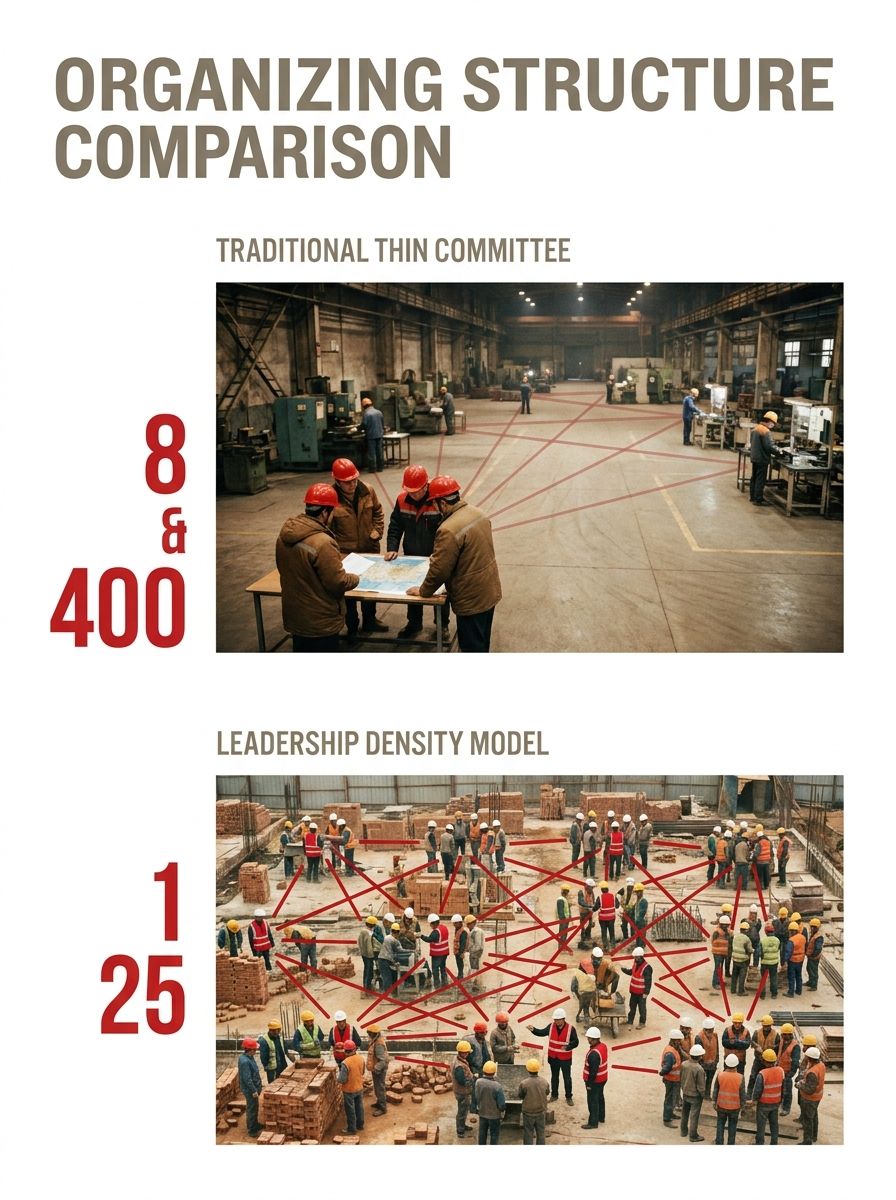
UFCW Local 1189 has cautioned organizers not to select committee members based solely on demographic representation, noting through UnionTrack that "the unionization effort reflects the interests of the whole workforce, not just a few select workers." The advice is sound. The problem is that even when organizers follow it, they end up with a committee of eight people in a plant of four hundred.
And those eight people become the entire union campaign's point of contact with the workforce. When management launches captive audience meetings, supervisor one-on-ones, and anti-union messaging that reaches every single employee simultaneously, eight people cannot respond fast enough. The math doesn't work. It never did.
The Rank-and-File Idea Before It Had a Name
The intellectual foundation for a denser, more distributed model existed long before anyone called it "leadership density." Kim Moody's rank-and-file strategy, articulated in the 1970s and later formalized in a widely cited Jacobin essay, proposed that a "militant minority" of activist, class-conscious workers could "set the agenda for the rest of their union and even for the rest of the movement."
Moody was clear-eyed about the track record: "Though only a small number of workers took up the Rank and File Strategy over the years, their accomplishments were impressive," he wrote, while acknowledging "there were probably more failures than successes during that period." The honest framing matters. The rank-and-file concept identified the right problem (worker passivity, staff-driven unionism, cozy relationships between union leadership and management) but didn't solve the structural question of how many leaders were enough.
Britain's National Minority Movement in the early twentieth century illustrated the trap. As analyzed in the International Socialism journal, the NMM ultimately failed "because of ambiguities about its aims," drifting into a ginger group that appealed to left officials rather than building durable organization at the shop-floor level. Without strong workplace-level union structure, the militant minority stayed a minority, and management picked off supporters one by one.
This pattern recurred for decades. Campaigns that built genuine rank-and-file organizing failures into their learning process survived longer, but the ones that treated committee-building as a checklist item (form committee, collect cards, file petition) kept losing at the same rate. The question that nobody had a disciplined answer to was coverage: what percentage of a workforce needs a direct, trusted relationship with a trained leader before the campaign can withstand the employer's counter-offensive?
Higher Education Becomes the Testing Ground
The answer started to crystallize in higher education campaigns beginning around June 2021. University organizing drives, particularly at private institutions with aggressive anti-union law firms on retainer, forced organizers to confront the coverage question directly. A small committee of graduate students or adjuncts could collect enough authorization cards to trigger an election, but they'd get steamrolled in the weeks between filing and voting.
Columbia University's organizing campaign became the clearest test case. Organizers there built leadership coverage for 95 percent of the bargaining unit before the election, according to the labor strategy analysis published in Jacobin. That meant nearly every worker in the unit had a direct, personal relationship with a trained leader who could answer questions, counter management talking points in real time, and report back on shifting sentiment.
The Columbia campaign also developed specific techniques for handling captive audience meetings, the employer's most potent weapon. When management herded workers into mandatory anti-union presentations, the response wasn't a flyer or an email blast. Trained leaders sitting in those meetings could consolidate reactions immediately, identify workers who seemed shaken, and have one-on-one conversations within hours. That kind of rapid response requires density. It requires people physically present in every shift, every department, every floor.
Rutgers University's School of Management and Labor Relations documented the broader implications. Their research concluded that "re-orienting staff and union resources towards training up and supporting wide numbers of worker leaders is an essential step towards lowering organizing costs, increasing union democracy, and putting the movement back into the labor movement," as detailed in their movement-building analysis. The phrase "wide numbers" is doing heavy lifting in that sentence. It's the opposite of the traditional five-to-ten-person committee.
VW Chattanooga, 2024: The Ratio That Won
Everything the higher education campaigns tested at small scale got stress-tested at VW Chattanooga, the only nonunion auto plant to win a union election following the UAW's 2023 strike wave. The Chattanooga plant had seen two failed organizing attempts before. Both followed the conventional playbook.
The 2024 campaign did something different. As analyzed in Jacobin's April 2026 report on leadership density in manufacturing, the campaign emphasized "a flexible but systematic approach to leadership development and density building" as the decisive factor.
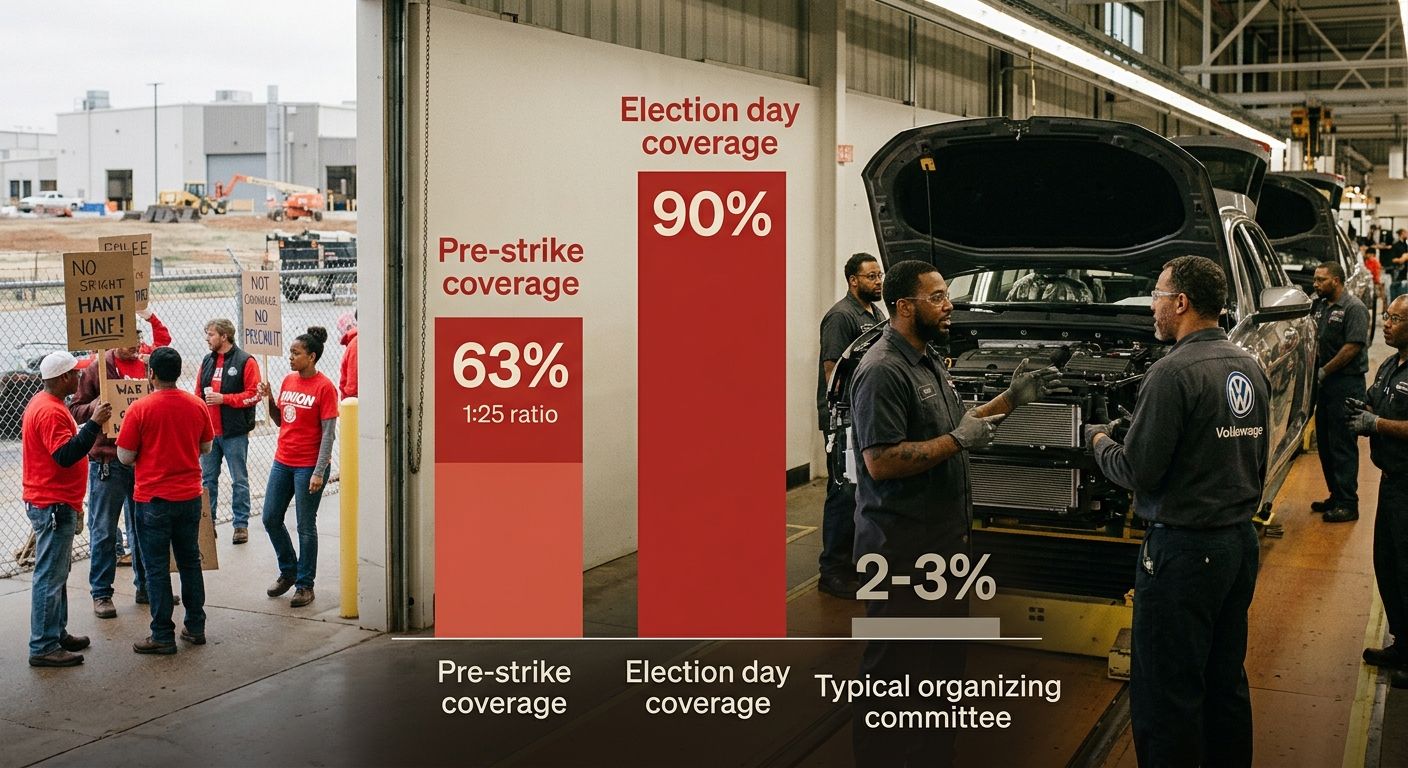
The numbers tell the story. Before the UAW's 2023 strike against the Big Three automakers, 63 percent of VW Chattanooga was covered by trained leaders maintaining a 1:25 ratio (one leader for every twenty-five workers), with an additional 14 percent at a 1:50 ratio. The strike's momentum attracted more volunteers, and by election day, 90 percent of the plant had 1:25 coverage. Over 100 workers received specific training to identify and counter management's anti-union campaign tactics.
The difference between the failed 2019 campaign and the successful 2024 campaign wasn't external support from IG Metall, the German union with a relationship to Volkswagen's global works council. It wasn't a change in NLRB rules or a shift in Tennessee's political climate. It was the depth and breadth of trained leadership inside the plant.
This is what worker power sustainability looks like in practice. When management brought in consultants to run captive audience meetings, there were trained leaders in every session. When supervisors pulled workers aside for one-on-one conversations designed to sow doubt, workers already had a trusted colleague on their shift who could reframe the conversation. The employer's information advantage, the ability to reach everyone quickly, was neutralized by a parallel structure that could also reach everyone quickly.
Those involved in building rank-and-file leadership development pipelines will recognize the underlying logic. But the VW campaign went further than most theoretical models by specifying a measurable target: 1:25, across 90 percent of the unit.
What Thin Committees Can't Survive
Why does the traditional organizing committee structure fail so consistently? The answer is operational, not ideological. Management's anti-union campaigns are designed to exploit the gap between the committee and the rest of the workforce.
A typical employer response to an NLRB filing includes captive audience meetings (mandatory, company-wide), supervisor scripts for one-on-one conversations with every employee, anti-union messaging on bulletin boards and company intranets, and, in aggressive cases, the hiring of firms like Littler Mendelson that specialize in "union avoidance." MIT Sloan professor Thomas Kochan and the Worker Empowerment Research Network have documented how "[s]huttered storefronts, disrupted operations, corporate reputations under public scrutiny" result from contentious unionization fights, urging instead that executives embrace distributed leadership.
The math of a thin committee versus a well-funded employer campaign is brutal. An organizing committee of 10 people in a 500-person workplace covers 2 percent of the unit. The employer's campaign reaches 100 percent. Even if those 10 committee members are extraordinary communicators, they can't hold 50 one-on-one conversations each in the 25-day period between filing and election. The gap between first contact and first contract only widens when the initial vote itself is vulnerable.
Leadership density changes the equation. At 1:25, a 500-person workplace has 20 trained leaders. Each leader is responsible for building and maintaining relationships with 25 coworkers, people they already work alongside. When management holds a captive audience meeting at 2 p.m., leaders can have counter-conversations by 3 p.m. on the same shift.
Beyond the NLRB Framework
The leadership density model's implications extend past traditional NLRB elections. Organizations like Honest Representation Arizona (HRA) have built worker power through civic and political engagement rather than collective bargaining, maintaining a membership base of 2,000 Arizonans who organize around state-level policy, as documented by Inequality.org. And the Emergency Workplace Organizing Committee's distributed model, which Labor Notes reported "has endured beyond the pandemic," trains workers to build organizing committees and make demands regardless of whether a formal union election is the end goal.
These models share a common thread with VW Chattanooga: they treat leadership development as the primary output of organizing, with election wins or policy victories as downstream results. The organizing committee structure, whether it's called an OC, a worker committee, or a shop-floor network, succeeds or fails based on how many workers it has trained to lead, not how many cards it has collected.
The question for unions pursuing examples of successful collective bargaining is whether they're willing to invest the time and resources that density requires. Building a 1:25 ratio takes months. It requires identifying, recruiting, and training leaders across every shift, department, and job classification. It's slower than filing a petition the moment you hit 30 percent authorization cards. But the campaigns that rush to election without density keep losing, and the ones that build density first keep winning.
The State of Play
Union election win rates have fluctuated between 48 and 68 percent over the past decade depending on the data source and unit size. The campaigns using leadership density at VW Chattanooga and in higher education have posted win rates substantially above that baseline, but the model hasn't yet been adopted at scale across the labor movement.
The barrier is resource allocation. Training one leader per twenty-five workers requires staff time, curriculum development, and ongoing coaching. Many unions still operate on a model where a single organizer manages an entire campaign, making density-building impractical. The Rutgers research points toward a "Learn-Do-Teach" model where trained worker-leaders become trainers themselves, potentially solving the scalability problem without requiring additional paid staff.
For workers considering whether to organize their own workplaces, or for union locals evaluating their approach to the NLRB process, the VW Chattanooga campaign offers a concrete benchmark. Don't ask how many authorization cards you have. Ask how many trained leaders you have, and whether their combined reach covers 90 percent of the people who will cast ballots. If the answer is no, the organizing committee isn't ready. Build the density first. The election can wait.
The Union Edge Staff
Related Articles

Leadership Density Over Card Counts: Why Union Authorization Metrics Fail and What Actually Predicts Organizing Success
Authorization cards measure interest, not resilience.

Beyond the Organizing Committee: Building Durable Worker Power Through Rank-and-File Leadership Development
Rank-and-file leadership development works through a three-stage pipeline: identification of organic workplace leaders, structured skills training in bargaining and grievance handling, and deployment into accountable union roles.

How Starbucks Workers United Turned Social Media Into a Bargaining Pressure Tool — and What Other Unions Can Learn
Starbucks Workers United's social media campaign didn't succeed because it generated public sympathy.
Also in the paper