
Beyond the Union Office: Why Organizers Fail When They Wait for Workers to Come to Them
Campaigns that file for an NLRB election with 60–70% worker support win 78% of the time. Campaigns built primarily on walk-in interest at a union hall rarely come close to that success rate.

Beyond the Union Office: Why Organizers Fail When They Wait for Workers to Come to Them
Campaigns that file for an NLRB election with 60–70% worker support win 78% of the time. Campaigns built primarily on walk-in interest at a union hall rarely come close to that success rate. The distance between those outcomes reveals the real cost of passivity in organizing strategy: when organizers sit and wait, the workers who need representation most are the ones who never walk through the door. Immigrant day laborers, warehouse temps on rotating shifts, home care aides scattered across dozens of private residences. These workers exercise their Section 7 rights only when somebody brings the conversation to them.
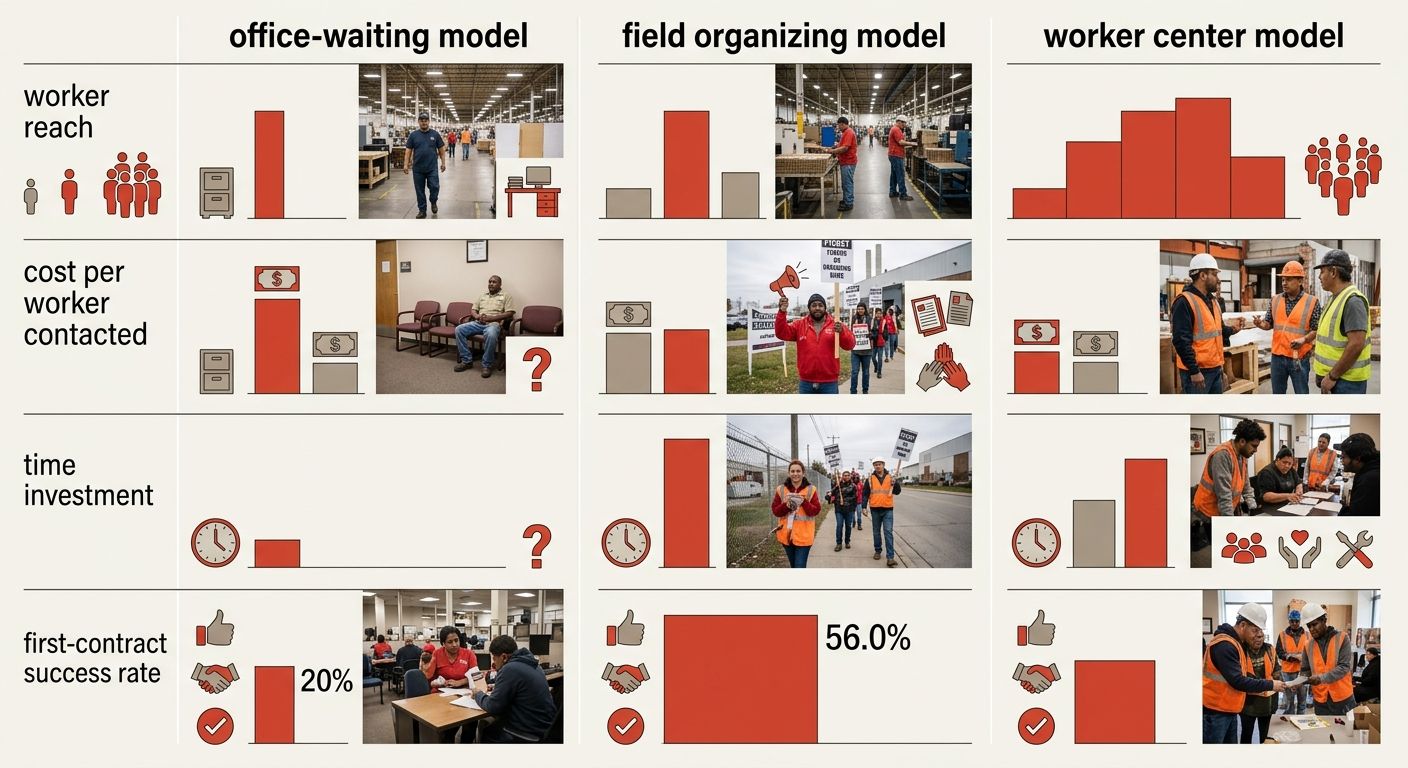
Three models of worker outreach compete for time, money, and organizer energy across the labor movement. Each carries genuine tradeoffs, and the one your local defaults to will determine who you reach, who you miss, and whether the organizing culture you build can survive a first-contract fight.
The Office-Waiting Model and Its Quiet Failure
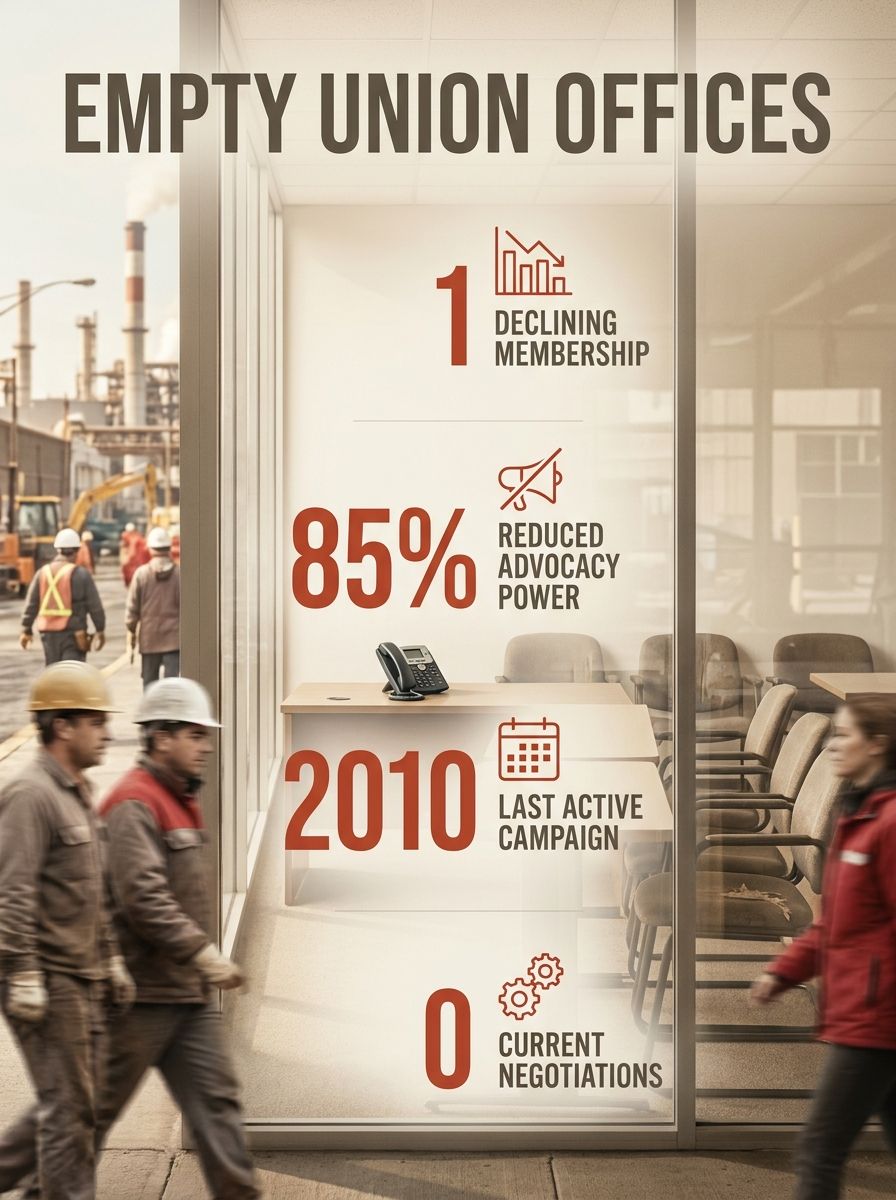
The oldest approach is the simplest: maintain a union office, answer the phones, and respond when workers call in with complaints. For decades, established locals relied on this model because it was efficient. Stewards handled grievances, business agents negotiated contracts, and new organizing happened when a group of disgruntled workers showed up asking for help.
This model works when your industry already has high union density. Construction trades in closed-shop states, public-sector unions with automatic dues deduction, and longshore workers covered by master agreements can all afford to wait, because the institutional infrastructure already funnels workers toward them. The problem is that this describes a shrinking fraction of the American workforce.
For everyone else, including the expanding warehouse, service, and gig economy sectors, the passive model carries three critical weaknesses.
First, it selects for the workers who are already confident, informed, and resourced enough to seek out a union on their own. That skews heavily toward workers who are native English speakers, who have stable schedules, who don't fear deportation, and who already know what a union is. Workers facing the worst conditions and holding the strongest legal right to organize under the NLRA get systematically filtered out. This is a civil rights problem. The right to collective action means nothing if the most vulnerable workers in a bargaining unit never hear about it.
Second, office-based organizing produces campaigns that are reactive rather than strategic. The organizer responds to whatever workplace walks through the door rather than targeting industries or employers where a win would build lasting power. Campaign planning suffers because the organizing committee forms around whoever showed up, not around the workers with the deepest social networks on the shop floor. We've written about how inadequate worker education weakens campaigns, and the office-waiting model almost guarantees that education starts too late.
Third, and most damaging to long-term strategy, passive models generate no data. When you're not in the field, you don't know which employers are churning through workers, which shifts have the worst safety records, or where the informal leaders are. You can't plan what you can't see.
Who it still serves
The office model isn't dead. It works for locals that are maintaining existing contracts rather than organizing new shops. And it's appropriate for workers in high-skill trades who have leverage and mobility. But if your local is trying to grow, if you're trying to bring the labor movement into warehousing, food service, home care, or gig work, waiting for the phone to ring is a strategy for decline.
Field Organizing Goes to the Shift Change
Field organizing flips the passive model. Instead of waiting in the office, organizers go to the worksite. They show up at shift changes, at bus stops near distribution centers, at parking lots before dawn. The conversations happen on the workers' turf, on the workers' schedule.
This approach draws on a long tradition of grassroots tactics. Door-to-door canvassing, phone banking, and community events allow organizers to meet people where they already are, both physically and psychologically. The conversation is different when it happens in a break room or a parking lot instead of inside a building with a union logo on the door. Workers who would never initiate contact with a union will talk when someone they trust introduces the idea face to face.
The key to field organizing is the one-on-one conversation. Skilled organizers know how to guide these talks as dialogue, not lectures. The goal is to get each worker to articulate their own concerns, connect those concerns to collective action, and commit to a concrete next step: signing a card, joining a committee, or recruiting a coworker.
This is where union organizer training matters most. The one-on-one is a skill, and it deteriorates without practice. Training covers how to respond to anti-union arguments, how to read body language for fear versus interest, and how to keep coworkers engaged during the long months between initial contact and an election. Solidarity Tech's research on long-term worker power emphasizes leadership development workshops and mentorship programs that help rank-and-file workers grow into organizers themselves. The best field campaigns don't depend on a paid organizer being present forever. They build internal capacity so the workers carry the campaign forward, which is exactly the approach we've seen succeed when locals focus on identifying and training first leaders from within the workplace itself.
The costs of going to the field
Field organizing is expensive. It demands organizer time measured in months, not days. It requires travel budgets, sometimes housing for organizers in remote areas, and the willingness to work nights, weekends, and holidays to match workers' schedules. Smaller locals with tight budgets struggle to sustain this model, and organizer burnout is a constant risk.
There's also a legal dimension. Organizers working outside a facility have to navigate trespassing laws, employer surveillance, and restrictions on access to private property. Knowing where organizers have a legal right to be and where they don't is essential, which is why converting workplace complaints into sustained campaigns requires careful planning, not enthusiasm alone.
And field organizing still has a geographic ceiling. You can't canvass a workforce that's distributed across an entire metro area with the same tools you'd use at a single factory gate. Home care aides working in dozens of separate private residences, app-based drivers picking up passengers across a county, freelancers logging in from their kitchens: these workers can't be reached at a shift change because there is no shift change.
Worker Centers as Organizing Labs
Worker centers emerged precisely because neither the office-waiting model nor traditional field organizing could reach the growing population of low-wage, often immigrant workers excluded from standard NLRA protections. Organizations like the National Day Laborer Organizing Network, the Restaurant Opportunities Center, and dozens of local worker centers across the country operate outside the formal collective bargaining framework entirely.
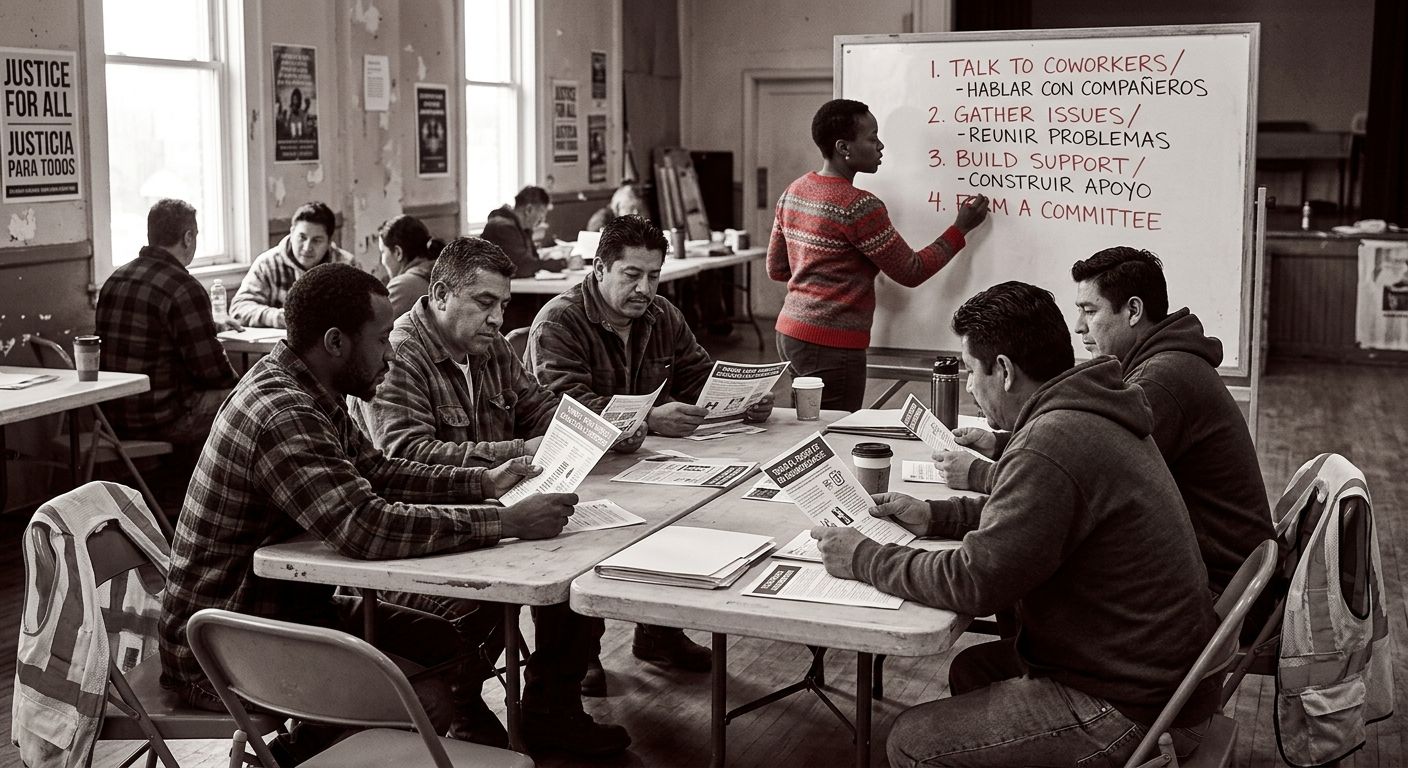
These centers involve, train, and promote organizational leaders from within the ranks of the low-wage immigrant worker community. They provide legal clinics, language classes, know-your-rights workshops, and direct services that address the immediate crises workers face. But the services are the entry point, not the end goal. The real work is political education and collective action, building the kind of organizing culture that sustains worker power over years rather than election cycles.
The Century Foundation has described worker centers as laboratories of organizational experimentation, and the label fits. Because they aren't bound by the NLRA's election process, worker centers can try tactics that traditional unions can't. Minority unionism, direct action campaigns against wage theft, public pressure on individual employers, and coalition-building with faith communities and tenant organizations all fall within the worker center playbook.
The results produced by worker centers are concrete and measurable. Day laborer centers in Los Angeles established hiring halls that set wage floors for an entire informal labor market. Restaurant worker centers won policy changes on tipped wages in multiple states. Domestic worker organizations secured new labor protections through state legislatures when federal law explicitly excluded their members. And as Brookings research confirms, a combination of better pay, upward mobility, and genuine worker voice gives workers reason to stay and fight rather than quit and disappear.
Where worker centers fall short
Worker centers can't negotiate binding collective bargaining agreements. They don't have the legal standing to file for elections or represent workers at the bargaining table. This means their wins tend to be policy-level or individual rather than contractual, and they can be reversed when political winds shift. A state legislator who passed a domestic workers' bill of rights can be replaced by one who guts it.
Funding presents another persistent vulnerability. Worker centers often depend on foundation grants and donations rather than member dues, which makes them financially precarious in ways that established unions are not. And because they operate outside the NLRA framework, their organizing work doesn't produce the institutional permanence of a ratified contract.
For organizers considering the worker center model, the critical question is whether the population you're trying to reach is actually reachable through the NLRA process at all. If your workers are independent contractors, domestic workers, or farmworkers, all of whom are excluded from NLRA coverage, a worker center may be the only viable path to collective power. If your workers are covered by the NLRA, a worker center can build the foundation, but you'll eventually need to transition toward formal representation to lock in gains.
The Victoria Uber drivers who ratified the first rideshare collective bargaining agreement showed what's possible when community-based organizing evolves into formal representation. Their campaign started with grassroots relationship-building and ended with a binding contract. That trajectory, from worker center energy to bargaining table permanence, may be the most promising path for sectors where traditional field organizing hits its geographic ceiling.
The Verdict
No single model fits every campaign, but the evidence points in a clear direction.
If you're organizing workers already in a high-density union industry with established contracts and clear bargaining units, the office model, supplemented by strong steward networks, can still function. You don't need to reinvent the wheel when the wheel is turning.
If you're organizing a defined worksite with NLRA-covered employees who don't yet have representation, field organizing is the strongest approach. The data on supermajority support before filing is unambiguous: campaigns that build 60–70% commitment through face-to-face conversations before going public win at dramatically higher rates than campaigns built on passive interest. The investment in organizer training, one-on-one conversation skills, and leadership development within the rank and file pays for itself many times over.
If you're trying to build power among workers who fall outside traditional labor law protections, including gig workers, domestic workers, day laborers, and undocumented workers who fear retaliation, worker centers offer the most realistic path. They won't produce a contract on their own, but they create the organizing infrastructure and leadership pipelines that make future campaigns viable.
The labor movement's civil rights obligations run deeper than filing unfair labor practice charges after the fact. An organizing strategy that systematically excludes workers who lack transportation to your office, who work nights when your doors are closed, or who speak languages your staff doesn't speak is a decision about who gets representation and who doesn't. The three models described here carry real consequences for which workers gain collective power and which workers remain alone. Choose based on the workers you want to reach, not the habits your local already has.
The Union Edge Staff
Related Articles

The Migrant Worker Organizing Blind Spot: Why Standard Union Strategies Fail Vulnerable Workforces
In Malaysia, achieving official government recognition for a new trade union representing migrant workers takes between five and seven years, according to research from the Malaysian Trades Union Congress. The average guest worker visa in that country lasts two to three years.

The Organizing Committee's Hidden Liability: Why Inadequate Worker Education Becomes Your Weakest Link
The AFL-CIO's Organizing Institute trains participants to have one-on-one organizing conversations, chart workplace leaders, and run mini-campaigns around live issues.

The Organizing Model vs. Service Model: Why Your Union's Strategic Choice Determines Campaign Success
Thirty-one percent. That's the win rate for private-sector union elections in the United States, according to the Economic Policy Institute, after workers endure the full weight of employer anti-union campaigns. The number is grim, but it hides something important.
Also in the paper