
Ohio Company Pleads Guilty in Fatal 2021 Plant Explosion That Killed Worker
Yenkin Majestic Paint Corporation pleaded guilty to negligent endangerment in federal court following a catastrophic April 8, 2021 explosion at its Columbus, Ohio manufacturing facility that killed one employee and injured nine others, according to an announcement from the U.S.

Ohio Company Pleads Guilty in Fatal 2021 Plant Explosion That Killed Worker
Yenkin Majestic Paint Corporation pleaded guilty to negligent endangerment in federal court following a catastrophic April 8, 2021 explosion at its Columbus, Ohio manufacturing facility that killed one employee and injured nine others, according to an announcement from the U.S. Department of Justice on September 4. The company admitted in U.S. District Court for the Southern District of Ohio that it failed to properly test and maintain a newly installed vessel component, allowing flammable vapors to escape and ignite throughout the resin manufacturing plant.
The guilty plea concludes more than five years of federal investigation into safety failures at the coatings and resin manufacturer. Federal prosecutors traced the disaster to a series of decisions involving a production vessel called Kettle 3, where the company installed a new access door in December 2020 without pressure-testing the equipment before returning it to service. The company has since ceased operations, and the case marks one of the first criminal prosecutions for workplace safety violations resulting in worker fatalities in recent years.
The Explosion and Its Immediate Cause
The explosion occurred shortly after midnight on April 8, 2021, when an agitator inside Kettle 3 stopped operating during resin production, likely due to electrical work being performed at the facility. When the operator restarted the agitator around midnight, solvent that had accumulated on top of hot resin rapidly vaporized, increasing pressure inside the vessel until the newly installed manway and its gasket failed, federal prosecutors said.
Hot liquid resin and flammable solvent vapor escaped into the plant and spread to adjacent operating areas. Flammable gas detectors registered increasing concentrations of combustible vapor but were not configured to sound an audible alarm, the Justice Department said. At approximately 12:04 a.m., the escaped vapors reached an ignition source and exploded.
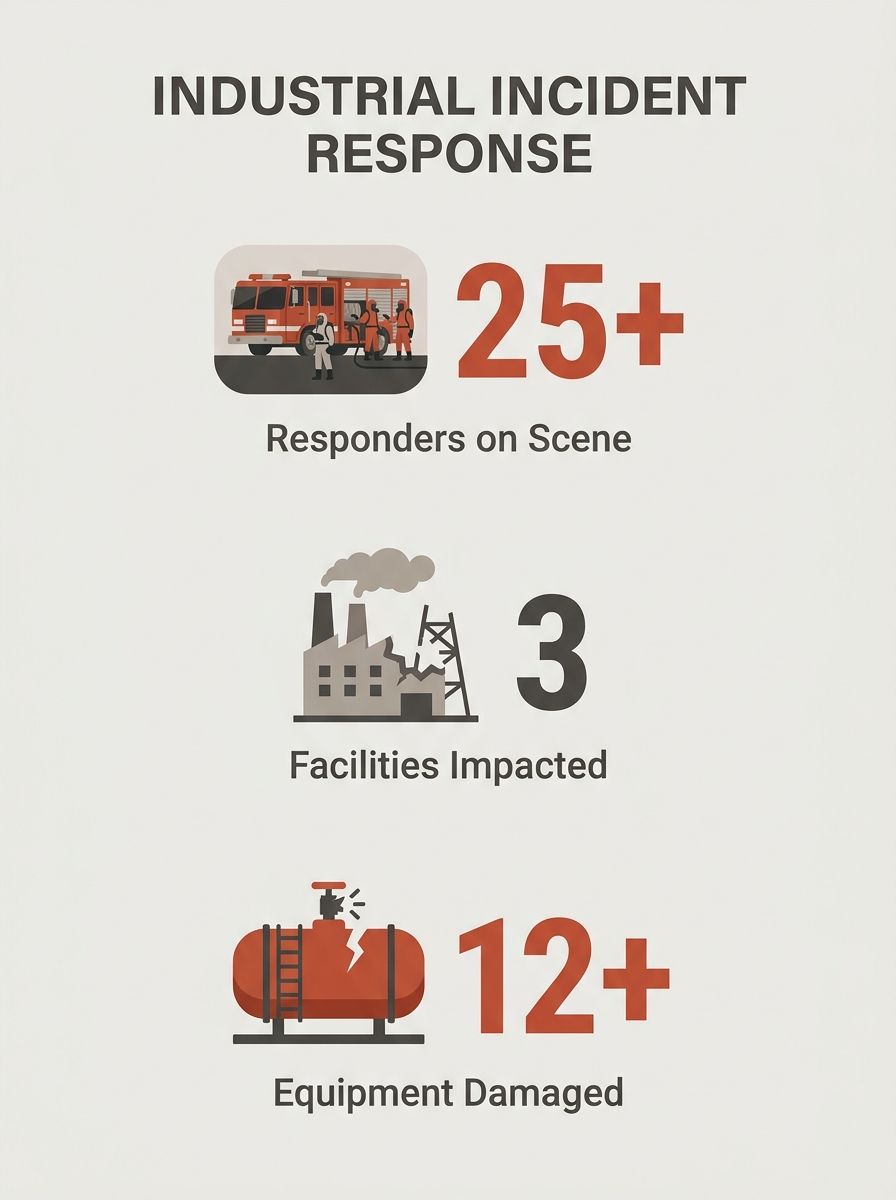
The blast killed one employee and severely injured several others. According to OSHA records, nine workers were injured, with eight transported to hospitals according to a separate investigation by the U.S. Chemical Safety and Hazard Investigation Board. The resulting fire burned for approximately 11 hours.
Equipment Failures and Ignored Warnings
Yenkin Majestic fabricated and installed a new manway on top of Kettle 3 in December 2020, working with a local fabrication company. Federal prosecutors said Kettle 3 had previously experienced high-pressure spikes, but the newly installed manway was not pressure-tested before the company returned the kettle to service.
"The new manway began leaking after installation," according to the Justice Department announcement. Instead of removing the kettle from operation, the company continued using it and installed a thicker gasket. Federal authorities said the company believed the gasket was Teflon, but it was actually silicone—a material less capable of withstanding the pressure and temperature conditions inside the vessel.
The Chemical Safety Board, which released its final investigation report in November 2023, identified three major safety failures: mechanical integrity of low-pressure vessels, selection of safeguards, and emergency preparedness. "Yenkin Majestic had failed to ensure the mechanical integrity of the newly installed manway," the CSB concluded, and the company "lacked engineering controls that could have prevented the accident and did not have adequate emergency response preparations."
Multiple Federal Investigations
OSHA investigated workplace conditions following the explosion, examining operating procedures and process safety requirements. The Chemical Safety Board separately investigated the incident and released a safety video in December 2025 revisiting the explosion and its findings.
The CSB determined that solvent accumulated on top of hot resin while the agitator was not operating. When agitation resumed, the solvent mixed with the hot material and rapidly vaporized, increasing pressure inside the kettle and contributing to the failure of the newly installed manway. The resulting flammable vapor cloud spread through the facility before finding an ignition source.
The Chemical Safety Board does not issue criminal charges or regulatory fines but investigates major chemical accidents and makes recommendations to prevent similar incidents. The Justice Department's criminal case against Yenkin Majestic represents a separate enforcement action based on federal workplace safety statutes.
Context and Outlook
The guilty plea marks a rare criminal prosecution for workplace safety violations in the manufacturing sector, where most enforcement actions result in civil penalties rather than criminal charges. The case demonstrates federal prosecutors' willingness to pursue negligent endangerment charges when equipment failures and ignored safety warnings lead to worker deaths—a development closely watched by labor advocates who have called for stronger criminal accountability in workplace fatality cases.
Workplace safety attorneys have noted that criminal prosecutions under federal workplace safety laws remain uncommon despite thousands of worker fatalities each year. The Yenkin Majestic case may signal increased enforcement focus on companies that continue operating equipment with known defects or fail to implement basic safety protocols like pressure-testing newly installed components on vessels containing flammable materials.
The company has ceased operations since the explosion. Sentencing has not yet been scheduled, and the guilty plea does not preclude additional civil actions by injured workers or the family of the deceased employee. The case also highlights ongoing debates about whether existing workplace safety enforcement mechanisms provide sufficient deterrence against unsafe operating practices, particularly in chemical manufacturing facilities where equipment failures can result in catastrophic explosions affecting multiple workers simultaneously.
The Union Edge Staff
Related Articles

Workplace Safety Failures Kill 30 Workers Across Three Countries in Four-Day Span
At least 30 workers died in workplace accidents across Greece, China, and the United States between July 9 and July 12, 2026, prompting regulators to impose safety penalties exceeding half a million dollars and order operational shutdowns at facilities in three countries, according to enforcement fi

Six OSHA Inspectors Oversee 60,000 West Virginia Workplaces After Fatal Chemical Plant Incident
Federal workplace safety enforcement in West Virginia relies on six inspectors to oversee 60,000 workplaces, according to the WV Gazette-Mail, a staffing shortage that came into focus after two workers died in April 2026 at a chemical facility that had not been inspected in eight years despite prior

Criminal Charges Filed Against Contractor and Metro Officials After 70-Year-Old Worker Dies in Electrocution at Bengaluru Construction Site
Bengaluru police filed criminal negligence charges on June 29 against a contractor, site supervisors, and Bengaluru Metro Rail Corporation Limited officials following the electrocution death of Gurappa P., a 70-year-old contract worker, at a Namma Metro construction site on M.G. Road three days earl
Also in the paper