
Minimum Wage Arizona: 2024 Rates & Requirements
Arizona's minimum wage is $14.35 per hour, effective January 1, 2024, governed by an automatic annual formula tied to the Consumer Price Index that no legislature and no governor can override without a three-quarters supermajority vote.

Minimum Wage in Arizona: How the State's Automatic Adjustment Mechanism Works
Arizona's minimum wage is $14.35 per hour, effective January 1, 2024, governed by an automatic annual formula tied to the Consumer Price Index that no legislature and no governor can override without a three-quarters supermajority vote. That formula, embedded in the state constitution through a 2016 ballot initiative, determines what hundreds of thousands of Arizona workers, including tens of thousands of home health aides, certified nursing assistants, and hospital support staff, take home each pay period.
Proposition 206 and the Legal Foundation
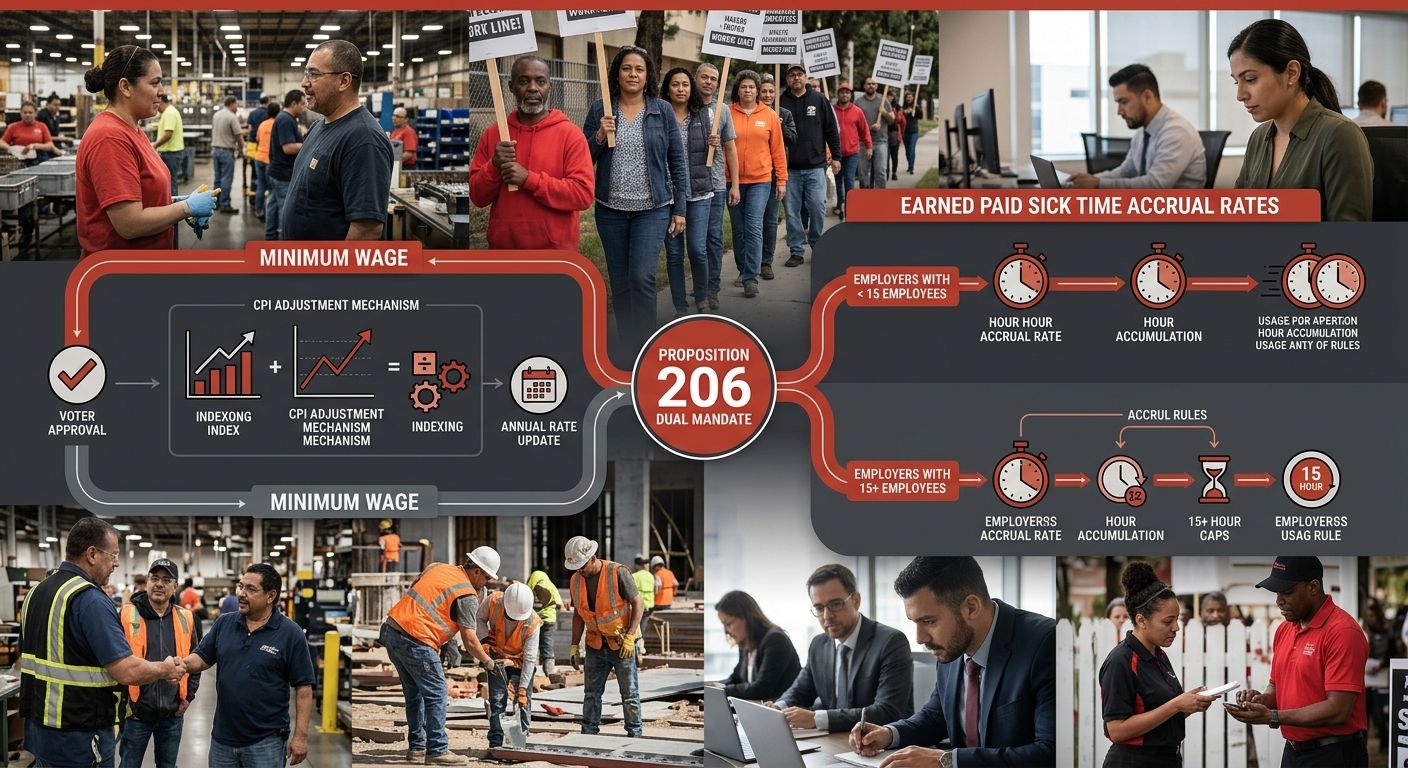
The Fair Wages and Healthy Families Act, passed as Proposition 206 by Arizona voters in November 2016 with 58.3% approval, established both a minimum wage floor and a mechanism for automatic annual increases. The Industrial Commission of Arizona holds enforcement authority under the Act, which also mandated earned paid sick time for employees statewide.
Proposition 206 set a phased schedule: $10/hr in 2017, $10.50 in 2018, $11 in 2019, and $12 in 2020. After 2020, the Act shifted to automatic CPI-based adjustments rather than fixed statutory increases. This is the critical design choice that separates Arizona's minimum wage from states where the legislature must vote on every change. As we've covered in our overview of the federal minimum wage structure, the federal floor of $7.25/hr has sat unchanged since 2009 precisely because it lacks any automatic adjustment mechanism.
The Act carries a legal protection that matters enormously for workers: because voters approved it as a ballot initiative, Arizona's legislature cannot weaken or repeal it without a three-quarters supermajority vote in both chambers. Under the Arizona Constitution's Voter Protection Act, legislative tampering with ballot initiatives faces one of the highest procedural thresholds in American state government.
The CPI Formula Behind Annual Adjustments
The Industrial Commission of Arizona calculates each year's minimum wage by measuring the percentage increase in the Consumer Price Index for All Urban Consumers (CPI-U, U.S. city average for all items) from August of the prior year compared to August of the year before that. That percentage is applied to the current minimum wage, and the result is rounded to the nearest $0.05.
Here's how the 2024 rate was set: the ICA compared the CPI-U from August 2023 against August 2022, found a percentage increase reflecting continued (though cooling) inflation, and applied that increase to the 2023 rate of $13.85. The result: $14.35/hr, a $0.50 increase, announced by the ICA in December 2023.
The formula contains one crucial guardrail: the minimum wage can never decrease. If the CPI-U drops (deflation), the wage stays at its current level. This one-way ratchet means Arizona workers don't lose ground during deflationary periods, though they can lose purchasing power if CPI adjustments fail to keep pace with actual cost-of-living increases in high-cost metro areas like Phoenix and Flagstaff.
The St. Louis Federal Reserve tracks Arizona's state minimum wage as a data series, confirming the annual CPI-driven methodology. For workers in healthcare, home health aides earning a median wage barely above the floor, each $0.25 or $0.50 adjustment has immediate paycheck impact. The mechanism ensures annual movement, but the magnitude depends entirely on inflation data, not on any assessment of whether the wage is sufficient to cover housing, food, or medical costs in a given Arizona city.
Tipped Worker Wages and the $3 Differential
Arizona law permits employers to pay tipped workers up to $3.00 per hour less than the standard minimum wage, provided the employee "customarily and regularly receives tips or gratuities." In 2024, that sets the tipped minimum wage at $11.35/hr. The critical legal requirement: if an employee's tips combined with the $11.35 base don't reach $14.35/hr for any pay period, the employer must make up the difference.
This $3 tip credit has been codified since Proposition 206's passage and adjusts alongside the standard minimum wage. In practice, the obligation to track and verify that tipped employees reach the full minimum wage falls on the employer, who must maintain detailed records of both direct wages paid and tips received.
The tip credit matters for healthcare-adjacent workers more than you'd expect. Employees at assisted living facilities who receive tips from residents, valet workers at hospitals, and food service staff in medical campuses all fall into gray areas where the tip credit might apply. Employers who misclassify workers as tipped to reduce their wage obligation face penalties under the Act.
Proposition 138, which appeared on Arizona's November 2024 ballot, proposed a constitutional amendment that would have allowed tipped workers to be paid 25% less than the standard minimum wage, instead of the flat $3 differential, as long as their total compensation reached at least $2 above the minimum wage. The measure was backed by the restaurant industry to insulate the tip credit from future minimum wage increases. For tipped workers across the state, the outcome of that ballot measure shapes the trajectory of their earnings going forward.
Local Ordinances That Override the State Rate
Arizona's minimum wage functions as a floor, and local governments can set higher rates. Two cities currently do:
Jurisdiction | 2024 Minimum Wage | Tipped Wage | Notes |
|---|---|---|---|
Arizona (statewide) | $14.35/hr | $11.35/hr | CPI-adjusted annually |
Flagstaff | $17.40/hr | $15.90/hr | Separate CPI adjustment |
Tucson | $14.35/hr | $11.35/hr | Matches state rate in 2024; rises to $15.00 in 2025 |
Federal | $7.25/hr | $2.13/hr | Unchanged since 2009 |
Flagstaff's rate of $17.40/hr, $3.05 above the state minimum, reflects the city's high cost of living, driven by its position as a university town and tourist destination with limited housing stock. Flagstaff's ordinance includes its own CPI adjustment, meaning the city rate and the state rate can diverge further over time.
For healthcare employers operating across jurisdictions, this creates compliance complexity. A home health agency dispatching aides to clients in both Phoenix (state rate) and Flagstaff (city rate) must track which rate applies based on where the work is performed, not where the company is headquartered. The same applies to traveling CNAs and per diem hospital staff who pick up shifts at facilities in different cities.
The gap between Arizona's $14.35 and the federal minimum wage of $7.25 is $7.10/hr. Arizona employers must always pay the higher applicable rate, whether that's the state, local, or federal minimum. Since Arizona's rate exceeds the federal rate by such a wide margin, the federal floor is essentially irrelevant for workers in the state, except as a stark reminder of how far congressional inaction has let the national baseline fall.
Enforcement, Exemptions, and the Earned Paid Sick Time Mandate
The ICA enforces the minimum wage through a complaint-driven process. Workers who believe their employer is paying below the minimum wage can file complaints with the Industrial Commission's Labor Department, which investigates and can order back pay. The Act also allows workers to file civil actions on their own behalf, and violations can result in additional penalties beyond the unpaid wages.
Certain narrow exemptions exist under the minimum wage in Arizona. The state wage floor does not apply to:
Workers employed by a parent, sibling, or child
Casual babysitters employed directly by families
Workers employed by the state of Arizona or the federal government
Small businesses with annual gross revenue below a threshold (though this exemption is narrower than many employers believe, the ICA's FAQ clarifies that most businesses are covered)
When an employer is subject to both state and federal wage laws, the employer must follow whichever requirement benefits the employee more. This "most beneficial to the employee" standard applies across all covered workers and eliminates any argument that the federal rate provides a lower-cost alternative.
Proposition 206 also mandated earned paid sick time, a provision often overlooked in minimum wage discussions. Employers with 15 or more employees must provide 40 hours of paid sick time per year; smaller employers must provide 24 hours. Workers accrue one hour of paid sick time for every 30 hours worked. For healthcare workers, who face elevated exposure to infectious disease and workplace injuries, this sick time mandate is inseparable from the wage floor. A minimum-wage CNA who can't afford to miss a shift without pay becomes a patient safety concern for every person in that facility.
This dual mandate (wage floor plus sick time) distinguishes Arizona's law from states that address wages and sick leave through separate statutes. Missouri's approach, for example, added paid sick leave through a separate ballot measure years after establishing its minimum wage schedule.
Where the Mechanism Breaks
The CPI-based adjustment mechanism is elegant in its automaticity. It's also limited in ways that matter for every worker earning near the floor.
The formula doesn't account for regional cost-of-living variation within Arizona. CPI-U is a national urban average. A worker in rural Yuma and a worker in central Phoenix face wildly different housing and transportation costs, yet both are covered by the same $14.35 floor. Only Flagstaff and Tucson have addressed this through local ordinances, the rest of the state relies on a one-size-fits-all number derived from national data.
CPI lags actual cost increases. The formula uses August-over-August data, meaning the rate set for January 1, 2024, reflects inflation through August 2023. If prices spike between September and December, workers absorb those costs for an entire year before the next adjustment catches up. During periods of rapid inflation, this lag can eat 3–5% of a worker's real purchasing power before the mechanism corrects.
The three-quarters supermajority protection is strong but tested regularly. The Arizona legislature has repeatedly introduced bills attempting to preempt local minimum wage ordinances or create new exemption categories. HB 2127, introduced in the 56th Legislature, proposed setting certain wage categories at $15/hr while altering the relationship between state and local authority. While the Voter Protection Act makes outright repeal nearly impossible, legislative erosion at the margins remains a constant threat. Workers and unions should track each session's labor bills with care.
Exemption boundaries remain contested. The "small business" exemption is poorly understood by employers, many of whom incorrectly believe they're exempt when they aren't. And the classification of workers as independent contractors, who fall outside the minimum wage entirely, continues to be the single largest loophole in Arizona's wage framework, particularly in home healthcare, where misclassification rates among home health aides have drawn federal scrutiny.
For workers covered under collective bargaining agreements, the minimum wage functions as a floor that union contracts typically exceed by several dollars per hour. But for the majority of Arizona's low-wage workforce, including healthcare support staff, retail workers, and food service employees, the CPI formula is the only mechanism standing between them and the kind of decade-long wage stagnation visible at the federal level.
Common Questions
Does the Arizona minimum wage apply to all workers?
The minimum wage of Arizona covers most private-sector employees. Exemptions are narrow: workers employed by a parent, sibling, or child; casual babysitters; and state or federal government employees. Most businesses are covered regardless of size. Employees may also be exempt based on criteria related to their salary level, actual duties, and skills, similar to the federal FLSA's white-collar exemptions. If you're unsure whether you're covered, the ICA's FAQ document clarifies the boundaries.
What happens if my employer pays below the minimum wage for Arizona?
Workers can file a complaint with the Industrial Commission of Arizona's Labor Department, which investigates and can order back wages and penalties. The Fair Wages and Healthy Families Act also permits workers to file civil lawsuits on their own behalf. Certain time limits apply to filing, so acting quickly matters. Retaliation against workers who file complaints is prohibited under the Act, though documenting any retaliatory actions strengthens a worker's case.
How does Arizona's rate compare to neighboring states?
Arizona's $14.35/hr sits above New Mexico ($12.00/hr) and Texas ($7.25/hr, matching the federal rate), but below California ($16.00/hr). The variation across the region is dramatic, a worker earning the minimum wage in Arizona takes home nearly double per hour what a worker at the Texas minimum receives. States like Washington use CPI-adjustment mechanisms similar to Arizona's, producing comparable rates through the same automatic formula approach.
Does the CPI adjustment ever result in a wage decrease?
No. Arizona's statute includes a ratchet provision: if the CPI decreases year over year, the minimum wage holds at its current level. The wage can stay flat but it never drops. This protection ensures that deflationary periods don't cut worker pay, though it also means the minimum wage can lose real purchasing power during years when CPI is flat but localized costs, particularly housing in the Phoenix metro area, continue climbing.
Are healthcare workers in Arizona affected differently by the minimum wage?
Healthcare support workers, home health aides, certified nursing assistants, medical assistants, and hospital housekeeping and food service staff, are among the largest groups of workers earning at or near the minimum wage in Arizona. The Act's earned paid sick time provision is particularly important for these workers, who face high rates of workplace exposure to illness and injury. Unionized healthcare facilities typically negotiate wages well above the state floor, but non-union facilities often pay at or very close to the minimum, making the CPI formula the primary driver of their annual raises.
The Union Edge Staff
Frequently Asked Questions
- What is the Arizona minimum wage for 2024?
- Arizona's minimum wage is $14.35 per hour, effective January 1, 2024. This rate is determined by an automatic annual adjustment formula tied to the Consumer Price Index that was established through Proposition 206 in 2016.
- How does Arizona's minimum wage increase each year?
- Arizona uses an automatic CPI-based formula that adjusts the minimum wage each January 1 based on the percentage increase in the Consumer Price Index for All Urban Consumers from August of the prior year compared to August of the year before that, rounded to the nearest $0.05. The wage can never decrease, even during deflationary periods.
- What is the tipped minimum wage in Arizona for 2024?
- The tipped minimum wage in Arizona is $11.35 per hour in 2024, which is $3.00 less than the standard minimum wage. Employers must ensure that tipped employees' combined wages and tips reach at least $14.35 per hour, or they must make up the difference.
- Do any Arizona cities have higher minimum wages than the state rate?
- Yes, Flagstaff has a minimum wage of $17.40 per hour and Tucson will have $15.00 per hour starting in 2025, both exceeding Arizona's state minimum of $14.35 per hour. Local ordinances can set higher rates than the state floor.
- Can the Arizona legislature change the minimum wage without a vote?
- No. Because Proposition 206 was approved by voters as a ballot initiative, the Arizona legislature cannot weaken or repeal it without a three-quarters supermajority vote in both chambers under the state constitution's Voter Protection Act.
- What is Arizona's paid sick time requirement?
- Employers with 15 or more employees must provide 40 hours of paid sick time per year; smaller employers must provide 24 hours. Workers accrue one hour of paid sick time for every 30 hours worked, and this requirement was established by Proposition 206 alongside the minimum wage mandate.
- How do I file a complaint if my employer pays below minimum wage in Arizona?
- Workers can file a complaint with the Industrial Commission of Arizona's Labor Department, which investigates and can order back pay and penalties. The Fair Wages and Healthy Families Act also allows workers to file civil lawsuits on their own behalf, and retaliation against workers who file complaints is prohibited.
- What are the exemptions to Arizona's minimum wage requirement?
- Arizona's minimum wage does not apply to workers employed by a parent, sibling, or child; casual babysitters employed directly by families; workers employed by the state or federal government; and certain employees classified as independent contractors. Most private businesses, regardless of size, are covered.
Related Articles

state of arizona minimum wage 2024 Guide
Arizona's state minimum wage in 2024 is $14.35 per hour, set by an automatic inflation-adjustment formula that voters embedded in state law through Proposition 206 in 2016.
Arizona Minimum Wage 2026: What's Changing
Proposition 206, the ballot initiative Arizona voters passed in 2016, built an automatic escalator into state law: each year, the minimum wage adjusts based on Consumer Price Index changes. That formula pushed the az minimum wage 2026 rate to $15.15 per hour on January 1, a $0.45 increase from $14.

State of Colorado Minimum Wage 2024: Rates & Changes
Colorado's state minimum wage rose to $14.42 per hour on January 1, 2024, set automatically by a Consumer Price Index formula that removes the state legislature from annual rate decisions entirely.
Also in the paper