
Minimum wage state of michigan: 2024 Guide
Michigan's minimum wage is $13.73 per hour as of January 1, 2026, governed by the Improved Workforce Opportunity Wage Act, a law that was gutted by the state legislature in 2018, restored by the Michigan Supreme Court in 2024, and then rewritten through bipartisan compromise in 2025.

Minimum Wage State of Michigan: How the Rate Schedule Actually Works
Michigan's minimum wage is $13.73 per hour as of January 1, 2026, governed by the Improved Workforce Opportunity Wage Act, a law that was gutted by the state legislature in 2018, restored by the Michigan Supreme Court in 2024, and then rewritten through bipartisan compromise in 2025. The result is a scheduled climb to $15.00 per hour by January 2027, followed by permanent inflation indexing.
The Law Behind the Number
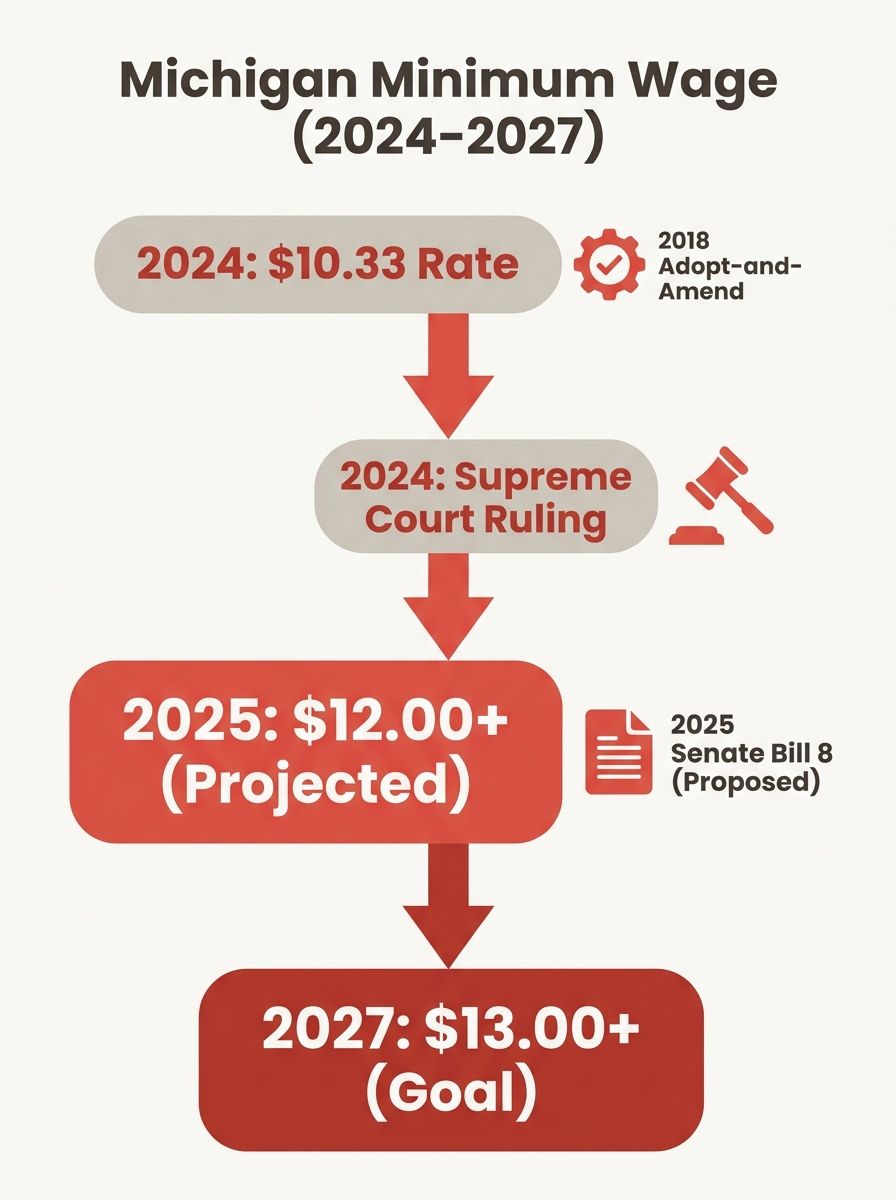
The Improved Workforce Opportunity Wage Act (IWOWA) is the statute that sets the michigan state minimum wage. Originally passed as a voter-initiated ballot measure in 2018, it called for annual increases reaching $12.05 per hour by 2022 and the gradual elimination of the tip credit.
The Michigan legislature used a procedural maneuver called "adopt and amend", accepting the ballot initiative to keep it off the November ballot, then immediately weakening it with amendments that slowed the rate schedule and preserved the tip credit permanently. That maneuver set the minimum wage at $10.33 per hour for January 1, 2024, a figure far below what the original initiative intended.
In July 2024, the Michigan Supreme Court ruled the adopt-and-amend strategy unconstitutional, voiding the 2018 legislative amendments entirely. The original voter-initiated language snapped back into effect, creating an immediate compliance crisis for employers statewide. Bipartisan legislation, Senate Bill 8, followed in February 2025, setting the current schedule of annual increases while retaining a modified tip credit.
This legal history matters because it determines every rate on the current schedule. The minimum wage state of Michigan employers owe their workers didn't emerge from a simple legislative vote. It survived a court fight.
The Annual Rate Schedule
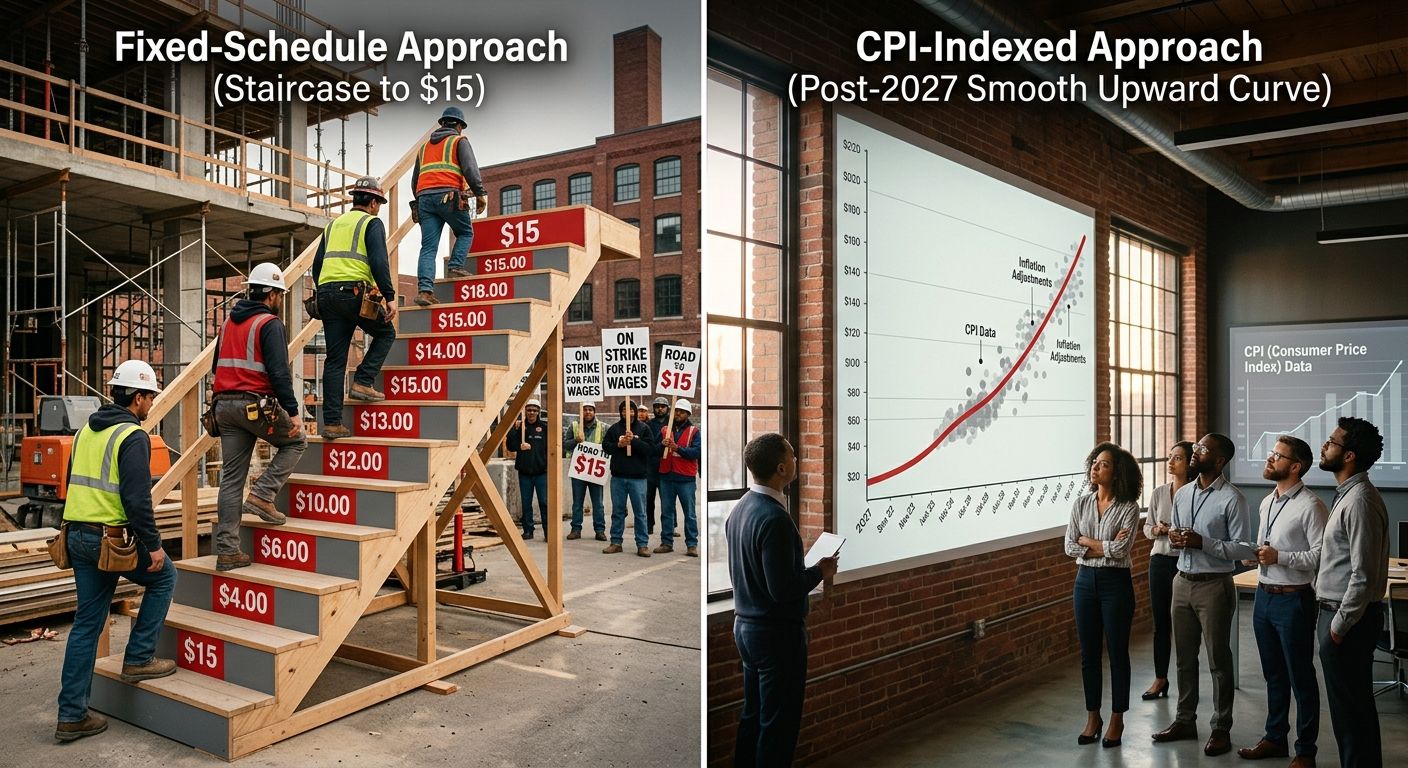
Senate Bill 8 established a fixed staircase of annual increases, each taking effect on January 1. The Michigan Department of Labor and Economic Opportunity publishes the rates and compliance guidance for each step.
Year | Standard Rate | Tipped Rate | Minor Rate (16–17) |
|---|---|---|---|
2024 | $10.33/hr | $3.93/hr | $8.78/hr |
2025 | $12.48/hr | $4.99/hr | $10.60/hr |
2026 | $13.73/hr | $5.49/hr | $11.67/hr |
2027 | $15.00/hr | $6.30/hr | $12.75/hr |
Each step represents a fixed dollar increase, not a percentage bump. The jump from 2024 to 2025 was the largest single-year increase in the schedule, $2.15 per hour, because the 2024 Supreme Court ruling forced the state to accelerate from the weakened rate trajectory back toward the original voter-initiated targets.
For comparison, the federal minimum wage remains frozen at $7.25 per hour, where it's been since 2009. Michigan workers are protected by the higher state rate. And several other states have taken similar paths toward $15, Missouri voters approved Proposition A in November 2024, while Arizona's minimum wage runs on an automatic CPI formula that bypasses the legislature entirely.
How the Tipped Wage Mechanism Functions
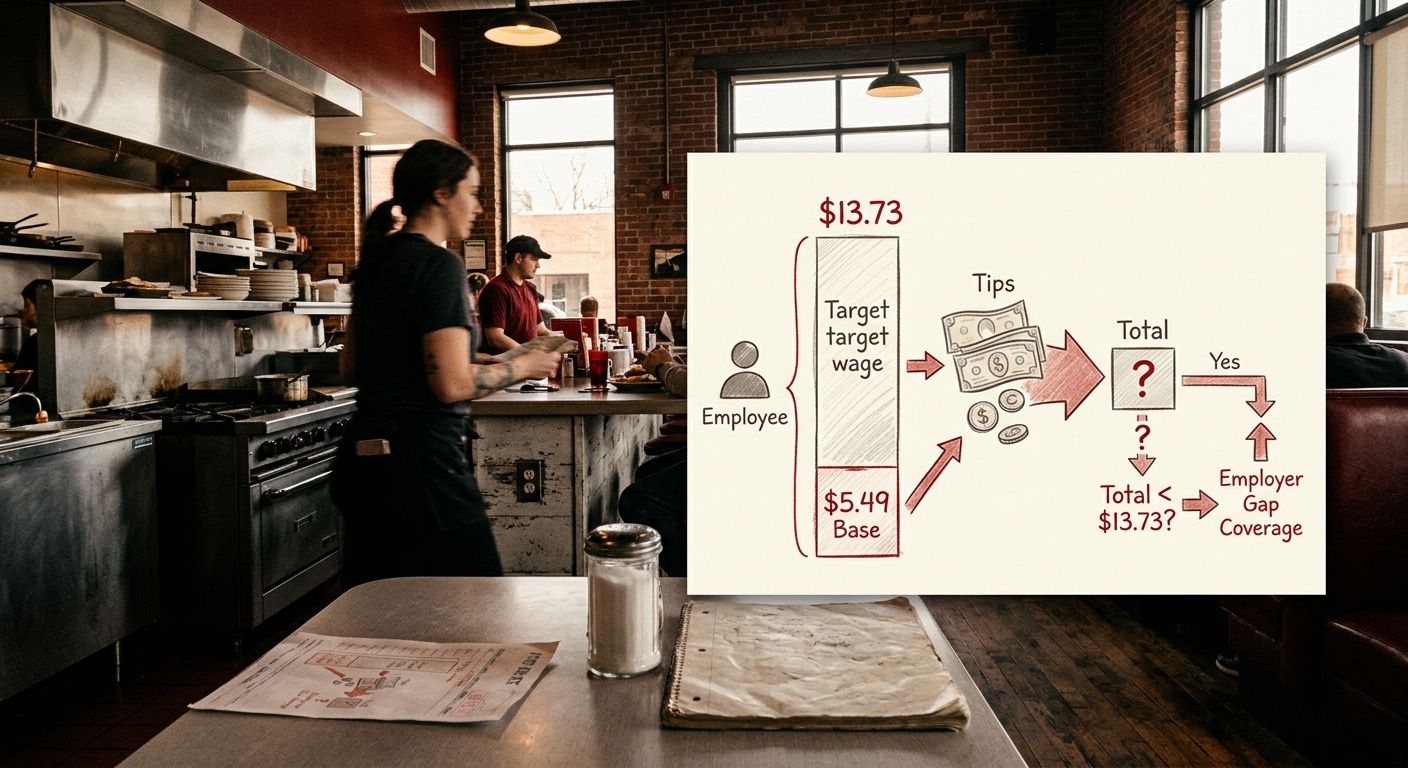
The tipped employee rate is calculated as a fixed percentage of the standard minimum wage. In 2026, that percentage is 40%, producing a base hourly rate of $5.49. Employers can pay this reduced rate only when an employee customarily receives more than $30 per month in tips.
The critical safeguard: employers must make up the difference if an employee's tips plus base wage don't reach the full $13.73 minimum in any pay period. This obligation, called the "tip credit guarantee", requires employers to track tip income per employee per pay period and issue supplemental pay when tips fall short.
After 2027, the tipped wage percentage is scheduled to increase gradually, reaching 50% of the standard rate by 2031. The original voter-initiated law would have eliminated the tip credit entirely by 2024. Senate Bill 8's compromise preserved the credit but narrowed it over time.
Workers in states with weakened wage enforcement know how easily tip credit violations go undetected. If you're seeing patterns of unpaid wages or tip credit shortfalls at your workplace, tracking your hours and tip income independently is the single most effective protection you have.
Minor and Training Wage Carve-Outs
Two additional sub-rates apply to specific worker categories under IWOWA.
Minor workers aged 16 and 17 earn 85% of the standard michigan state minimum wage. In 2026, that's $11.67 per hour. In 2027, the minor rate rises to $12.75 per hour. Workers turn 18 and become eligible for the full rate on their birthday, there's no waiting period or employer discretion involved.
Training wage applies to newly hired employees under age 20 during their first 90 calendar days of employment. The rate is $4.25 per hour. This is the lowest legal wage in Michigan, and it has a hard expiration: once 90 calendar days pass from the hire date, the employee must receive at least the full minimum wage regardless of age. Employers cannot restart the 90-day clock by terminating and rehiring the same worker.
The training wage provision is borrowed from federal law and has drawn criticism from worker advocates who argue it creates an incentive to churn young workers on 89-day cycles. Michigan doesn't publish data on how many employers use the training wage, which makes enforcement patterns difficult to track.
How Inflation Indexing Takes Over After $15
Once the standard rate reaches $15.00 per hour on January 1, 2027, the fixed staircase ends. Annual adjustments shift to a formula tied to the Consumer Price Index for Urban Wage Earners and Clerical Workers in the Midwest region (CPI-W Midwest).
The formula works like this: the state calculates the percentage change in CPI-W Midwest for the 12-month period ending in the previous September. That percentage increase is applied to the current minimum wage, and the new rate takes effect the following January 1.
LEO Deputy Director of Labor Sean Egan addressed the transition to inflation indexing in a February 2025 webinar explaining how Senate Bill 8 affects workers and businesses going forward. The shift to CPI tracking means the michigan state minimum wage will rise automatically each year without requiring new legislation, a design that mirrors systems already operating in Arizona, Colorado, and Washington.
One mechanical detail matters here: the law rounds the calculated rate to the nearest five cents. So if CPI-W Midwest rises 3.2% from a $15.00 base, the raw calculation produces $15.48, which rounds to $15.50.
Where the Model Breaks
The michigan state minimum wage mechanism has three boundary conditions where it behaves counterintuitively or fails to protect workers.
The unemployment pause. If Michigan's adjusted seasonally averaged unemployment rate exceeds 8.5% for the year preceding a scheduled increase, the increase is suspended until unemployment drops below that threshold. This means workers lose ground to inflation precisely when economic conditions are worst, the exact moment they need wage protection most. The 8.5% trigger hasn't been hit since 2020's pandemic unemployment spike, but it remains active in the statute.
Enforcement gaps in tip credit compliance. The tip credit guarantee only works if employers accurately track tip income and supplement wages when tips fall short. Michigan's Wage and Hour Division investigates complaints but doesn't conduct routine audits. Workers who don't know they're entitled to a makeup payment, or who fear retaliation for asking, absorb the loss. The growing pattern of wage theft cases across the country suggests this isn't a theoretical concern.
No local preemption override. Michigan state law preempts cities and counties from setting their own minimum wage rates. Detroit, Ann Arbor, and other municipalities with higher costs of living cannot enact local minimums above the state floor. A $13.73 hourly rate in rural Cheboygan and a $13.73 rate in downtown Detroit produce very different purchasing power outcomes, but the law treats them identically.
The CPI ceiling problem. Inflation indexing prevents the wage from stagnating, but it also caps growth at the rate of inflation. If productivity gains or housing cost spikes outpace CPI-W Midwest, the minimum wage falls behind real economic conditions. The index measures price changes for a national basket of goods weighted toward the Midwest, it doesn't track Michigan-specific cost of living.
Common Questions
Does Michigan's minimum wage apply to all employers?
IWOWA covers employers with two or more employees. Businesses with a single employee are exempt from the state minimum wage, though the federal $7.25 floor still applies through the Fair Labor Standards Act.
Can Michigan employers pay the federal minimum wage instead of the state rate?
No. When a state minimum wage exceeds the federal rate, employers must pay the higher amount. Michigan's $13.73 rate supersedes the federal $7.25 for all covered employees. The federal minimum wage serves as a floor, and states are free to set rates above it.
What happens to the tipped wage after 2027?
The tipped employee rate continues increasing as a percentage of the standard wage, climbing from 40% in 2026 to 50% by 2031. After 2031, the tipped rate adjusts alongside the standard rate through CPI indexing, maintaining the 50% ratio. The tip credit survives but narrows over time.
Are salaried workers affected by minimum wage increases?
Salaried workers classified as non-exempt must still earn at least the minimum wage for all hours worked. Salaried workers classified as exempt under FLSA's executive, administrative, or professional exemptions are not covered, but misclassification of non-exempt workers as exempt is one of the most common wage and hour violations in the country, and Michigan's Wage and Hour Division actively investigates complaints.
Will the minimum wage reach $15 if unemployment spikes?
The scheduled increase to $15.00 on January 1, 2027 can be suspended if Michigan's unemployment rate exceeds 8.5% in the preceding year. If suspended, the increase takes effect the first January 1 after unemployment falls below 8.5%. The $15 target itself doesn't disappear, it gets delayed.
The Union Edge Staff
Frequently Asked Questions
- What is Michigan's minimum wage in 2026?
- Michigan's minimum wage is $13.73 per hour as of January 1, 2026, with a scheduled increase to $15.00 per hour on January 1, 2027.
- What is the tipped minimum wage in Michigan?
- The tipped employee rate in Michigan is 40% of the standard minimum wage, which equals $5.49 per hour in 2026. Employers must make up the difference if tips plus base wage don't reach the full $13.73 minimum in any pay period.
- How much do 16 and 17 year olds earn in Michigan minimum wage?
- Workers aged 16-17 earn 85% of the standard minimum wage, which is $11.67 per hour in 2026 and rises to $12.75 per hour in 2027.
- What is Michigan's training wage for new employees under 20?
- The training wage in Michigan is $4.25 per hour for newly hired employees under age 20 during their first 90 calendar days of employment, after which they must receive the full minimum wage.
- How will Michigan's minimum wage increase after 2027?
- After reaching $15.00 per hour on January 1, 2027, Michigan's minimum wage will increase automatically each year based on the Consumer Price Index for Urban Wage Earners in the Midwest region, eliminating the need for legislative approval.
- Can Michigan cities set their own minimum wage above the state rate?
- No, Michigan state law preempts cities and counties from setting their own minimum wage rates, so municipalities like Detroit and Ann Arbor must follow the state minimum wage floor.
- Which employers must pay Michigan's minimum wage?
- The Improved Workforce Opportunity Wage Act covers employers with two or more employees, while single-employee businesses are exempt from the state minimum wage requirement.
- Can the scheduled $15 minimum wage increase be delayed in Michigan?
- Yes, if Michigan's unemployment rate exceeds 8.5% in the year preceding the increase, the scheduled raise to $15.00 on January 1, 2027 can be suspended until unemployment drops below 8.5%.
Related Articles

Michigan Minimum Wage: 2024 Updates & Requirements
Michigan's minimum wage is $13.73 per hour, effective January 1, 2026, after the Michigan Supreme Court's July 31, 2024 ruling reinstated voter-approved wage increases that the legislature had blocked for six years. The rate reaches $15.

Minimum Wage for Michigan: 2024 Updates
Adopt-and-amend is the legislative tactic that shaped the minimum wage for Michigan for six years, and understanding how it worked, and how it collapsed, explains every dollar amount on a Michigan paycheck today.

Michigan Minimum Wage: Current Rates & Updates
The Improved Workforce Opportunity Wage Act controls the state of Michigan minimum wage through a fixed annual escalator that raises the floor each January without requiring new legislative votes. As of January 1, 2026, that escalator pushed the standard rate to $13.
Also in the paper