
The Safety Reporting Culture Gap: Why Workers Fear Retaliation More Than Hazards
The Institute of Business Ethics surveyed 750 U.S. workers in 2024 as part of a larger global study of 10,000 employees, and one finding stands above the rest: 43% feared reprisals if they raised concerns about workplace misconduct.

The Safety Reporting Culture Gap: Why Workers Fear Retaliation More Than Hazards
The Institute of Business Ethics surveyed 750 U.S. workers in 2024 as part of a larger global study of 10,000 employees, and one finding stands above the rest: 43% feared reprisals if they raised concerns about workplace misconduct. A separate 35% said they doubted management would take any corrective action even if they did report. Add those figures together and you're looking at a workforce where the majority has already concluded that speaking up about unsafe conditions will either get them punished or get them ignored. Federal law under the OSH Act requires employers to maintain workplaces free from known safety and health hazards. The gap between that legal obligation and workers' lived experience is where people get hurt, permanently disabled, or killed.
Among those in the IBE survey who chose to report anyway, nearly half experienced personal disadvantage afterward: demotions, social isolation, fabricated performance complaints. And the retaliation fell hardest on the youngest workers. Seventy percent of reporters aged 18 to 34 faced backlash, compared with 33% of workers 55 and older. Younger employees reported at higher rates (70% versus 54% for their older colleagues), which means the workers most willing to speak up are also the ones most likely to be punished for it.
These aren't abstract numbers. They describe a safety reporting system that actively discourages the behavior it depends on.
The Law Says One Thing. The Workplace Does Another.
On paper, the protections are clear. OSHA's Whistleblower Protection Program states plainly that it is illegal for an employer to fire, demote, transfer, or otherwise retaliate against a worker who raises safety or health concerns. Workers can file complaints about unsafe conditions confidentially, and the filing deadline ranges from 30 to 180 days depending on the statute involved. Under the Energy Reorganization Act, for example, employees have 180 days from the date a retaliatory decision is communicated to them.
But legal protection on paper and protection in practice are two different things. The AFL-CIO's 2024 Death on the Job report documented a major backlog in OSHA whistleblower cases, with investigations languishing while workers who've already been fired or demoted wait for resolution. The proposed Protecting America's Workers Act (H.R. 2998) would strengthen anti-retaliation provisions and expand coverage to workers currently excluded from OSHA protections, but the bill has stalled in Congress.
The gap between what companies promise on safety and what they deliver isn't news to anyone who's worked a warehouse floor, a construction site, or a poultry processing line. Employer responsibilities under the OSH Act include providing training in a language workers understand, posting OSHA citations in visible locations, and maintaining accurate injury and illness records under § 1904.35. In practice, workers at our organizing tables consistently describe managers who coach them to undercount injuries, delay reporting, or classify lost-time incidents as "light duty" to keep recordable rates low.
We've written before about the persistent gap between corporate safety policies and on-the-ground reality. The data in the IBE survey gives that gap a concrete shape: when 43% of workers pre-emptively self-censor on safety, the official injury numbers that companies and regulators rely on represent a distorted picture of actual conditions.
Where Trust Breaks Down
The IBE data tells us how many workers stay silent. Understanding why requires looking at the structural incentives managers operate under.
A lack of trust in management is one of the most frequently cited reasons workers don't report hazards, according to research from Canada Safety Training. When workers feel unsafe speaking up, the silence compounds risk for everyone on the job. And that silence is rational. If you've watched a coworker get reassigned to a worse shift after filing a complaint, you learn fast. If you've seen a safety suggestion disappear into a suggestion box that nobody empties, you stop suggesting.
The problem runs deeper than individual bad managers. Entire safety cultures get built around metrics that reward silence. Companies that tie bonuses to low incident rates create a direct financial incentive for supervisors to discourage reporting. The worker who flags a near-miss becomes the person who might cost the team its safety bonus. The informal pressure to stay quiet doesn't show up in any policy manual, but every hourly worker in a manufacturing plant or distribution center knows exactly how it works.
Research on psychological safety in manufacturing environments confirms this dynamic. A supportive workplace encourages employees to voice concerns, report dangers, and suggest improvements without fear, according to analysis published on MillionBooks.org. But transforming workplace culture to prioritize psychological well-being alongside production targets requires changing how supervisors are evaluated, how incidents are investigated, and how the organization responds when someone raises an uncomfortable truth about conditions on the floor.
The Generational Divide Is a Warning Signal
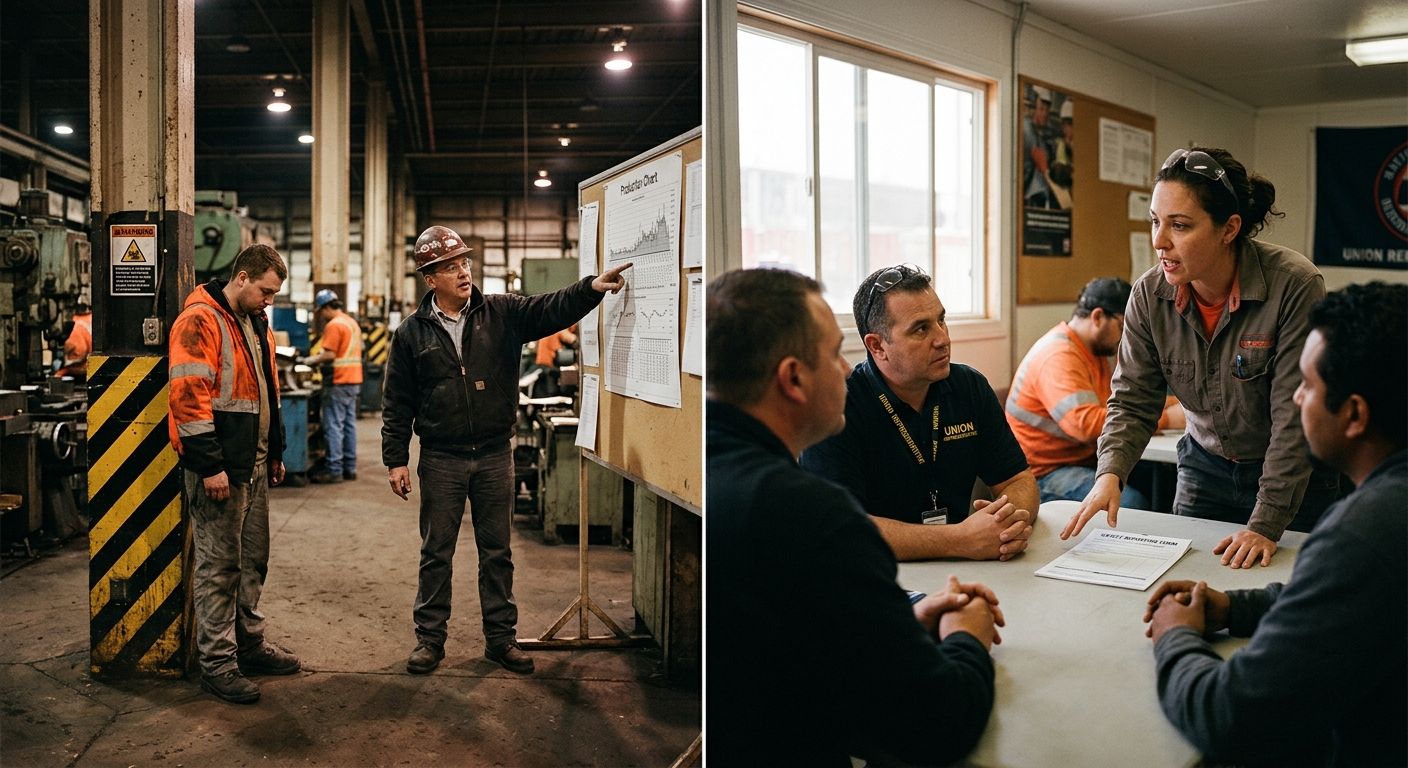
The age breakdown in the IBE data deserves closer attention. Workers aged 18 to 34 report at higher rates but face retaliation at more than double the rate of workers over 55. Several explanations are plausible, and they aren't mutually exclusive.
Younger workers tend to hold less seniority, making them easier targets for schedule changes, shift reassignments, and discipline that can be dressed up as performance management. They're also more likely to be in temporary, contracted, or gig-classified positions where the employment relationship itself provides less protection. And they may be less familiar with the legal frameworks that theoretically protect them.
But there's another reading of this data that should concern every union organizer and every safety committee chair. If the generation entering the workforce right now learns early that reporting hazards leads to punishment, that lesson will shape their behavior for decades. The 33% retaliation rate among older workers may itself be an artifact of survivorship bias: after years of watching what happens to people who speak up, older workers have learned which battles to pick and which to avoid. Their lower reporting rate (54% versus 70% for younger workers) suggests exactly that kind of learned caution.
For unions working to build lasting worker power on the shop floor, this generational pattern is a structural threat. A workforce that's been trained by experience to stay quiet about hazards is a workforce that will also stay quiet about contract violations, wage theft, and understaffing.
What Effective Reporting Systems Actually Look Like
If fear of workplace retaliation is the primary barrier to reporting, the solution has to address that fear directly. Telling workers to "just report it" while the same management structure that retaliates against reporters remains in place is worse than useless. It shifts responsibility to the people with the least power.
Effective safety reporting systems share several characteristics that the IBE data and OSHA research both point toward:
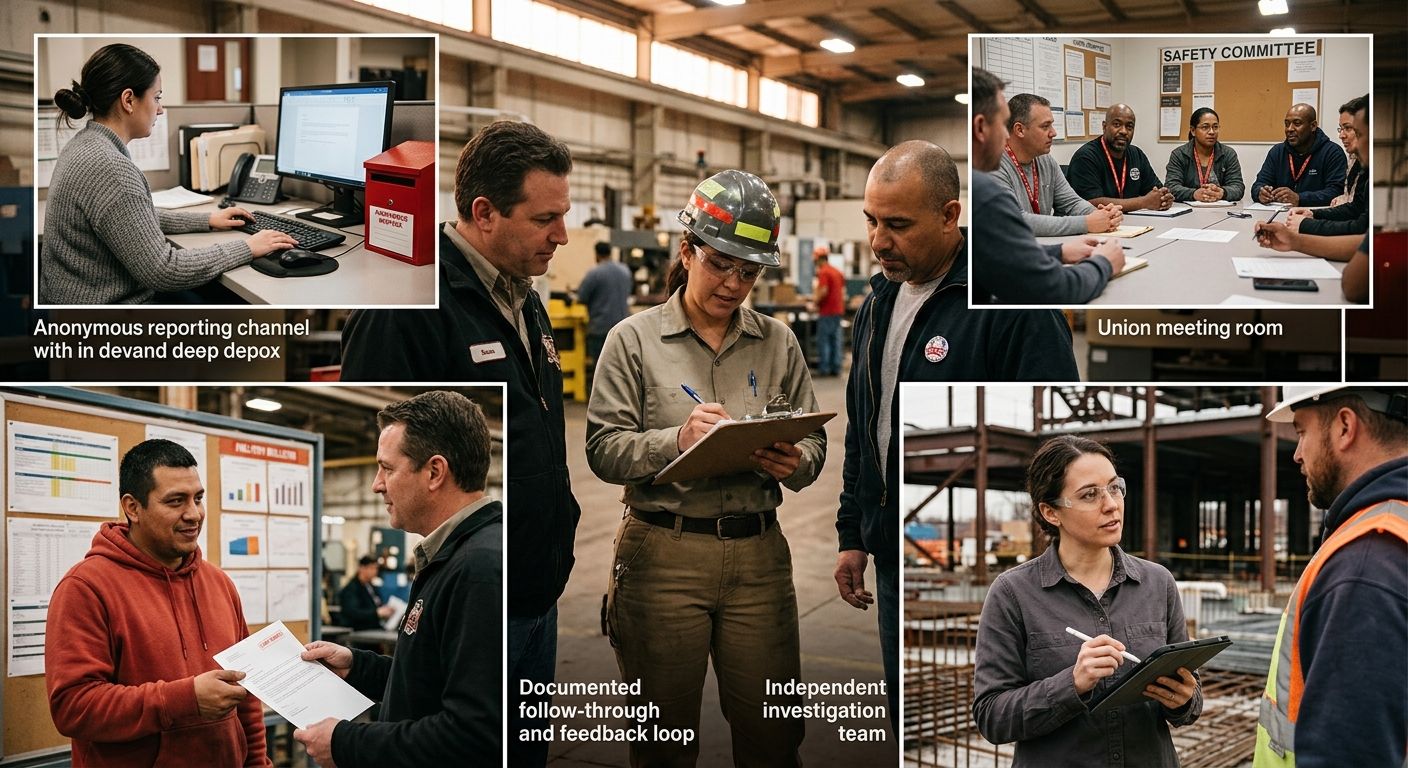
Anonymous and confidential channels that actually function. An anonymous hotline that routes complaints to the same supervisor workers are afraid of is theater, not protection. Reporting channels need to be independent of the direct management chain, with clear documentation of who receives complaints and what timeline governs the response.
Stop-work authority without managerial approval. Workers should be able to halt an unsafe operation in real time. OSHA supports this right, and unions have bargained it into contracts across heavy industry for decades. The key is whether the right exists on paper alone or whether workers can exercise it without informal retaliation.
Investigation processes focused on systems, not blame. When a hazard gets reported, the response determines whether anyone will report again. Organizations that treat incident investigation as a search for the root cause in processes and equipment create a different dynamic than organizations that treat it as a search for the worker who screwed up.
Visible follow-through. Workers in the IBE survey who doubted that reporting would lead to corrective action (35%) aren't paranoid. They've observed. The single most effective tool for encouraging future reports is demonstrating that past reports led to real changes, documented and communicated back to the workforce.
Unions play a critical role here because they can negotiate these systems into legally binding contracts, monitor compliance independently, and represent workers who face retaliation through the grievance process. Where workers are dealing with new OSHA standards for machinery safety or healthcare violence protections, collective bargaining gives the workforce a mechanism to hold management accountable for implementation.
The Cost of Silence Has a Body Count
When employees hesitate to voice concerns about potential hazards or unsafe conditions, it creates a breeding ground for accidents and incidents, as researchers at Rosenbaum Injury Firm have documented. This isn't a metaphor. Unreported near-misses become tomorrow's amputations. Unreported chemical exposures become next year's cancer diagnoses. Every worker who stays quiet because they've calculated that the personal risk of speaking up exceeds the personal risk of the hazard is making a rational choice within an irrational system.
The economic logic is stark. OSHA estimates that workplace injuries and illnesses cost employers, workers, and taxpayers billions annually. Companies that suppress reporting don't eliminate those costs; they defer and redistribute them. The worker who doesn't report a repetitive-stress injury absorbs the medical costs personally, often after the condition has progressed beyond early intervention. The company books a clean safety record. The insurer never sees the claim. And the underlying hazard persists for the next worker on that station.
OSHA compliance in a meaningful sense requires more than posting the required notices and keeping the OSHA 300 Log. It requires building an environment where the data in that log reflects reality. When 43% of workers are too afraid to report, the log is fiction.
Questions the Numbers Still Can't Answer
The IBE data is valuable because it quantifies something workers have described to organizers for years. But survey data has limits, and the numbers leave several critical questions unresolved.
First, the survey measured fear of reprisals and reported experience of retaliation, but it doesn't capture the full spectrum of informal punishment. Being excluded from overtime opportunities, getting passed over for a promotion without explanation, or receiving a suddenly critical performance review are all forms of retaliation that workers describe routinely. These are harder to document and harder to prove, and they almost certainly go underreported even in a survey designed to surface them.
Second, the data doesn't break down by industry, company size, or union status. We don't know from this survey whether unionized workers report at higher rates or face less retaliation. Anecdotally, from our own organizing work, the answer is that union presence helps, but it doesn't eliminate the problem. A grievance procedure provides a path to challenge retaliation. It doesn't prevent a supervisor from making a worker's life miserable in ways that are hard to grieve.
Third, and most importantly for labor organizers, the survey doesn't capture what happens in workplaces where workers have no formal reporting channel at all. Millions of U.S. workers in agriculture, domestic work, and informal employment fall outside OSHA's coverage or lack practical access to its protections. The 43% figure likely understates the scope of the problem across the full workforce.
What the data does tell us is clear enough. The American workplace has a reporting culture crisis, and it's driven by rational fear. Workers know what happens to people who speak up. Until the consequences of reporting are less dangerous than the consequences of staying silent, the numbers won't move. That's the structural problem unions exist to solve, and it's the reason collective bargaining over safety reporting procedures belongs at the center of every contract campaign.
The Union Edge Staff
Also in the paper