
OSHA Proposes to Eliminate Ladder Safety Retrofit Deadline After $3 Billion Industry Petition
The Occupational Safety and Health Administration issued a proposed rule in April 2026 to eliminate the November 2036 compliance deadline for ladder safety systems in response to a petition from oil, gas, and chemical industry trade groups claiming over $3 billion in retrofit costs, according to The

OSHA Proposes to Eliminate Ladder Safety Retrofit Deadline After $3 Billion Industry Petition
The Occupational Safety and Health Administration issued a proposed rule in April 2026 to eliminate the November 2036 compliance deadline for ladder safety systems in response to a petition from oil, gas, and chemical industry trade groups claiming over $3 billion in retrofit costs, according to The American Prospect. The proposal would remove the requirement that employers equip existing fixed ladders extending more than 24 feet with personal fall arrest systems or ladder safety rails by the 2036 deadline, allowing continued use of metal cages that federal and international safety research has found ineffective at preventing fall deaths.
The proposed rollback targets a provision in OSHA's 2016 Walking-Working Surfaces and Personal Protective Equipment rule that established a 20-year timeline for employers to retrofit or replace fixed ladders with fall arrest systems. The 2016 rule required all new ladders installed after the two-year phase-in period to include either ladder safety systems—rails or cables that automatically lock during a fall—or personal fall arrest systems consisting of a use, lanyard, and anchorage. The November 18, 2036 deadline applied specifically to ladders installed before the rule took effect.
Industry Groups Claim Billions in Compliance Costs
The American Chemistry Council, American Fuel & Petrochemical Manufacturers, and American Petroleum Institute submitted a joint petition in July 2025 requesting removal of the 2036 deadline. The petition claimed that ladder safety and personal fall arrest systems "have the real potential to make employees less safe" and cited compliance costs exceeding $3 billion for the petroleum refining industry alone. Dow Chemical holds membership in the American Chemistry Council, one of the three petitioning trade associations.
OSHA's April 2026 proposed rule also seeks public comment on whether to repeal or revise the requirement for newly installed ladders, leaving open the possibility that employers could continue relying exclusively on metal cages for fall protection. In its regulatory explanation, the agency determined that eliminating the deadline "is not likely to result in a meaningful increase in risk to workers."
Research Contradicts Cage Safety Claims
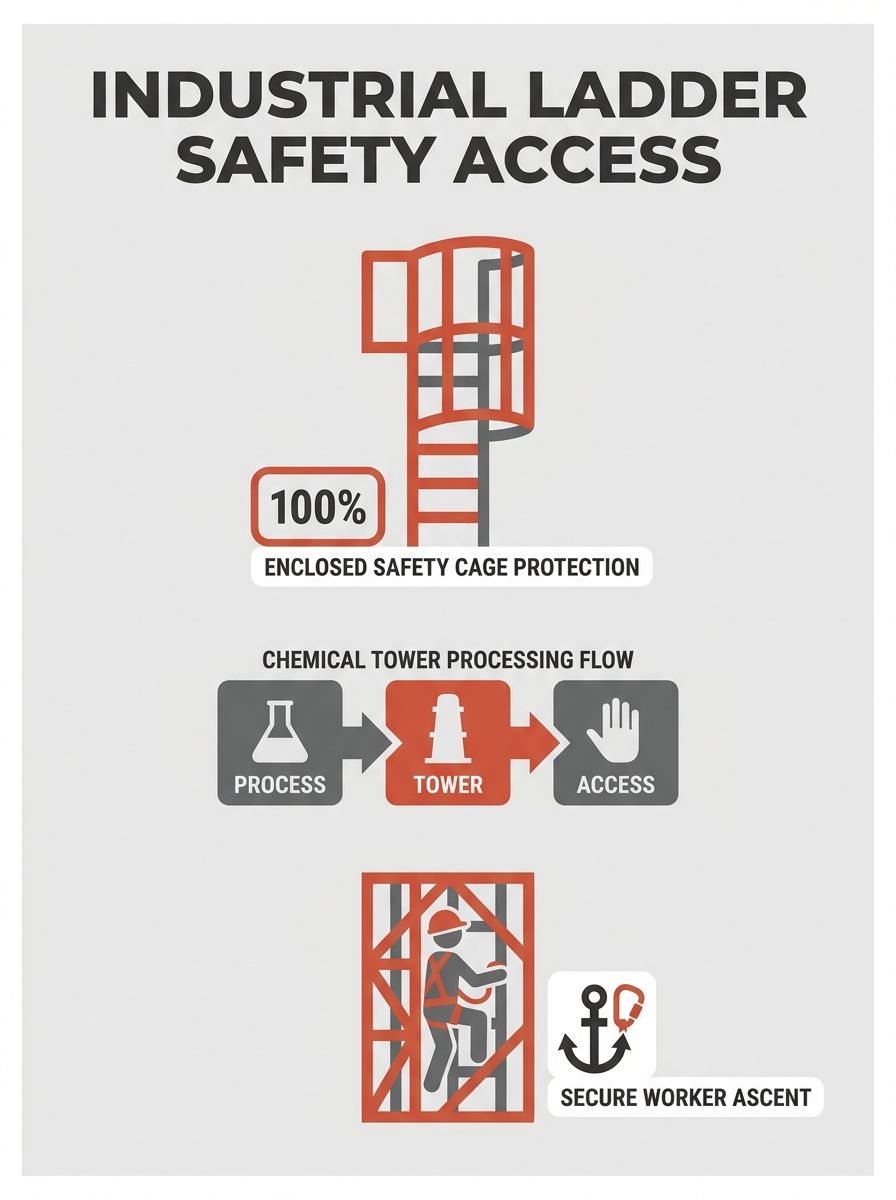
Multiple government agencies and safety organizations have concluded that metal cages surrounding fixed ladders do not prevent injury or death during falls. The United Kingdom's Health and Safety Executive found in 2004 that "caged ladders cannot provide positive fall-arrest" and that even when a cage catches a falling worker, it "can lead to significant if not fatal injury." Oregon's Department of Transportation reported that "falls in cages can be very gruesome … sometimes tearing off body parts," while the International Safety Equipment Association stated that "cages should not be used as an individual method of fall protection."
OSHA initiated its rulemaking process on enhanced ladder protections after reviewing this body of research. The agency's 2016 rule explicitly noted that traditional cage systems do not effectively arrest falls or protect workers from serious injury.
Falls remain the leading cause of death in the construction industry. The Bureau of Labor Statistics recorded 389 construction worker deaths from falls in 2024, up from an annual average of 213 fall deaths between 1992 and 2004. Nearly 80,000 lost workdays resulted from nonfatal construction falls during that earlier period, according to BLS data.
Unions and Safety Experts Oppose Rollback
Labor organizations representing workers in the affected industries submitted public comments opposing OSHA's proposed rule. "By eliminating the deadline, OSHA is effectively telling employers that an outdated cage, which offers zero fall arrest capability, is acceptable to let their employees fall to their deaths and suffer life-altering injuries," wrote the United Steelworkers in its comment to the agency. The union represents 850,000 workers, including employees at companies that belong to the petitioning trade associations.
Travis Parsons, director of occupational safety and health at the Laborers' Health and Safety Fund of North America, told The American Prospect that the proposal represents "a step backward for protecting workers from falls" and that "the administration is putting business interests in front of worker safety."
The proposed rollback comes fifteen years after United Steelworkers member David Roy died at a Dow Chemical plant in Midland, Michigan. Roy, a 47-year-old father of two, suffered a heart attack while on a caged ladder on a distillation column on April 14, 2011. He fell backwards approximately 30 feet and died from a combination of the heart attack and blunt force trauma. Following his death, Dow released a statement calling the accident a reminder of "how fragile life is."
What This Means for Union Members
The proposed regulatory rollback directly affects unionized workers in construction, chemical manufacturing, petroleum refining, and other industries that rely on fixed ladders for routine operations. Members working at facilities with pre-2018 ladder installations face continued exposure to cage-only systems that safety research has identified as inadequate fall protection. The 2036 deadline removal eliminates the timeline that would have required employers to upgrade these systems, potentially extending the use of outdated equipment for decades beyond the original compliance date.
Union locals should review current ladder safety provisions in collective bargaining agreements and consider bargaining for fall protection standards that exceed minimum regulatory requirements. Workers at facilities where employers cite the OSHA proposal as justification for delaying ladder safety upgrades can file grievances challenging the adequacy of existing fall protection measures under general duty clause obligations. Organizations like the United Steelworkers and LIUNA have established comment periods and advocacy channels for members seeking to oppose the final rule adoption before OSHA completes its rulemaking process.
The regulatory shift also affects workplace safety enforcement priorities across industries where fall hazards rank among leading injury causes. Members serving on joint labor-management safety committees can reference the extensive body of research contradicting cage efficacy when negotiating facility-specific ladder safety protocols independent of federal regulatory minimums.
The Union Edge Staff
Related Articles

Six OSHA Inspectors Oversee 60,000 West Virginia Workplaces After Fatal Chemical Plant Incident
Federal workplace safety enforcement in West Virginia relies on six inspectors to oversee 60,000 workplaces, according to the WV Gazette-Mail, a staffing shortage that came into focus after two workers died in April 2026 at a chemical facility that had not been inspected in eight years despite prior

Workplace Safety Failures Kill 30 Workers Across Three Countries in Four-Day Span
At least 30 workers died in workplace accidents across Greece, China, and the United States between July 9 and July 12, 2026, prompting regulators to impose safety penalties exceeding half a million dollars and order operational shutdowns at facilities in three countries, according to enforcement fi

Essential Workplace Safety: 10 Topics Every Business Needs
Fall protection has topped OSHA's most-cited violations list for over a decade, and the same ten health and safety topics in the workplace appear in the agency's enforcement data year after year, accounting for the bulk of preventable worker injuries and deaths across American industries.
Also in the paper