
Minimum Wage in Florida: 2024 Rate Changes
Before 2004, Florida had no state minimum wage at all. Voters fixed that twice through constitutional amendments, the second of which created a fixed $1.00-per-year escalator that brought the minimum wage in Florida to $13.00 per hour on September 30, 2024, with a $15.

Minimum Wage in Florida: How the 2024 Rate Change Works
Before 2004, Florida had no state minimum wage at all. Voters fixed that twice through constitutional amendments, the second of which created a fixed $1.00-per-year escalator that brought the minimum wage in Florida to $13.00 per hour on September 30, 2024, with a $15.00 ceiling set for September 2026.
How Florida's Constitutional Wage Floor Came to Exist
Florida was one of seven states without any state minimum wage before 2004, according to researchers at Rutgers University and Northwestern University who studied the state's wage enforcement history. Workers earning the minimum in Florida relied entirely on the federal floor, which at the time sat at $5.15 per hour. The state legislature showed no interest in changing that.
In 2004, Florida voters passed a ballot initiative that did something unusual: it wrote a minimum wage directly into the state constitution, Article X, Section 24. The amendment passed with roughly 71% support, a margin that made legislative repeal essentially impossible. The initial rate was $6.15 per hour, $1.00 above the federal minimum at the time, with annual adjustments pegged to inflation.
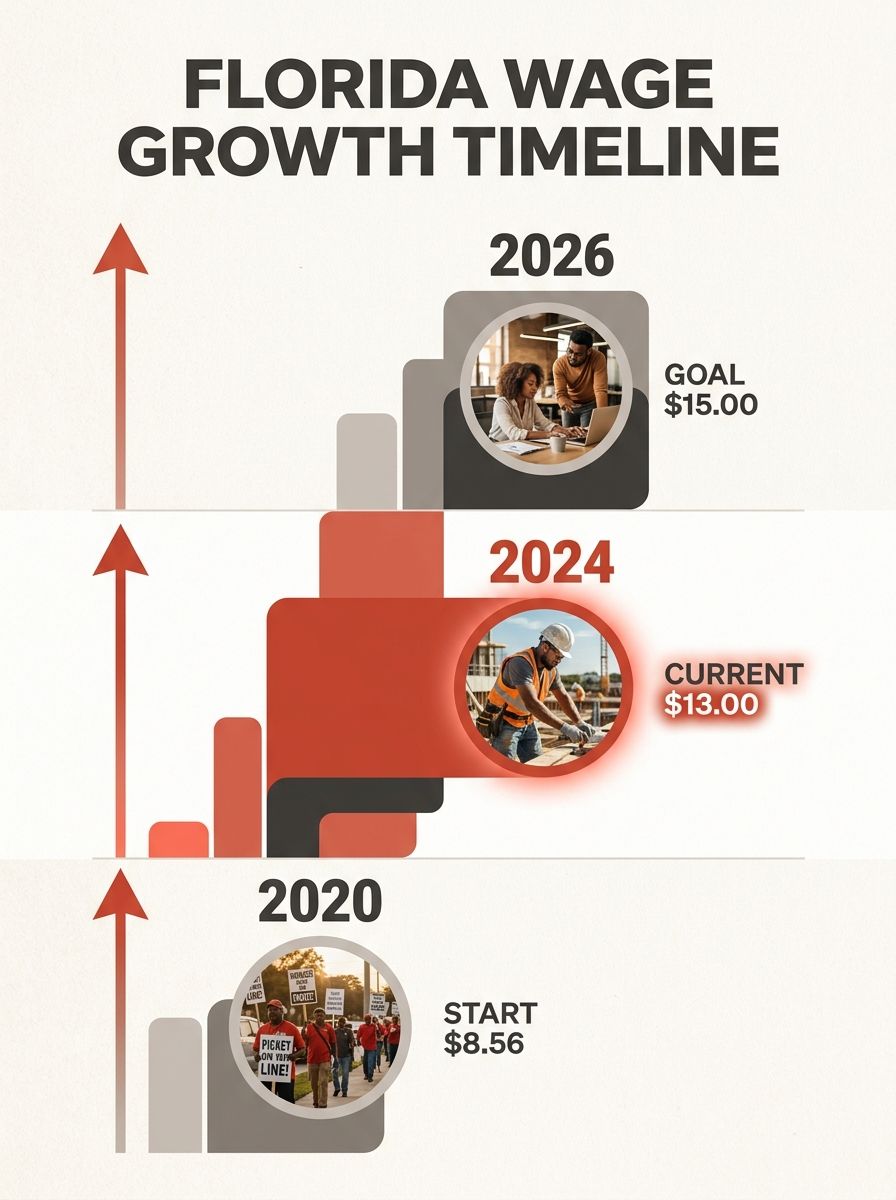
But the inflation-only formula moved slowly. By 2020, Florida's minimum wage had crawled to just $8.56 per hour. So voters acted again. On November 3, 2020, over 6 million Floridians approved Amendment 2, which replaced the gradual inflation adjustment with an aggressive fixed schedule: $1.00 increases every September 30, starting at $10.00 in 2021 and ending at $15.00 in 2026.
The constitutional route matters because it strips the wage floor out of the normal legislative process. Florida's legislature can't lower it, can't delay the increases, and can't add new exemptions without a separate constitutional amendment requiring 60% voter approval. For workers in a state with no collective bargaining rights for private-sector employees, that constitutional lock is one of the few structural protections available.
The $1-Per-Year Escalator, Step by Step
The mechanics of Amendment 2 are deliberately simple. Each September 30 triggers a $1.00 increase, with no discretion involved from any state agency or official. The Florida Department of Economic Opportunity publishes the updated rate, but it has no authority to modify the schedule.
Here's the complete escalator timeline:
Effective Date | Hourly Rate | Tipped Employee Cash Wage |
|---|---|---|
September 30, 2021 | $10.00 | $6.98 |
September 30, 2022 | $11.00 | $7.98 |
September 30, 2023 | $12.00 | $8.98 |
September 30, 2024 | $13.00 | $9.98 |
September 30, 2025 | $14.00 | $10.98 |
September 30, 2026 | $15.00 | $11.98 |
The 2024 increase from $12.00 to $13.00 represented a 8.3% raise for any worker earning exactly the minimum. Before Amendment 2 took effect, the minimum wage of Florida was $8.56, meaning the 2024 rate reflects a cumulative 51.9% increase over four years. By comparison, the federal minimum wage has remained at $7.25 per hour since 2009, making the Florida rate $5.75 higher than the national floor.
The fixed $1.00-per-year structure was a deliberate design choice by the amendment's authors. Variable increases tied to economic indicators are harder for workers and small businesses to plan around. A predictable annual jump of $1.00 gave employers 6 years of advance notice on every future payroll cost. Every restaurant, hotel chain, and landscaping company in the state knew exactly what their labor floor would be through 2026.
For context on how other states handle similar escalators, the minimum wage framework in New York uses a geographic tier system with different rates for New York City versus the rest of the state. Florida's approach is statewide and uniform, which brings its own tradeoffs.
How the Tipped Wage Credit Works
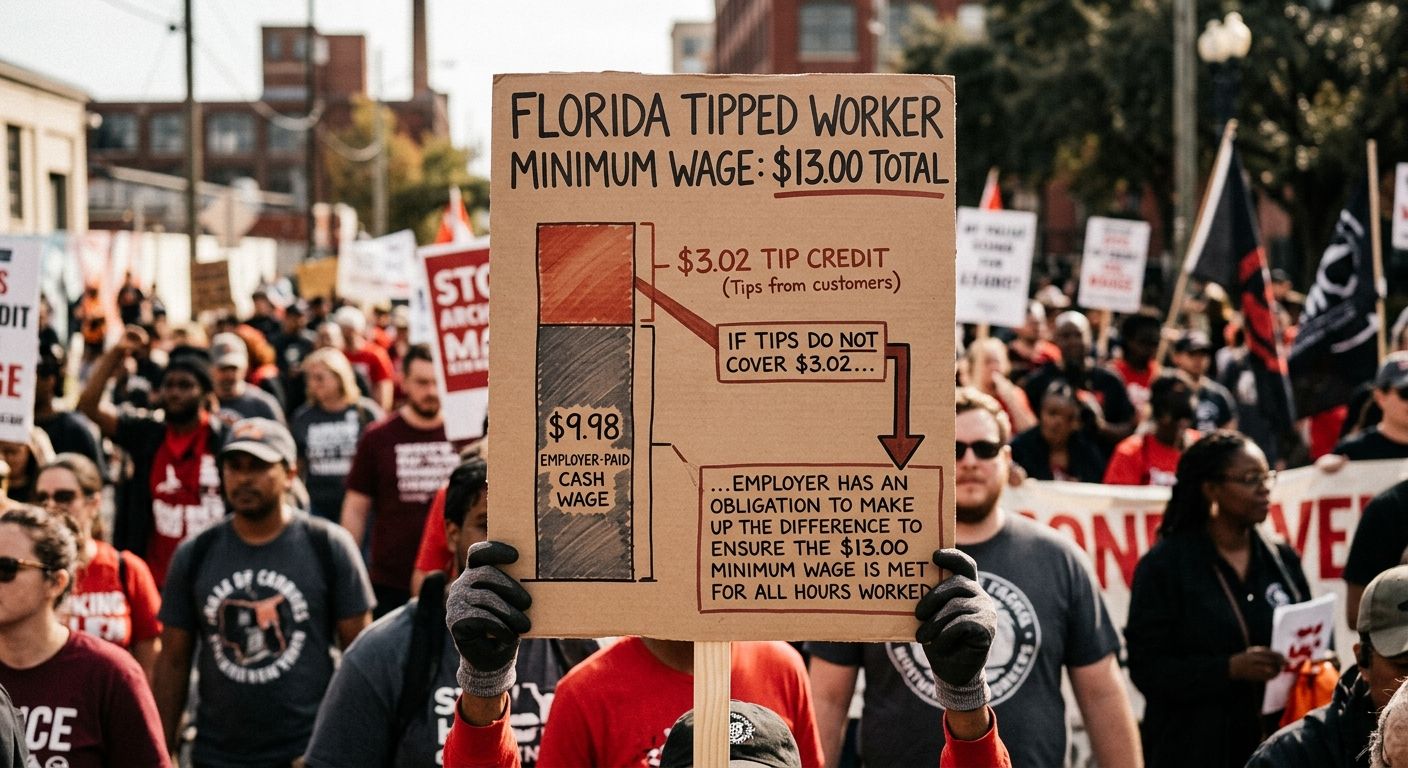
The tipped employee cash wage is the piece of Florida's minimum wage structure that generates the most confusion and the most wage theft complaints. Under Amendment 2, employers of tipped workers can claim a tip credit of up to $3.02 per hour. That means the employer's direct cash obligation in 2024 was $9.98 per hour, with tips expected to cover the remaining $3.02 to reach the $13.00 minimum.
The $3.02 credit stays constant as the base wage rises each year. So the tipped cash wage climbs in lockstep: $9.98 in 2024, $10.98 in 2025, $11.98 in 2026.
The enforcement challenge here is real. Workers in tipped occupations often don't track their hourly tip income precisely, and employers sometimes rely on averaged weekly totals that obscure slow shifts where tips didn't reach the credit threshold. A 2022 study published in the University of Florida Journal of Law & Public Policy by researchers Alexis Tsoukalas, Jenn Round, Janice Fine, and Daniel Galvin documented persistent enforcement gaps in Florida's minimum wage protections, noting that the constitutional amendment's passage didn't automatically create effective compliance monitoring.
The CPI-W Indexing Mechanism After $15.00
The escalator ends on September 30, 2026, when the minimum Florida wage hits $15.00 per hour. After that, a different mechanism takes over. Starting in 2027, annual adjustments will be calculated using the Consumer Price Index for Urban Wage Earners and Clerical Workers, commonly called CPI-W.
CPI-W tracks price changes in a basket of goods and services purchased by households where at least half of income comes from clerical or hourly wage jobs. The Bureau of Labor Statistics publishes the index monthly, and the Florida Department of Economic Opportunity will use the annual change to calculate each September 30 adjustment.
This is the same inflation-indexing formula that governed Florida's minimum wage between 2004 and 2020, before Amendment 2 replaced it with fixed $1.00 increases. Under that earlier regime, the rate moved slowly because consumer inflation was low for most of that period. The minimum wage grew from $6.15 in 2005 to just $8.56 by 2020, an increase of $2.41 over 15 years. That averages out to about $0.16 per year.
The obvious risk: if inflation stays low after 2026, CPI-W indexing will produce similarly modest annual increases, and the purchasing power of $15.00 will erode in real terms. If inflation runs high, the adjustments will be larger, but they'll always lag behind price increases by several months because of the calculation timeline. For workers and organizers tracking Florida's minimum wage rates and requirements, understanding this shift from fixed increases to inflation-pegged adjustments is critical for long-term planning.
Preemption and Who's Left Out
Florida's minimum wage applies uniformly across all 67 counties. State law preempts local minimum wage ordinances, meaning no city or county can set a rate higher than the statewide floor. Miami-Dade County, where the cost of living runs significantly above the state average, pays the same minimum as rural counties in the Panhandle where housing costs a fraction of the price.
This preemption is a significant limitation for workers in high-cost metro areas. A $13.00 hourly wage in 2024 produced gross annual earnings of roughly $27,040 for a full-time worker, before taxes. In Miami, where the median rent for a one-bedroom apartment exceeded $2,200 per month in 2024, that annual income left little margin after housing.
Several categories of workers fall outside Florida's minimum wage protections entirely. Federal exemptions under the FLSA apply, including certain full-time students who can be paid 85% of the minimum wage with proper certification, and workers in bona fide executive, administrative, or professional roles who meet salary thresholds. Independent contractors, a growing category in Florida's gig economy, receive no minimum wage protections at all.
For workers trying to understand where Florida's rate sits relative to other states, the minimum wage structure in New York City offers a useful comparison point: NYC's $16.00 per hour rate in 2024 exceeded Florida's by $3.00, but New York permits local variation while Florida does not.

Where the Mechanism Breaks
The constitutional escalator solved one problem and created others. It guaranteed wage increases that the legislature would never have passed voluntarily, but it left three structural weaknesses intact.
Enforcement remains underfunded. Florida has no state-level agency dedicated to minimum wage enforcement. The Tsoukalas, Round, Fine, and Galvin study characterized enforcement as "the unfinished business" of the constitutional amendment, documenting how the gap between the law's promise and workers' actual paychecks persists because of inadequate compliance infrastructure. Workers who experience violations must file complaints with the federal Department of Labor or pursue private lawsuits, both of which require time and resources that minimum-wage workers often lack. Organizers working to address wage theft and other workplace violations know this gap well.
The $3.02 tip credit is fixed, not indexed. While the cash wage for tipped workers rises each year, the tip credit amount doesn't shrink proportionally. And the entire tip credit structure assumes that service workers reliably earn enough in tips to clear the full minimum. In practice, back-of-house workers at restaurants, hotel housekeepers misclassified as tipped employees, and other workers in low-tip environments can fall through the cracks.
Preemption prevents local adaptation. The statewide uniformity that makes the escalator simple also makes it blunt. A $15.00 floor in 2026 will represent a meaningful raise in Ocala but will trail far behind the cost of living in Southeast Florida. Without the ability to set local rates, workers in expensive markets have no legislative avenue for higher floors. The constitutional amendment that protected the wage floor from downward legislative pressure simultaneously blocked upward local pressure.
The mechanism worked as designed: it delivered six consecutive annual raises to Florida's lowest-paid workers through a channel that couldn't be blocked by lobbying or legislative inaction. But the design carries tradeoffs that will become more visible once the fixed increases end and CPI-W indexing takes over in 2027, particularly if inflation moderates and annual adjustments shrink back toward the $0.16-per-year average that characterized the pre-Amendment 2 era.
Common Questions
Does the minimum wage in Florida vary by city or county?
No. Florida state law preempts local minimum wage ordinances. The $13.00 rate (as of September 30, 2024) applies identically across all 67 counties. No municipality can set a higher or lower rate.
What happens to the minimum wage after it reaches $15.00 in 2026?
Starting in 2027, annual adjustments will be based on the Consumer Price Index for Urban Wage Earners and Clerical Workers (CPI-W), calculated and published by the Bureau of Labor Statistics. The era of fixed $1.00 annual increases ends when the $15.00 rate takes effect on September 30, 2026.
How does Florida's tipped minimum wage work?
Employers of tipped employees can claim a tip credit of $3.02 per hour. In 2024, the employer's direct cash wage obligation was $9.98 per hour. If an employee's tips plus the $9.98 cash wage don't reach $13.00 in a pay period, the employer is legally required to cover the shortfall. The complete guide to Florida's wage requirements breaks down additional details.
Can the Florida legislature change or repeal the minimum wage increases?
The minimum wage is embedded in the Florida Constitution through Amendment 2. Changing it requires a new constitutional amendment, which must be placed on the ballot and approved by at least 60% of voters. The legislature has no unilateral power to alter, delay, or repeal the scheduled increases.
How does Florida's minimum wage compare to the federal rate?
The federal minimum wage has been $7.25 per hour since July 2009. Florida's 2024 rate of $13.00 exceeded the federal floor by $5.75. Florida employers must pay the higher state rate for all covered employees.
The Union Edge Staff
Frequently Asked Questions
- What is the Florida minimum wage in 2024?
- Florida's minimum wage increased to $13.00 per hour on September 30, 2024, marking the fourth of six annual $1.00 increases mandated by Amendment 2. This rate applies uniformly across all 67 counties in the state.
- When will Florida's minimum wage reach $15 per hour?
- Florida's minimum wage will reach $15.00 per hour on September 30, 2026, completing the six-year escalator schedule established by Amendment 2. After that date, annual adjustments will be based on the Consumer Price Index for Urban Wage Earners (CPI-W).
- What is the tipped employee minimum wage in Florida?
- In 2024, employers can pay tipped employees a cash wage of $9.98 per hour and claim a $3.02 tip credit. If the employee's tips plus the $9.98 cash wage don't reach $13.00 in a pay period, the employer must legally make up the difference.
- Can Florida cities or counties set their own minimum wage higher than the state rate?
- No. Florida state law preempts local minimum wage ordinances, so no city or county can set a minimum wage higher than the statewide floor. The same $13.00 rate applies uniformly across all counties.
- How much higher is Florida's minimum wage than the federal minimum?
- Florida's 2024 minimum wage of $13.00 per hour exceeds the federal minimum wage of $7.25 per hour by $5.75. The federal rate has remained at $7.25 since 2009.
- Can the Florida legislature change the minimum wage increases?
- No. The minimum wage is embedded in the Florida Constitution through Amendment 2, and changing it requires a new constitutional amendment approved by at least 60% of voters. The legislature cannot unilaterally alter, delay, or repeal the scheduled increases.
- What happens to Florida's minimum wage after it reaches $15 in 2026?
- Starting in 2027, annual adjustments will be based on the Consumer Price Index for Urban Wage Earners and Clerical Workers (CPI-W), rather than fixed $1.00 increases. These adjustments will be calculated and published by the Bureau of Labor Statistics.
Related Articles

What Is the State of Florida Minimum Wage
Amendment 2, ratified by Florida voters in November 2020, embedded a minimum wage escalator directly into Article X of the state constitution, removing the rate from legislative control entirely. The current floor is $14.00 per hour for non-tipped workers and $10.

Minimum Wage at Florida: 2024 Guide & Updates
Amendment 2 to Florida's constitution, approved by voters on November 3, 2020, hardwired a $1.00-per-year minimum wage escalator into state law that bypasses the legislature entirely. That mechanism set the minimum wage in Florida at $13.

What is the Minimum Wage in Florida
Unlike most state wage floors, which legislatures can freeze or repeal at will, Florida's minimum wage is locked into the state constitution. The current rate is $14.00 per hour, climbing to $15.
Also in the paper