
Minimum Wage in NYC: 2024 Rates & Requirements
Section 652 of New York's Labor Law sets the minimum wage in NYC at $16.00 per hour as of January 1, 2024. That headline number hides a tiered system of tip credits, industry-specific floors, and geographic zones that can reduce a worker's guaranteed cash wage to $10.

Minimum Wage in NYC: 2024 Rates, Requirements, and How the System Actually Works
Section 652 of New York's Labor Law sets the minimum wage in NYC at $16.00 per hour as of January 1, 2024. That headline number hides a tiered system of tip credits, industry-specific floors, and geographic zones that can reduce a worker's guaranteed cash wage to $10.65 per hour or push it above $18.00, depending on the job.
What Section 652 of the Labor Law Actually Says
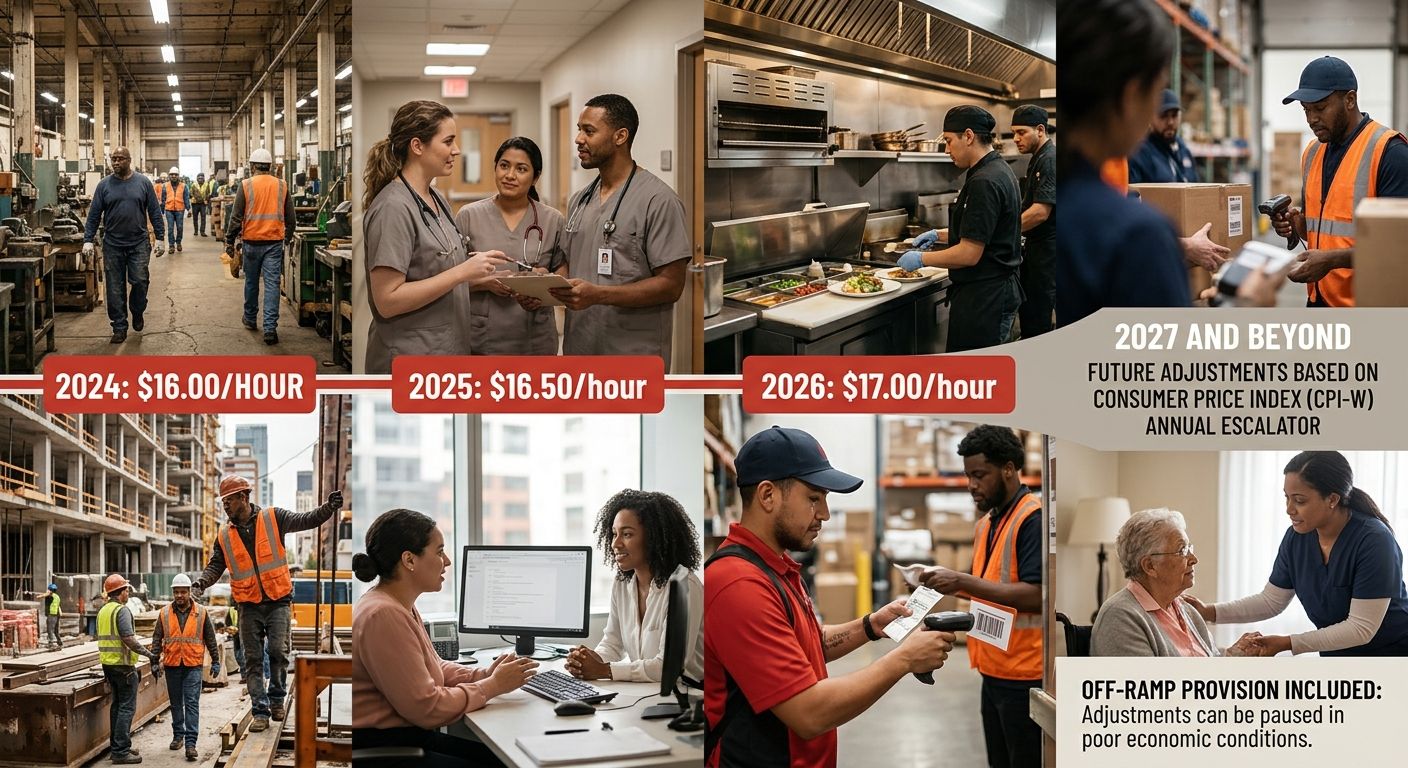
New York's Labor Law Section 652 is the controlling statute. It requires every employer, regardless of size, to pay each employee for each hour worked in New York City a wage of not less than $16.00 on and after January 1, 2024, $16.50 on and after January 1, 2025, and $17.00 on and after January 1, 2026. The language is blunt and leaves no discretion to employers about company size thresholds. Previous versions of New York's wage law created separate schedules for businesses with 10 or fewer employees versus those with 11 or more. That distinction ended when rates converged in 2019. Today, the law treats every NYC employer identically on the base rate.
The statute also establishes that the New York State Department of Labor (NYSDOL) administers enforcement. Workers who believe their employer is paying below the statutory floor file complaints with NYSDOL, not with the city. This centralized enforcement structure matters: it means the same agency handling complaints in Buffalo handles complaints in the Bronx, with the same investigators, the same backlog, and the same resource constraints. For a broader look at how these rates fit into the statewide picture, we've covered the full New York minimum wage structure in a separate breakdown.
The Geographic Zone System
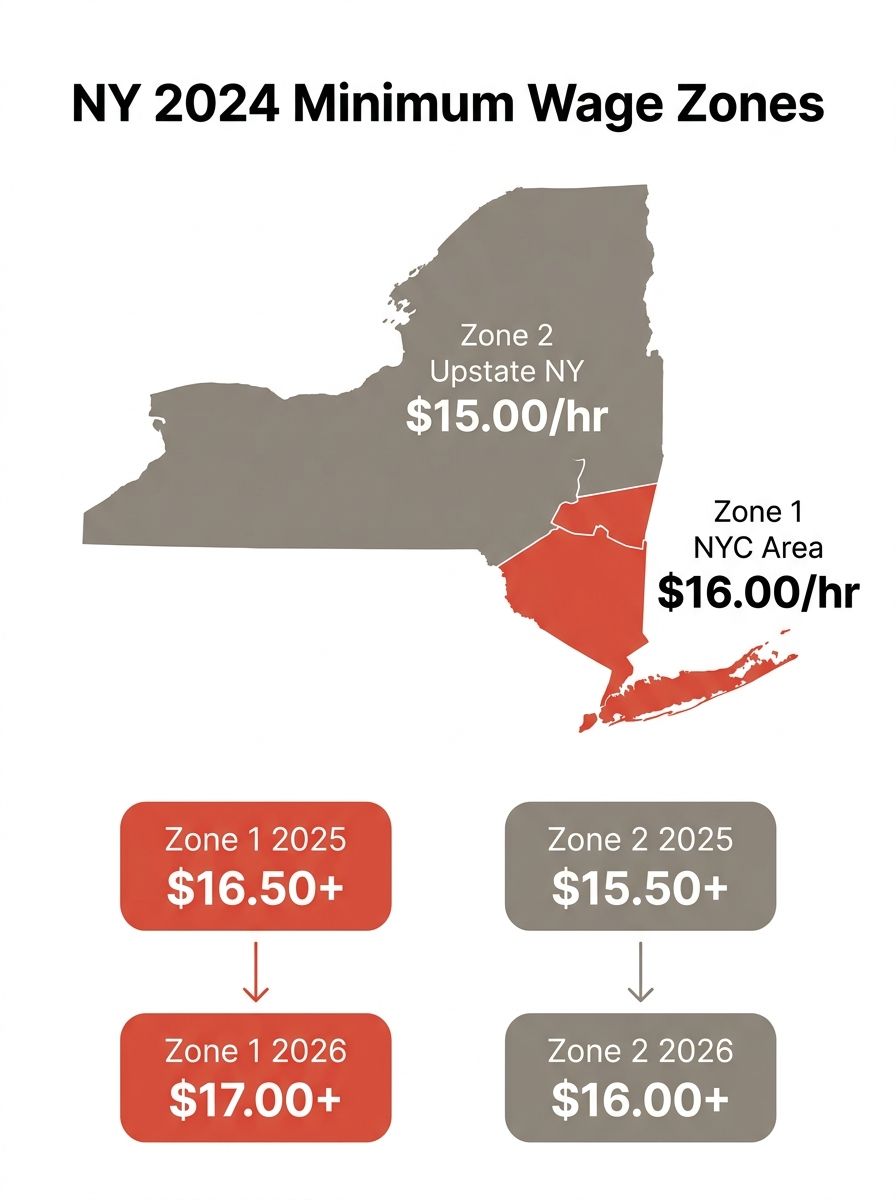
New York's minimum wage operates on a two-tier geographic map. Zone one covers New York City, Long Island (Nassau and Suffolk counties), and Westchester County. Zone two covers every other county in the state. As of January 1, 2024, zone one pays $16.00 per hour and zone two pays $15.00 per hour.
Governor Kathy Hochul's FY 2024 budget agreement locked in this tiered structure with scheduled annual increases through 2026. The increases are fixed dollar amounts, not percentages: $0.50 per year in both zones. That means the gap between zones stays constant at $1.00 per hour through the entire escalator period.
Year | NYC / Long Island / Westchester | Rest of New York State |
|---|---|---|
2024 | $16.00/hr | $15.00/hr |
2025 | $16.50/hr | $15.50/hr |
2026 | $17.00/hr | $16.00/hr |
2027+ | CPI-W indexed | CPI-W indexed |
The geographic split creates real consequences at county borders. A fast-food worker in White Plains (Westchester) earns $16.00 per hour in 2024. Drive 15 minutes north to Putnam County, and the same chain pays $15.00. Workers who commute across zone lines sometimes discover their pay rate depends on which location they're assigned to on a given shift, and multi-location employers have been cited for applying the wrong zone's rate.
Tip Credits and the Cash Wage Floor
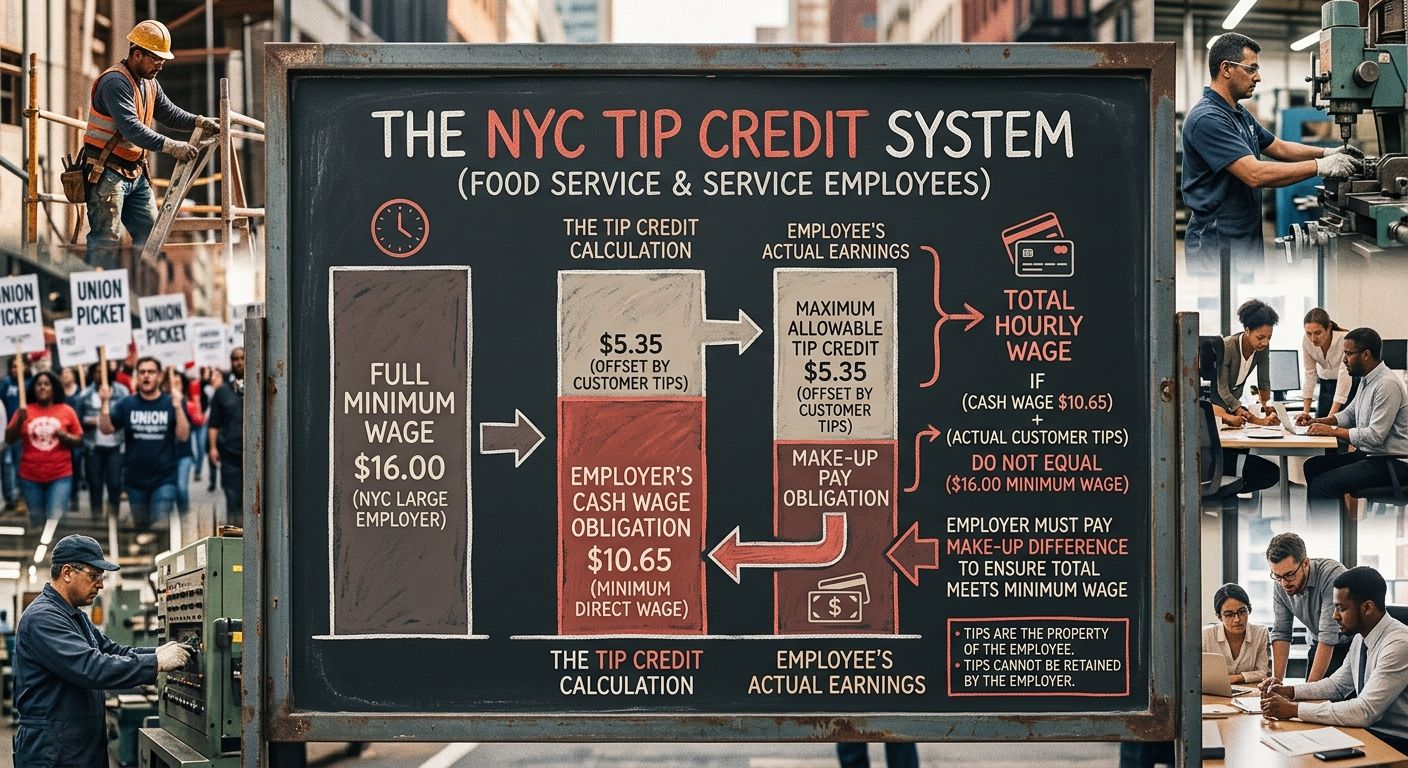
The tip credit mechanism is where the minimum wage in NYC gets complicated and where wage theft becomes most common. Employers in tipped industries don't have to pay the full $16.00 in cash wages. Instead, they pay a lower cash wage and claim a "tip credit" for the difference, arguing that the worker's tips make up the gap.
As of January 1, 2024, tipped service employees in NYC receive a cash wage of $10.65 per hour with a $5.35 tip credit. For food service workers specifically, the NYC Bar Association reports a slightly different split: $13.35 per hour in cash wages plus a $2.65 tip credit, applicable when the weekly average of hourly tips reaches at least $3.45. These different tip credit tiers depend on the worker's specific classification under NYSDOL's wage orders.
The enforcement gap is significant. Tipped workers often don't know they're entitled to make-up pay when tips fall short, and employers rarely volunteer the information. A 2023 analysis by the NYC Comptroller's Office found that the minimum wage's real purchasing power had dropped below $13.00 when adjusted to 2019 dollars, meaning even workers receiving the full statutory rate were losing ground to inflation. For tipped workers receiving only the cash wage floor of $10.65, the erosion is far worse.
Industry-Specific Floors for Fast Food and Home Care
Two industries operate under their own minimum wage rules in New York, and both pay above the general floor.
Fast food workers in NYC are covered by 12 NYCRR § 146-3.13, which defines a "Fast Food Establishment" as any business that is part of a chain with 30 or more locations nationally, requires customers to pay before eating, and offers limited or no table service. Workers at these establishments earn the statewide fast food minimum, which has already reached parity with the general NYC rate. The classification matters because it pulls workers at franchise locations into a higher wage tier than they'd receive at independent restaurants in upstate counties.
Home care aides in NYC and the surrounding downstate counties earn $18.55 per hour as of 2024. Upstate home care workers earn $17.55 per hour. These rates reflect legislative recognition that home care work involves physical demands, irregular hours, and direct patient responsibility that the general minimum wage doesn't adequately compensate. The home care differential also intersects with Medicaid reimbursement rates, creating tension between what the law requires employers to pay and what government payers are willing to fund.
These industry-specific floors show how the minimum wage in NYC functions as a set of overlapping regulatory layers rather than a single number. A worker's actual rate depends on employer type, chain affiliation, and service classification. Our detailed breakdown of NYC minimum wage changes covers how these categories have shifted over time.
How the CPI-W Indexing Mechanism Works After 2026
Beginning in 2027, New York's minimum wage transitions from fixed-dollar increases to automatic inflation adjustments. The formula uses a three-year moving average of the Consumer Price Index for Urban Wage Earners and Clerical Workers (CPI-W) for the Northeast Region, published by the Bureau of Labor Statistics.
The three-year average smooths out single-year spikes. If the CPI-W jumps 6% in one year but averages 3.2% over three years, the wage increase reflects 3.2%, not 6%. This design choice protects employers from sharp cost increases but also means workers experience a delayed response when inflation surges, exactly the scenario that played out during 2021-2023 when prices rose faster than wages for nearly two consecutive years.
The law includes an "off-ramp" provision: if the state experiences certain adverse economic or budget conditions, the scheduled CPI-W increase can be suspended. The specific triggers haven't been publicly tested yet, but the provision gives future governors and legislatures a mechanism to pause increases during recessions without repealing the indexing law itself. Workers and unions should watch this provision carefully. The Florida minimum wage system offers a cautionary comparison: constitutional protections there locked in annual increases, but the absence of an off-ramp created different political dynamics around enforcement and compliance.
Where the Wage Floor Breaks Down
The minimum wage system in NYC fails workers in three specific situations.
Misclassification as independent contractors. Employers who classify workers as 1099 independent contractors instead of W-2 employees sidestep the minimum wage entirely. Gig workers, delivery drivers, and freelance service providers fall outside Section 652's protections unless they can establish an employment relationship under New York's ABC test. Legislative proposals like the Raise Up NY bill, which sought to accelerate the minimum wage to $21.25 by 2026, also failed to address the classification gap. The rate on paper doesn't matter if workers can't access it.
Wage theft through off-the-clock work. Even at $16.00 per hour, the effective rate drops below minimum wage when employers require pre-shift setup, post-shift cleanup, or mandatory meetings without recording those hours. The Economic Policy Institute estimated that minimum wage violations cost U.S. workers billions annually, and low-wage workers in NYC's restaurant, retail, and construction sectors remain the most frequent targets. Knowing how to recognize and counter employer retaliation during organizing campaigns is directly relevant here, because workers who raise wage complaints face the same intimidation tactics as workers who push for union representation.
The purchasing power erosion problem. A $16.00 minimum wage in a city where median rent for a one-bedroom apartment exceeds $3,500 per month leaves a full-time worker spending more than 50% of gross income on housing alone. The NYC Comptroller's finding that real minimum wage value dropped below $13.00 in 2023 dollars illustrates the structural mismatch: the wage floor rises in nominal terms while the cost of living in New York City rises faster.
Common Questions
Does the $16.00 minimum wage apply to all workers in NYC?
The $16.00 rate applies to all W-2 employees working in New York City regardless of employer size, effective January 1, 2024. Independent contractors, certain student workers, and workers covered by industry-specific orders (fast food, home care) operate under different rates. Tipped workers receive a lower cash wage combined with a tip credit that must total at least $16.00.
What happens if my tips don't reach the minimum wage?
Your employer is legally required to pay the difference. If your cash wage of $10.65 plus your tips for the week average less than $16.00 per hour, the employer must make up the shortfall. Track your tips weekly and compare your total hourly compensation against the minimum. File a complaint with the NYSDOL if you find consistent gaps.
When does the minimum wage in NYC increase next?
The rate rose to $16.50 on January 1, 2025, and will rise to $17.00 on January 1, 2026. Starting January 1, 2027, increases shift to an automatic formula based on the three-year moving average of the CPI-W for the Northeast Region.
Do fast food workers earn a different minimum wage?
Fast food workers in NYC are covered by the general minimum wage rate of $16.00 in 2024. The fast food minimum wage, which previously operated on a separate and faster escalator, has converged with the general rate. The key distinction now is the industry classification: workers at chains with 30 or more national locations fall under specific fast food worker protections defined in 12 NYCRR § 146-3.13.
Can my employer reduce my hours to offset the minimum wage increase?
Employers can adjust scheduling, but they cannot pay below the statutory minimum for any hour worked. Reducing hours is legal; reducing the hourly rate below $16.00 is not. If you notice schedule cuts that coincide suspiciously with wage increases, document the pattern and consult with NYSDOL or a workers' rights organization.
The Union Edge Staff
Frequently Asked Questions
- What is the NYC minimum wage in 2024?
- The NYC minimum wage is $16.00 per hour as of January 1, 2024, set by Section 652 of New York's Labor Law. This rate applies to all W-2 employees working in New York City regardless of employer size.
- What is the cash wage for tipped workers in NYC?
- Tipped service employees in NYC receive a cash wage of $10.65 per hour with a $5.35 tip credit as of January 1, 2024. If tips don't bring the total to $16.00 per hour, the employer is legally required to pay the difference.
- When will NYC minimum wage increase to $17.00?
- NYC minimum wage will increase to $17.00 per hour on January 1, 2026. After 2026, increases will shift to automatic adjustments based on a three-year moving average of the CPI-W for the Northeast Region.
- What is the minimum wage for home care aides in NYC?
- Home care aides in NYC and surrounding downstate counties earn $18.55 per hour as of 2024, which is higher than the general minimum wage due to the physical demands and direct patient responsibility of the work.
- Does the minimum wage differ by county in New York?
- Yes, New York operates a two-tier geographic system. Zone one (NYC, Long Island, and Westchester) has a $16.00 minimum in 2024, while zone two (all other counties) has a $15.00 minimum, with a $1.00 gap maintained through 2026.
- What should I do if my tips don't add up to minimum wage?
- Track your tips weekly and calculate your total hourly compensation. If it falls below $16.00 per hour, your employer must pay the difference. File a wage claim with the New York State Department of Labor if you find consistent gaps.
- Are independent contractors covered by NYC minimum wage?
- No, independent contractors classified as 1099 workers fall outside the minimum wage protections of Section 652. Only workers classified as W-2 employees are covered by the minimum wage law.
Related Articles

New York State Minimum Wage: 2024 Rates & Requirements
The new york state minimum wage is a two-zone geographic system where workers in New York City, Long Island, and Westchester earn one hourly floor, and workers everywhere else in the state earn a lower one. As of January 1, 2024, those floors sat at $16.00 and $15.

New York City Minimum Wage: 2024 Updates & What Changed
New York City's minimum wage is the legal hourly floor every employer in the five boroughs must pay, and on January 1, 2024, it climbed from $15.00 to $16.00 per hour. That dollar increase was the first move in a three-year legislated schedule that reaches $17.

Minimum Wage New York: 2024 Update
New York's minimum wage operates through a geographic tier system that pays workers in New York City, Long Island, and Westchester a different hourly rate than workers in the rest of the state. The 2024 update set those tiers at $16.00 and $15.
Also in the paper