
Essential Workplace Safety: 10 Topics Every Business Needs
Fall protection has topped OSHA's most-cited violations list for over a decade, and the same ten health and safety topics in the workplace appear in the agency's enforcement data year after year, accounting for the bulk of preventable worker injuries and deaths across American industries.

Essential Workplace Safety: 10 Topics Every Business Needs
Fall protection has topped OSHA's most-cited violations list for over a decade, and the same ten health and safety topics in the workplace appear in the agency's enforcement data year after year, accounting for the bulk of preventable worker injuries and deaths across American industries.
That repetition tells you something important. Employers aren't failing on obscure regulations. They're failing on the basics, on the same handful of hazards that OSHA's Recommended Practices identify as core to any functioning safety program. The agency outlines seven elements of an effective safety and health program, and when businesses skip them, workers absorb the consequences in broken bones, chemical burns, amputations, and funerals.
What follows is a breakdown of each topic, grounded in OSHA standards and enforcement data, written from the perspective of the people these rules are supposed to protect.
Fall Protection
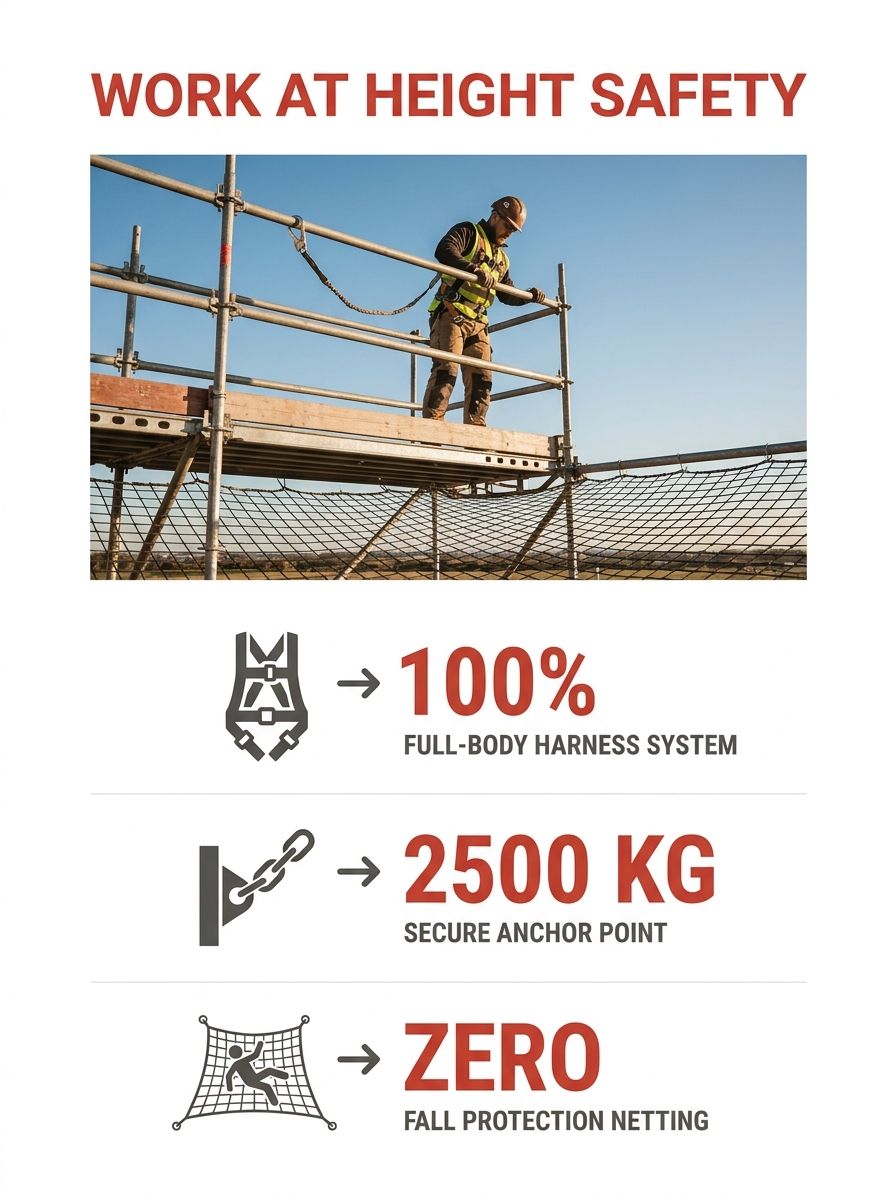
Falls kill more construction workers than any other single hazard. OSHA requires guardrails, safety nets, or personal fall arrest systems for workers at six feet or more in construction and four feet in general industry. The standard is clear. The violation rate is staggering.
PPE violations for fall protection, respiratory equipment, and eye protection remain among the top 10 most cited OSHA violations every year. And the pattern holds because enforcement alone doesn't change employer behavior. What changes it is workers who know the standard, report the gap, and have a union steward or safety committee member who can file a grievance the same day the harness goes missing from the job site. If your workplace treats fall protection as a suggestion rather than a mandate, you've already got documentation for a complaint.
Hazard Communication and the GHS Standard
OSHA's Hazard Communication Standard requires employers to maintain Safety Data Sheets (SDS) for every hazardous chemical on site, label containers properly, and train workers on the risks of substances they handle. The Globally Harmonized System (GHS) Revision 7 now governs how those labels and data sheets are formatted, bringing U.S. standards closer to international classification norms.
Here's the worker-level reality: an SDS binder gathering dust in a supervisor's office doesn't protect anyone. OSHA's own compliance checklist specifies that employers must identify safety and health hazards and reduce risk to a low and acceptable level. Workers have the right to access every SDS in their workplace. If you can't walk to the binder, read the sheet in your language, and understand what happens if the chemical hits your skin, the employer is out of compliance. That's an OSHA complaint waiting to happen, and it's one of the everyday safety practices that can prevent a trip to the emergency room.
Why Lockout/Tagout Failures Kill
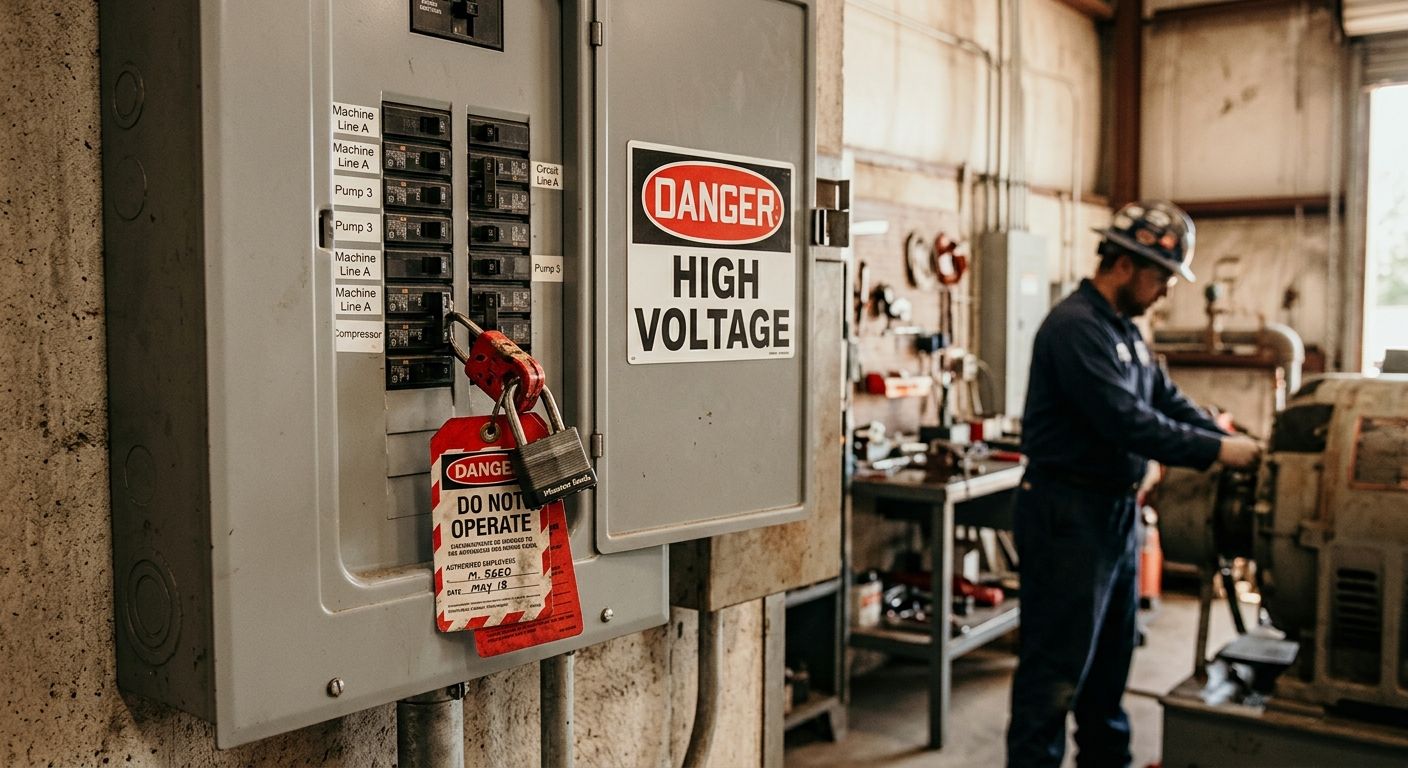
Lockout/tagout (LOTO) procedures exist to prevent machines from releasing stored energy while workers perform maintenance. When LOTO fails, limbs get crushed, fingers get severed, and workers die from electrocution or entanglement. The standard applies across manufacturing, food processing, construction, and any facility with powered equipment.
One poultry plant's experience makes the stakes concrete: after three amputations, a worker-led safety committee won enforceable LOTO procedures through the grievance process, converting a pattern of injuries into binding policy. That case illustrates what OSHA's hazard identification guidance describes as the core process: employers and workers must "collect and review information about the hazards present or likely to be present in the workplace." The critical word is "and." OSHA expects workers to participate in identifying hazards, and the CDC's NIOSH framework specifies that hazard assessments must be performed based on job title, function, and the procedures each worker actually carries out.
Slips, Trips, and Falls on the Same Level
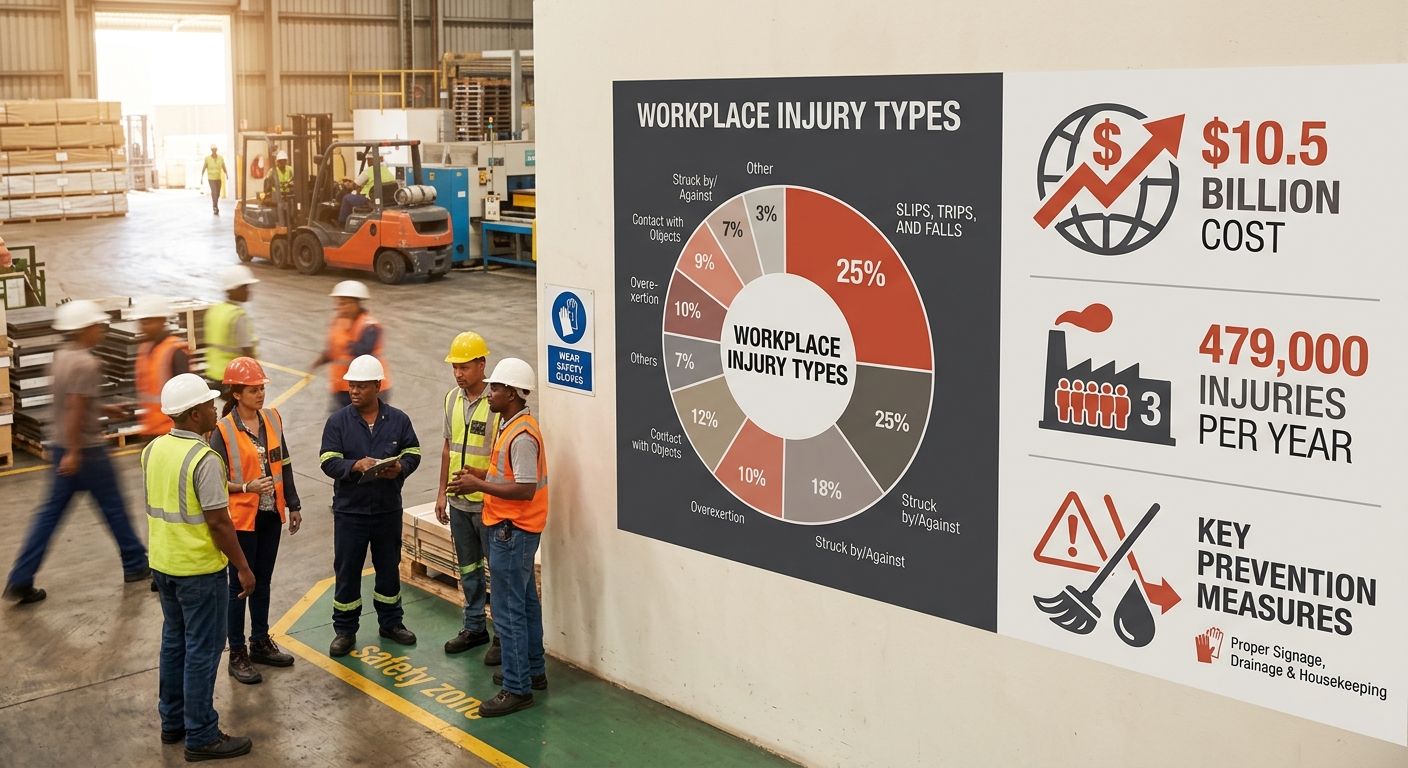
Distinct from fall protection at heights, slips and trips on walking-working surfaces account for roughly 25% of all workplace injury claims and 479,000 nonfatal injuries annually. The cost to employers exceeds $10.5 billion per year. Wet floors, cluttered aisles, uneven surfaces, and poor lighting drive these numbers.
Prevention requires strict housekeeping protocols, adequate drainage, slip-resistant flooring, and proper workplace safety signage marking wet or uneven surfaces. The 5S methodology (Sort, Set in Order, Shine, Standardize, Sustain) provides a useful framework for daily maintenance, but it only works when front-line workers have the authority to stop work in a hazardous area without retaliation. That authority, in practice, comes through collective bargaining agreements that protect workers who raise safety concerns.
Personal Protective Equipment
OSHA mandates that employers provide and require employees to wear appropriate PPE wherever hazardous conditions exist. The standard covers hard hats, safety glasses, hearing protection, respirators, gloves, and steel-toed boots. Respiratory and eye protection violations rank consistently among the agency's top citations.
But PPE is the last line of defense, not the first. OSHA's hierarchy of controls places elimination and substitution of hazards above engineering controls, administrative controls, and finally PPE. When an employer hands you a dust mask instead of installing ventilation, they're choosing the cheapest option, not the safest one. Workers and safety committees should push employers up that hierarchy. A workplace hazard assessment, which OSHA requires before PPE selection, must evaluate the specific risks of each job role. A thorough assessment gathers information about equipment, machinery, processes, chemicals, and prior incident reports before any PPE program is built.
Heat Illness Prevention in a Warming Climate
Rising temperatures have pushed heat stress from a seasonal concern to a year-round hazard in warehouses, kitchens, foundries, and outdoor job sites. OSHA's National Emphasis Programs now target high-risk industries for heat-related inspections, requiring employers to provide hydration access, shade or cool-down areas, acclimatization schedules for new workers, and training on recognizing heat exhaustion and heat stroke symptoms.
Workers in the UK, where there's no legal maximum workplace temperature despite dangerous heat forecasts, face even fewer protections. In the U.S., the absence of a finalized federal heat standard means OSHA enforces heat protections under the General Duty Clause. That enforcement tool is weaker than a specific standard because it requires OSHA to prove the employer knew about the hazard. Workers who document heat conditions on the job, including temperature readings, water access (or lack of it), and break schedules, build the evidence trail that makes General Duty Clause citations stick.
Fire Safety and Emergency Action Plans
Uncontrolled fires claim approximately 3,920 civilian lives per year across the United States. OSHA requires employers to develop Emergency Action Plans (EAPs) covering evacuation routes, assembly points, alarm systems, and communication chains for notifying emergency services. Businesses with more than ten employees must keep these plans in writing.
Fire drills matter, and they matter more when workers have input on the plan. An EAP designed by management without consulting the people who actually work the floor tends to miss critical details: blocked exits behind storage pallets, alarm systems inaudible over machinery, evacuation routes that don't account for workers with disabilities. First aid services and medical provisions must be available for all employees, according to OSHA's general industry standards, and the Insurance Information Institute recommends including first-aid training as part of onboarding so the workforce can respond effectively if an accident does occur.
Electrical Safety
Electrical hazards range from shocks and burns to arc flashes that can reach temperatures of 35,000°F. OSHA's electrical standards cover wiring design, grounding, use of flexible cords, and clearance around electrical panels. Workers performing maintenance on electrical systems must follow lockout/tagout procedures, and only qualified employees are permitted to work on or near exposed energized parts.
The intersection of electrical and LOTO standards is where many fatalities occur. A worker servicing a junction box assumes the circuit is de-energized. It isn't. Regular inspections, clear labeling of circuits and panels, and ground-fault circuit interrupter (GFCI) protection on construction sites are baseline requirements. If your workplace skips any of these, that's a recognized hazard worth documenting and reporting.
Ergonomics and Musculoskeletal Disorders
Musculoskeletal disorders (MSDs) from repetitive motion, heavy lifting, awkward postures, and vibration exposure represent one of the largest categories of lost-workday injuries. OSHA doesn't have a standalone ergonomics standard after the congressional repeal of the 2000 rule, so enforcement happens through the General Duty Clause and industry-specific guidelines.
That regulatory gap makes collective bargaining the most effective tool for winning ergonomic protections. Unions have negotiated job rotation schedules, weight limits for manual handling, mandatory rest breaks, and employer-funded ergonomic assessments. The examples of collective bargaining wins across industries show that contract language on workstation design and lifting limits produces measurable reductions in MSD-related injuries. Without a contract, workers depend entirely on OSHA's willingness to pursue General Duty Clause citations, which happens far less often than specific-standard enforcement.
Workplace Violence Prevention
Training in de-escalation techniques and identifying warning signs is critical in healthcare, retail, social services, and late-night work settings. OSHA has published guidelines for preventing workplace violence, and several states have enacted their own requirements, particularly for healthcare facilities where assaults on workers have increased sharply.
An effective violence prevention program includes a written policy, hazard assessments of the physical environment (lighting, security cameras, panic buttons, staffing levels), employee training, and a reporting system that doesn't punish workers for filing complaints. The reporting piece is where most employer programs break down. Workers who fear retaliation for reporting a threatening interaction will stop reporting, and the data that could drive policy changes disappears. Union contracts with anti-retaliation provisions and joint labor-management safety committees create the conditions where incident data actually flows.
A Worker-Centered Safety Audit
These ten topics share a common thread: OSHA sets the floor, but workers raise it. The agency's safety management framework identifies worker participation as one of its seven core elements, alongside management leadership, hazard identification, hazard prevention and control, education and training, program evaluation, and multi-employer coordination.
You can evaluate your own workplace against a three-part test we call the Safety Readiness Score:
Access: Can every worker view the written safety program, SDS binders, emergency action plan, and injury logs (OSHA 300) without asking permission or waiting for a supervisor?
Voice: Do workers participate in hazard identification walkthroughs, and can they report hazards or refuse unsafe work without documented or informal retaliation?
Enforcement: When a hazard is reported, is there a tracked timeline for correction, and do workers receive written confirmation that the fix was implemented?
If the answer to any of these is no, the employer's safety program has a structural gap that paperwork alone won't fix. OSHA's Training Institute Education Centers deliver occupational safety and health training to both public and private sectors, and the Susan Harwood Grant Program funds nonprofit organizations to develop worker-focused training programs. These are free or low-cost resources that exist because OSHA itself recognizes that employer-provided training often isn't sufficient.
The 10 safety suggestions we've covered previously are a good starting point for individual workplaces, but the larger pattern across these ten topics is consistent: safety programs run by management alone underperform programs where workers have real authority to identify, report, and resolve hazards.
What Remains Unresolved
Several of these ten topics sit on shaky regulatory ground. OSHA still lacks a finalized federal heat standard. The ergonomics standard was repealed in 2001 and never replaced. Workplace violence prevention guidelines remain voluntary at the federal level. And the agency's enforcement budget has not kept pace with the number of workplaces it's responsible for inspecting, meaning that many employers will never see an OSHA inspector unless a worker files a complaint or someone gets seriously hurt.
The gap between what OSHA recommends and what OSHA can enforce is where collective action does its most important work. Safety committees with bargaining power can write heat protocols, ergonomic standards, and violence prevention procedures directly into contracts, creating enforceable protections that don't depend on a federal inspector showing up. For workers in non-union workplaces, the right to file OSHA complaints without retaliation (protected under Section 11(c) of the OSH Act) remains the single most important tool for holding employers accountable on each of these ten fronts. Knowing the specific standard your employer is violating, and putting that knowledge in writing, is what turns a workplace gripe into a federal case file.
The Union Edge Staff
Related Articles
Safety Topics for Workplace: 10 Must-Know Guidelines
Slips, trips, and falls account for 25% of all injury claims filed each year and cost employers more than $10.5 billion annually. This guide covers ten critical safety topics for the workplace, each with a concrete action you can take and a way to verify you've done it right.

10 Essential Safety Suggestions for Modern Workplaces
Workplace safety suggestions fall into three categories: compliance-only programs that meet OSHA's legal minimum, technology-driven systems that use data and wearables to track hazards, and worker-led safety committees where employees identify and fix risks themselves.

Workplace Safety Failures Kill 30 Workers Across Three Countries in Four-Day Span
At least 30 workers died in workplace accidents across Greece, China, and the United States between July 9 and July 12, 2026, prompting regulators to impose safety penalties exceeding half a million dollars and order operational shutdowns at facilities in three countries, according to enforcement fi
Also in the paper