
The Organizer's Mistake: Why Leading With Power Costs You the Campaign
The UAW's 2025 Organizing Conference devoted an entire session to a question the labor movement has struggled with for decades: why do campaigns with strong worker support on paper still lose elections?

The Organizer's Mistake: Why Leading With Power Costs You the Campaign
The UAW's 2025 Organizing Conference devoted an entire session to a question the labor movement has struggled with for decades: why do campaigns with strong worker support on paper still lose elections? Delegates who practiced breaking down workplaces and planning committee meetings kept arriving at the same answer. The campaigns that collapsed fastest were the ones where organizers assumed they already knew what workers needed and led conversations with displays of union strength instead of genuine curiosity.
This tracks with what the Emergency Workplace Organizing Committee has been documenting across hundreds of campaigns: organizers who talk directly to workers about their specific concerns get more attention than those who show up with a pitch about collective power. And yet the power-first approach persists. It persists because it feels right to organizers. It feels like confidence. It feels like solidarity. It also loses elections.
Every organizer training program eventually confronts a fork in the road. You can lead with power, lead with grievances, or lead with relationships. Each approach shapes the entire campaign that follows, from the first hallway conversation to the NLRB ballot. We've watched all three play out across industries, and the results aren't ambiguous. Here's what each approach actually looks like in practice, what it costs, and why two of them keep producing union campaign failures that didn't have to happen.
The Power-First Approach Sounds Strong and Plays Weak
You've heard the pitch. The organizer shows up with stories about strikes won, contracts secured, and management brought to heel. The message is implicit: join us because we're powerful enough to fight for you. Sometimes the language is more direct. "We can shut this operation down." "They can't fire all of you." "The law protects you, and we know how to use it."
This approach draws organizers in because it addresses their own deepest anxiety. They worry that workers won't take the union seriously unless it projects strength. They've seen anti-union campaigns paint organizers as outsiders and the union as a weak third party that collects dues and delivers nothing. So they compensate. They lead with muscle.
The problem is immediate and measurable. Workers in the early stages of considering unionization aren't looking for a show of force. They're weighing personal risk. They're thinking about their mortgage, their shift supervisor's temper, whether the coworker they confided in will stay quiet. Walking into that calculus with a power display reads as reckless. It tells the worker you're more interested in the fight than in their specific situation.
As Labor Notes' veteran organizer guidance puts it plainly, the labor movement has "lost our organizing muscle," and failing is part of the process of getting it back. But failing because you scared workers away from you before management even got involved is a particular kind of loss. It's a self-inflicted one.
The power-first approach also hands management its best talking point. When the employer's law firm runs captive-audience meetings, what do they show workers? Clips of picket lines, stories about strikes that dragged on for months, examples of union campaigns that ended in plant closures. If your own messaging has already primed workers to associate you with confrontation, management barely has to do any work. You've confirmed their narrative before they even opened their mouths.
There are moments in a campaign where projecting strength matters. A successful authorization card drive, a visible show of solidarity during a sticker day or group action, the decision to file for an election with strong majority support. But these moments come later in the campaign arc, after trust has been built. Leading with power at the beginning is like a doctor prescribing surgery before asking where it hurts.
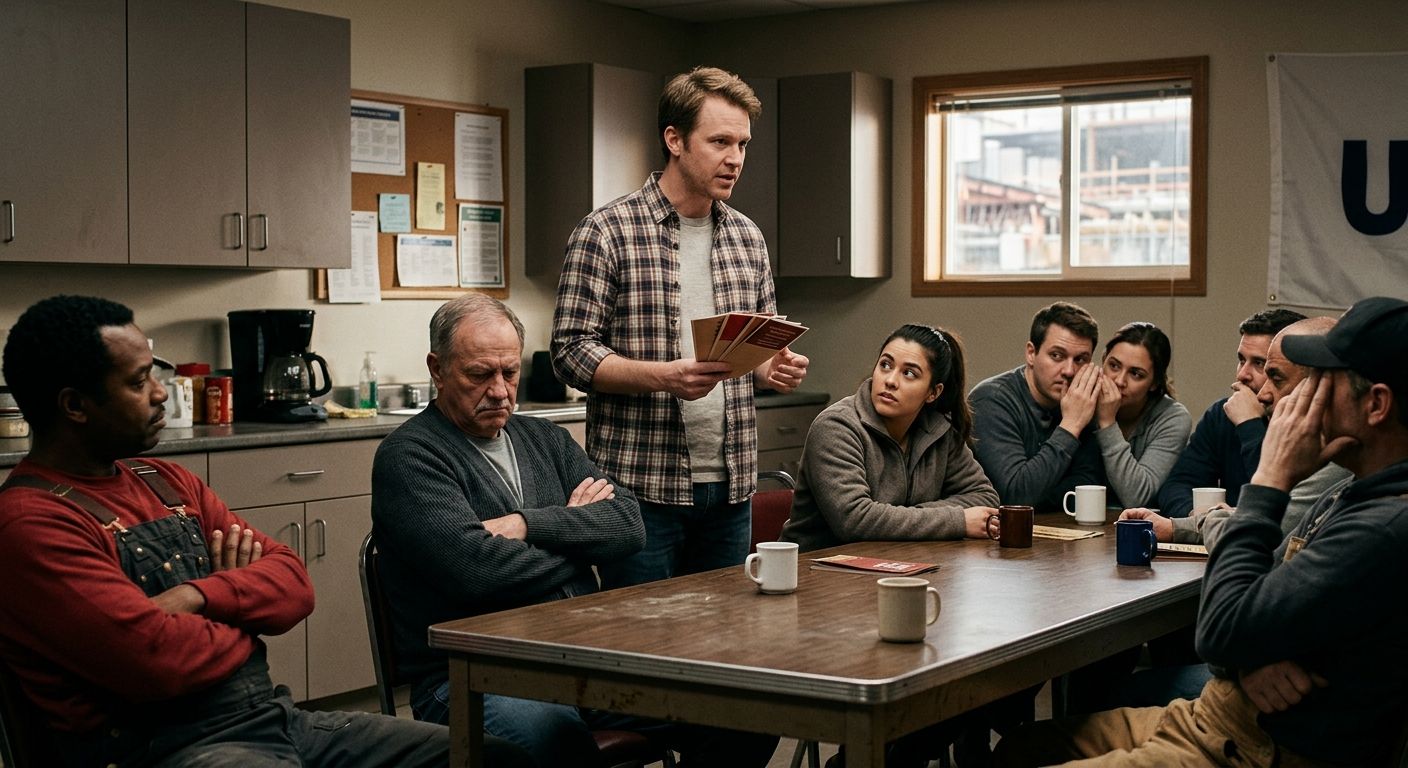
The Grievance-First Approach Gets Attention but Doesn't Hold It
The second common organizer messaging strategy feels more logical than the power pitch. You do your homework. You learn that the company violated overtime regulations, that the safety committee hasn't met in six months, that wages haven't kept pace with inflation since 2022. You walk into conversations armed with facts. You tell workers what's wrong with their workplace.
This approach gets nods. Workers already know their workplace has problems. They live those problems every shift. When you name specific grievances, you build credibility fast. You demonstrate that you've done research, that you understand the industry, that you aren't bluffing. And for about two weeks, the campaign feels like it's picking up momentum.
Then it stalls.
The grievance-first approach stalls because anger is a mobilizing emotion but a poor sustaining one. Workers who sign authorization cards because they're furious about a specific policy change often cool off once management makes a minor concession. And management will make a minor concession. It's the first play in every anti-union handbook: identify the loudest grievance, fix it partially, and then tell workers the union is unnecessary because "we listened."
The deeper problem with grievance-first organizing is structural. When you build a campaign around complaints, you attract workers who want those specific complaints resolved. You don't necessarily build the kind of organizing committee that can sustain a campaign through a six-month legal delay, a decertification attempt, or the grueling process of turning an election win into a first contract. The CWA's collective bargaining communications guide emphasizes building messaging around three or four key points supported by evidence, but those points need to reflect workers' values and aspirations, not only their complaints.
There's also a subtler failure mode. Grievance-first organizers tend to talk more than they listen. They arrive at conversations with a catalog of workplace problems and start ticking through them, looking for the one that gets a reaction. But as the Emergency Workplace Organizing Committee's organizer training materials emphasize, effective organizing conversations start small, ask the worker to take concrete action, and plan follow-up meetings to build trust over time. A grievance dump doesn't leave room for any of that.
We should be clear: grievances matter. Workplace safety violations matter. Wage theft matters. The documented reality that federal enforcement of labor protections has declined while workplace deaths continue makes these issues urgent. But grievances are the raw material of a campaign, not its foundation. The foundation is the relationship between workers and the committee that represents them.
The Relationship-First Approach Is Slower, Harder, and the One That Wins
The third model flips the conversation. Instead of walking in with a pitch about union power or a list of workplace failures, the organizer walks in with a question: "What's it like working here?" Then they listen. Then they ask a follow-up question. Then they listen again.
This approach is the least satisfying in the short term. There are no dramatic moments in the first week. No angry workers signing cards in a burst of solidarity. No viral video of a walkout. The organizer's daily report looks thin: "Had fifteen-minute conversation with second-shift worker about scheduling. She's interested but cautious. Follow-up scheduled for Thursday."
And yet relationship-first campaigns win at significantly higher rates. The reason is straightforward. When you build trust before you build a campaign, the campaign has structural integrity that survives employer opposition. Workers who joined because an organizer genuinely understood their life circumstances don't abandon the effort when management holds a captive-audience meeting. They've already processed their fears in honest one-on-one conversations. They've already decided this matters to them personally, independent of any single grievance.
Solidarity Tech's research on long-term worker engagement tactics documents how successful campaigns use low-pressure settings like lunch-and-learn sessions to discuss union benefits without the formality of a meeting. These sessions work because they mirror what the relationship-first approach does in every individual conversation: they create space for workers to explore their own interest at their own pace.
The UAW's 2025 conference reinforced this by having delegates practice identifying strong leaders and planning organizing committee meetings that emphasized broad, representative networks. The goal wasn't to find the angriest workers. It was to find the workers other people trust and respect, because those are the workers who can carry a campaign when the organizer isn't in the room.
The tradeoffs are real, though. Relationship-first campaigns take longer to reach critical mass. They require consistent staffing, which is a genuine problem because, as the Emergency Workplace Organizing Committee notes, most unions don't prioritize new organizing and the "personal relations between an organizer and the committee are often broken" by inconsistent assignments. If your union or organizing body can't commit a single organizer to a campaign for its full duration, the relationship-first model suffers badly. Building trust requires showing up repeatedly, and a revolving door of organizers destroys that trust faster than any captive-audience meeting.
There's also a learning curve for organizers themselves. Workers trained in advocacy and confrontation sometimes find it difficult to sit in a conversation without offering solutions. The instinct to fix problems is strong. But the organizer's real job is to move past solutions and sit in the discomfort of the worker's actual experience long enough for genuine connection to form.

How to Choose Between These Three
The honest answer is that you don't choose all three equally, and you don't choose based on what feels natural to you as an organizer. You choose based on what wins.
If you're organizing in a workplace where a crisis has already mobilized workers, grievance-first messaging can accelerate an existing movement. But even then, the grievances should be the entry point, not the foundation. Within the first week, you need to transition from "here's what's wrong" to "what do you want this place to look like?" If you can't make that transition, you're building on sand.
If you're organizing in a workplace where workers have already attempted and failed a campaign, power-first messaging carries extra risk. Those workers have seen promises before. They've heard about union strength before. What they haven't experienced is someone who listened to why the last effort failed and designed this campaign differently. That's where the relationship-first approach becomes essential.
And if you're building an organizing committee from scratch, the relationship-first model is the only one with a strong track record of producing committees that survive the full campaign cycle. You need leaders who joined because they trust each other and the process, not because they were swept up in a moment of collective anger.
The power-first approach has a place, but it belongs in the middle and late stages of a campaign, after trust is established, after the committee has identified its own leaders, after workers have made individual decisions to participate. Power displayed too early looks like someone else's power. Power built collectively over months of organizing conversations looks like it belongs to the workers who built it. That distinction determines whether your campaign survives election day and everything that comes after.
Every organizer we've worked with who made the switch from leading with power to leading with questions has described the same experience: it felt like giving something up. It felt slower, less certain, more vulnerable. It also worked. The campaigns didn't just win elections. They produced organizing committees strong enough to bargain first contracts and sustain workplace change after the organizer moved on to the next shop. That's the metric that matters, and it's the one that the power-first and grievance-first approaches consistently fail to deliver.
The Union Edge Staff
Also in the paper