
Ninety C&H Sugar Warehouse Workers Strike Over Retiree Benefits and Overtime Rule Changes in First Warehouse-Led Walkout Since 1930s
Ninety warehouse workers at C&H Sugar's Crockett, California facility walked out on June 16, 2026, rejecting a three-year contract proposal that would eliminate retiree medical benefits, cut five of 10 annual sick days, and shift overtime calculations from daily to weekly totals, according to Local

Ninety C&H Sugar Warehouse Workers Strike Over Retiree Benefits and Overtime Rule Changes in First Warehouse-Led Walkout Since 1930s
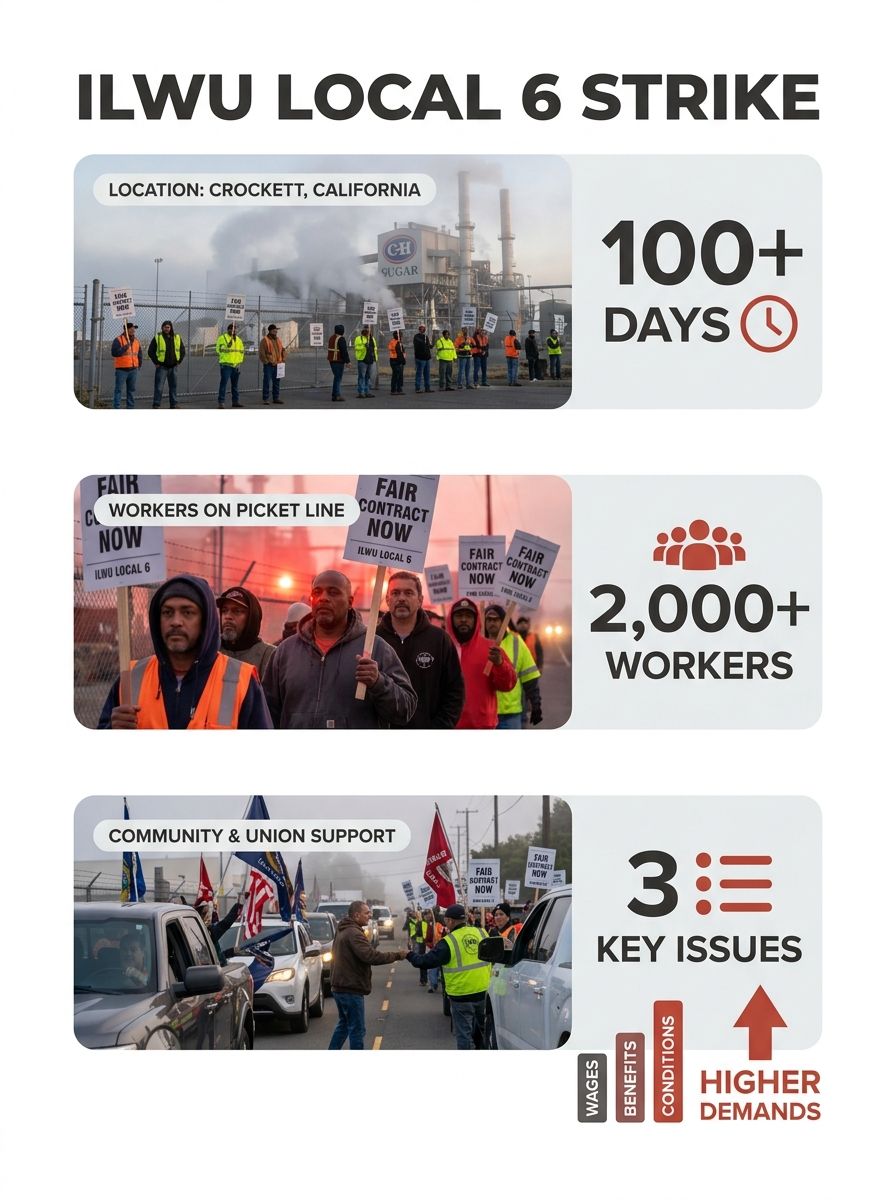
Ninety warehouse workers at C&H Sugar's Crockett, California facility walked out on June 16, 2026, rejecting a three-year contract proposal that would eliminate retiree medical benefits, cut five of 10 annual sick days, and shift overtime calculations from daily to weekly totals, according to Local News Matters. The strike marks the first time the International Longshore and Warehouse Union Local 6 warehouse unit has walked out over its own contract since the late 1930s, when what became known as the Sugar Wars resulted in clashes between workers and police.
American Sugar Refining, C&H's parent company, offered a 20% wage increase in the proposed contract but brought chief labor counsel Rene Ruiz, whose biography states he "trains employers on union avoidance and strike preparation", to the negotiating table for the first time. Workers have maintained picket lines from 4:30 a.m. to past 7 p.m. daily since the strike began.
The Core Contract Disputes
The proposed contract eliminates medical benefits for approximately 100 retired workers and 20 active employees hired before 2008, according to the union. Workers made concessions in 2008 that discontinued retiree medical benefits for future hires, but the new proposal retroactively removes coverage for those already grandfathered in.
"There's people that worked in this plant for 40 years," said Mario Rivas, a 10-year crane operator at C&H, in an interview with Local News Matters. "A lot of them are in there on fixed incomes, and they rely on their medical."
The overtime provision shift represents the second major sticking point. California law mandates time-and-a-half pay after eight hours in a single shift. The proposed contract would change the calculation to 40 hours per week, the federal standard, allowing management to schedule workers for 12-hour shifts Monday through Wednesday without triggering overtime rates, Rivas explained. Workers currently face mandatory overtime due to staffing shortages, regularly working beyond 12-hour shifts.
The contract also proposes cutting annual sick days from 10 to five. ILWU Local 6 representative Cesar Garibay told Local News Matters the union offered flexibility on wages but would not eliminate existing rights. "We're willing to work around some of the stuff they're proposing, but not eliminate it," Garibay said.
Company Response and Union Stance
An American Sugar Refining spokesperson said the company remains "disappointed the union has chosen to walk out" but respects workers' right to strike. The spokesperson emphasized the 20% wage increase included in the offer and expressed commitment to "open and constructive dialogue."
C&H General Manager Hitesh Modgil sent a letter to striking workers on June 14 offering a $1,000 bonus to employees who return to work. The company has not publicly addressed the elimination of retiree benefits or the overtime calculation change.
Rivas characterized the 2026 negotiations as fundamentally different from past collective bargaining cycles. "Every three years, we have a contract," he said. "There's always a give and take. This year is the first year there was no negotiation."
The presence of Ruiz, American Sugar Refining's chief labor counsel, marked a departure from previous negotiations conducted primarily with local management. Workers identified his involvement as a signal that the parent company intended to extract major concessions rather than negotiate modifications.
Historical Context and Failed Solidarity
The last C&H strike occurred in 2003, when the 90-member warehouse unit walked out in support of approximately 300 Sugar Workers Union Local No. 1 members disputing their own contract. "When we strike, we stand with each other," Rivas said. "When the refinery went out in 2003, we joined them automatically."
That solidarity was not reciprocated in 2026. Rivas reported that several hundred refinery workers prepared to join the warehouse picket line on June 16 but reversed course at the last minute. The warehouse workers have maintained their strike without refinery support.
Rising regional costs boost workers' contract concerns. Bridge tolls connecting Contra Costa County to other Bay Area employment centers continue to increase, while gas prices climb. "They're going to raise the bridge tolls again, gas prices are going up," Rivas said. "This is pretty egregious."
Locals have driven by the picket line to honk support, with family members bringing coffee, donuts, and pizza to workers maintaining the early-morning-to-evening shifts outside the factory gates.
What Happens Next
The strike's duration depends on whether American Sugar Refining returns to the table with modified proposals on retiree benefits and overtime calculations. The warehouse operation handles sugar distribution across Northern California, and sustained disruption could affect regional supply chains.
ILWU Local 6 has not announced a timeline for ending the strike. The union's willingness to negotiate on wages while holding firm on benefits and working conditions suggests mediation or arbitration may be necessary if the company maintains its current positions.
Workers face the calculation familiar to any prolonged work stoppage: how long they can sustain lost wages against the long-term cost of accepting a contract that fundamentally reshapes their compensation structure and eliminates benefits for retirees who spent decades in the plant. The $1,000 return-to-work bonus represents roughly two weeks of base pay for many warehouse positions, a limited incentive against permanent benefit losses.
The Union Edge Staff
Related Articles

Ten Workers Detained as Motorists Drive Through C&H Sugar Strike Line in Crockett
Deputies detained ten striking workers and declared an unlawful assembly at the C&H Sugar refinery in Crockett, California on Tuesday after two motorists drove through a picket line, injuring two union members, according to ABC7 San Francisco.

HCA Healthcare Workers Stage Pickets at Dozen Hospitals During Contract Talks Over Pay and Staffing
Twenty-two thousand unionized workers at HCA Healthcare hospitals picketed locations across California, Texas, Nevada, and Florida this week as contract negotiations stalled over demands for a $25-per-hour wage pathway and improved staffing ratios, according to the Guardian.

University of California Averts Strike With Last-Minute Deal for 40,000 Healthcare Workers
The University of California and AFSCME Local 3299 reached a tentative labor agreement late on May 13, preventing a planned strike by more than 40,000 healthcare and service workers hours before a May 14 walkout deadline, according to Bloomberg Law. The deal secures minimum wage increases to $30.10
Also in the paper