
Workplace Safety Moments That Save Lives
Three formats dominate how employers run workplace safety moments before shifts: management-scripted toolbox talks, worker-led peer discussions, and joint safety committee programs backed by union contracts.

Workplace Safety Moments That Save Lives: Three Approaches, One Goal
Three formats dominate how employers run workplace safety moments before shifts: management-scripted toolbox talks, worker-led peer discussions, and joint safety committee programs backed by union contracts. Each format reduces injuries, but the tradeoffs in who controls content, how honestly hazards get reported, and whether fixes actually stick differ in ways that matter to workers on the floor.
How the Three Formats Compare at a Glance
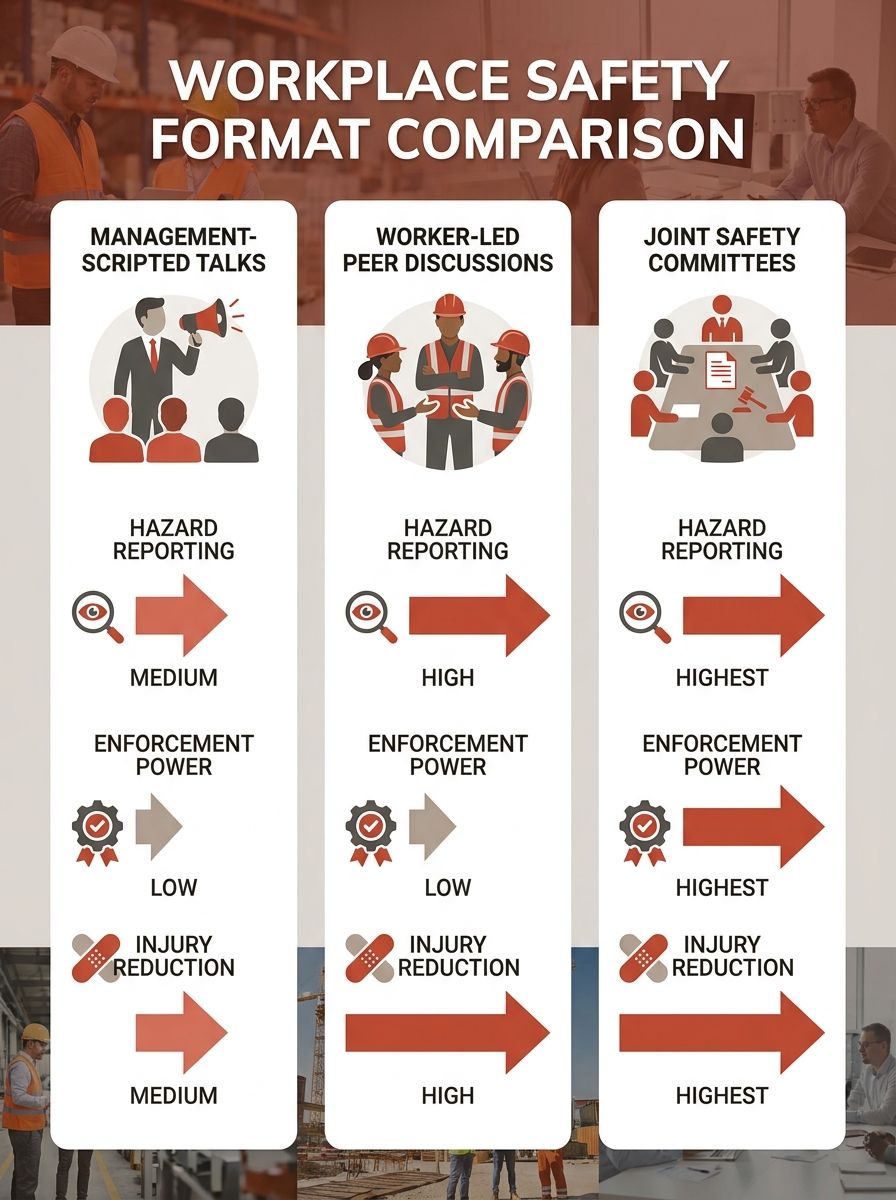
Feature | Management-Scripted Toolbox Talks | Worker-Led Safety Moments | Joint Safety Committees |
|---|---|---|---|
Who controls the agenda | Supervisors or EHS staff | Frontline workers | Elected worker reps + management |
Typical length | 5–15 minutes | 2–5 minutes | 15–30 minute meetings + daily moments |
Hazard reporting honesty | Low to moderate (retaliation fear) | High among peers, but informal | High, with contractual protections |
Legal enforceability | Meets OSHA documentation requirements | Rarely documented | Grievance-backed; tied to CBA language |
Cost to employer | Low (pre-written scripts) | Minimal | Moderate (paid committee time) |
Injury reduction evidence | Moderate | Moderate | Strongest documented outcomes |
Management-Scripted Toolbox Talks
Washington State's Department of Labor & Industries describes toolbox talks as starting "your shift with a few minutes of useful conversation about effective ways to prevent hazards at work and protect employees from injuries on the job." In practice, many employers treat these brief safety discussions as compliance paperwork rather than genuine conversation.
The format works like this: a supervisor reads a pre-written script about a single topic—ladder safety, confined space entry, hand protection, chemical spill cleanup—and workers sign an attendance sheet. The National Safety Council documented that more than 4 million workplace injuries required medical attention in 2020, and failure to recognize hazards was flagged as a leading cause. The toolbox talk, in theory, exists to close that recognition gap.
So what's the problem? The script. When management writes every word, the content tends to cover generic hazards that fulfill OSHA training documentation requirements under standards like 29 CFR 1910.132 (PPE) and 1926.21 (safety training). Topics drift toward what protects the company from citation, not what protects the worker from the saw blade. Anyone who's sat through a fifteen-minute lecture on slip resistance while a malfunctioning overhead crane swings loads ten feet away knows the disconnect.
The tradeoff is real, though. Toolbox talks create a documented training record. If OSHA shows up after an incident, that attendance sheet proves the employer covered the relevant topic. OSHA inspections have been shown to reduce injury claims by 9.4% and save employers an average of $355,000 in workers' compensation costs over four years. Employers who run consistent toolbox talks build the paper trail that makes those inspection outcomes more favorable.
For workers, the question is whether the talk addressed the actual hazard that hurt someone, or a different one that looked better on the compliance checklist. If you've followed how proper safety signage is supposed to warn about specific site conditions, you'll recognize the same gap: generic warnings satisfy regulators while missing the danger right in front of you.
Worker-Led Safety Moments
The peer-led workplace safety moment flips the script—literally. Instead of a supervisor reading from a binder, a worker shares a personal experience, a near-miss from yesterday's shift, or a hazard they spotted walking in that morning. The format is short, usually two to five minutes, and the power comes from specificity. A coworker describing how a forklift blind spot nearly crushed someone against a racking column teaches more than a printed pamphlet about pedestrian awareness zones.
AlertMedia's 2026 guide on safety moment ideas emphasizes that effective moments should "review the importance of proper signage, timely spill cleanup, fall protection, and the use of non-slip footwear" while encouraging workers "to immediately report hazards and near misses." The peer-led model does exactly this because the person talking is the person who saw the hazard.
Why does honesty matter so much here? Consider the numbers. In 2022, 5,486 workers were killed on the job in the United States, a fatality rate of 3.7 per 100,000 workers. Black and Latino workers faced fatality rates 24% higher than the national average. These aren't abstract statistics. They describe who gets hurt when hazards go unreported because the person closest to the danger doesn't trust the reporting system.
Peer-led moments build trust in a way that top-down scripts cannot. When a packing line worker describes how a repetitive motion caused numbness in their hands—the kind of injury detailed in hand safety training that notes "a serious hand injury can have a significant negative impact on an individual's ability to work and their overall quality of life"—other workers listen differently than they listen to a supervisor.
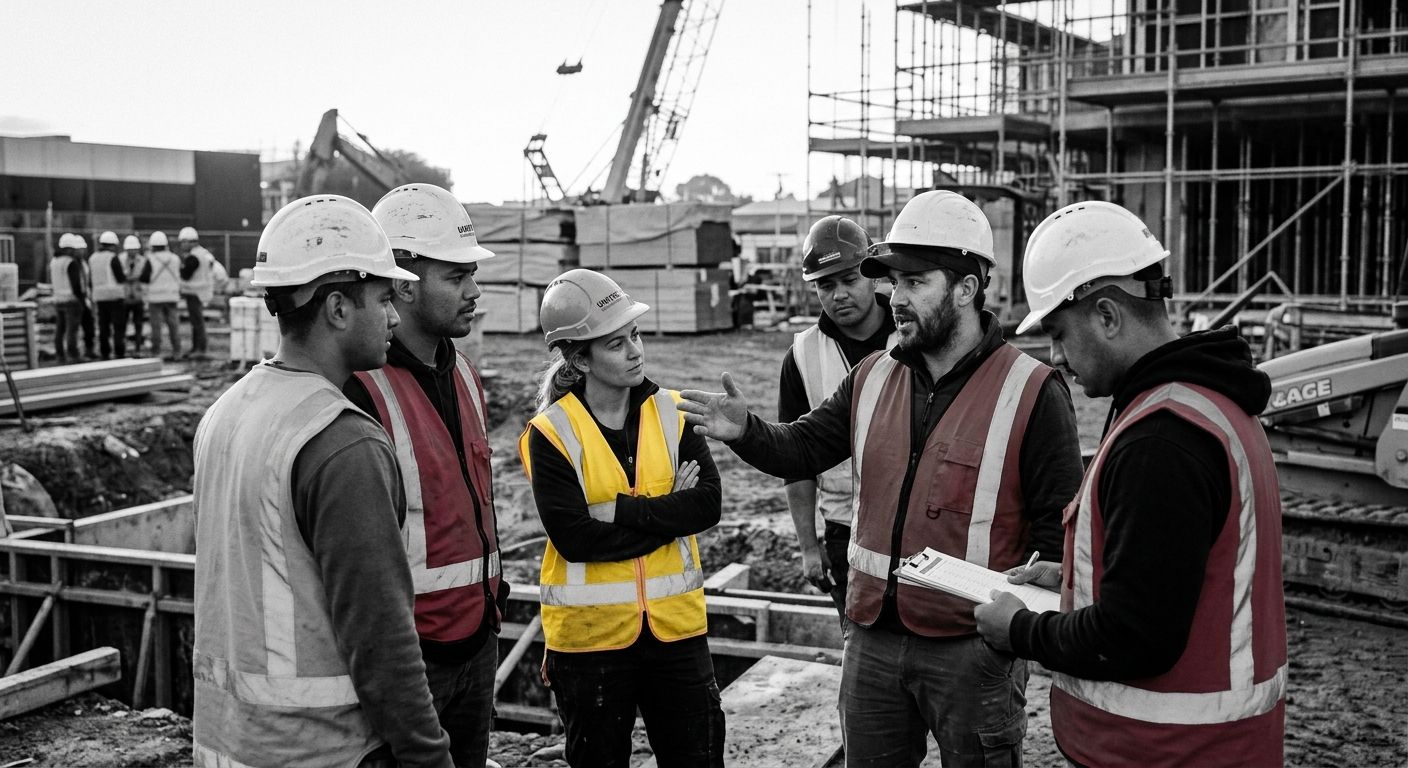
But here's the tradeoff that unions understand well: peer-led moments have no enforcement mechanism. A worker can describe a jammed emergency stop button on a press brake every morning for a month. If management doesn't fix it, the safety moment becomes a ritual of acknowledged futility. The hazard stays. The documentation of the conversation disappears because these informal talks rarely generate written records.
The format also leaves workers exposed. Speaking up about hazards without contractual protection means risking the supervisor's goodwill. The case of one poultry plant's safety committee winning lockout/tagout enforcement after three amputations shows what happens when individual reports get ignored until the consequences become catastrophic. Peer-led moments surface information faster than any other format. They just can't force anyone to act on it.
Joint Safety Committees With Union Backing
Joint safety committees take what works about both previous approaches—management's documentation discipline and workers' first-hand knowledge—and add the one ingredient that makes fixes enforceable: a collective bargaining agreement.
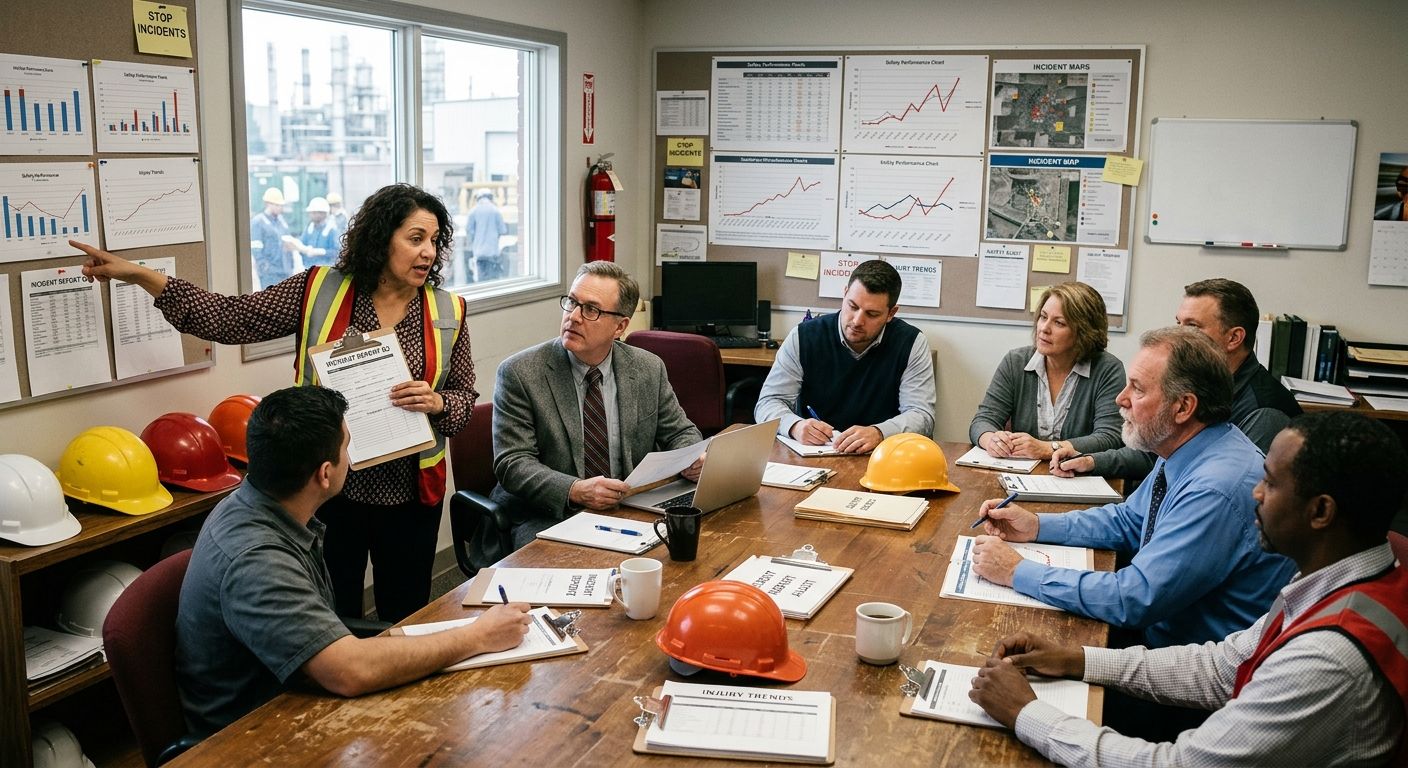
Under a joint committee structure, elected worker representatives sit across from management in regular meetings to review incident reports, inspection findings, and pending hazard corrections. Pre-shift safety moments still happen, but the topics come from committee decisions, not from a supervisor's binder or a single worker's discretion. The committee tracks whether reported hazards actually get resolved. When they don't, the CBA's grievance procedure provides a formal path to escalation.
The data strongly favors this approach. Safety training programs overall can reduce workers' compensation claims by as much as 42%. Programs that include joint committee structures with contractual authority show the strongest outcomes because they address the root cause gap: hazards that workers identify but management deprioritizes. When a committee has the power to flag an unresolved hazard as a contract violation, the response timeline compresses from months to days.
OSHA Practice's 2026 safety guidance notes that effective safety moments keep employees "alert to potential hazards before they escalate into accidents" and gain strength when "workers share experiences and suggestions." Joint committees formalize this sharing. They create standing agenda items for near-miss reports, assign follow-up responsibility to named individuals, and review corrective actions at subsequent meetings. The essential safety suggestions that workers generate in peer-led moments become trackable action items rather than verbal observations that evaporate by lunch.
What does this look like on the ground? A unionized warehouse might run a daily three-minute workplace safety moment at shift start, with the topic pulled from the committee's monthly hazard review. If workers on second shift reported three near-misses involving a loading dock plate, that dock plate becomes the safety moment topic for every shift until the repair is verified and documented. The committee meeting minutes, protected under the CBA, create an enforceable record that neither an attendance sheet nor an informal huddle can match.
The tradeoff is cost and complexity. Committee meetings require paid time for worker representatives. Grievance procedures take administrative effort. And some employers resist joint committees precisely because they shift power toward workers. If your workplace doesn't have a union, establishing a joint safety committee requires either negotiating one into a first contract or convincing management to create a voluntary committee—which lacks the contractual teeth that make the format effective. Understanding how collective bargaining agreements work is the first step toward building this structure.
Adopting strong injury prevention programs can save organizations between $9 billion and $23 billion annually across the U.S. economy. The investment in committee time and grievance administration is small against those numbers, but individual employers often optimize for short-term payroll costs rather than long-term injury reduction.
The Verdict
The right format depends on what your workplace has and what you're willing to build. Here's the honest breakdown.
If you work in a non-union shop with cooperative management, peer-led safety moments give you the best return for zero institutional cost. Workers share real hazards. Supervisors who listen will act on some of them. The format builds a culture of awareness even without enforcement power, and the specificity of real stories beats scripted talks every time.
If you work somewhere that treats safety as a regulatory checkbox, management-scripted toolbox talks will keep happening whether workers find them useful or not. The realistic move is to push for worker input into the script selection. Ask to add agenda items. Request that near-miss reports from the previous week get incorporated into the next talk. Even within a top-down structure, workers can shift the content toward hazards that actually threaten them.
If you have a union or are building one, fight for a joint safety committee in your contract. This is the format with the strongest evidence behind it and the only one that gives workers enforceable authority over hazard correction timelines. The 42% reduction in workers' compensation claims associated with structured safety training programs doesn't come from better scripts. It comes from systems where reported hazards lead to documented fixes, and where ignoring a report has contractual consequences.
Every workplace safety moment, regardless of format, shares one truth: the person closest to the hazard knows the most about it. The question is whether that knowledge reaches someone with the authority and obligation to act. Management-scripted talks often don't ask. Peer-led moments ask but can't compel. Joint committees ask, document, and hold both sides accountable through binding agreements. Workers who want safety moments that save lives rather than satisfy auditors should know which model they're operating under and what it would take to upgrade.
The Union Edge Staff
Related Articles

The Safety Committee Power Play: How Unions Win Workplace Hazard Control Through Formal Joint Representation
Workplace safety committees without union backing don't reduce injury rates.

How to Run a Workplace Safety Audit Before OSHA Shows Up: A Step-by-Step Union Guide
Unions that run their own workplace safety audits catch hazards months before OSHA inspectors arrive, build airtight documentation for grievances, and shift power over working conditions back to the shop floor.

10 Essential Safety Suggestions for Modern Workplaces
Workplace safety suggestions fall into three categories: compliance-only programs that meet OSHA's legal minimum, technology-driven systems that use data and wearables to track hazards, and worker-led safety committees where employees identify and fix risks themselves.
Also in the paper