
Federal Workers Bargaining Rights Bill Explained
The Protect America's Workforce Act (H.R. 2550) passed the U.S. House on December 11, 2025, by a 231-195 bipartisan vote.

The Federal Workers Bargaining Rights Bill, Explained: From Executive Order to Congressional Fight
The Protect America's Workforce Act (H.R. 2550) passed the U.S. House on December 11, 2025, by a 231-195 bipartisan vote. This federal workers bargaining rights bill would restore collective bargaining protections for roughly one million federal employees who lost union representation through executive order earlier that year.
To understand why the bill matters, you need to understand how those rights were won, how they were taken away, and where the fight stands right now.
How Federal Workers Won Bargaining Rights in the First Place
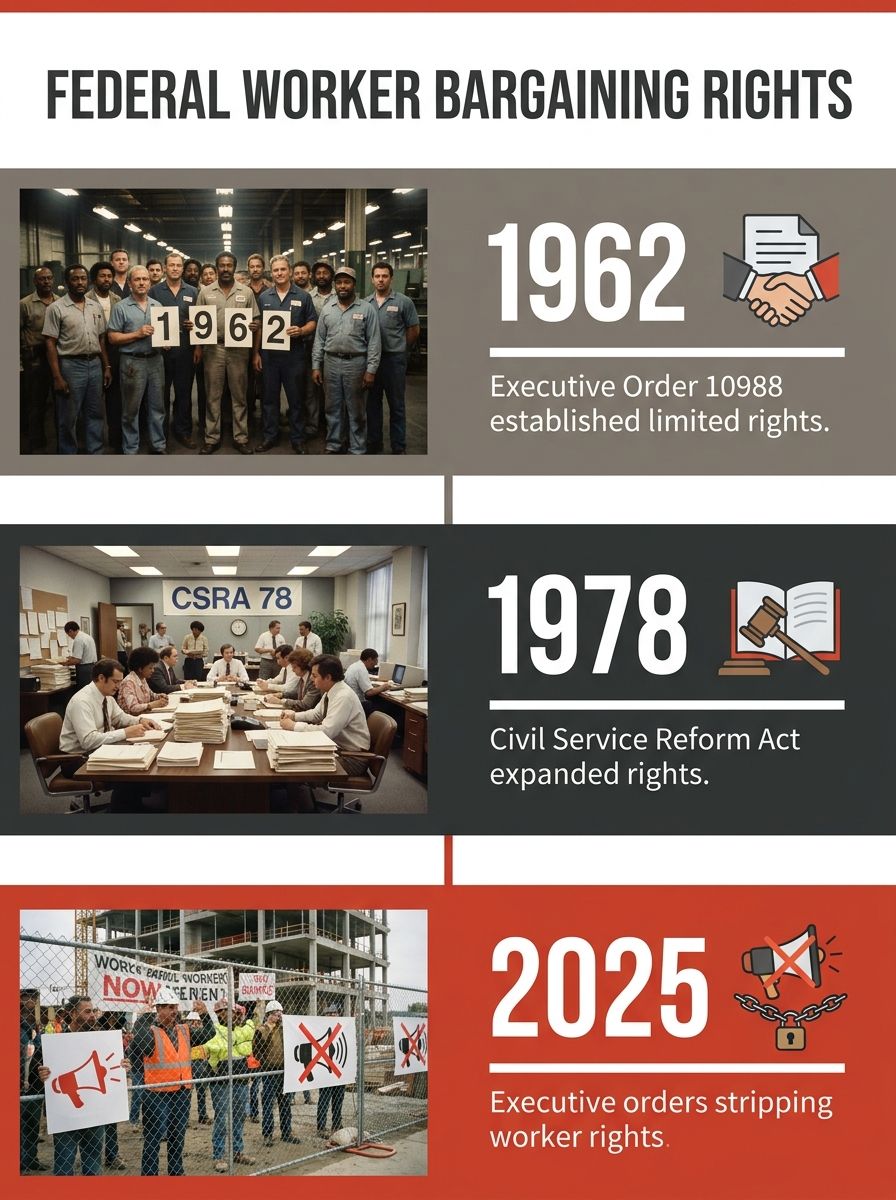
On January 17, 1962, President John F. Kennedy signed Executive Order 10988, giving federal employees the right to engage in collective bargaining for the first time. Before that date, federal workers had no legal framework for union representation at the workplace level. They could join unions, but agencies had zero obligation to negotiate with them.
That executive order held for sixteen years. But executive orders are fragile. Any president can undo what a prior president created with a signature. Congress recognized this vulnerability and, after extensive hearings, passed the Civil Service Reform Act of 1978. Title VII of that law, known as the Federal Service Labor-Management Relations Statute, wrote bargaining rights into statute. It created the Federal Labor Relations Authority (FLRA) to oversee federal labor disputes. It established the Federal Service Impasses Panel to resolve negotiation deadlocks between agencies and unions.
The AFL-CIO has described the Civil Service Reform Act as codifying rights that "safeguard the public interest," according to its official position on federal bargaining protections. The law requires agencies and unions to bargain in good faith over grievance procedures, arbitration, and working conditions.
This distinction matters: federal unions don't negotiate pay or benefits. That's set by Congress. What they do negotiate are protections against retaliation, discrimination, illegal firings, political interference, and whistleblower safeguards. If you've ever wondered why the scope of collective bargaining agreements in the federal sector looks different from private-sector contracts, this is why.
The Executive Orders That Gutted Union Protections
In March and August 2025, President Trump signed executive orders that classified large swaths of the federal government as primarily focused on national security. That classification triggered an exemption in the statute. Under the law, agencies deemed critical to national security can be excluded from collective bargaining requirements.
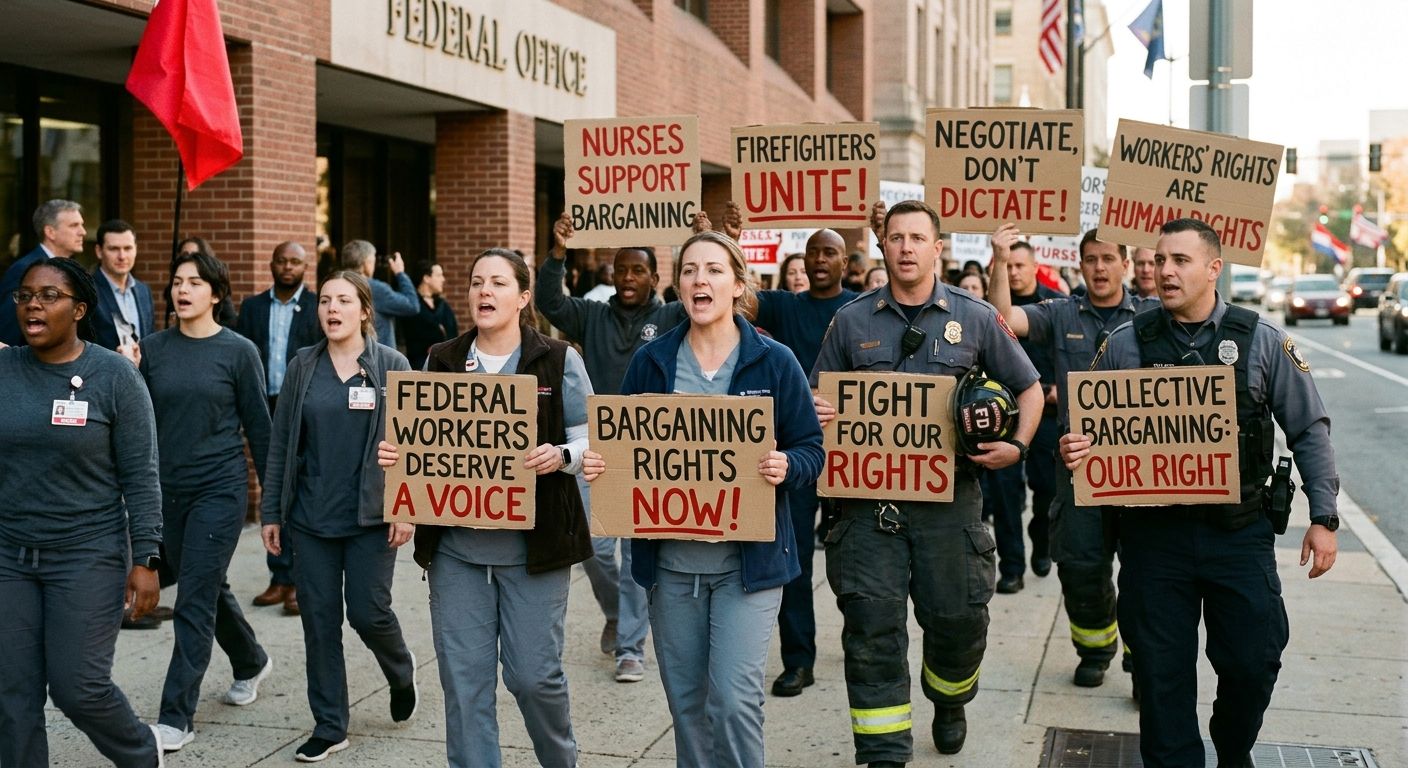
The scope was staggering. Roughly two-thirds of the federal civilian workforce lost bargaining rights. Nurses at VA hospitals. Firefighters on federal land. Law enforcement officers across multiple agencies. Scientists, administrative staff, IT workers. The executive orders swept in agencies that had never been classified as national security operations before.
A coalition of federal unions, led by the American Federation of Government Employees (AFGE), sued. They argued the national security label was a pretext — that the administration was using a narrow statutory exception as a wrecking ball. A federal judge agreed and initially blocked the orders in April 2025. But an appeals court reversed the decision, allowing agencies to move forward with de-recognizing unions.
By mid-2025, agencies were already acting on the orders. Union representatives were losing access to worksites. Grievance procedures were being dismantled. Workers who had spent decades under collective bargaining agreements found those agreements voided overnight.
AFGE President Everett Kelley called the rollback "the biggest attack on workers that this country has ever seen," and described the affected employees as "largely unseen civil servants who keep our government running."
The legal battle continued, but unions weren't waiting for courts alone. They turned to Congress. The broader context of executive power challenges facing labor protections made the legislative route critical.
Forcing a Vote Through Discharge Petition
The Protect America's Workforce Act was introduced by Rep. Jared Golden (D-Maine) and Rep. Brian Fitzpatrick (R-Pa.). The bill's core mechanism is straightforward: it would repeal the executive orders and restore the collective bargaining status that existed before March 2025.
But getting the bill to the House floor was its own battle. House leadership showed no interest in scheduling a vote. So Golden and his allies used a discharge petition — a procedural tool that forces a floor vote if 218 members sign on. It's a blunt instrument. Discharge petitions rarely succeed because they require members of the majority party to break with their own leadership.
This one succeeded. Enough Republicans signed the petition to reach the 218-member threshold, forcing the bill out of committee and onto the floor.
"We commend every Democrat and Republican who signed the discharge petition to bring the Protect America's Workforce Act to a vote, but the fight isn't over," said AFL-CIO President Liz Shuler, according to a statement from Golden's office.
The discharge petition itself was a signal. Members who signed it took a public stand against their own party's leadership. For the 20 Republicans who eventually voted for the bill, the political calculation was clear: federal employees are constituents, and stripping their workplace protections wasn't popular back home.
This kind of procedural fight has echoes across labor's recent legislative history. The struggle to advance the PRO Act and broader labor legislation has shown that floor access, not vote counts, is often the biggest barrier.
December 11, 2025, on the House Floor
The final vote was 231-195. Every Democrat voted yes. Twenty Republicans crossed the aisle to join them.
The bill's supporters framed it as a defense of existing law. The Civil Service Reform Act of 1978 established bargaining rights through statute. The executive orders, they argued, exploited a narrow exception in ways Congress never intended. PAWA would close that loophole by prohibiting future presidents from using the national security exemption to strip bargaining rights from broad categories of federal workers.
NFFE National President Randy Erwin called the passage "an incredible testament to the strength of federal employees," adding that Congress had asserted its authority to hold the President accountable.
Opponents had their own frame. Rep. James Comer (R-Ky.) argued the bill would undermine the President's authority to manage the federal workforce and protect union agreements made "at the expense of the American taxpayer."
But the vote totals told a different story about where the political center sits on this issue. Twenty Republicans in competitive districts looked at a million federal workers losing union protections and decided that was too far. In a Congress where bipartisan votes on labor issues are rare, that margin matters. The history of American labor legislation shows these crossover moments are often the ones that produce durable change.
The Senate Path and the Filibuster Problem
The companion bill in the Senate (S. 2837) was introduced by Sen. Mark Warner (D-Va.) with bipartisan backing. Every member of the Democratic caucus signed on as a cosponsor. Republican Sens. Lisa Murkowski (R-Alaska) and Susan Collins (R-Maine) joined as well.
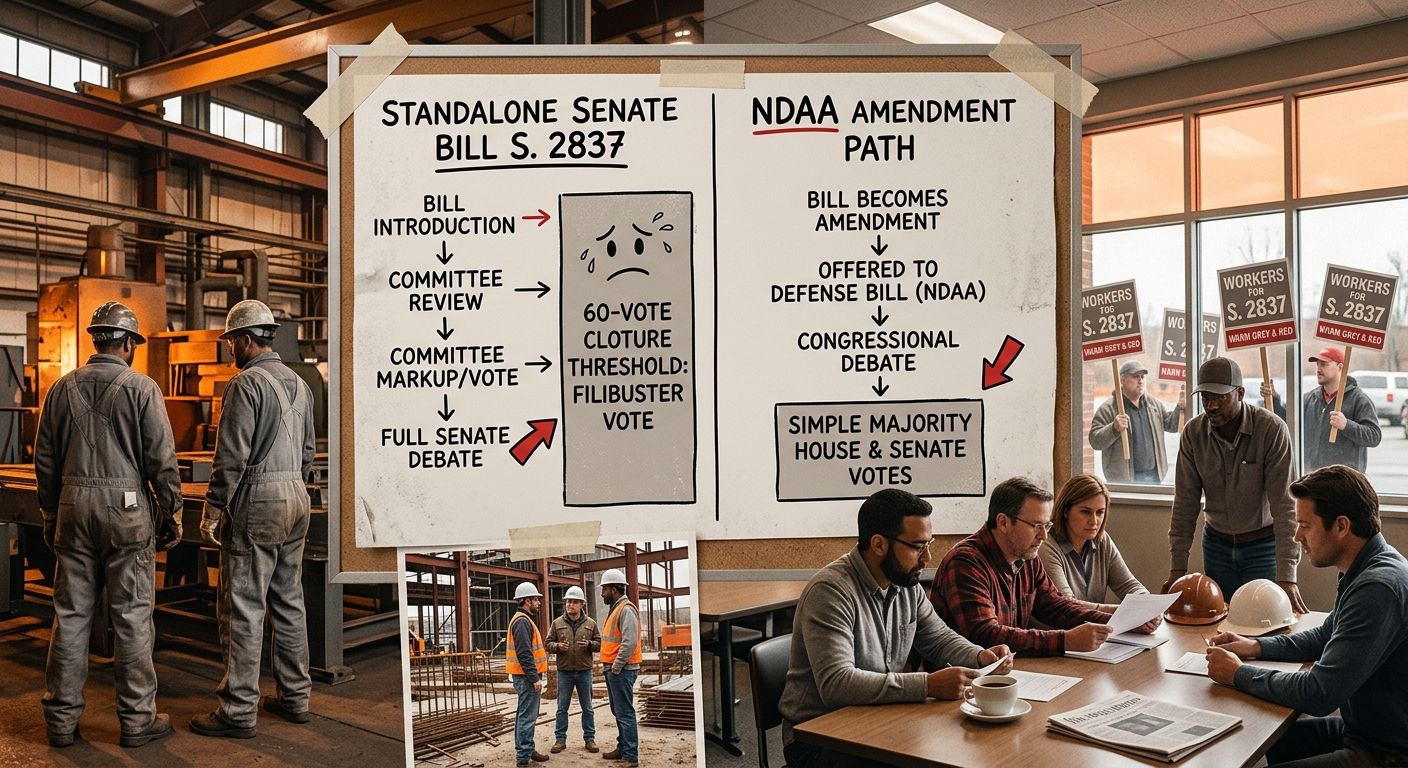
That gives the bill somewhere around 51-52 votes. The problem is that 51 votes don't clear a filibuster. Senate rules require 60 votes to end debate and proceed to a final vote on most legislation. Without 8-9 additional Republican votes, PAWA will stall.
AFGE has been pressing for immediate Senate action, arguing that every week of delay means more workers lose active representation. The union has also pursued a parallel track through the defense authorization process. The House Armed Services Committee approved an amendment to the fiscal 2027 National Defense Authorization Act that would restore bargaining rights specifically at the Department of Defense.
This NDAA strategy matters because defense authorization bills pass every year. They're considered must-pass legislation. Attaching a bargaining-rights provision to the NDAA sidesteps the filibuster problem entirely, since the NDAA typically passes with broad bipartisan support.
Path to Passage | Mechanism | Votes Needed | Current Support | Main Obstacle |
|---|---|---|---|---|
S. 2837 standalone vote | Regular Senate procedure | 60 (to overcome filibuster) | ~51-52 confirmed | 8-9 more Republican votes |
NDAA amendment | Defense authorization rider | Simple majority in conference | Armed Services Committee approved | Surviving conference committee negotiations |
Reconciliation | Budget process | 51 (no filibuster) | Uncertain | Likely ruled out by Senate parliamentarian |
The standalone bill and the NDAA amendment aren't mutually exclusive. Unions are pushing both tracks at the same time. If the NDAA route works, the standalone bill becomes unnecessary for the Defense Department workforce. But it would still be needed for the hundreds of thousands of workers at non-defense agencies.
Where This Lands Now
The federal workers bargaining rights bill sits in a familiar but precarious position. It has passed the House. It has bipartisan Senate sponsors. It has the backing of every major federal employee union and the AFL-CIO. And it faces the 60-vote wall that has killed labor legislation for decades.
The NDAA track remains the most likely path for at least partial restoration. Conference committee negotiations on the fiscal 2027 defense bill will determine whether the Armed Services Committee's amendment survives. Those negotiations are expected to conclude later this year.
Meanwhile, agencies continue operating under the executive orders. The appeals court ruling that lifted the injunction remains in effect. Federal unions in affected agencies are functioning without recognized bargaining units, unable to file grievances or represent members in disciplinary proceedings. The practical impact hits hardest at agencies where workers face safety risks — VA hospitals, federal prisons, wildfire operations — and where strong first contracts had previously given workers meaningful protections against arbitrary management decisions.
The stakes are concrete. One million federal employees either have collective bargaining rights or they don't. The Protect America's Workforce Act would settle that question through statute, the way Congress settled it in 1978 — by writing the answer into law where no single executive order can erase it. Whether the Senate delivers that answer depends on whether enough members decide that the principle behind the 1978 law still holds: that collective bargaining for federal workers safeguards the public interest.
The Union Edge Staff
Related Articles

The PRO Act Is Dead Again — and Labor's Legislative Strategy Needs a Hard Reset
The Richard L. Trumka Protecting the Right to Organize Act has been introduced in four consecutive Congresses. It passed the House once, never reached a Senate floor vote, and changed zero lines of federal labor law.

Teamsters-Backed First Contract Bill Passes House With Bipartisan Support, Heads to Senate
The U.S. House of Representatives passed the Faster Labor Contracts Act on June 9, 2026, with bipartisan support, advancing Teamsters-led legislation that would require employers to begin bargaining with newly organized workers within 10 days of a union vote, according to the International Brotherho
House Passes Union Contract Bill as Worker Income Share Hits 79-Year Low
The U.S. House of Representatives passed the Faster Labor Contracts Act on September 15, legislation designed to expedite union contract negotiations for newly organized workplaces, according to an analysis published in the Las Vegas Sun.
Also in the paper