
Minimum Wage Missouri: Current Rates & Updates
Proposition A won 58% of the vote in November 2024, directing Missouri's minimum wage to climb to $15.00 per hour by January 2026 and then adjust annually for inflation. Seven months later, Governor Mike Kehoe signed House Bill 567, which kept the $15.

Minimum Wage in Missouri: How the $15 Rate Works, What HB 567 Changed, and Where Workers Lose
Proposition A won 58% of the vote in November 2024, directing Missouri's minimum wage to climb to $15.00 per hour by January 2026 and then adjust annually for inflation. Seven months later, Governor Mike Kehoe signed House Bill 567, which kept the $15.00 number but stripped out both the automatic cost-of-living increases and the paid sick leave provisions voters had approved. The minimum wage in Missouri is now $15.00 per hour with no built-in mechanism for future raises.
What Missouri Law Requires Right Now
The Missouri Department of Labor and Industrial Relations sets the current minimum wage for Missouri at $15.00 per hour, effective January 1, 2026. This represents a $1.25 increase from the 2025 rate of $13.75 and a $2.70 jump from the 2024 rate of $12.30. The legal foundation sits in Missouri Revised Statutes § 290.502, as amended by both the voter-approved Proposition A and the legislature's subsequent House Bill 567.
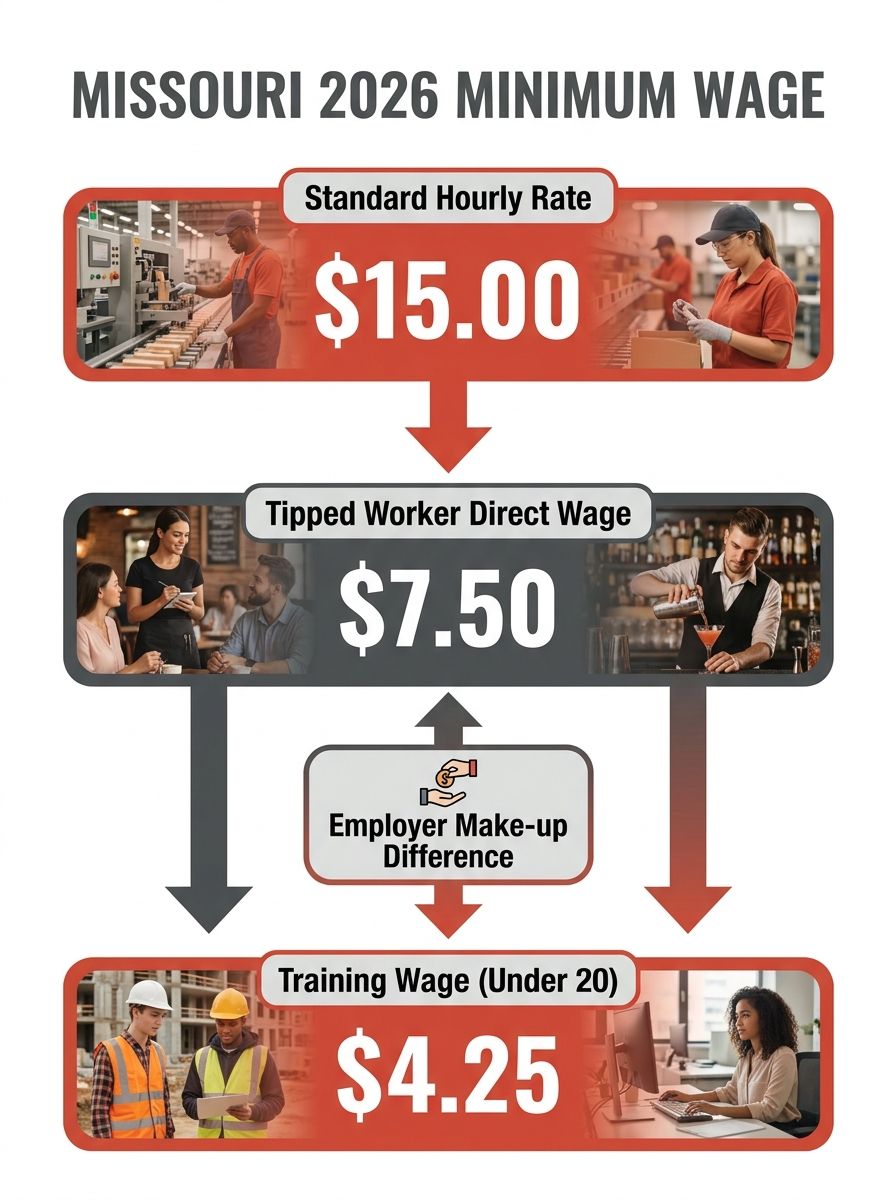
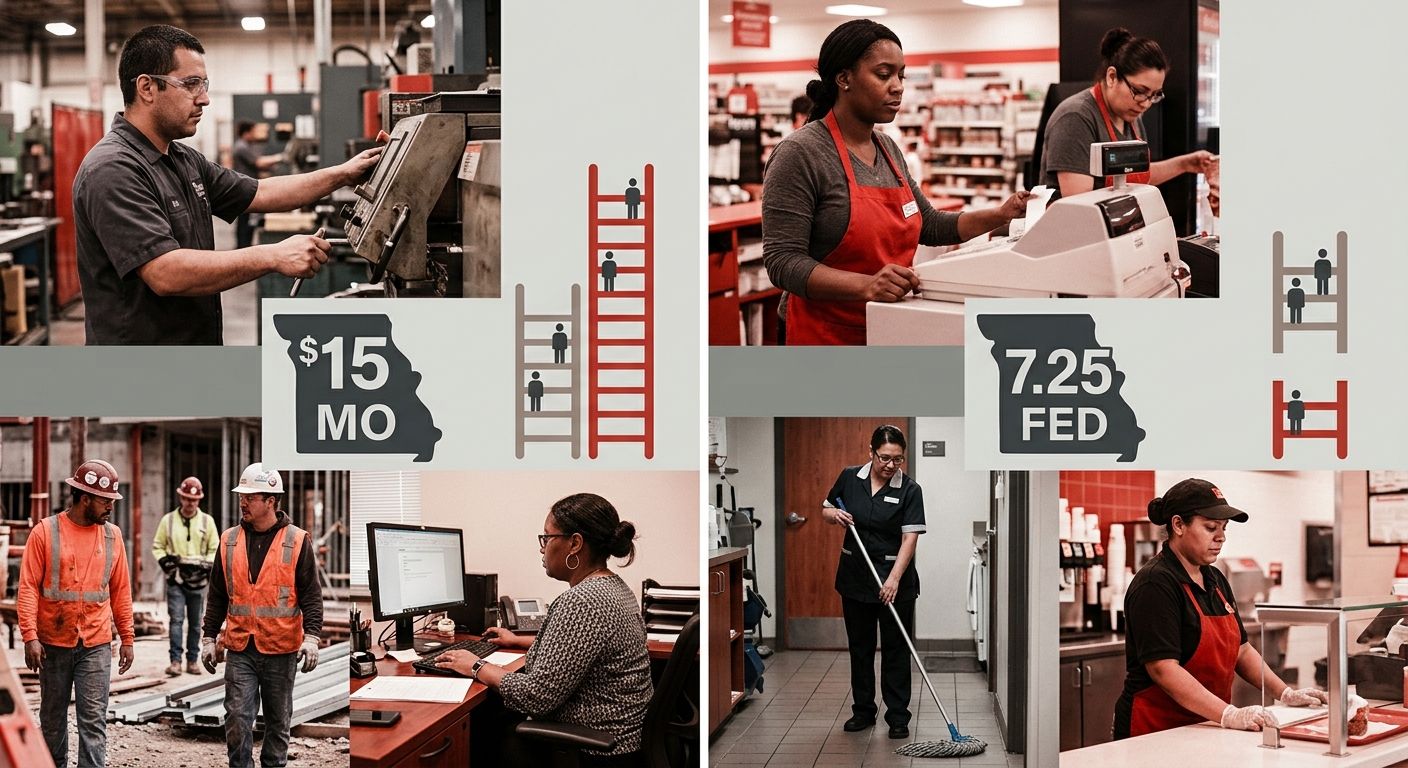
Employers covered by both state law and the federal minimum wage must pay whichever rate is higher. Since the federal minimum has been frozen at $7.25 per hour since July 2009, Missouri's $15.00 rate controls for every covered employer in the state. Tipped employees must receive a direct cash wage of at least $7.50 per hour, which is 50% of the full minimum wage. If tips don't bring total compensation to $15.00 per hour, the employer must make up the difference.
Workers under 20 years old face a separate tier during their first 90 consecutive calendar days of employment: a training wage of $4.25 per hour, which follows federal guidelines under the FLSA.
The Ballot Box Path from $7.65 to $15.00
Missouri's minimum wage spent decades mirroring the federal rate. The state broke away in 2006, raising its minimum to $6.50 per hour when the federal floor still sat at $5.15. After the federal minimum climbed to $7.25 between 2007 and 2009, the two rates converged again and Missouri's wage barely moved for years.
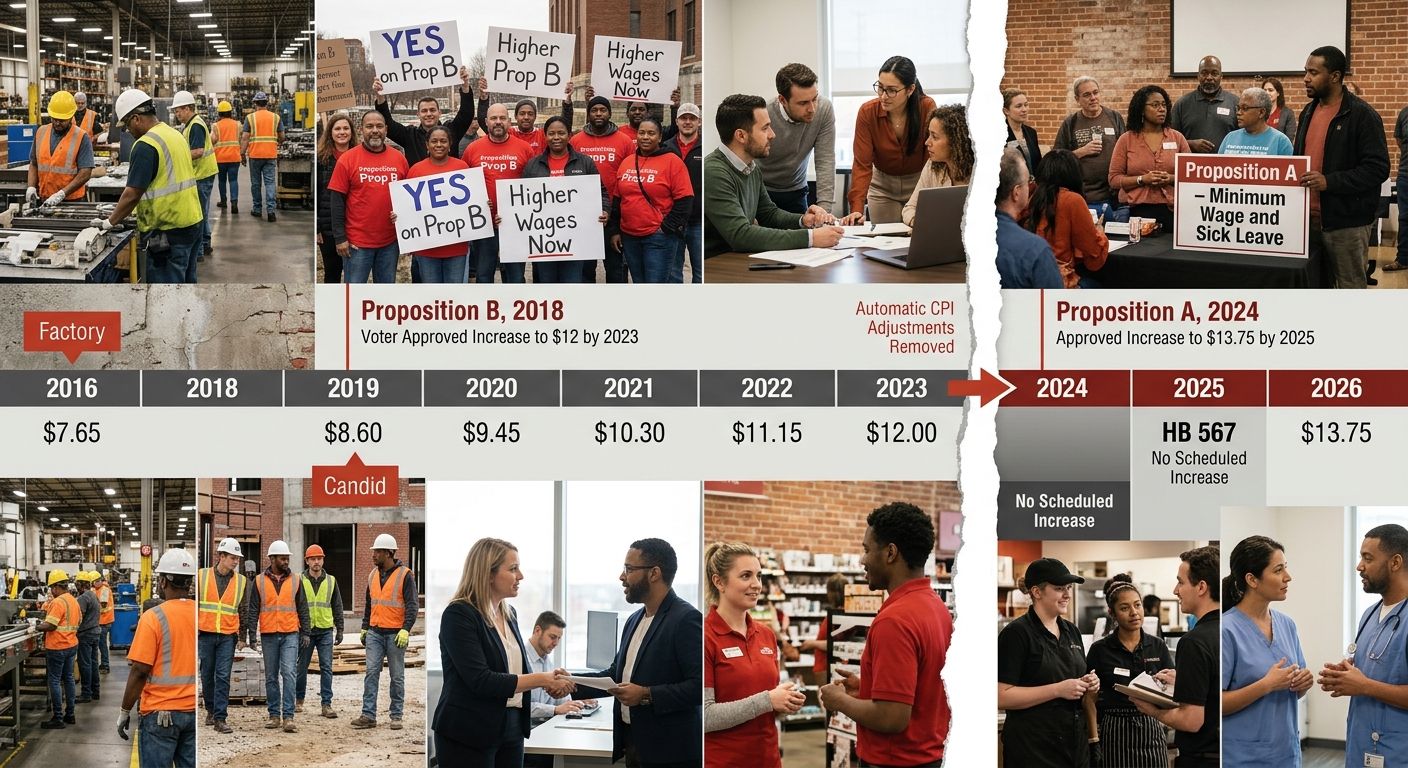
The real escalation started through direct democracy. Missouri's minimum wage began rising in 2016 from $7.65 an hour and reached $7.85 in 2018. Then Proposition B landed on the 2018 ballot. Voters approved it, mandating annual increases that pushed the rate from $8.60 up through $12.00 by 2023, with CPI-based adjustments each year after that. The Missouri Department of Labor established the 2024 rate at $12.30 per hour following those inflation formulas.
Proposition A in November 2024 accelerated the trajectory: $13.75 for 2025, $15.00 for 2026, and automatic annual inflation adjustments beginning in 2027. The measure also created statewide earned paid sick time requirements for the first time.
Every dollar of increase since 2016 came through voter initiative, not legislative action. The pattern matters because it reveals the mechanism Missouri workers have used to raise their own wages when the legislature wouldn't do it for them.
How House Bill 567 Dismantled the Adjustment Mechanism
On July 10, 2025, Governor Kehoe signed HB 567 into law. The bill preserved the $15.00 rate that was already scheduled to take effect in January 2026 but gutted two structural provisions that voters had approved seven months earlier.
The first casualty was the automatic CPI adjustment. Under Proposition A, starting in 2027, Missouri's minimum wage would have risen or fallen annually based on changes in the Consumer Price Index, keeping pace with actual cost-of-living shifts. HB 567 repealed that mechanism entirely. The $15.00 rate is now static, and any future change requires new legislation. Given that the federal minimum wage has been frozen since 2009 at $7.25, the precedent for prolonged legislative inaction on wage floors is well established.
The second casualty was paid sick leave. Proposition A had created a statewide earned paid sick time mandate, a provision that labor and reproductive rights organizations had campaigned hard to pass. HB 567 repealed it. A $1 million coalition campaign has since targeted Republican legislators who voted for the repeal, framing the issue as one where the legislature overrode a clear democratic mandate.
HB 567 also expanded minimum wage coverage to public employers, including state agencies, school districts, and political subdivisions, which had been exempt under prior law. This provision expanded the number of workers covered even as it eliminated the inflation protection those workers' fellow voters had demanded.
Tipped Workers and the Sub-Minimum Structure
Missouri law requires employers to pay tipped employees at least 50% of the standard minimum wage as a direct cash wage. At the 2026 rate, that means $7.50 per hour before tips. The employer bears a legal obligation called the "tip credit": if an employee's combined cash wage and tips fall short of $15.00 in any pay period, the employer must pay the shortfall.
This structure creates a compliance problem that disproportionately affects restaurant workers, hotel staff, and delivery personnel. Tracking tip income accurately requires systems that many small employers don't maintain. When enforcement is weak, the gap between the $7.50 direct wage and the $15.00 effective minimum becomes a zone where wage theft occurs with little documentation to prove it.
The training wage adds another sub-minimum layer. Workers under 20 can legally be paid $4.25 per hour during their first 90 days with an employer. After that window closes, the full $15.00 rate applies. Seasonal workers, by contrast, must receive at least the state minimum wage unless they qualify for a specific exemption under state or federal law.
Who the Law Doesn't Cover
Missouri's minimum wage law contains exemptions that leave significant groups of workers earning less than $15.00 per hour legally. The most consequential exemption targets small businesses: retail or service businesses with annual gross income under $500,000 are not required to pay the state minimum wage. This threshold is established under Missouri Revised Statutes § 290.500(3).
These employers still must comply with the federal minimum wage of $7.25 per hour if they're covered by the Fair Labor Standards Act, which applies to businesses with at least two employees and $500,000 in annual gross sales, or to individual employees engaged in interstate commerce. The overlap creates a narrow but real category of workers who fall below both thresholds and have no statutory wage floor above $7.25.
Worker Category | Applicable Rate | Legal Basis |
|---|---|---|
Standard non-exempt employee | $15.00/hour | MO Rev. Stat. § 290.502 |
Tipped employee (direct cash wage) | $7.50/hour + tips to $15.00 | MO Rev. Stat. § 290.502 |
Training wage (under 20, first 90 days) | $4.25/hour | FLSA § 206(g) |
Small retail/service (under $500K gross) | $7.25/hour (federal floor) | MO Rev. Stat. § 290.500(3) |
Public employer employees (new in 2026) | $15.00/hour | HB 567 expansion |
Overtime rate (40+ hours/week) | $22.50/hour | 1.5× standard rate |
Public employers were exempt from paying the state minimum wage rate until HB 567 extended coverage to them. While this expansion represented a genuine gain for some government workers, the irony is hard to miss: the same bill that expanded coverage also eliminated the inflation adjustments that would have given that coverage increasing value over time.
The Preemption Lock on Local Wages
Missouri maintains a statewide preemption law that prohibits cities and counties from setting minimum wages higher than the state rate. St. Louis and Kansas City, where rent and cost of living substantially exceed state averages, cannot enact local wage floors of $17 or $18 to match their local economies.
This preemption is the structural reason why workers in Missouri's most expensive metro areas earn the same minimum wage as workers in rural counties where housing costs are a fraction of urban rates. The mechanism creates a one-size-fits-all floor that, by design, fits nobody particularly well. States like Georgia operate under a similar constraint where local action is blocked, but Missouri's preemption is more consequential because the state rate is higher and the urban-rural cost gap is wider.
The practical effect: Missouri workers who want a higher local minimum must pursue another statewide ballot initiative or push for legislative change in Jefferson City. With HB 567 demonstrating the legislature's willingness to override voter-approved measures, the ballot initiative path has become the more reliable route, even as it's become clear that winning at the ballot box doesn't guarantee the result survives.
Where the $15 Rate Fails to Protect Workers
The $15.00 rate is a real improvement over the $12.30 workers earned in 2024. But the mechanism has three structural weaknesses that will erode its value over time.
The first is inflation exposure. Without CPI adjustments, $15.00 in 2026 will buy less every year it stays frozen. The federal minimum wage has been $7.25 since 2009, losing roughly 30% of its purchasing power over that stretch. Missouri's $15.00 is now on the same trajectory. By 2030, if inflation runs at 3% annually, that $15.00 will have the purchasing power of roughly $13.30 in today's dollars.
The second weakness is enforcement capacity. The Missouri Department of Labor investigates wage complaints, but staffing and funding levels determine how many complaints actually get resolved. The tip credit system, the training wage, and the small business exemption all create ambiguity zones where underpayment can persist unchallenged. Research consistently shows that workers with collective bargaining agreements are far more likely to receive their full legal wages because union representatives monitor compliance.
The third is the vote-and-override cycle itself. Missouri workers used the ballot initiative process twice in six years (Proposition B in 2018, Proposition A in 2024) to raise their wages. The legislature partially undid the second effort within months. This dynamic calls into question whether the ballot initiative remains a durable mechanism for setting labor policy, or whether it's become a cycle where workers spend organizing resources to win rights that the legislature then modifies before the next election.
The $15.00 number was a significant organizing victory. The mechanism that delivered it was supposed to keep delivering. What workers got instead was a snapshot of a wage floor with no mechanism to keep it current. The CEO-to-worker pay gap will continue widening unless the adjustment mechanism is restored or a new ballot measure succeeds.
Common Questions
Does minimum wage for Missouri apply to all employers?
No. Retail or service businesses with annual gross income below $500,000 are exempt from the state rate under Missouri Revised Statutes § 290.500(3). Those employers must still pay the federal minimum of $7.25 per hour if covered by the FLSA. Public employers are now covered as of 2026 under HB 567.
Can cities like St. Louis or Kansas City set a higher minimum wage?
Missouri's preemption law prohibits local jurisdictions from enacting minimum wages above the state rate. Both cities are locked at $15.00 per hour regardless of local cost-of-living differences.
Will Missouri's minimum wage increase automatically in 2027?
No. HB 567 repealed the automatic CPI-based adjustments that Proposition A had established. The $15.00 rate is fixed until the legislature passes new wage legislation or voters approve another ballot initiative.
How much must employers pay tipped workers in Missouri?
Employers must pay tipped employees a direct cash wage of at least $7.50 per hour, which is 50% of the $15.00 minimum wage. If an employee's tips combined with the cash wage don't reach $15.00 per hour in a given pay period, the employer must cover the difference.
What is the overtime rate under Missouri's current minimum wage?
Overtime must be paid at 1.5 times the regular rate for hours worked beyond 40 in a workweek. At the minimum wage, that's $22.50 per hour. Salaried employees must earn at least $684 per week ($35,568 annually) to qualify for overtime exemptions.
The Union Edge Staff
Frequently Asked Questions
- What is the current minimum wage in Missouri as of 2026?
- Missouri's minimum wage is $15.00 per hour as of January 1, 2026, established through voter-approved Proposition A in November 2024. This applies to most private and public employers, though some small businesses and specific worker categories are exempt.
- Will Missouri's minimum wage increase automatically in 2027?
- No. House Bill 567, signed in July 2025, repealed the automatic cost-of-living adjustments that Proposition A had established. The $15.00 rate is now frozen and will only increase if the legislature passes new legislation or voters approve another ballot initiative.
- What is the minimum wage for tipped employees in Missouri?
- Tipped employees must receive a direct cash wage of at least $7.50 per hour (50% of the full minimum wage). If tips combined with the cash wage don't reach $15.00 per hour in a pay period, the employer must make up the difference.
- Which employers are exempt from Missouri's $15 minimum wage?
- Retail or service businesses with annual gross income under $500,000 are exempt from paying Missouri's state minimum wage and instead must pay the federal minimum of $7.25 per hour. Workers under 20 also qualify for a training wage of $4.25 per hour during their first 90 days of employment.
- Can St. Louis or Kansas City set their own higher minimum wage?
- No. Missouri's preemption law prohibits cities and counties from enacting minimum wages higher than the state rate, locking both St. Louis and Kansas City at $15.00 per hour regardless of their higher local cost of living.
- What is the overtime rate in Missouri for minimum wage workers?
- Overtime must be paid at 1.5 times the regular rate for hours worked beyond 40 in a workweek. At the minimum wage, that equals $22.50 per hour.
- Did Missouri's minimum wage lose purchasing power since HB 567 was signed?
- Yes. Without automatic inflation adjustments, Missouri's $15.00 minimum wage will lose purchasing power each year it remains frozen. If inflation runs at 3% annually, that $15.00 will have the purchasing power of roughly $13.30 in today's dollars by 2030.
Related Articles

State of Missouri Minimum Wage: 2024 Guide
The state of Missouri minimum wage is set through voter-approved ballot initiatives rather than ordinary legislation, a mechanism that carried the rate to $12.30 per hour in 2024 and will push it to $15.00 by January 2026.

Minimum Wage State of Maryland: 2024 Guide
The Fair Wage Act of 2023 set the minimum wage in the state of Maryland at $15.00 per hour for all employers regardless of size, effective January 1, 2024, pulling an estimated 163,000 workers above the previous $13.25 floor. But $15.00 is the baseline, not the ceiling.

Minimum Wage Ohio: 2024 Rates & Legal Guide
Article II, Section 34a of the Ohio Constitution contains the formula that sets Ohio's minimum wage every January 1, removing the state legislature from the process entirely. The rate adjusts automatically based on the Consumer Price Index, which pushed the minimum wage in Ohio from $10.
Also in the paper