
Minimum Federal Wage: Current Rates & Policy
Congress sets the minimum federal wage; it does not update it. The $7.

Minimum Federal Wage: Current Rates, How the Floor Works, and Where Policy Stands
Congress sets the minimum federal wage; it does not update it. The $7.25 hourly rate established by the Fair Labor Standards Act has been frozen since July 24, 2009, the longest stretch without an increase in the law's 88-year history, and its purchasing power has fallen 30% in real terms to its lowest value in 77 years.
The Fair Labor Standards Act and the Origin of a Federal Wage Floor
The minimum wage federal law traces back to the Fair Labor Standards Act of 1938, signed by President Franklin D. Roosevelt as part of the New Deal. The Economic Policy Institute documents that the original bill set the wage floor at $0.25 per hour, instituted a 44-hour work week, and prohibited child labor. Its stated purpose, according to the National Employment Law Project, was "to keep U.S. workers out of poverty, serve as a thriving wage and increase consumer purchasing power to stimulate the economy."
The 1938 law covered a narrow slice of the workforce. Agricultural workers, domestic employees, and retail staff were explicitly excluded. Many of those exclusions mapped directly onto the racial demographics of the Depression-era South. Black workers and Latino workers were disproportionately concentrated in the exempted sectors, a design that civil rights historians have traced to Southern congressional Democrats who conditioned their support for the FLSA on maintaining racial wage hierarchies in agriculture and domestic service.
Congress has amended the FLSA 22 times to raise the rate, expand coverage, or both. In 1974, the law was extended to cover all nonsupervisory employees of federal, state, and local governments and many domestic workers. By 1990, a grandfather clause drew most employees under the federal minimum wage umbrella, which at that point stood at $3.80 per hour. The last increase, from $6.55 to $7.25, took effect on July 24, 2009.
How Federal and State Wage Floors Interact
When an employee is subject to both state and federal minimum wage laws, the employee is entitled to the higher of the two rates. That principle, codified in the FLSA and confirmed by the U.S. Department of Labor, is the single most important rule governing minimum wage for federal compliance.
The federal rate of $7.25 serves as the nationwide floor. Individual states, cities, and counties can pass their own minimum wage requirements as long as those rates exceed the federal minimum. They cannot go below it. When a state sets a higher rate, employers in that state must pay the state rate. When a state has no minimum wage law or sets a rate below $7.25, the federal floor applies to all FLSA-covered workers.
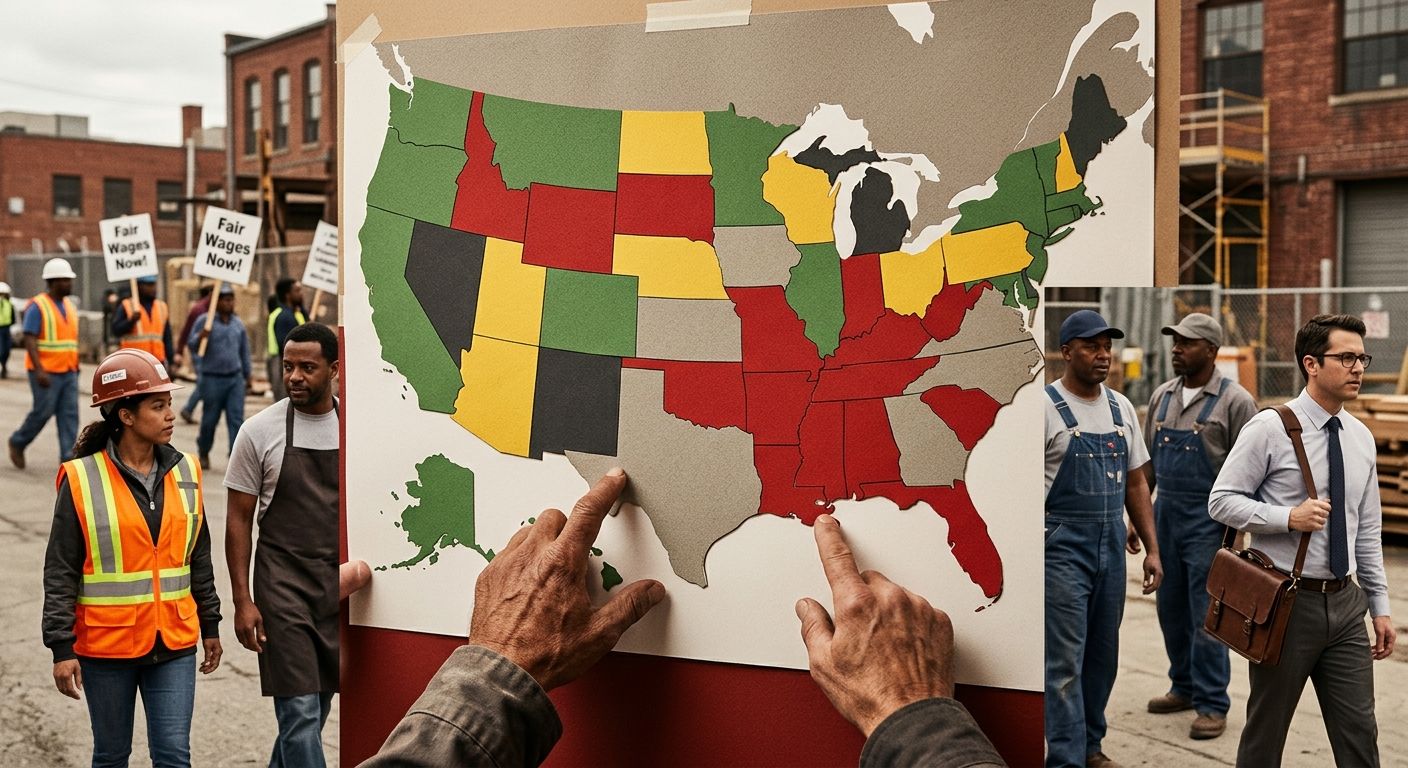
As of 2026, 30 states and the District of Columbia have set minimum wages above the federal floor. Washington state leads at $17.13 per hour. DC tops all jurisdictions at $17.95. On the other end, states like Georgia ($5.15) and Wyoming ($5.15) maintain rates below the federal floor, but FLSA-covered workers in those states still receive $7.25 because the federal rate preempts the lower state rate. We've previously broken down how Georgia's two-tier wage structure works in detail.
Jurisdiction | Minimum Wage | Relationship to Federal Floor |
|---|---|---|
Federal (FLSA) | $7.25 | The floor |
Georgia (state law) | $5.15 | Below federal; federal applies |
Wyoming (state law) | $5.15 | Below federal; federal applies |
Florida | $13.00 | Above federal; state applies |
Illinois | $14.00 | Above federal; state applies |
Washington State | $17.13 | Above federal; state applies |
Washington, DC | $17.95 | Above federal; DC rate applies |
This patchwork means the minimum federal wage is the binding rate for workers in roughly 20 states that either match the federal floor or have no state minimum wage law at all. For workers in the other 30+ states, the federal rate is a legal technicality that their state rate has long surpassed.
Who Still Earns the Federal Minimum
The Bureau of Labor Statistics' 2024 report on minimum wage workers provides the demographic profile of workers earning at or below the prevailing federal minimum. The data reveals patterns that track closely with historical exclusions in the original FLSA.
Workers in leisure and hospitality, food service, and retail make up the largest share of those earning at or below $7.25. Women are overrepresented among minimum wage earners. Workers under 25 account for a disproportionate share, though the framing of minimum wage work as "teenager jobs" obscures the reality that millions of adults depend on these wages to pay rent, buy food, and cover healthcare costs.
The geographic concentration mirrors the state-level policy map. Workers in states that haven't raised their minimums above the federal floor are overwhelmingly located in the South and parts of the Mountain West. These are also the regions with the lowest unionization rates, the fewest worker protection statutes, and some of the highest rates of workplace injury and wage theft. When companies fail to pay workers what they're owed, the baseline they're cheating from is already $7.25.
Healthcare support workers occupy an especially precarious position within this system. Home health aides, nursing assistants, and hospital orderlies in low-wage states often earn close to the federal floor while performing physically demanding, high-injury work. A home health aide in a state pegged to the federal minimum earns $15,080 annually at full-time hours before taxes, well below the federal poverty line for a family of two.
The 30% Purchasing Power Collapse
Adjusted for inflation, the $7.25 federal wage minimum buys less than at any point since the late 1940s. A full-time worker at this rate brings home about $15,080 per year before taxes, roughly $290 per week. The minimum wage hit its peak purchasing power in 1968, when the nominal rate of $1.60 per hour had the equivalent buying power of roughly $14.00 in today's dollars. The current $7.25 is worth about half of what the 1968 rate could buy.
Congress effectively allowed the minimum wage to shrink by doing nothing. And this stagnation at the bottom of the pay scale has widened the gap between frontline workers and executive compensation. A recent analysis found that CEOs at low-wage corporations earned 614 times the median worker's pay, a ratio that hovered around 20-to-1 in the 1960s. The federal minimum wage's freeze hasn't been accompanied by any freeze in executive pay, corporate profits, or the cost of rent, groceries, and healthcare.
For healthcare workers specifically, the purchasing power collapse has accelerated a staffing crisis. Hospitals and nursing homes in states paying near the federal floor struggle to retain certified nursing assistants and dietary staff, who leave for retail jobs that pay the same or better with less physical risk. The resulting understaffing drives up injury rates, burnout, and patient safety incidents, a cycle that poverty wages initiate and sustain.
Current Legislative Proposals
Several bills in Congress aim to raise the minimum wage federal floor, though none has advanced to a vote as of mid-2026. The divide between proposals illustrates how wide the gap between $7.25 and a living wage has grown.
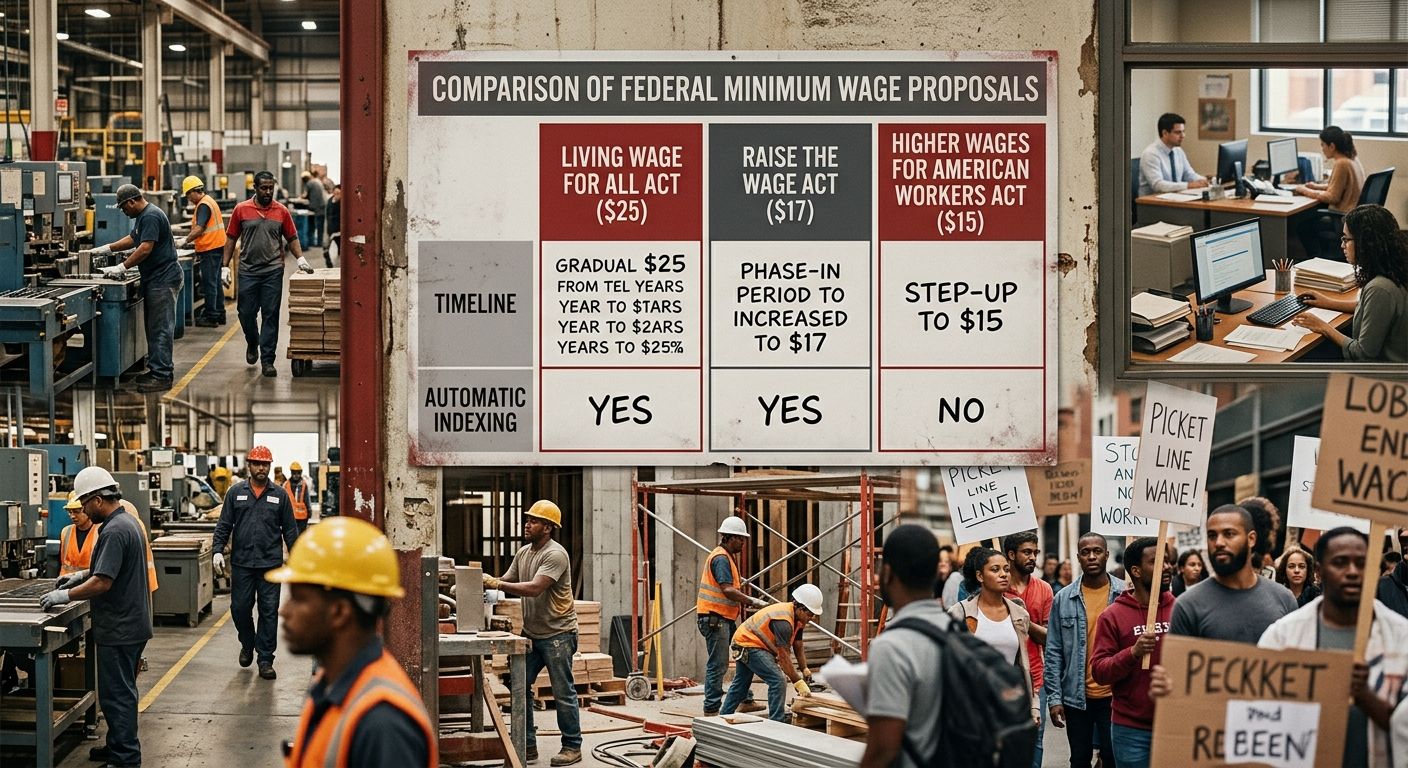
Senator Chris Murphy of Connecticut introduced the Living Wage for All Act, which would raise the federal minimum wage to $25 per hour. Murphy stated that the bill "would ensure millions of workers are able to earn enough to support their families, build financial stability and invest in their futures." The proposal aligns with recommendations from the Economic Policy Institute and the Roosevelt Institute, which advocate pegging the minimum to two-thirds of the national median wage, a benchmark projected to reach $20 by 2030 and $25 by 2038 with automatic annual indexing.
The Raise the Wage Act, reintroduced in various forms, proposes a phased increase to $17 by 2029 or 2031 depending on the version. The Higher Wages for American Workers Act takes a different approach, proposing a faster jump to $15 with subsequent adjustments tied to inflation.
Implementing a $20 federal minimum by 2030 would raise pay for approximately 39.6 million workers, about 27% of the wage-earning workforce, according to EPI projections. Average annual wage gains would reach $4,400 per worker. Black workers would see an average gain of $5,000, Hispanic workers $4,200, and women would make up 31% of those affected. These numbers would reshape entire regional economies, particularly in the South and rural Midwest where the federal rate still functions as the actual pay floor.
Business lobby groups argue that sharp increases would force layoffs and price hikes, particularly in low-margin sectors like food service and retail. The Baker Institute at Rice University notes that supporters of raising the wage "are going back to the drawing board to find the most feasible way to move the policy forward, and there is no shortage of alternatives."
For workers organizing at the state and local level, ballot initiatives have proven more effective than waiting for Congress. States like Florida, Arizona, and Missouri have raised their minimums through direct voter action. Understanding the fundamentals of the federal minimum wage matters because it helps organizers frame state-level campaigns against the backdrop of federal inaction. And as coalition efforts like the Missouri labor alliance fighting for paid sick leave demonstrate, wage campaigns often gain traction when bundled with broader worker protection demands.
Where the Federal Wage Floor Breaks Down
The FLSA's minimum wage provisions contain significant carve-outs that reduce or eliminate the $7.25 floor for specific categories of workers. These exceptions mean the federal wage minimum is more porous than most people realize.
Tipped employees can be paid a direct cash wage of $2.13 per hour, provided their tips bring total compensation to at least $7.25. This "tip credit" system has been in place since 1991, and the $2.13 rate hasn't changed in 35 years. Employers are legally required to make up the difference if tips fall short, but enforcement is weak and violations are widespread. The Department of Labor's Wage and Hour Division recovers millions in back wages from tip credit violations annually.
Workers with disabilities can be paid below the minimum under Section 14(c) of the FLSA, which allows employers holding special certificates to pay "commensurate wages" based on productivity comparisons with non-disabled workers. Some workers under this provision earn pennies per hour. Disability rights organizations have spent years campaigning to eliminate 14(c), calling it a Depression-era relic that segregates disabled workers into exploitative sheltered workshops.
Youth workers under 20 years old can be paid $4.25 per hour for their first 90 consecutive calendar days of employment. After that, the full $7.25 applies. Full-time students, student learners, and workers in certain seasonal establishments may also be paid subminimum rates under specific FLSA certificates.
Independent contractors fall outside the FLSA entirely. Workers classified as contractors receive no minimum wage protections, no overtime, and no coverage under the wage floor. The growth of gig work has made this exclusion increasingly consequential, as companies structure work arrangements to avoid employer obligations. States like New Jersey have moved to tighten classification rules, but the federal framework still allows broad contractor classifications that strip workers of basic pay protections.
These exceptions reveal the federal wage floor as a structure with significant holes. For millions of tipped workers, disabled workers, and gig workers, the $7.25 rate functions as a ceiling they can't reach rather than a floor they stand on.
Common Questions
Does the minimum federal wage apply to all workers?
No. The FLSA covers most private-sector employees and federal, state, and local government workers, but specific exemptions exist for tipped employees ($2.13 direct cash wage), workers with disabilities under Section 14(c) certificates, youth workers in their first 90 days ($4.25), and independent contractors. Small businesses with annual gross sales below $500,000 that don't engage in interstate commerce may also fall outside FLSA coverage, though state minimum wage laws typically still apply.
What happens when a state minimum wage is lower than the federal rate?
The worker receives the higher rate. Federal law preempts lower state rates for all FLSA-covered employees. Georgia and Wyoming both set state minimums at $5.15, but covered workers in those states earn the federal $7.25. The only workers who could legally receive the lower state rate are those in the narrow category of jobs not covered by the FLSA.
Why hasn't Congress raised the minimum wage since 2009?
The 17-year freeze is the longest in the FLSA's 88-year history. Multiple bills have been introduced, including proposals to raise the rate to $15, $17, or $25, but none has secured enough votes to pass both chambers. Political opposition centers on concerns about job losses and inflation, while supporters point to the 30% erosion in purchasing power and the 39.6 million workers who would benefit from a raise to $20 by 2030. State-level action through legislatures and ballot initiatives has filled some of the gap, with over 30 states now exceeding the federal floor.
How does the federal minimum wage affect healthcare workers?
Healthcare support workers in states pegged to the federal floor are among the hardest hit by the $7.25 rate. Home health aides, nursing assistants, and hospital support staff in these states earn annual full-time wages of roughly $15,080 before taxes. The low pay drives turnover rates above 50% annually in many facilities, contributing to chronic understaffing that increases workplace injuries and reduces patient care quality. States with higher minimums, like Washington at $17.13, see measurably better healthcare worker retention than states sitting at the federal floor.
Can cities set their own minimum wage above both state and federal levels?
Yes. Cities and counties can enact local minimum wage ordinances that exceed both the state and federal rates, as long as state law doesn't preempt local wage-setting authority. Cities like Seattle, San Francisco, and Denver have done exactly this. But roughly 25 states have passed preemption laws that block cities and counties from setting local minimums higher than the state rate, effectively locking workers in those areas into whatever the state legislature decides.
The Union Edge Staff
Frequently Asked Questions
- What is the current federal minimum wage?
- The current federal minimum wage is $7.25 per hour, established by the Fair Labor Standards Act and frozen since July 24, 2009.
- What happens when state minimum wage is lower than federal minimum wage?
- When a state sets a minimum wage lower than the federal rate, workers are entitled to the higher federal rate of $7.25 per hour. Federal law preempts lower state rates for all FLSA-covered employees.
- Which states have minimum wages higher than federal minimum?
- As of 2026, 30 states and the District of Columbia have set minimum wages above the federal floor, with Washington DC leading at $17.95 per hour and Washington state at $17.13 per hour.
- How much has the federal minimum wage lost in purchasing power?
- The $7.25 federal minimum wage has lost 30% of its purchasing power in real terms and is worth roughly half of what the 1968 minimum wage rate of $1.60 could buy.
- What are the exceptions to the $7.25 minimum wage?
- The FLSA allows tipped employees to be paid $2.13 per hour, workers with disabilities under Section 14(c) certificates to be paid below minimum based on productivity, youth workers under 20 to earn $4.25 for their first 90 days, and independent contractors receive no minimum wage protections.
- How much would a full-time worker earn at federal minimum wage per year?
- A full-time worker earning the federal minimum wage of $7.25 per hour brings home approximately $15,080 per year before taxes, which is below the federal poverty line for a family of two.
- What are the proposed bills to raise the federal minimum wage?
- Pending proposals include the Living Wage for All Act proposing $25 per hour, the Raise the Wage Act proposing a phased increase to $17 by 2029-2031, and the Higher Wages for American Workers Act proposing a faster jump to $15 with inflation adjustments.
- Why hasn't Congress raised the minimum wage since 2009?
- Multiple bills have been introduced but none has secured enough votes to pass both chambers, with political opposition centered on concerns about job losses and inflation, while the 17-year freeze is the longest in the FLSA's 88-year history.
Related Articles

Federal Minimum Wage: What You Need to Know
The federal minimum wage is $7.25 per hour, set by the Fair Labor Standards Act (FLSA) and enforced by the U.S. Department of Labor's Wage and Hour Division. That rate has been frozen since July 24, 2009, making it the longest period without an increase since the FLSA became law in 1938.

Minimum Texas Wage: What You Need to Know
Unlike 30 states that set independent minimum wage floors above the federal rate, Texas adopted the federal number by reference and then built a legal architecture that prevents any city or county from going higher. The result: the minimum wage in Texas has been $7.

Minimum Wage Texas: Current Laws & Rates
Chapter 62 of the Texas Labor Code contains no independent wage figure. It copies the federal minimum wage by reference, which means the texas minimum wage has been $7.25 per hour since July 24, 2009, and won't change unless Congress acts.
Also in the paper