
The Hidden Dangers of Workplace Machinery: Why OSHA's 2026 Standards Matter for Your Safety
"I watched the press come down on Marcus's hand because the guard had been removed three shifts ago and nobody fixed it. Management knew. We all knew. The difference is, we couldn't afford to refuse the work." That's what a stamping plant worker in Ohio told us.

The Hidden Dangers of Workplace Machinery: Why OSHA's 2026 Standards Matter for Your Safety
"I watched the press come down on Marcus's hand because the guard had been removed three shifts ago and nobody fixed it. Management knew. We all knew. The difference is, we couldn't afford to refuse the work." That's what a stamping plant worker in Ohio told us. She asked us not to use her real name. Marcus lost two fingers. The company got a $16,131 fine.
That fine structure is changing. And so are the rules. But if you're a worker standing next to machinery every day, you need to understand exactly what the OSHA 2026 standards mean for you, what they don't cover, and how your coworkers can organize to fill the gaps that regulation alone never will.
The Numbers That Should Make You Angry
Contact with objects and equipment accounted for 14% of all workplace fatalities in 2024, according to the Bureau of Labor Statistics. Machinery-related incidents were a leading contributor within that category. That's not a rounding error. That's people.
And here's the part that keeps us up at night: most of those deaths were preventable. Not theoretically preventable, not "if only we had better technology" preventable, but preventable with basic machine guarding that's been required under 29 CFR 1910.212 since the 1970s. The standard is clear. When the periphery of fan blades is less than seven feet above the floor or working level, those blades must be guarded with openings no larger than one-half inch. That's specific. That's measurable. And it's still being ignored on shop floors across the country.
The problem was never a lack of rules. The problem has been a lack of enforcement, a lack of worker voice, and a culture where production speed beats safety every single time.
What's Actually Changing With OSHA in 2026
So what's different now? Several things, and they matter.
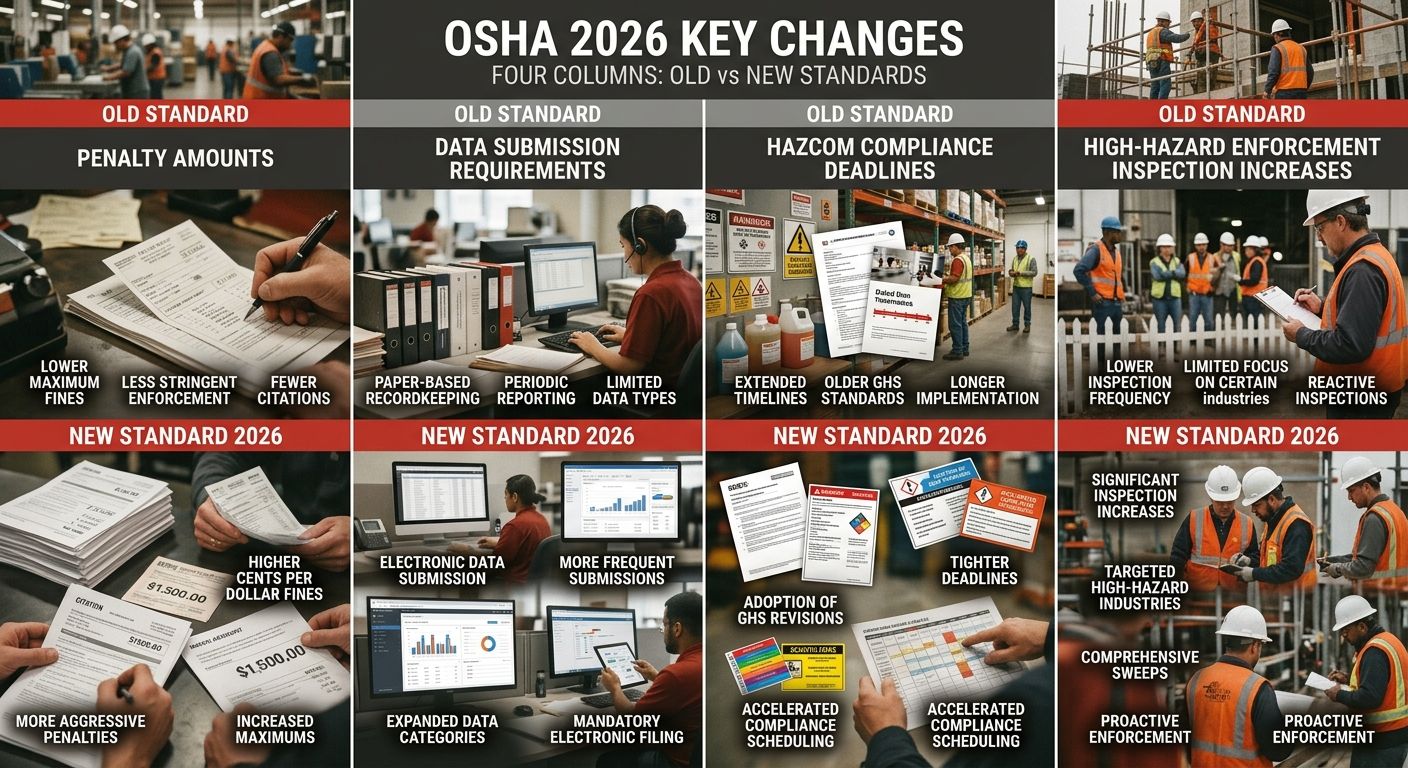
High-risk industries like construction, manufacturing, energy, and utilities are facing expanded inspections, stricter enforcement, and updated safety standards. OSHA isn't just writing new rules. They're building the infrastructure to actually catch violators.
Data-Driven Enforcement Is Here
Since January 2024, certain high-hazard employers have been required to electronically submit OSHA Forms 300 and 301 in addition to Form 300A. By 2026, OSHA is expected to ramp up enforcement and increase data transparency using that data. Translation: OSHA now has a much clearer picture of which facilities are racking up injuries, and they're using predictive analytics to target inspections.
This is a direct response to decades of complaints from workers and safety advocates that OSHA operated blind. The agency simply didn't have the data to know where the worst actors were. Now they do. National Emphasis Programs on heat, falls, and warehousing signal that facilities with recurring machinery-related incidents should expect more frequent audits.
Penalty Increases
Fines went up. As of January 2025, serious and other-than-serious violations carry a maximum penalty of $16,550 per violation. Willful or repeated violations can hit $165,514 per incident. These numbers sound big until you compare them to the profits of a mid-size manufacturer. A $16,550 fine for a missing machine guard is a rounding error on a quarterly earnings report.
Hazard Communication Updates
OSHA has strengthened the Hazard Communication Standard (HazCom) to align with the Globally Harmonized System Revision 7. Manufacturers, importers, and distributors must comply with updated requirements for hazard classification, labeling, and Safety Data Sheets by May 19, 2026. Employers must update workplace labeling, training, and written programs by November 20, 2026. If you work around chemicals used to clean, lubricate, or treat machinery, this affects you directly.
Heat Illness Prevention Standard
This one might surprise you in an article about machinery, but hear us out. OSHA is advancing a proposed Heat Illness Prevention Standard that requires hydration, rest breaks, acclimatization, and monitoring. Why does this matter for workplace machinery safety? Because heat stress impairs cognitive function and reaction time. A press operator working in a 105-degree foundry without adequate breaks is a press operator who's going to make a mistake. The human body isn't separate from the machine it operates.
The Machine Guarding Problem Nobody Wants to Talk About
Let's get specific about what kills and maims people.
Under 29 CFR 1910, Subpart O, employers must guard machinery at the point of operation, at power transmission points, and at any other area where worker contact with moving parts is possible. The CDC's machine safety guidance reinforces that employers must educate employees on machine safety for every specific machine they use, follow government regulations, and stay current on safety training.
OSHA's own hazard prevention framework emphasizes "Prevention through Design" principles, urging employers to select equipment and machinery that are inherently safer based on the application. The idea is simple: design out the hazard before a worker ever touches the machine.
But here's what we see on the ground, over and over. Guards get removed because they slow production. Lockout/tagout procedures get skipped because they add fifteen minutes to a changeover. Emergency stops get bypassed because they're "too sensitive." And workers who raise concerns get labeled as troublemakers.
This is exactly why worker protection regulations matter, but they're never enough on their own. The gap between what OSHA requires and what actually happens in your facility is the space where organizing lives.
What High-Hazard Enforcement Actually Looks Like
The phrase high-hazard enforcement gets thrown around a lot. Here's what it means in practice.
OSHA designates certain industries and workplaces as high-hazard based on injury rates, fatality data, and the nature of operations. Manufacturing, construction, energy, utilities, and increasingly warehousing and logistics fall into this category. The 2026 priorities reflect stepped-up enforcement for these high-risk industries, including workplace violence prevention efforts that directly affect workers who operate around dangerous machinery.
When OSHA targets a high-hazard workplace, you can expect:
Unannounced inspections triggered by injury data patterns, worker complaints, or referrals from other agencies
Record reviews of your facility's 300 logs, 301 incident reports, and training documentation
Walk-around inspections where OSHA compliance officers observe actual working conditions, interview employees, and check machine guards, LOTO stations, and PPE availability
Follow-up inspections to verify that cited hazards have been corrected
Workers have rights during these inspections. Under Section 8(e) of the OSH Act, an authorized employee representative has the right to accompany the OSHA compliance officer during the physical inspection. If you have a union, your steward should be walking that inspection. If you don't have a union yet, a designated worker representative can still participate.
Five Things You Can Do Right Now
We've been at this long enough to know that articles about regulations don't save fingers. Action does. Here's what works.
1. File OSHA Complaints Strategically
You have the legal right under Section 11(c) of the OSH Act to report unsafe conditions without retaliation. File online, by phone, or in writing. Be specific. Don't say "the machines are dangerous." Say "the point-of-operation guard on press #7 in Building C has been removed since March and the supervisor is aware." Specificity triggers inspections.
2. Document Everything
Take photos. Keep a personal log with dates and times. Save text messages where supervisors tell you to bypass safety procedures. If you're building toward an organizing campaign, this documentation becomes critical evidence that demonstrates why collective bargaining over safety conditions matters.
3. Request Your Facility's OSHA 300 Logs
Under 29 CFR 1904.35, current and former employees have the right to access their workplace's injury and illness records. Request them. Compare the official numbers to what you actually see happening. Discrepancies are powerful organizing tools and potential evidence of recordkeeping violations.
4. Build a Safety Committee
Even in non-union workplaces, you can organize an informal safety committee. Walk the floor together. Identify hazards. Present findings to management in writing. This creates a paper trail and builds the kind of collective muscle that translates directly into organizing power. The connection between workplace stress on families and unsafe conditions is real, and framing safety as a family issue brings more coworkers into the fight.
5. Connect Safety to Broader Organizing
Safety grievances are among the most powerful catalysts for union drives. Workers who've been told to run a machine with a broken guard understand immediately why they need a contract that gives them the right to refuse unsafe work. If your workplace is ready, understanding your NLRB protections is the essential first step.
Why Corporate "Safety Culture" Programs Often Fail Workers
You've probably sat through the presentations. The glossy posters. The pizza parties when your department hits zero recordable injuries for a quarter. The apps where you're supposed to report "near-misses" with a smiley-face interface.
We're not against safety programs. We're against safety theater that shifts blame to workers while ignoring systemic hazards. When a company celebrates "behavioral-based safety" while removing machine guards to speed up production, that's not a culture of safety. That's a culture of liability management.
The real test is simple. Can a worker on your floor stop a machine because they believe it's unsafe, without losing their job or getting written up? If the answer is no, your company doesn't have a safety culture. It has a PR strategy.
This is where civic engagement beyond the picket line becomes essential. Workers who understand OSHA rulemaking processes, who submit public comments during regulatory proceedings, who show up at state legislative hearings on worker protection regulations are the ones who shape the standards that eventually protect everyone.
The Fight Ahead
The OSHA 2026 standards represent real progress. More data. More inspections. Higher penalties. Better hazard communication. All of these things matter.
But they won't matter enough if workers aren't organized to enforce them. OSHA has roughly 1,850 inspectors covering 130 million workers at more than 8 million worksites. Do the math. An inspector can't be at your facility every day. Your coworkers can.
Every machine guard that stays in place because a worker insisted on it, every lockout/tagout procedure that gets followed because a steward made it non-negotiable, every near-miss that gets reported honestly instead of buried represents the real enforcement mechanism in American workplaces. It's not a federal agency. It's you, standing together.
Talk to your coworkers this week. Walk the floor and look at the machines you use every day with fresh eyes. Ask yourself: if OSHA showed up tomorrow, what would they find? Then ask the harder question: what are you going to do about it before they get here?
Solidarity keeps people alive. That's not rhetoric. That's the whole point.
The Union Edge Staff
Also in the paper