
US Union Membership Rose by 411,000 Workers in 2025, With Most Gains in States Protecting Collective Bargaining
Union membership in the United States increased by 411,000 workers in 2025, the largest single-year gain since 2008, with nearly three-quarters of new members concentrated in states that legally protect collective bargaining rights, according to a report released September 7, 2026, by the Illinois E

US Union Membership Rose by 411,000 Workers in 2025, With Most Gains in States Protecting Collective Bargaining
Union membership in the United States increased by 411,000 workers in 2025, the largest single-year gain since 2008, with nearly three-quarters of new members concentrated in states that legally protect collective bargaining rights, according to a report released September 7, 2026, by the Illinois Economic Policy Institute and the Project for Middle Class Renewal at the University of Illinois at Urbana-Champaign. States with collective bargaining protections added approximately 305,000 union members, compared to roughly 107,000 in the 26 states with right-to-work laws, according to the analysis.
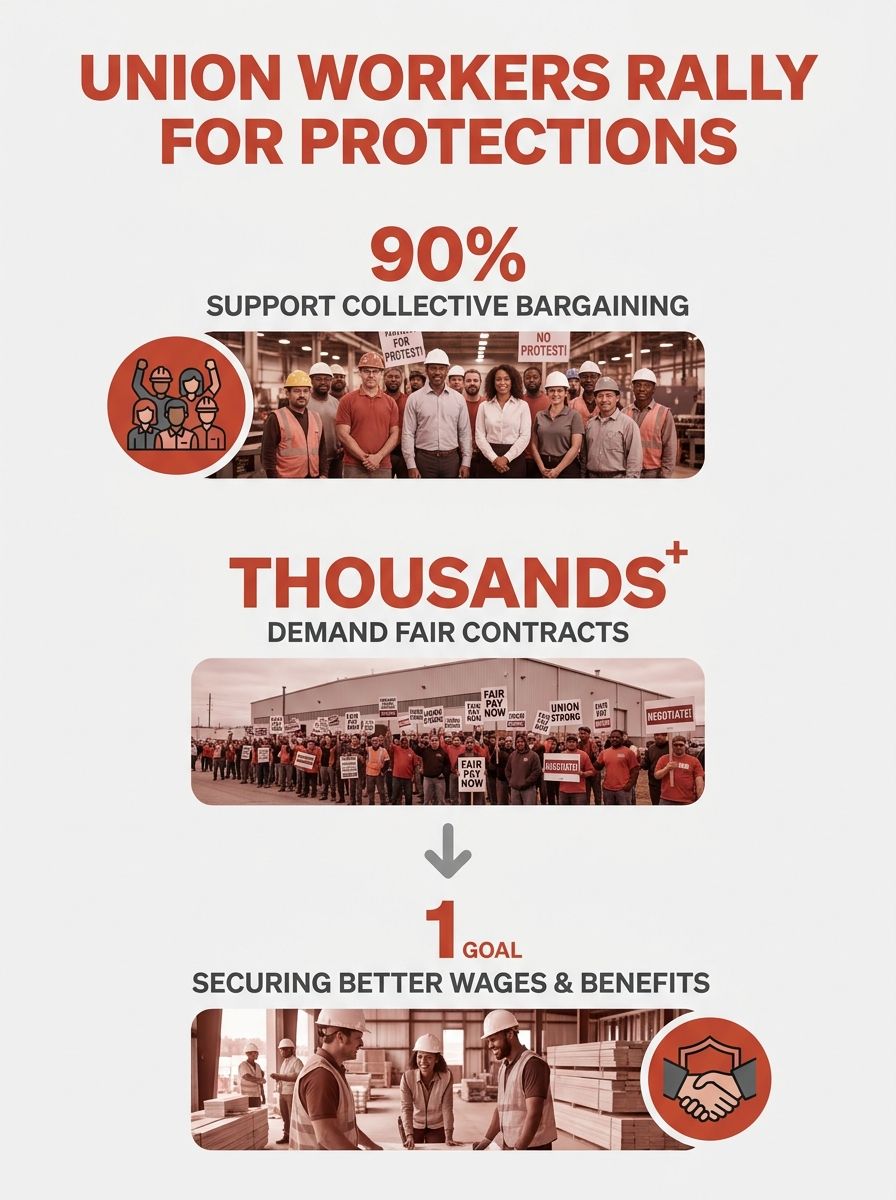
The data reveals a widening divide in union participation based on state labor policy. States with collective bargaining protections now count 10.9 million union members among 76.9 million total workers, while right-to-work states have 3.7 million members across 69.7 million workers. National union density—the percentage of workers belonging to unions—rose from 9.9% to 10.0% in 2025, with 16.5 million workers represented by unions, the highest level recorded in 16 years.
Geographic Distribution of Membership Growth
States with collective bargaining protections saw union membership rates nearly triple those in right-to-work jurisdictions during 2025. The 305,000-member increase in protection states represented 74% of total national growth, despite these states employing a roughly equivalent share of the national workforce. Right-to-work states, which account for 26 jurisdictions across primarily southern and western regions, added 107,000 members but continue to lag significantly in overall union density.
The membership pattern reflects legal frameworks established over decades. Right-to-work laws permit workers to receive benefits of collective bargaining agreement protections without paying union dues, a structure labor economists describe as "free riding." Most right-to-work legislation passed during the 1940s and 1950s following advocacy by conservative activist Vance Muse, who promoted the laws in southern states with arguments linked to preserving segregation-era policies.
Wage Impact Across State Policy Lines
Workers in states protecting collective bargaining rights earned 8% more than their counterparts in right-to-work states in 2025, after adjusting for cost-of-living differences, the report found. Labor unions nationally raise average wages by 8%, according to the analysis. Workers in right-to-work states also experienced 3% slower wage growth from 2019 to 2025 compared to workers in protection states.
"The data consistently shows that workers earn higher wages when they are union members and work in states that protect collective bargaining rights," said Frank Manzo IV, economist at the Illinois Economic Policy Institute and report coauthor. "More Americans are turning to unions as a bulwark against the rising cost of living."
The wage gap between protection states and right-to-work states more than doubled over the past decade, expanding from 3.2% in 2015 to 6.7% in 2025. For the median full-time worker, that differential translates to approximately $4,000 less in annual earnings in right-to-work states. Robert Bruno, professor at the University of Illinois at Urbana-Champaign and director of the Project for Middle Class Renewal, noted that collective bargaining lifts wages for both union and non-union workers by raising the regional wage floor.
Public Support and Legislative Activity
Public approval of labor unions remained strong through 2025, with 71% of Americans expressing support in a recent Gallup poll and 47% stating they want unions to have more influence. An AFL-CIO poll released before Labor Day found 52% of Americans trust labor unions, compared to 32% who trust the Democratic Party and 26% who trust the Republican Party. Among young workers not currently in unions, 57% reported they would join if given the option.
"This Labor Day, shit's too expensive," said Liz Shuler, president of the AFL-CIO, during a Labor Day address. "That's what 94% of workers told us, in our new poll. Four out of five say: paychecks aren't keeping up with the cost of living—groceries, rent, childcare, gas."
Nineteen US states passed 88 laws expanding workers' rights in 2025, according to a September 3 issue brief by State Futures and NYU Wagner Labor Initiative. The legislation included paid sick leave and medical leave in Virginia, warehouse worker protections in Connecticut, and a near-total ban on non-compete agreements in Washington. The legislative wave coincided with organizing momentum in sectors including tech, retail, and service industries.
Context and Outlook
The 2025 membership surge represents the strongest validation yet that state-level labor policy directly determines organizing success in the modern economy. The 305,000-to-107,000 split between protection states and right-to-work jurisdictions provides organizers with quantifiable evidence that legal frameworks either enable or suppress union growth regardless of economic conditions or industry composition. For unions targeting expansion in southern and western states, the data underscores the structural disadvantage posed by right-to-work laws passed generations ago with explicit segregationist intent.
The wage findings carry particular weight as inflation concerns dominate worker conversations. The $4,000 annual earnings gap tied to state policy creates a measurable recruiting argument for organizers operating across state lines, especially in industries where workers can compare compensation with peers in neighboring jurisdictions. The doubling of this gap from 3.2% to 6.7% over ten years suggests right-to-work states are falling further behind, not converging.
With 16.5 million workers now represented by unions and public approval at 71%, the movement enters 2026 with momentum uncommon in recent decades. Whether that translates to legislative rollback of right-to-work statutes—particularly in states where margins shifted in recent elections—will determine if 2025's gains mark a temporary spike or the beginning of sustained density growth across previously hostile terrain.
The Union Edge Staff
Related Articles
House Passes Union Contract Bill as Worker Income Share Hits 79-Year Low
The U.S. House of Representatives passed the Faster Labor Contracts Act on September 15, legislation designed to expedite union contract negotiations for newly organized workplaces, according to an analysis published in the Las Vegas Sun.

U.S. Employers Spent $1.7 Billion Fighting Unions in 2025 as Membership Hits 16-Year High
U.S. employers spent an estimated $1.7 billion in 2025 hiring consultants and attorneys to oppose union organizing efforts, according to a study released Tuesday by union-busting watchdog LaborLab and the Economic Policy Institute, even as union membership climbed to 16.5 million workers—the highest

AFL-CIO Endorses Sectoral Bargaining for First Time as States Lead New Wave of Worker Organizing
The AFL-CIO passed a resolution at its July 2026 conference endorsing sectoral bargaining for the first time in the federation's history, according to a Time article published Wednesday.
Also in the paper