
Minimum Wage State of Maryland: 2024 Guide
The Fair Wage Act of 2023 set the minimum wage in the state of Maryland at $15.00 per hour for all employers regardless of size, effective January 1, 2024, pulling an estimated 163,000 workers above the previous $13.25 floor. But $15.00 is the baseline, not the ceiling.

Minimum Wage State of Maryland: How the Three-Layer Rate Structure Works
The Fair Wage Act of 2023 set the minimum wage in the state of Maryland at $15.00 per hour for all employers regardless of size, effective January 1, 2024, pulling an estimated 163,000 workers above the previous $13.25 floor. But $15.00 is the baseline, not the ceiling. County-level laws and living wage statutes stack additional requirements on top, creating a layered system that determines what your employer actually owes you.
What the Fair Wage Act of 2023 Changed
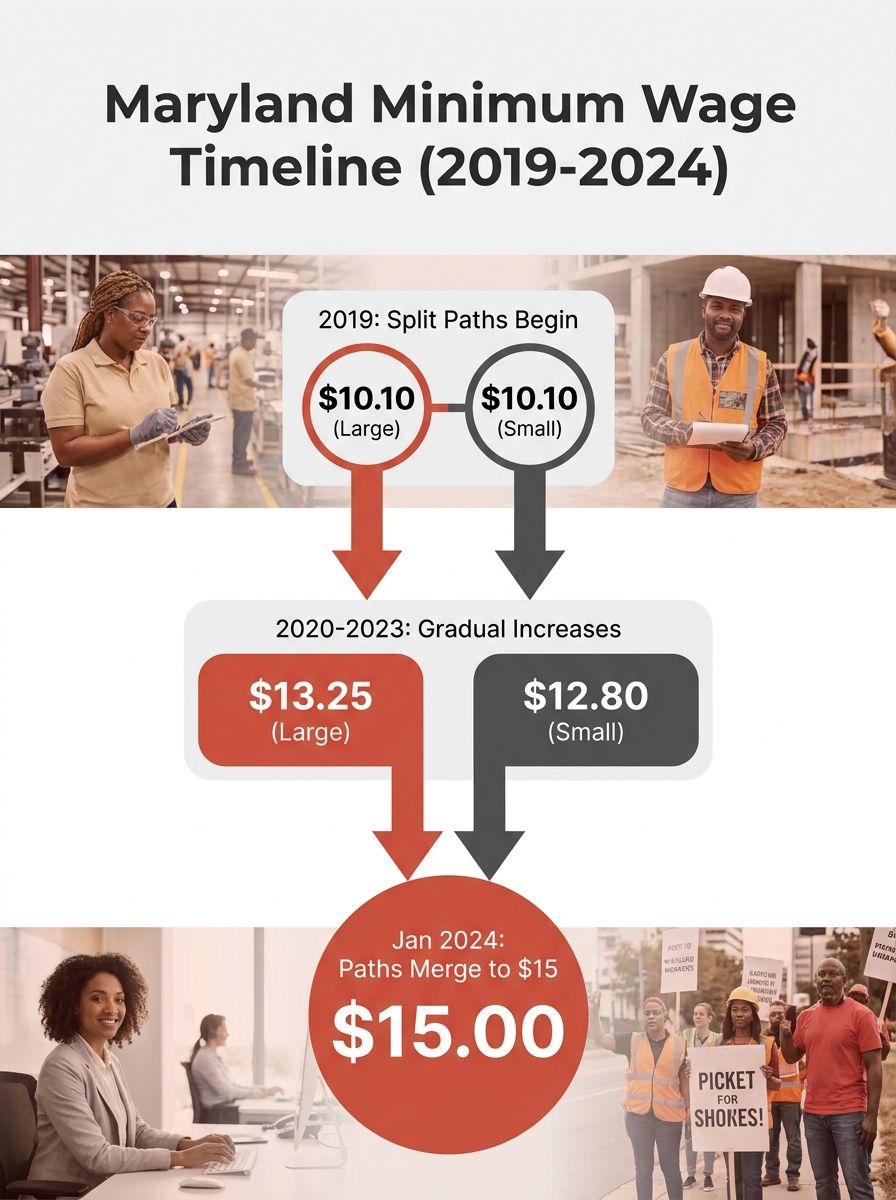
Governor Wes Moore signed the Fair Wage Act of 2023 to accelerate a minimum wage timeline that had been creeping upward since 2019. Before the Act, Maryland had a split schedule: large employers (15 or more employees) were on track to reach $15.00 by January 1, 2024, while small employers (fewer than 15) wouldn't hit $15.00 until July 1, 2026. The Fair Wage Act collapsed that distinction, requiring every employer in the state to pay $15.00 per hour starting January 1, 2024.
The acceleration mattered most for workers at small businesses. Under the old schedule, an employee at a 10-person company would have earned $13.25 per hour through the end of 2023, then gone through another two and a half years of incremental raises. The Fair Wage Act gave those workers a $1.75-per-hour raise overnight, which amounts to roughly $3,640 more per year for someone working full time.
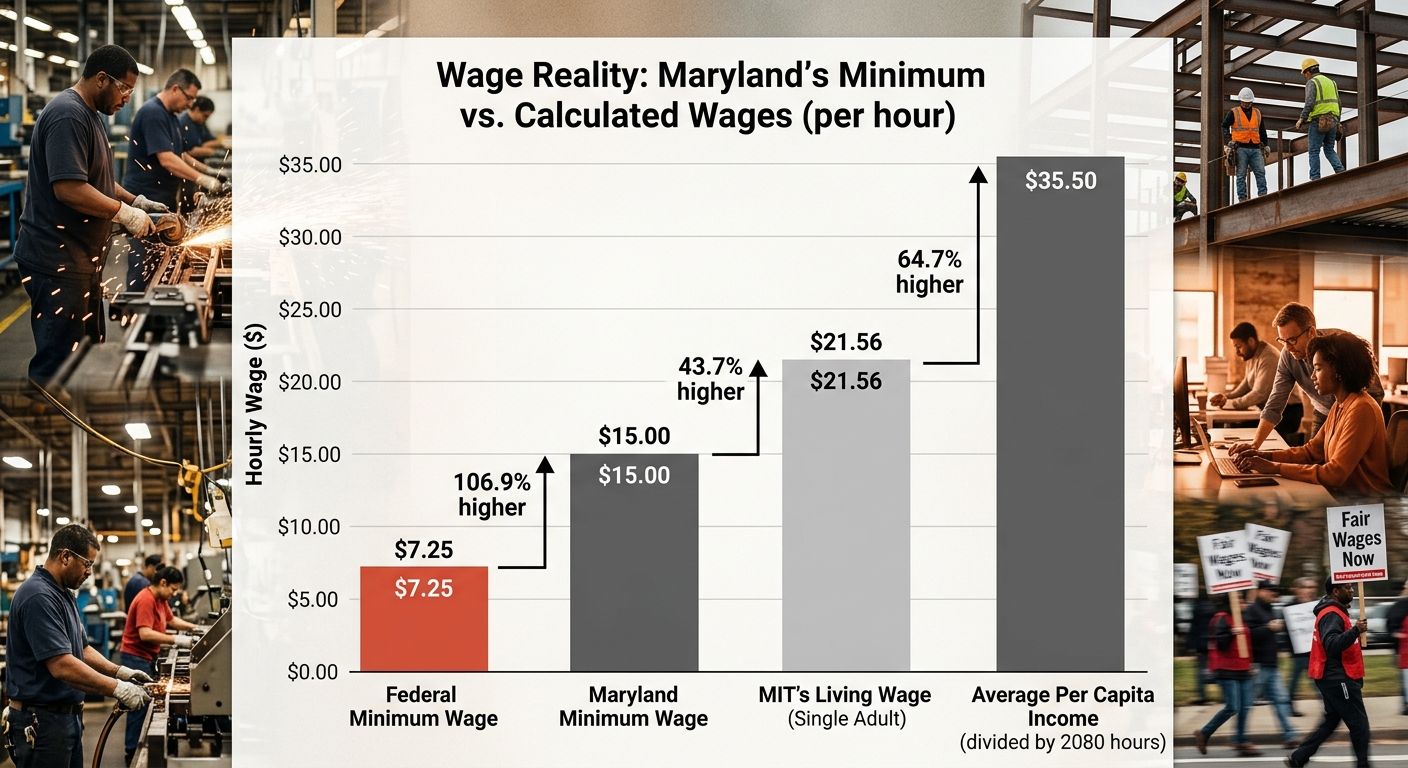
For context, Maryland workers averaged a per capita personal income of $73,849 in 2023, compared to the national average of $68,499. The state ranks among the wealthiest in the country, which makes the gap between $15.00 per hour ($31,200 annually for full-time work) and the actual cost of living especially pronounced. A worker earning the minimum wage in Maryland brings home less than half the state's average income.
The County Override System
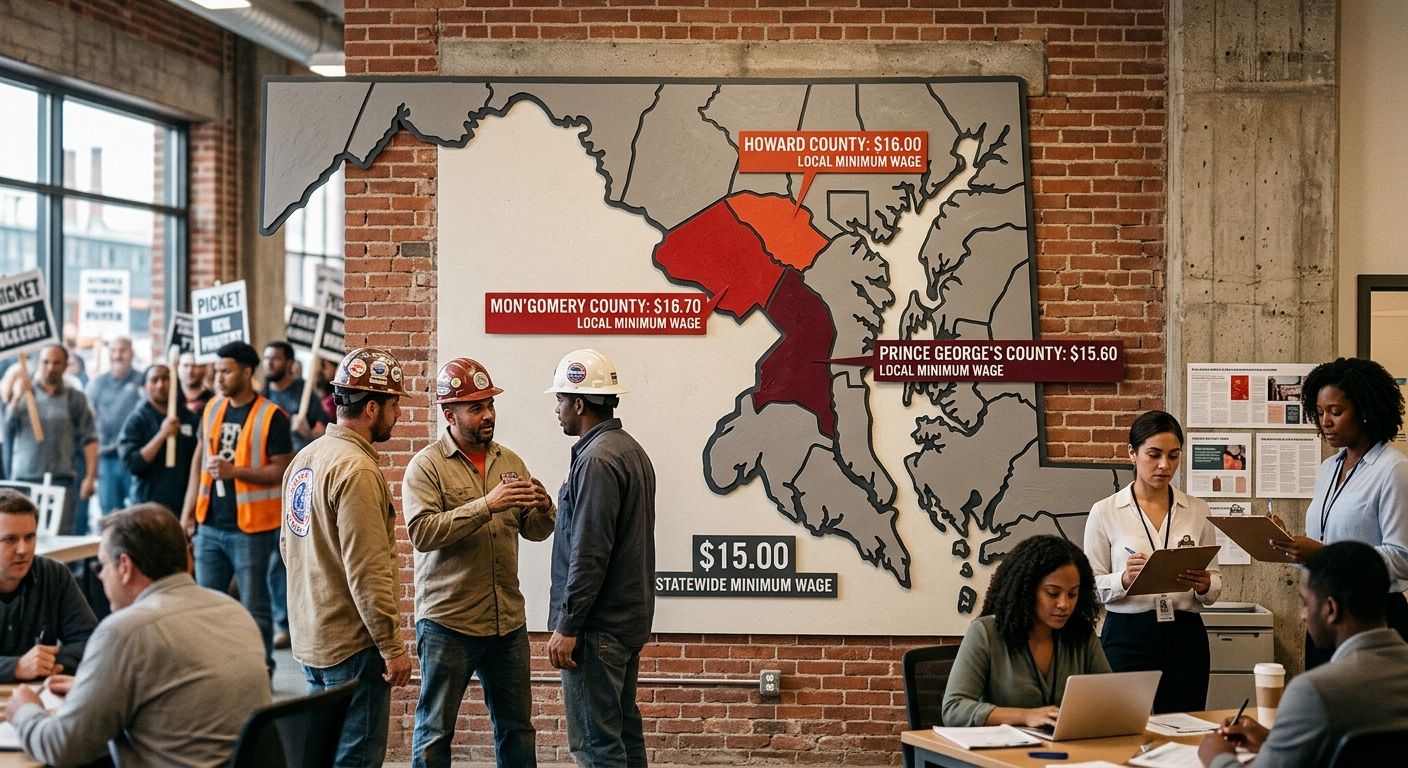
The statewide $15.00 floor operates like a basement. Local jurisdictions can build higher, and three Maryland counties currently enforce their own minimum wage laws. Employers within those counties must pay whichever rate is higher.
Montgomery County runs the highest rates in the state. As of July 1, 2026, rates break down by employer size:
Employer Size | Hourly Rate (July 1, 2026) |
|---|---|
Large (51+ employees) | $18.00 |
Mid-sized (11–50 employees) | $16.50 |
Small (10 or fewer employees) | $15.95 |
Montgomery County had already required most employers to pay $15.00 or more before the state law caught up. The Fair Wage Act's primary impact in Montgomery County was on small businesses with 10 or fewer employees, which had been paying $14.50 under the county schedule.
Howard County established its own minimum as of January 1, 2025: $16.00 per hour for employers with 15 or more employees, and $15.50 for employers with 14 or fewer. The smaller-employer rate rises to $16.00 by July 2025.
Prince George's County set its minimum wage at $15.30 per hour for all employers, effective January 1, 2026.
Workers in the rest of Maryland follow the statewide $15.00 rate. The practical effect of this patchwork: a fast-food worker in Bethesda earns a guaranteed $18.00 per hour while a fast-food worker in Hagerstown earns $15.00, for identical work, because county borders determine which layer of law applies.
This county-level variation mirrors patterns across the country. Similar dynamics play out in states like Michigan, where the minimum wage structure also layers state and local rules, and in Arizona, where a CPI-indexed formula sets automatic annual adjustments.
Tipped Wages, Youth Rates, and the Subminimum Floor
Maryland law permits employers to pay tipped employees a cash wage of $3.63 per hour, roughly 24% of the full minimum wage, provided that tips bring the worker's total hourly compensation to at least $15.00. If tips fall short, the employer must make up the difference. This is the "tip credit" system, and it shifts the financial risk of slow shifts onto workers while giving employers a subsidy that can exceed 75% of the base wage.
The enforcement gap is real. Workers who don't track their own tip totals, or whose employers don't maintain accurate records, often end up earning below the legal floor without knowing it. Maryland law under Md. Code, Lab. & Empl. § 3-413 requires employers to keep precise records of hours and tips for at least three years, but compliance audits are infrequent. We've seen this pattern of wage underpayment repeatedly, including in cases like Chicago daycare workers fighting to recover thousands in stolen wages.
Minors under 18 who work fewer than 20 hours per week can be paid 85% of the state minimum wage, which works out to $12.75 per hour. The rationale is that these are part-time, supplemental positions, but for teenagers helping to support their families, the lower rate means hundreds of dollars left on the table each month.
Overtime in Maryland follows the federal standard: 1.5 times the regular rate for hours worked over 40 per week. Agricultural workers have a separate threshold of 60 hours per week before overtime kicks in. That carve-out affects some of the state's lowest-paid workers, many of whom are immigrant laborers with limited bargaining power.
Living Wage Laws Add a Fourth Variable
Maryland's living wage statute operates separately from the minimum wage and applies specifically to employers who hold contracts with the state government. These contractors must pay their employees a "living wage" that varies based on geographic location within the state. The law distinguishes between the Baltimore-Washington metropolitan area and the rest of Maryland, setting different floors for each.
Here's the critical detail: if the living wage rate falls below the state minimum wage, the minimum wage prevails. Workers must always receive whichever figure is higher. This creates a ratcheting effect. As the minimum wage has climbed to $15.00, some living wage rates that were once above the minimum have been absorbed into it, effectively disappearing as a separate protection.
MIT's Living Wage Calculator estimates that a single adult in Maryland needs approximately $21.56 per hour to cover basic expenses including housing, food, transportation, and healthcare. For a single adult with one child, that figure jumps above $40.00. The $15.00 minimum wage covers roughly 70% of what a single adult actually needs to live in the state, and less than 40% for a single parent.
This gap between the minimum wage and a genuine living wage is the structural tension underneath every wage debate in Maryland. The federal minimum wage remains frozen at $7.25, which means Maryland's $15.00 floor is more than double the federal standard, yet it still falls short of covering basic needs in one of the country's most expensive states.
How Union Contracts Push Above Every Layer
AFSCME's contract with the state of Maryland demonstrates what collective bargaining produces on top of the statutory floor. Under the agreement effective July 1, 2024, state workers covered by AFSCME contracts received pay increases ranging from 5% to upwards of 20%, depending on job classification, agency, and years of service. Every covered worker received a 3% cost-of-living adjustment (COLA) as a baseline, with additional raises layered on for specific job classes that had fallen behind market rates.
The Maryland Comptroller's office confirmed the 3% COLA for all state regular employees, including Executive Pay Plan employees, effective July 1, 2024. This kind of structured, negotiated increase is fundamentally different from a legislated minimum wage hike. It's the result of workers at the table, not waiting for lawmakers to act.
The contrast matters because it reveals the limits of minimum wage law as a tool for economic justice. A $15.00 floor helps the workers earning $13.25, but it does nothing for the worker earning $15.50 who watched their rent climb 30% since 2020. Union contracts address wage compression, cost-of-living erosion, and classification-specific underpayment in ways that minimum wage statutes can't. And as CEO-to-worker pay ratios continue widening across the economy, the case for organized bargaining grows sharper.
Where the Model Breaks
Maryland's three-layer wage structure has several failure points that leave workers exposed, even after the Fair Wage Act brought the floor to $15.00.
Wage compression is the most immediate problem. When the minimum wage jumps to $15.00, employees who were already earning $15.50 or $16.00 see their wage advantage disappear. Experienced workers and supervisors suddenly earn the same as new hires. The Maryland Chamber of Commerce has flagged this effect in response to HB 1229/SB 886, a bill that would raise Maryland's minimum wage to $25.00, eliminate the tip credit entirely, and embed the mandate in the state constitution. The Chamber warned that "for some small and mid-sized businesses, the question may not be whether to raise prices, but whether to reduce staff, automate, delay growth, or close altogether."
Enforcement remains thin. Maryland's Division of Labor and Industry handles wage complaints, but the agency lacks the staffing to proactively audit employers, particularly small businesses with fewer than 15 employees. Tipped workers and agricultural laborers, the groups most vulnerable to wage theft, are also the least likely to file formal complaints due to fears of retaliation and immigration-related risks.
The youth subminimum creates a perverse incentive. Paying 17-year-olds $12.75 per hour for the same register work that an 18-year-old earns $15.00 for raises obvious equity concerns. The age threshold incentivizes employers to favor minors for part-time shifts, displacing adult workers who cost more per hour.
County borders create arbitrary wage cliffs. A restaurant straddling the Montgomery County / Frederick County line might pay different wages to workers at different locations, even within the same business. Compliance burden falls on the employer, but the economic distortion falls on workers who happen to work on the wrong side of a county line.
And the biggest structural limitation: the minimum wage in the state of Maryland has no automatic inflation adjustment. Unlike Arizona's CPI-indexed formula, Maryland's rate stays at $15.00 until the legislature passes a new bill. Every year without an adjustment is a real-wage cut for minimum wage workers, measured in groceries they can no longer afford.
Common Questions
Does the $15.00 minimum wage apply to all Maryland employers?
Yes. As of January 1, 2024, every employer in Maryland must pay at least $15.00 per hour, regardless of company size. The Fair Wage Act of 2023 eliminated the earlier distinction between large employers (15+ employees) and small employers (fewer than 15). Some exemptions exist for certain agricultural workers, tipped employees (who have a separate cash wage floor of $3.63 per hour with tip credit), and minors under 18 working fewer than 20 hours per week.
What if my county has a higher minimum wage than the state?
Your employer must pay whichever rate is higher. Montgomery County's large-employer rate of $18.00 per hour (as of July 1, 2026) overrides the state's $15.00 floor. Howard County and Prince George's County also enforce their own rates above the state minimum. The state law establishes the floor; local laws can raise it but never lower it.
Will Maryland's minimum wage increase automatically with inflation?
No. Maryland's minimum wage has no automatic cost-of-living adjustment or CPI-indexed formula. The rate stays at $15.00 per hour statewide until the General Assembly passes new legislation. HB 1229/SB 886 has been introduced to raise the rate to $25.00 and eliminate the tip credit, but as of mid-2026, the bill has not passed.
How does Maryland's minimum wage compare to the federal rate?
Maryland's $15.00 per hour is more than double the federal minimum wage of $7.25, which hasn't been raised since 2009. Any Maryland worker covered by both state and federal law receives the state rate, because the higher rate always applies.
What should I do if my employer isn't paying the correct minimum wage?
File a complaint with the Maryland Division of Labor and Industry's Employment Standards Service. You can reach them through the state labor department's wage page. Gather documentation of your hours worked, pay stubs, and, if you're a tipped employee, your own records of tip income. Maryland law requires employers to maintain these records for at least three years, and the burden of proof in a wage dispute falls on the employer.
The Union Edge Staff
Frequently Asked Questions
- What is the minimum wage in Maryland for 2024?
- The minimum wage in Maryland is $15.00 per hour for all employers regardless of size, effective January 1, 2024, as set by the Fair Wage Act of 2023. However, some counties have higher rates: Montgomery County reaches $18.00 for large employers, Howard County is $16.00, and Prince George's County is $15.30.
- Does Maryland's minimum wage apply to tipped employees?
- Tipped employees can be paid a cash wage of $3.63 per hour, but tips must bring their total hourly compensation to at least $15.00. If tips fall short, the employer must make up the difference to meet the minimum wage requirement.
- What is the minimum wage for teenagers in Maryland?
- Minors under 18 who work fewer than 20 hours per week can be paid 85% of the state minimum wage, which is $12.75 per hour.
- How much do you need to earn per hour to afford basic expenses in Maryland?
- According to MIT's Living Wage Calculator, a single adult in Maryland needs approximately $21.56 per hour to cover basic expenses including housing, food, transportation, and healthcare, while a single adult with one child needs above $40.00 per hour.
- Will Maryland's minimum wage automatically increase with inflation?
- No, Maryland's minimum wage has no automatic cost-of-living adjustment or CPI-indexed formula. The rate remains at $15.00 per hour statewide until the General Assembly passes new legislation.
- What should I do if my employer isn't paying minimum wage?
- File a complaint with the Maryland Division of Labor and Industry's Employment Standards Service. Document your hours worked, pay stubs, and tip income if applicable, as the burden of proof falls on the employer to show they paid the full minimum wage.
- How does Montgomery County's minimum wage differ from the state rate?
- As of July 1, 2026, Montgomery County requires $18.00 per hour for large employers (51+ employees), $16.50 for mid-sized employers (11-50 employees), and $15.95 for small employers (10 or fewer), all higher than the state's $15.00 floor.
Related Articles

Maryland Minimum Wage 2024: Complete Guide
Maryland's minimum wage is $15.00 per hour for every employer in the state, regardless of business size, a rate that took effect January 1, 2024 under the Fair Wage Act of 2023.

Minimum Federal Wage: Current Rates & Policy
Congress sets the minimum federal wage; it does not update it. The $7.

Minimum Wage Missouri: Current Rates & Updates
Proposition A won 58% of the vote in November 2024, directing Missouri's minimum wage to climb to $15.00 per hour by January 2026 and then adjust annually for inflation. Seven months later, Governor Mike Kehoe signed House Bill 567, which kept the $15.
Also in the paper