
Minimum Wage for Pennsylvania: Complete 2024 Guide
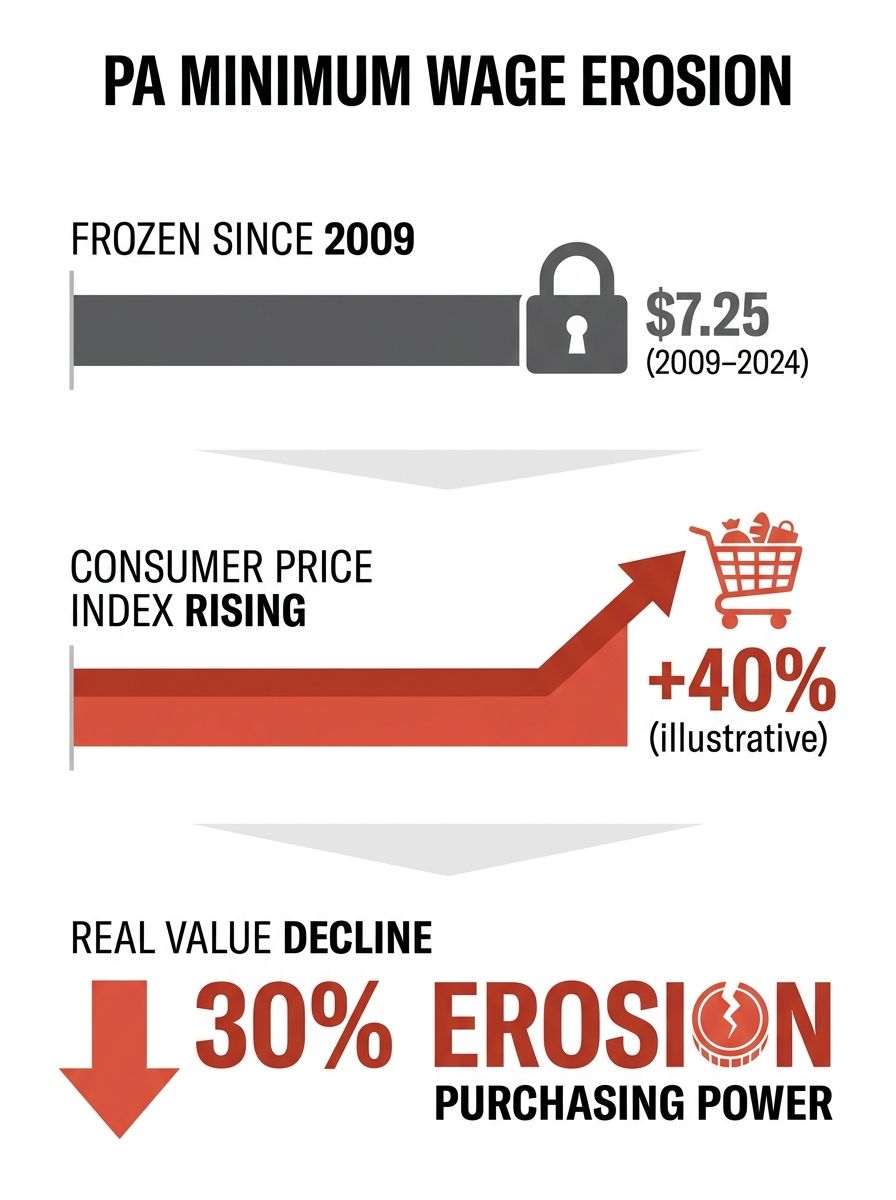
Since July 24, 2009, Pennsylvania has not raised its minimum wage by a single cent. The rate sits at $7.25 per hour, locked to the federal floor, while inflation has eroded its real purchasing power to approximately $6.87 in 2009 dollars.

Minimum Wage for Pennsylvania: Complete 2024 Guide
Since July 24, 2009, Pennsylvania has not raised its minimum wage by a single cent. The rate sits at $7.25 per hour, locked to the federal floor, while inflation has eroded its real purchasing power to approximately $6.87 in 2009 dollars. An estimated 553,700 workers across the state still earn below $15 an hour.
How the Pennsylvania Minimum Wage Act Sets the Rate
The Pennsylvania Minimum Wage Act, originally enacted in 1968, establishes the legal floor for hourly compensation across the commonwealth. Under this law, every covered employer must pay at least $7.25 per hour, the same as the federal minimum wage. The state rate has tracked the federal floor since 2009, when both were last raised simultaneously from $6.55.
This structure means Pennsylvania doesn't independently adjust its wage floor. When Congress raises the federal minimum, Pennsylvania's rate rises automatically. When Congress doesn't act, Pennsylvania workers stay frozen. The state legislature could pass its own increase by amending the Minimum Wage Act, but repeated efforts to do so have died in committee or never received a floor vote.
The law covers most employers and employees in the state, with narrow exceptions for agricultural workers, domestic workers in certain household arrangements, and some seasonal employees. Pennsylvania's Department of Labor & Industry oversees enforcement, processing complaints and conducting investigations when employers fail to pay the mandated rate. But the scope of the law's coverage matters less than the rate itself, which now stands as the longest unchanged minimum wage in modern Pennsylvania history.
Who Still Earns $7.25 in Pennsylvania
According to the Pennsylvania Department of Labor & Industry's 2024 minimum wage report, workers earning at or below the minimum wage declined by 48% between 2019 and 2023, falling to 63,600 individuals. That decline doesn't reflect legislative action. Tight labor markets during the pandemic forced many employers to raise pay above $7.25 simply to attract applicants.
The food services and drinking places sector accounts for 73% of those 63,600 minimum-wage workers. Restaurants, bars, and cafeterias remain the industries where the $7.25 floor is most likely to be the actual wage paid, particularly for tipped employees whose cash wage can legally sit at $2.83 per hour.
The broader picture is grimmer than the 63,600 figure suggests. Commonwealth Foundation analysis found that 553,700 Pennsylvania workers earn less than $15 per hour. These workers cluster in retail, food service, home health care, and warehouse operations, sectors where wages have crept above the legal minimum but remain well below what economists consider a living wage in most Pennsylvania counties. The minimum wage of Pennsylvania functions as a floor that a shrinking number of employers technically pay, while the actual wage crisis extends to hundreds of thousands of workers above it.
Tipped Workers and the $2.83 Cash Wage
'If a tip-credited employee earns less than $7.25 per hour, including their base hourly wage plus tips, the employer must make up the difference,' states the Pennsylvania Department of Labor & Industry's wage compliance guidance. The mechanism works through a tip credit: employers pay a cash wage of $2.83 per hour, slightly above the federal tipped minimum of $2.13, and claim a $4.42 credit against the worker's tips.
Pennsylvania defines a "tipped employee" as someone who customarily and regularly receives more than $30 per month in tips. This includes servers, bartenders, valets, and certain delivery workers.
The state enforces an 80/20 rule that restricts how employers can assign tipped workers' time. Tipped employees must spend at least 80% of their working hours on tip-generating activities. If an employer schedules a server to spend more than 20% of a shift on side work like rolling silverware, cleaning floors, or prepping food, that worker must receive the full $7.25 minimum for those hours, without tip credit applied. This rule matters because wage theft in tipped occupations often involves employers misclassifying back-of-house tasks as tipped work.
Category | Rate | Key Condition |
|---|---|---|
Standard minimum wage | $7.25/hour | Applies to most covered employees |
Tipped employee cash wage | $2.83/hour | Tips must bring total to at least $7.25 |
Overtime rate | $10.88/hour | For hours worked beyond 40 per week |
Exempt salary threshold | $844/week ($43,888/year) | Below this, overtime protections apply |
Overtime, Exemptions, and Salary Thresholds
Non-exempt employees in Pennsylvania earn overtime at 1.5 times their regular hourly rate for every hour worked beyond 40 in a workweek. For a worker earning the $7.25 minimum, that means $10.88 per hour in overtime pay. The Pennsylvania Minimum Wage Act mandates this premium, and employers cannot avoid it by averaging hours across two-week periods or offering compensatory time off in place of wages.
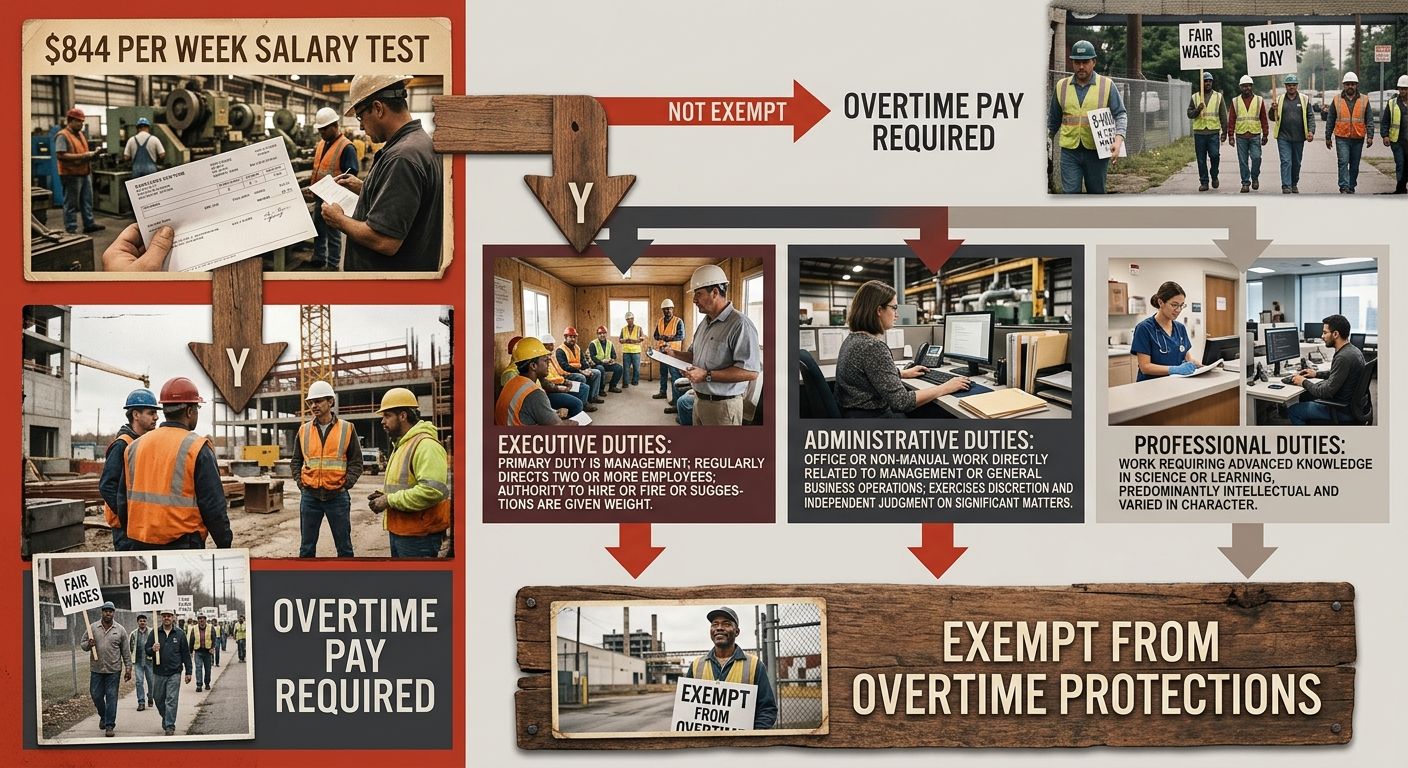
The exempt employee salary threshold saw a change effective July 1, 2024, when the minimum salary for workers classified as exempt from overtime protections rose to $844 per week, or $43,888 annually. Below that threshold, salaried employees are entitled to overtime pay regardless of their job title or duties. This threshold matters because misclassification of workers as "exempt" has been one of the most widespread wage-and-hour violations in the state, particularly in retail management, restaurant supervision, and nonprofit administration.
The salary threshold test is the first screen: if the employee earns less than $844 per week, the analysis stops and they're entitled to overtime. Above that line, the employee must also meet specific duties tests, classified as executive, administrative, or professional, to qualify as truly exempt. Employers who slap a "manager" title on a $35,000-a-year worker and deny them overtime are breaking the law.
Why the Legislature Can't Pass a Raise
State Senator Christine Tartaglione introduced Senate Bill 19, legislation aimed at raising the minimum wage for Pennsylvania to $15 an hour by 2026 and tying future increases to the cost of living. A separate proposal, Senate Bill 1186, went further with a $20-per-hour minimum and cost-of-living adjustments pegged to the Consumer Price Index for Urban Consumers every five years. Neither bill advanced through both chambers.
The political math is blunt. Pennsylvania's General Assembly has been split between a Democratic-controlled House and a Republican-controlled Senate for most of the past decade. Republican leadership has blocked minimum wage bills from reaching the Senate floor, arguing that increases would burden small businesses and accelerate automation. Democratic governors have supported raises but lack the authority to change the wage by executive order. Only the legislature can amend the Minimum Wage Act.
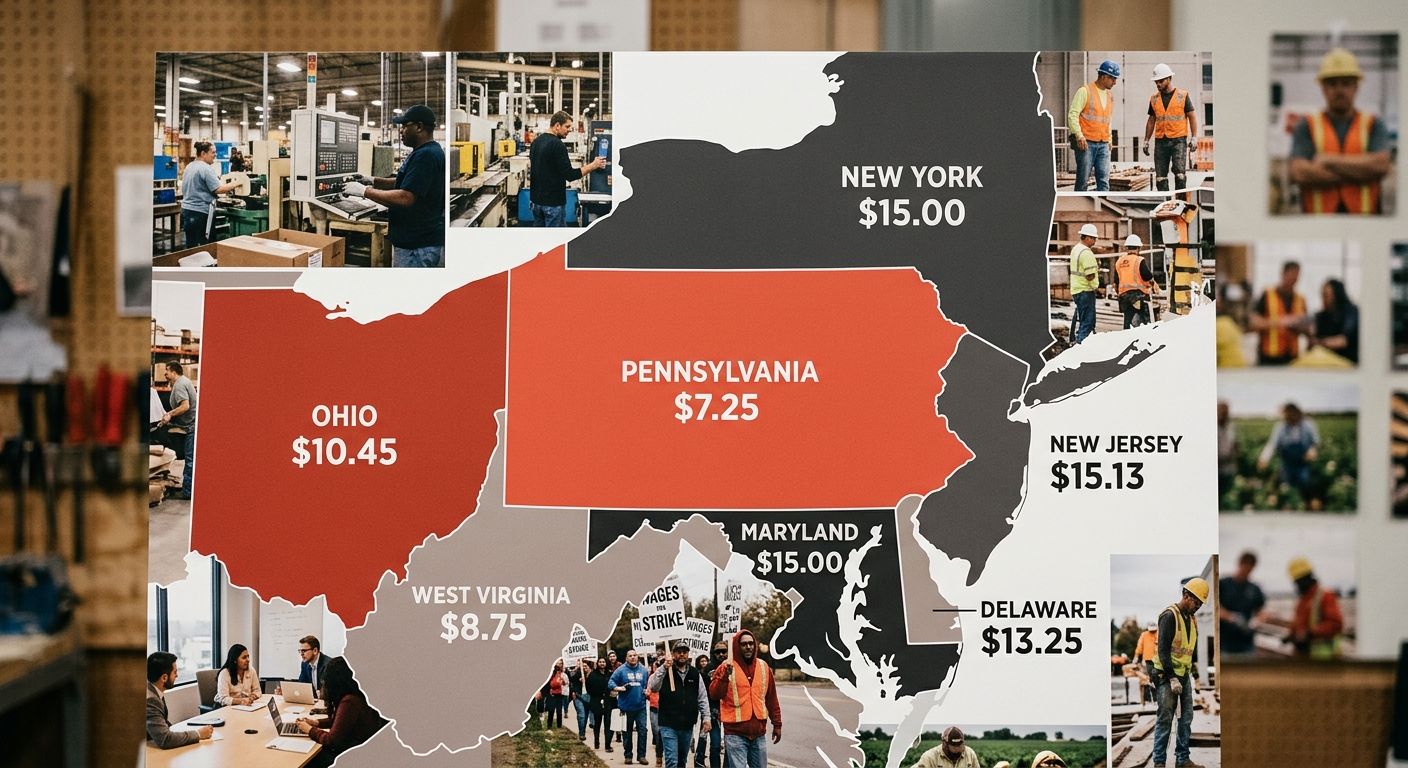
While Pennsylvania has stayed frozen, neighboring states have moved decisively. New Jersey's minimum wage is dramatically higher. Delaware has passed increases of its own. Maryland reached $15 per hour for all employers regardless of size. Michigan's wage floor rose after a legal fight that went to the state Supreme Court. Pennsylvania workers in border counties often commute to these neighboring states for the wage differential alone, draining the local labor pool and putting Pennsylvania's service-sector employers in a bind of their own making.
Where the $7.25 Floor Breaks Down
The Pennsylvania Minimum Wage Act covers most workers, but its protections have practical limits that weaken with each passing year.
Inflation is the most devastating breakdown. The real value of $7.25 has dropped to approximately $6.87 in 2009-adjusted purchasing power, representing only about 20-21% of the average Pennsylvania wage. A worker earning the minimum in 2009 could buy roughly 30% more with each paycheck than a worker earning the identical dollar amount today. The law contains no automatic adjustment mechanism. No indexing to inflation. No periodic review trigger. The rate moves only when the legislature votes or the federal government acts, and neither has acted since the summer Barack Obama was in his first year as president.
The preemption problem compounds this. Because state law blocks local wage ordinances, cities where the cost of living far exceeds rural areas cannot adjust independently. A minimum-wage worker in Center City Philadelphia and a minimum-wage worker in rural Tioga County face vastly different costs of living under the same $7.25 floor.
Enforcement gaps create a third failure point. The Department of Labor & Industry fields wage complaints, but staffing constraints mean investigations can stretch for months. Workers in tipped positions, the 73% concentrated in food services, are especially vulnerable to violations: unpaid make-up wages when tips fall short, tip pooling that includes ineligible managers, and misapplication of the 80/20 rule. Many workers never file complaints because they fear retaliation or simply don't know the rules exist.
For workers facing these conditions, the right to organize and bargain collectively remains one of the most effective paths to wages above the legal minimum. Sectors with higher union density in Pennsylvania, such as construction, public education, and healthcare, consistently pay well above $7.25, and recent data shows union membership growing nationally as workers in low-wage industries seek that same collective power.
Common Questions
Does Philadelphia have a higher minimum wage than the rest of Pennsylvania?
No. Pennsylvania's state preemption law prevents any city or county from setting a minimum wage above the state rate of $7.25 per hour. Philadelphia's 2014 attempt to establish a $15 local minimum was blocked by this law. Every municipality in Pennsylvania is bound to the same $7.25 floor, regardless of local cost of living.
How much do tipped workers actually make per hour in Pennsylvania?
Tipped employees receive a cash wage of $2.83 per hour. Their employer claims a tip credit of $4.42, which means the worker's tips must bring total compensation to at least $7.25 per hour. If tips fall short, the employer is legally required to pay the difference. The 80/20 rule also requires that tipped workers spend at least 80% of their shift time on tip-generating duties.
When was the last time Pennsylvania raised its minimum wage?
July 24, 2009. The increase matched the federal minimum wage hike from $6.55 to $7.25 per hour. Pennsylvania has not enacted an independent state-level minimum wage increase since that date, making it a 15-year-plus freeze.
Are any workers exempt from Pennsylvania's minimum wage?
The Pennsylvania Minimum Wage Act excludes certain categories: agricultural laborers, domestic workers in some household arrangements, newspaper delivery workers, and some seasonal amusement or recreational establishment employees. Federal exemptions for workers with disabilities under Section 14(c) certificates also apply in the state, though these subminimum wage certificates are increasingly controversial and several states have moved to eliminate them.
Could the governor raise the minimum wage without the legislature?
No. The minimum wage rate is set by statute and can only be changed through legislation passed by both chambers of the General Assembly and signed by the governor. Executive orders cannot modify the statutory wage floor. Governor Josh Shapiro has publicly supported a higher minimum wage but requires legislative cooperation to change the number on workers' paychecks.
The Union Edge Staff
Frequently Asked Questions
- What is the current minimum wage in Pennsylvania in 2024?
- Pennsylvania's minimum wage is $7.25 per hour, the same as the federal minimum wage. This rate has remained unchanged since July 24, 2009.
- What is the minimum wage for tipped employees in Pennsylvania?
- Tipped employees in Pennsylvania receive a cash wage of $2.83 per hour, and their tips must bring their total compensation to at least $7.25 per hour. If tips fall short, the employer must make up the difference.
- Can Philadelphia set its own higher minimum wage?
- No. Pennsylvania state preemption law prevents cities and counties from setting a minimum wage above the state rate of $7.25 per hour. Philadelphia's 2014 attempt to establish a $15 local minimum was blocked by this law.
- How many Pennsylvania workers earn below $15 per hour?
- An estimated 553,700 Pennsylvania workers earn less than $15 per hour, concentrated in retail, food service, home health care, and warehouse operations.
- What is the 80/20 rule for tipped workers in Pennsylvania?
- Tipped employees must spend at least 80% of their working hours on tip-generating activities. If an employer schedules a tipped worker to spend more than 20% of a shift on non-tipped tasks, that worker must receive the full $7.25 minimum for those hours without tip credit applied.
- What is the overtime rate in Pennsylvania?
- Non-exempt employees in Pennsylvania earn overtime at 1.5 times their regular hourly rate for every hour worked beyond 40 in a workweek. For a worker earning the $7.25 minimum, overtime pay is $10.88 per hour.
- What is the exempt employee salary threshold in Pennsylvania?
- Effective July 1, 2024, the minimum salary for workers classified as exempt from overtime protections is $844 per week, or $43,888 annually. Below this threshold, salaried employees are entitled to overtime pay regardless of job title.
- Why hasn't Pennsylvania raised its minimum wage since 2009?
- Pennsylvania's General Assembly has been split between a Democratic-controlled House and a Republican-controlled Senate, with Republican leadership blocking minimum wage bills from reaching the Senate floor. Multiple legislative proposals have stalled in committee or never received a floor vote.
Related Articles

state of pennsylvania minimum wage: Current Rates
Pennsylvania's minimum wage is $7.25 per hour, the lowest rate any state can legally enforce because it mirrors the federal floor set by the Fair Labor Standards Act.

Minimum Wage New Jersey 2024: Rates & Updates
New Jersey's minimum wage for most employees reached $15.13 per hour on January 1, 2024, completing a legislated climb from $8.85 in 2019 and triggering a permanent CPI-indexed adjustment formula. The rate doesn't come from annual legislative votes anymore.

Minimum Federal Wage: Current Rates & Policy
Congress sets the minimum federal wage; it does not update it. The $7.
Also in the paper