
House Passes Union Contract Bill as Worker Income Share Hits 79-Year Low
The U.S. House of Representatives passed the Faster Labor Contracts Act on September 15, legislation designed to expedite union contract negotiations for newly organized workplaces, according to an analysis published in the Las Vegas Sun.
House Passes Union Contract Bill as Worker Income Share Hits 79-Year Low
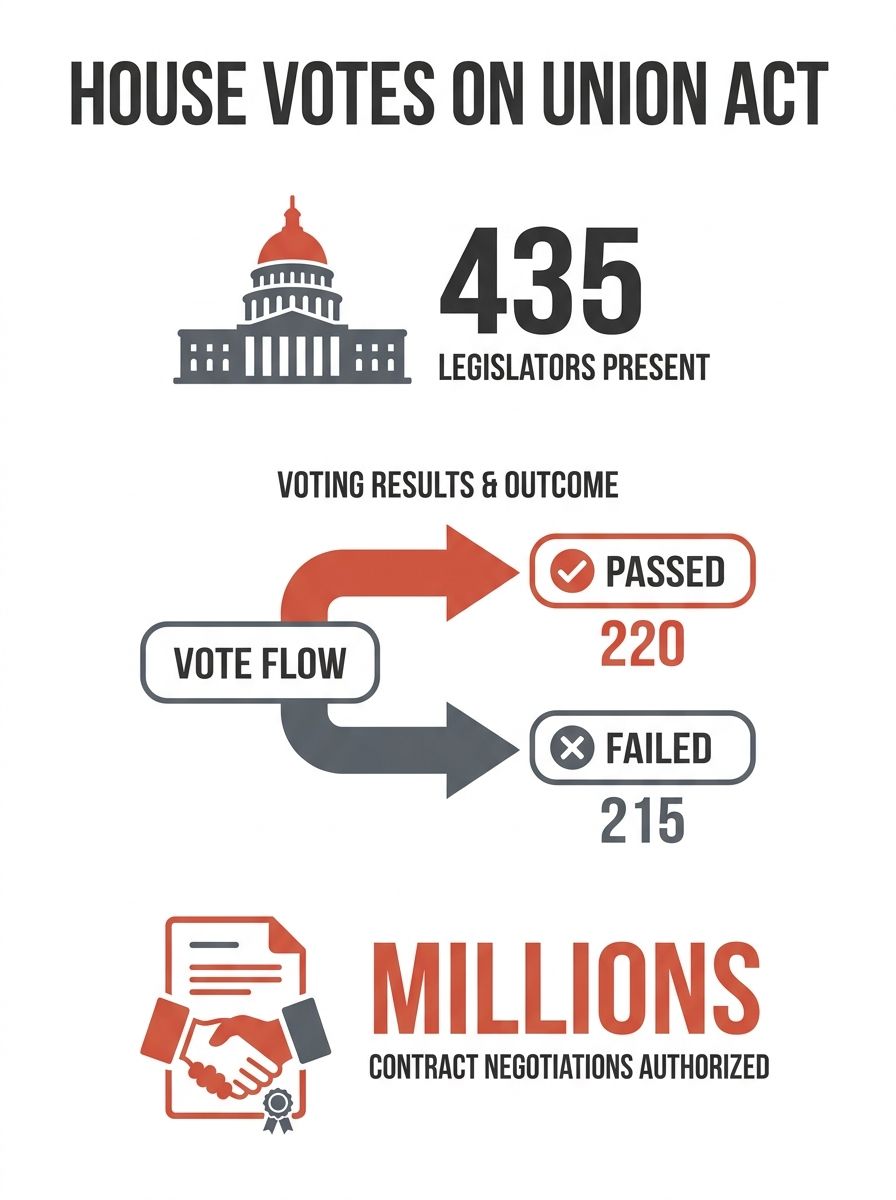
The U.S. House of Representatives passed the Faster Labor Contracts Act on September 15, legislation designed to expedite union contract negotiations for newly organized workplaces, according to an analysis published in the Las Vegas Sun. The bill received unanimous Democratic support but only 20 Republican votes, and faces an uncertain future in the Republican-controlled Senate. The vote came as workers' share of national income fell to its lowest level since the Bureau of Labor Statistics began tracking the data in 1947.
Legislative Divide on Union Contract Reform
The Faster Labor Contracts Act would simplify the process for newly unionized workers to secure their first collective bargaining agreement, addressing what labor advocates describe as prolonged employer delays in contract negotiations. David Madland and Aurelia Glass, policy analysts at the Center for American Progress Action Fund, wrote in their September 16 analysis that the vote illustrates a sharp partisan divide on worker protections.
The legislation's prospects in the Senate remain unclear, with Republican leadership signaling reluctance to schedule a vote. Senate Democrats have advocated for the measure as part of a broader effort to strengthen organizing rights, but lack the votes to overcome procedural hurdles without bipartisan support.
Overtime Protections Eliminated for Middle-Income Workers
The Trump administration eliminated an overtime eligibility rule in July 2026 that would have extended mandatory overtime pay to workers earning below $58,656 annually. The rule, finalized during the previous administration, aimed to expand protections to an estimated 4 million workers across retail, hospitality, and service sectors.
Labor Department officials described the rule as "burdensome" for employers, particularly small businesses. The reversal means salaried workers earning between $35,568 and $58,656 can be classified as exempt from overtime requirements if they meet job-duty tests, regardless of salary level.
The change affects workers in supervisory and administrative roles who frequently work beyond 40 hours per week without additional compensation. Critics argue the elimination disproportionately impacts workers in industries with irregular scheduling practices.
Manufacturing Employment Declines Since Tariff Implementation
The United States has lost manufacturing jobs since the administration implemented comprehensive tariffs on February 1, 2026, a date officials labeled "Liberation Day." Bureau of Labor Statistics data through August 2026 shows a net decline in manufacturing payrolls, contradicting administration projections that tariffs would spur domestic production growth.
Economists attribute the job losses to disrupted supply chains and retaliatory tariffs from trading partners. Consumer prices for manufactured goods rose 4.2% in the six months following tariff implementation, according to Consumer Price Index data.
Gas prices increased 30% nationally since the administration's military engagement in Iran, adding approximately $1 per gallon at the pump. The conflict has cost American households an average of $1,200 through higher energy expenses and inflation ripple effects.
Tax Legislation Benefits High Earners
The One Big Beautiful Bill Act, passed in March 2026, included $1 trillion in tax reductions for the highest-earning 1% of households over a ten-year period. The legislation also reduced Medicaid and Supplemental Nutrition Assistance Program funding, affecting millions of recipients.
The bill's healthcare provisions have resulted in coverage losses for low-income families as states adjust to reduced federal matching rates. Food assistance reductions took effect in June 2026, tightening eligibility requirements and benefit calculations.
State-Level Unionization Models Advance
Democratic-controlled states have implemented a new framework for collective bargaining that expands sectoral bargaining rights and establishes industry-wide labor standards. Minnesota, Washington, and Colorado piloted programs in 2025 allowing workers in specific industries to negotiate wages and conditions that apply across multiple employers.
The sectoral model contrasts with the traditional workplace-by-workplace organizing approach protected under the National Labor Relations Act. Proponents argue the framework addresses challenges in industries with high worker turnover and fragmented employment relationships, including gig economy platforms and franchise operations.
States have also raised minimum wages beyond federal levels—which remains at $7.25 per hour, unchanged since 2009—and expanded healthcare access through state-run insurance programs. Federal minimum wage stagnation has prompted 30 states to enact higher wage floors.
What This Means for Union Members
The Faster Labor Contracts Act, if it advances beyond the House, would address a persistent challenge facing newly organized workplaces: the extended period between winning union recognition and securing a first contract. Union organizers report that employers frequently delay negotiations, eroding member support during the interim. Expedited contract procedures could strengthen organizing campaigns by delivering tangible results faster.
The overtime rule elimination underscores the vulnerability of workplace protections established through administrative action rather than statute. Workers earning between $35,568 and $58,656 should review their exempt status classifications and document hours worked beyond 40 per week, as misclassification remains a common wage-theft mechanism.
State-level collective bargaining innovations present a potential model for federal reform if political conditions shift. Sectoral bargaining frameworks have delivered wage increases and benefit improvements in pilot industries, demonstrating viability for sectors where traditional organizing faces structural barriers. Union strategists are monitoring these programs as templates for broader legislative proposals.
The Union Edge Staff
Related Articles

Teamsters-Backed First Contract Bill Passes House With Bipartisan Support, Heads to Senate
The U.S. House of Representatives passed the Faster Labor Contracts Act on June 9, 2026, with bipartisan support, advancing Teamsters-led legislation that would require employers to begin bargaining with newly organized workers within 10 days of a union vote, according to the International Brotherho

US Union Membership Rose by 411,000 Workers in 2025, With Most Gains in States Protecting Collective Bargaining
Union membership in the United States increased by 411,000 workers in 2025, the largest single-year gain since 2008, with nearly three-quarters of new members concentrated in states that legally protect collective bargaining rights, according to a report released September 7, 2026, by the Illinois E

House Passes Binding Arbitration Bill for First Union Contracts as NLRB Moves Toward Republican Majority
The House of Representatives passed H.R. 5408 on June 9, 2026, legislation that would impose 10-day bargaining deadlines and binding arbitration for initial union contracts, while Republican NLRB nominee James Macy advanced toward confirmation in a June 10 hearing that could shift the Board's majori
Also in the paper