
Virginia Governor Vetoes Mandatory Public Sector Collective Bargaining Bill, Breaking Campaign Promise to Unions
Virginia Governor Abigail Spanberger vetoed mandatory public sector collective bargaining legislation this month, according to Reason, breaking with union allies who backed her 2025 campaign after the Democratic-controlled legislature rejected her amendments weakening union protections and giving re

Virginia Governor Vetoes Mandatory Public Sector Collective Bargaining Bill, Breaking Campaign Promise to Unions
Virginia Governor Abigail Spanberger vetoed mandatory public sector collective bargaining legislation this month, according to Reason, breaking with union allies who backed her 2025 campaign after the Democratic-controlled legislature rejected her amendments weakening union protections and giving regulatory control to a governor-appointed board.
The veto marks a sharp reversal for a governor who answered "yes" on a 2025 campaign questionnaire asking if she would "champion and sign legislation to ensure collective bargaining rights for all public employees." The Virginia Police Benevolent Association, a police union that historically backed Republican candidates, endorsed Spanberger over GOP candidate Winsome Sears during the 2025 race.
Virginia's Eight-Decade Ban on Public Sector Bargaining
Virginia has prohibited public sector collective bargaining since a 1977 state supreme court decision. The state is among a handful that maintain such bans, which prevent government employees from negotiating contracts covering wages, benefits, and working conditions through union representatives.
In 2021, under former Governor Ralph Northam, Democrats changed the law to an opt-in system allowing localities to pass ordinances permitting public sector collective bargaining. Only a small fraction of Virginia localities opted in under that framework, prompting Democratic lawmakers to introduce legislation this year converting the opt-in system to a statewide mandate.
The Economic Policy Institute noted that the original bill contained detailed rules about union elections and contract negotiation timelines, while Spanberger's revised version left these matters to the discretion of a newly created Public Employee Relations Board.
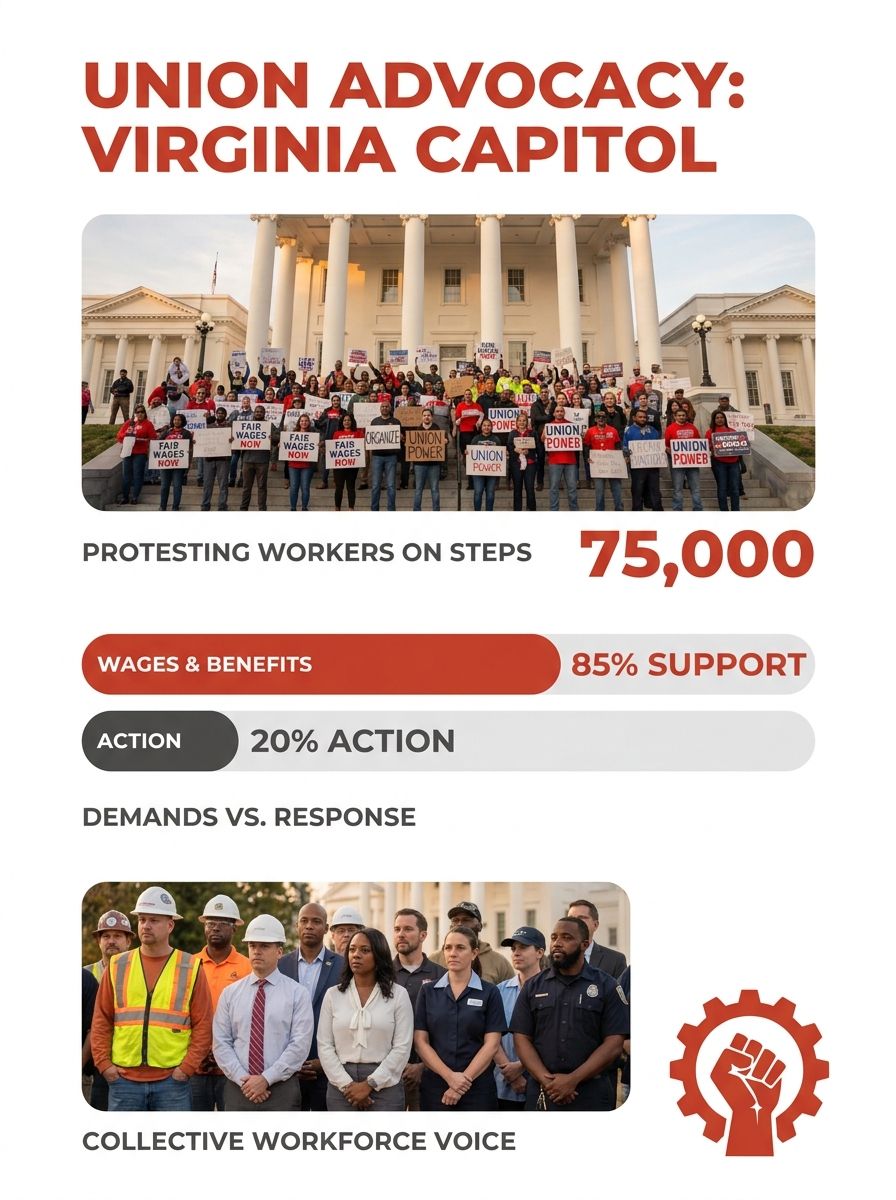
The Amendment Fight and Legislative Rejection
The mandatory collective bargaining bill cleared the Democratic-controlled state legislature and moved to Spanberger's desk earlier this year, where union interests expected her to sign it. Instead, Spanberger sent a revised version back to the legislature with material changes to the bill's language and enforcement mechanisms.
Spanberger's amendments changed "shall" language in the original bill—which specified that the scope of collective bargaining "shall include" bargaining over wages, hours, and benefits—to "may," cutting back on prescriptive requirements. The revised version also delayed implementation for localities from 2028 to 2030 and opted for advisory arbitration rather than binding arbitration to settle contract disputes.
The governor's version eliminated a requirement that two of the five Public Employee Relations Board members must be union representatives. Because the governor appoints all five board members, unions argued this created a regulatory vulnerability that would allow a future Republican governor to stock the board with anti-union members and effectively block collective bargaining through administrative obstruction.
Faced with Spanberger's revised bill, the state assembly rejected the amendments under pressure from union groups. The rejection returned the original bill to the governor for either a signature or veto.
Union Response and Political Calculations
Union interests viewed the veto as a bait and switch, with some comparing Spanberger to her Republican predecessor, Governor Glenn Youngkin. Despite the veto, Spanberger maintained that she supports public sector collective bargaining and will "continue to look forward to a place where we'll have a bill that I'll sign into law."
Research cited in the debate found that mandatory public sector collective bargaining raises state and local government spending by $600 to $750 per person annually. The proposed Virginia legislation carried an estimated $50 million annual cost for the state, with locality costs projected between $50,000 and $403 million over a two-year period.
Virginia Democrats will retain their trifecta control of the governorship and legislature through at least the 2027 state elections, potentially providing time to negotiate a compromise version before the political balance shifts. Spanberger said several times during her 2025 campaign that she did not support a "full" repeal of Virginia's right-to-work law, which has existed for close to 80 years, leading observers to parse her statements for positions on partial labor law reforms.
The veto represents a strategic split within the Democratic coalition that swept to power in 2025, with labor groups arguing that the governor's concerns about regulatory structure mask substantive opposition to mandatory bargaining itself. Unions that invested in Spanberger's campaign now face the prospect of renewed legislative battles without the executive support they anticipated when they backed her candidacy over Sears.
Reading Between the Lines
Spanberger's veto exposes the fault line between electoral coalition-building and governing in states where labor law reform tests the limits of Democratic unity. Her campaign secured union endorsements by signaling support for collective bargaining rights while avoiding explicit commitments on right-to-work repeal—a positioning strategy that worked until legislation forced her to define what "support" actually meant in practice.
The governor's focus on regulatory structure rather than the principle of mandatory bargaining suggests she's calculating that labor policy details provide political cover for substantive opposition. By framing her objections around implementation timelines and board composition rather than collective bargaining itself, Spanberger preserves the option to sign a future version while satisfying fiscal conservatives concerned about the projected $50 million annual state cost. Whether that middle ground exists depends on whether unions accept weakened enforcement mechanisms in exchange for a mandate, or whether they view any compromise on regulatory power as functionally equivalent to maintaining the ban through administrative sabotage.
For organizers watching Virginia, the lesson is tactical: campaign commitments that avoid specifying enforcement mechanisms can unravel when legislative language forces clarity on who controls the regulatory apparatus. The fight over the Public Employee Relations Board's composition and discretionary authority reveals that labor law reforms live or die on administrative details, not on rhetorical support for worker rights.
The Union Edge Staff
Related Articles

The PRO Act Is Dead Again — and Labor's Legislative Strategy Needs a Hard Reset
The Richard L. Trumka Protecting the Right to Organize Act has been introduced in four consecutive Congresses. It passed the House once, never reached a Senate floor vote, and changed zero lines of federal labor law.

Federal Workers Bargaining Rights Bill Explained
The Protect America's Workforce Act (H.R. 2550) passed the U.S. House on December 11, 2025, by a 231-195 bipartisan vote.

Judge Blocks VA's Third Attempt to Terminate Union Contract on Contract Expiration Eve
U.S.
Also in the paper