
From Salting to Sustained Campaigns: How Unions Plant Organizers and Build Lasting Workplace Power
Salting, the practice of trained union organizers taking jobs at non-union workplaces to build support from the inside, drove the first successful Starbucks organizing campaign in decades.

From Salting to Sustained Campaigns: How Unions Plant Organizers and Build Lasting Workplace Power
Salting, the practice of trained union organizers taking jobs at non-union workplaces to build support from the inside, drove the first successful Starbucks organizing campaign in decades. At least 10 undercover activists secured positions at Buffalo-area cafes, and by late 2024, Starbucks Workers United represented 507 stores and over 11,500 workers nationwide. The tactic is generations old. Its current resurgence is reshaping American labor.
How Salts Actually Work a Shop Floor
Why does salting succeed where outside organizing often stalls? Because the salt is a coworker first, an organizer second. The central insight of the tactic is trust, and trust inside a workplace is earned through shared labor, shared grievances, and shared risk. Will Westlake, one of the undercover activists who helped launch the Starbucks campaign in Buffalo, distilled this to practical advice at a secret off-hours gathering in Rochester, New York: volunteer for thankless chores. "Be the person who's willing," Westlake told the room. "It's going to make the company less suspicious of you."
That advice sounds mundane, but it reveals the operational logic of undercover organizing. A salt applies for a job, gets hired through normal channels, and then does the work genuinely. They unclog drains, cover shifts, show up early. The goal is to become someone coworkers naturally confide in about scheduling problems, wage complaints, and safety concerns. As one analysis of salting tactics explains, operating a clandestine organizing drive will usually be the most effective approach to entering a workforce with minimal resistance from management because, from the employer's perspective, the salt looks like any other new hire.
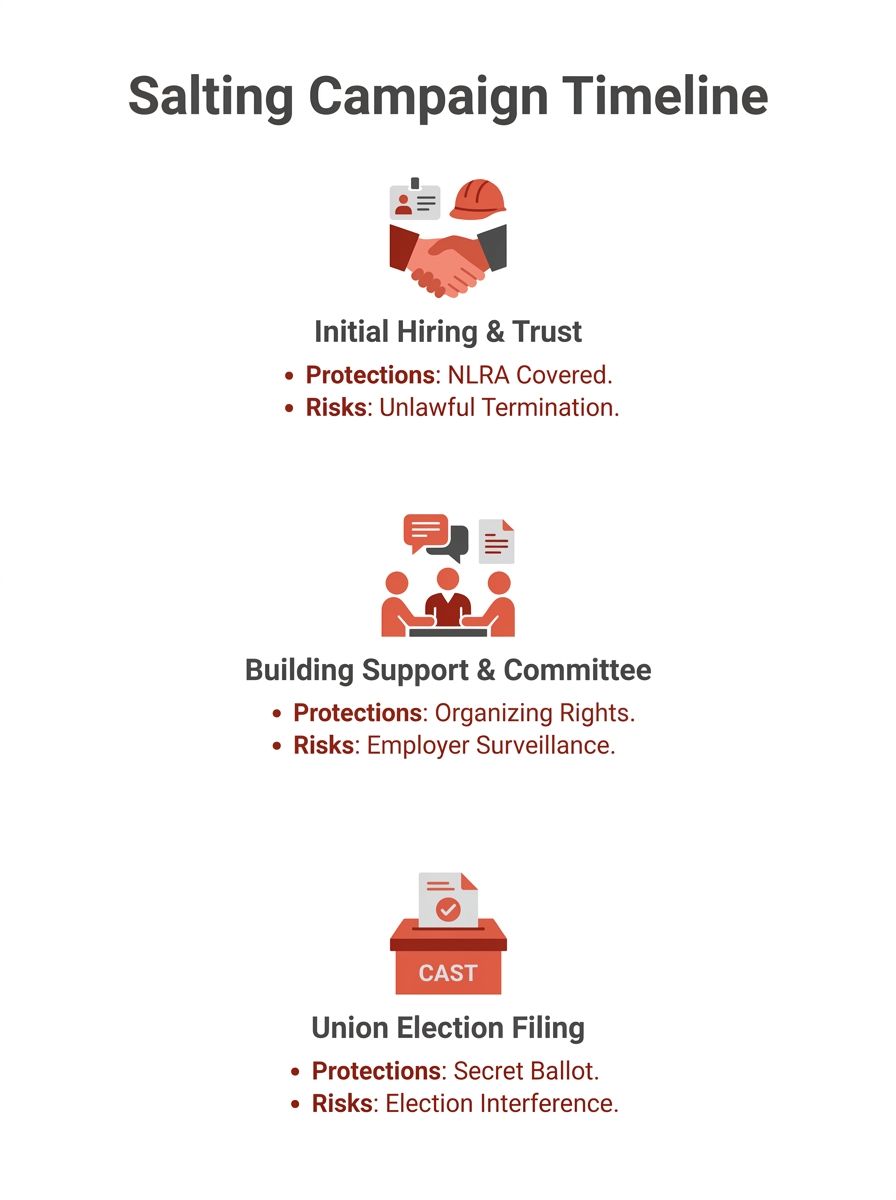
The legal foundation for this is settled. Under the National Labor Relations Act, salts are protected employees. The NLRA prohibits employers from discriminating against job applicants based on union affiliation, and the Supreme Court affirmed in NLRB v. Town & Country Electric (1995) that paid union organizers who also genuinely work for an employer are "employees" under the Act. Employers who refuse to hire or who fire a worker for being a salt face unfair labor practice charges. Without this legal protection, the entire rank-and-file organizing strategy collapses, because employers could simply screen out anyone with union ties during hiring.
But legal protection doesn't mean legal simplicity. On July 24, 2025, the NLRB's Acting General Counsel William Cowen issued new guidance requiring regional offices to "deeply probe" whether job applicants in salting cases were genuinely seeking employment. Investigators must now examine application materials for red flags: antagonistic language, unusual employment gaps, or resumes that overemphasize union activism. The Oil Capitol Sheet Metal, Inc. precedent already limits backpay remedies for salts, and the new scrutiny adds another layer of risk. Unions that deploy salts without careful internal coordination, clear documentation, genuine work intent, and meticulous record-keeping expose themselves to weakened legal standing when cases reach the Board. Understanding the full landscape of employer-side legal consultants helps organizers anticipate how management will respond when they discover a salt in their ranks.
From Individual Salts to Rank-and-File Infrastructure
Jaz Brisack's story illustrates how a single salt can catalyze something much larger. Fresh off a successful organizing campaign at Spot Coffee, and motivated by a failed union drive at a Nissan factory in Mississippi, Brisack decided to get hired at Starbucks after witnessing what they believed was a friend's unjust firing. Within a year, Starbucks Workers United was born. The speed of that transformation, from one person's decision to a national campaign covering hundreds of stores, challenges the assumption that union drives always need years to materialize. But speed alone doesn't explain sustainability.
The rank-and-file organizing strategy, as articulated by labor scholars and organizers over the past decade, argues that progressive activists should focus on identifying and developing workplace-based leadership that can organize on a day-to-day basis. Eric Blanc, a labor studies professor at Rutgers University, has emphasized this principle in concrete terms: "Compared to being a full-time union organizer supporting from the outside, it's easier to organize people when you're in the trenches with them as a co-worker, building personal relationships and trust day-by-day on the shop floor." The Rank & File Project, founded in 2024, has made this philosophy operational by recruiting young activists to take jobs in strategic sectors like healthcare and logistics. One member, a former union staffer who joined UPS to organize from within, described the approach directly: "My job is to get in here, do a good job, and help my co-workers understand the contract and build solidarity."
What distinguishes sustained campaigns from flash-in-the-pan victories is what happens after the initial salting phase. The United Mine Workers of America's Pittston Coal strike in 1989-1990 remains a landmark example: rank-and-file members led the campaign themselves, achieving significant gains in wages, benefits, and working conditions because the organizing infrastructure survived the departure of any single activist. The SEIU's Justice for Janitors campaign followed a similar pattern, where permanent committees of workers, not temporary outside organizers, became the engine of bargaining power. Engaging in rank-and-file unionism, as the Emergency Workplace Organizing Committee has noted, keeps organizing leaders on task because they're constantly reminded that their work exists at the behest of members. The difference between a service model and an organizing model shows up most clearly after the election is won, when the salt leaves and the workers either have their own leaders or they don't.
The number of union representation petitions filed with the NLRB jumped 27% in fiscal year 2024 compared to 2023, and more than doubled from 2021 levels. That growth reflects real grassroots momentum, driven in part by salting campaigns that seed organizing committees across multiple locations simultaneously. The companies facing these drives are often forced to deal with a reality that employer-side consultants describe bluntly: they don't see the conversations until the campaign is well underway, because the union's rank-and-file infrastructure was built from the inside before management knew to look.

Campaign Secrecy as Structural Discipline
The operational security of modern organizing campaigns has changed dramatically with digital communication tools. Private chats, encrypted messaging apps, and closed social media groups are commonly used to organize without employer detection, allowing workers to plan meetings, share materials, and coordinate messaging on platforms that employers cannot monitor. The common thread in all salting tactics and broader undercover organizing is silence, deliberate, structured, and maintained through agreed-upon campaign secrecy protocols that every participant understands before the first group text is sent.
This kind of internal union coordination requires more discipline than most people outside the labor movement realize. A salt who posts about their organizing work on a personal social media account, or a committee member who discusses the campaign within earshot of a sympathetic-seeming manager, can unravel months of careful groundwork. The ten undercover activists who joined Starbucks stores in Buffalo operated as a coordinated unit, sharing intelligence about store-level conditions while maintaining separate, independent work relationships with their coworkers. The coordination happened off-site and off-clock, through channels the company had no access to and no legal right to surveil. For workers building campaigns at companies that spend heavily on anti-union consultants, this kind of operational compartmentalization is the difference between filing for an election with strong majority support and getting picked off one by one through targeted firings and intimidation.
Building a secure digital organizing infrastructure is now a baseline requirement. Unions training salts increasingly emphasize digital hygiene alongside traditional one-on-one conversation techniques: which apps to use, how to compartmentalize information so that the exposure of one participant doesn't compromise the entire committee, and when to move conversations from digital channels to face-to-face meetings where nothing is recorded. The Insider Organizer School, co-developed by Brisack at UC Berkeley, trains young workers in these techniques alongside traditional skills like countering anti-union messaging and reading a room during outreach conversations. The result is a generation of organizers who treat campaign security as a core competency rather than an afterthought, and who understand that the period between a salt's first day on the job and the public announcement of a union drive is the most vulnerable window for employer interference. As employer-side resources openly acknowledge, online forums, group chats, and private social media groups allow the union's message to spread "unchecked" before management becomes aware. That's the whole point.

Where the Strategy Meets Its Own Contradictions
The resurgence of salting tactics raises questions that the labor movement hasn't fully answered, and some of those questions are genuinely uncomfortable for organizers who believe in transparency and worker agency. The most obvious tension sits between the secrecy required for a successful salt campaign and the democratic principles that unions claim to represent. When a trained activist takes a job specifically to steer coworkers toward unionization, the power dynamic between that activist and their less-experienced colleagues is real, even if the cause is just. The rank-and-file strategy's own advocates acknowledge this tension by insisting that the salt's role is to develop indigenous workplace leadership, people who will carry the campaign and the contract long after the salt moves on, but the execution doesn't always match the theory. Some campaigns produce deep, lasting worker committees. Others produce a quick election win followed by a bargaining process that stalls without experienced internal leadership.
The legal landscape adds its own instability. The NLRB's July 2025 guidance on scrutinizing salt applicants reflects political pressure that shifts with every administration. Protections that feel settled under one general counsel can be reinterpreted or weakened under the next. Union density in the United States hovers near historic lows, around 10%, and while the 27% spike in NLRB petitions during fiscal year 2024 represents genuine energy, converting petitions into first contracts and first contracts into sustained bargaining power remains a separate, harder problem. The grassroots campaigns that salting enables still depend on institutional support structures like legal teams, bargaining expertise, and strike funds that many unions struggle to fund at the scale the current moment demands.
What remains unresolved is whether salting can operate at scale without becoming formulaic in ways that employers learn to detect and neutralize. The Starbucks campaign worked in part because it was unexpected. The company didn't know how to respond to coordinated undercover organizing across dozens of stores simultaneously. Now every major employer in retail, food service, and logistics has studied that playbook. Employer-side labor consultants have published guides on identifying salts, and the NLRB's new investigative standards give management additional tools to challenge organizing efforts at the application stage. The labor movement's answer will need to involve constant tactical evolution, deeper investment in worker education before and after elections, and an honest reckoning with the gap between organizing wins and the sustained economic power that workers actually need to change their material conditions. The evidence from Buffalo and the 507 Starbucks stores that followed answers the question of whether salting works. The harder, still-open question is whether the institutions built around this tactic can grow fast enough, and stay nimble enough, to keep ahead of the countermeasures now being assembled against them.
The Union Edge Staff
Related Articles

The Salting Strategy Playbook: How Pro-Union Workers Organize From Inside High-Resistance Workplaces
Three distinct salting tactics dominate internal union organizing in high-resistance workplaces: professional salts paid by unions, covert activist salts driven by ideology, and hybrid organizers trained at schools like the Inside Organizer School.

The Salting Strategy Exposed: How Unions Plant Organizers and What Employers Should Know About Detection
Salting puts trained union organizers on a company's payroll by having them apply for real jobs at non-union workplaces. The NLRA has protected this organizing strategy since 1935.

How Starbucks Workers United Turned Social Media Into a Bargaining Pressure Tool — and What Other Unions Can Learn
Starbucks Workers United's social media campaign didn't succeed because it generated public sympathy.
Also in the paper