
The PRO Act Is Dead Again — and Labor's Legislative Strategy Needs a Hard Reset
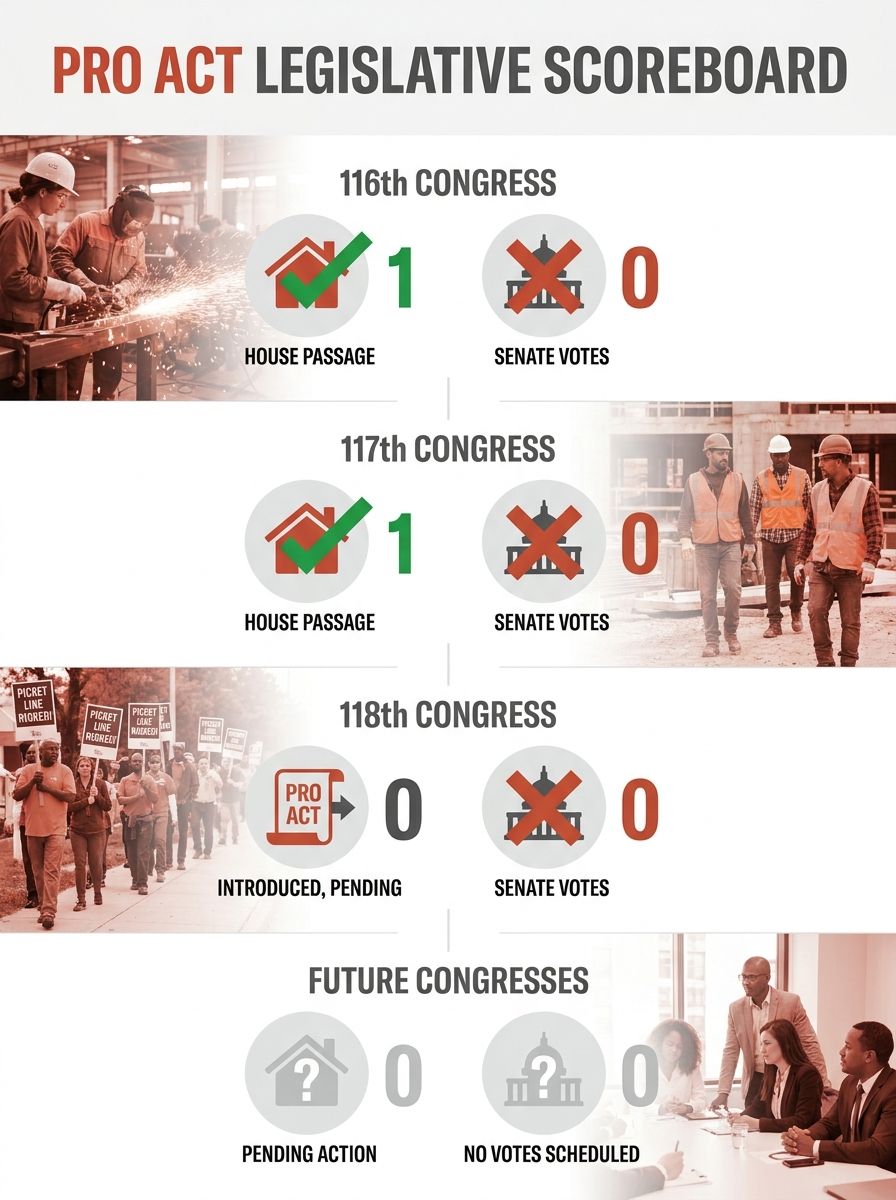
The Richard L. Trumka Protecting the Right to Organize Act has been introduced in four consecutive Congresses. It passed the House once, never reached a Senate floor vote, and changed zero lines of federal labor law.

The PRO Act Is Dead Again — and Labor's Legislative Strategy Needs a Hard Reset
The Richard L. Trumka Protecting the Right to Organize Act has been introduced in four consecutive Congresses. It passed the House once, never reached a Senate floor vote, and changed zero lines of federal labor law. Federal union legislation remains labor's most expensive dead end, and the union legislative strategy built around it needs a complete overhaul before the 2026 midterms.
The PRO Act's provisions are strong. It would prohibit captive audience meetings, allow immediate reinstatement via court injunctions for workers fired during organizing campaigns, create civil penalties and personal liability for corporate officers who violate the National Labor Relations Act, and overturn right-to-work laws in 27 states. The problem was never the policy. The problem is that organized labor has spent the better part of a decade pouring political capital into a legislative vehicle that cannot reach its destination in the current Senate.
Sen. Bernie Sanders (I-VT), Rep. Bobby Scott (D-VA), and Rep. Brian Fitzpatrick (R-PA) reintroduced the bill in January 2026 as H.R. 20, adding a bipartisan cosponsor for the first time. That's progress on paper. In practice, the bill faces the same 60-vote Senate threshold that killed it in 2021, 2022, 2023, and 2024. Union approval sits at 70% nationally, the highest since 1965. Yet 26 states still maintain anti-union right-to-work legislation that constrains collective bargaining rights by barring union security agreements. The gap between public support and legislative reality defines the crisis.
Here are six rules for unions and their allies willing to stop repeating the same losing play.
Unbundle the PRO Act into single-issue bills that can actually move
The PRO Act contains at least seven distinct policy changes — captive audience bans, ABC test worker classification, right-to-work preemption, secondary boycott legalization, first-contract mediation and arbitration, expanded NLRB penalties, and joint-employer standards. Packaging them together makes for great messaging and terrible vote-counting.
Each provision faces different levels of opposition. The captive audience ban polls well even among Republican voters. Right-to-work preemption is a non-starter with any senator from the 26 states that have those laws on the books. By lashing these provisions together into one omnibus bill, labor guarantees that the most controversial element sinks the most popular ones. The American Action Forum estimates the full PRO Act package would cost the franchise sector alone $33.3 billion annually and affect 44% of private-sector employers through expanded joint-employer standards. Whether or not those numbers hold up to scrutiny, they give opponents a single large target. Smaller bills present smaller targets.
The IAFF modeled this approach when it announced its top legislative priorities for the 119th Congress, breaking firefighter and EMS worker protections into discrete, winnable bills rather than one sweeping package. Individual provisions can attract bipartisan cosponsors who would never sign onto the full PRO Act. Research on how captive audience meetings shape anti-union campaigns shows that a standalone ban on mandatory meetings could move through committee with broader support than the omnibus version ever will.
Redirect 40% of federal lobbying spend toward state labor policy campaigns
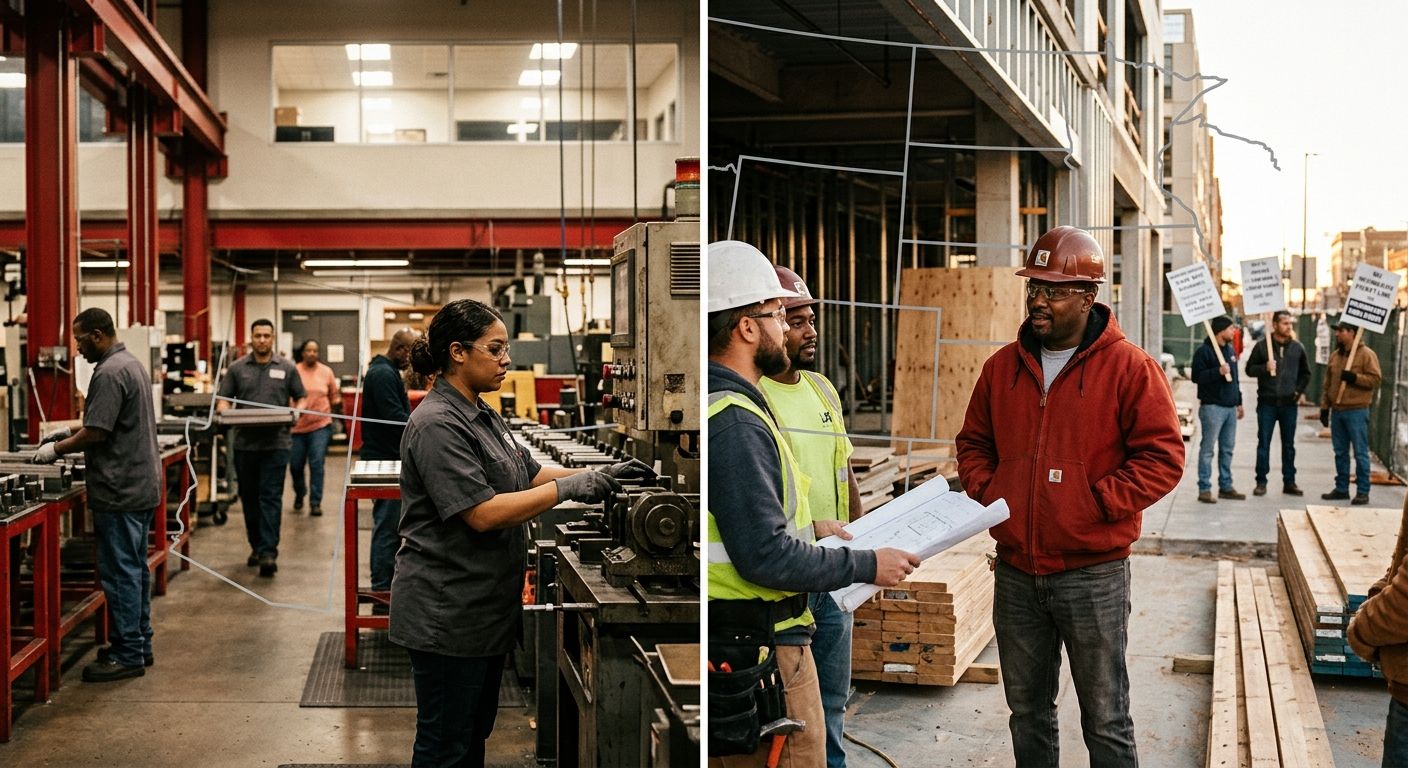
Why does so much union political spending flow to Washington when state legislatures have proven far more responsive? California and New York have already enacted state-level labor protections that fill gaps left by federal inaction, including restrictions on captive audience meetings, expanded definitions of joint employment, and stronger penalties for retaliation. Colorado passed S.B. 23-111 extending limited collective bargaining rights to public sector workers, and the Center for American Progress has identified seven concrete paths state lawmakers can use to build public sector union power immediately.
The math favors state-level action. A competitive state legislative race costs between $100,000 and $500,000. A competitive U.S. Senate race costs $30 million to $80 million. For the price of flipping one Senate seat — which still wouldn't overcome the filibuster — labor could fund dozens of state campaigns that produce binding legislation within a single session. Virginia's experience illustrates both the opportunity and the risk: even after unions helped elect a governor who campaigned on mandatory public sector collective bargaining, the bill was vetoed. But that veto cost the governor politically, and the groundwork for the next attempt is already laid.
Treat the NLRB's survival as the fight that matters right now
The National Labor Relations Act worked for 90 years. The NLRB, the federal agency enforcing it, is now under direct threat. The Taft-Hartley Act of 1947 rolled back key NLRA protections and allowed state right-to-work laws to proliferate, but the Board itself continued functioning as an enforcement mechanism. The current situation is different. NLRB member Gwynne Wilcox's removal threatens the Board's quorum, and without a functioning Board, existing labor rights become unenforceable.
As the Los Angeles Times editorial board noted, the NLRA is suddenly "in the crosshairs" in ways that make the PRO Act debate feel abstract by comparison. Employers are already anticipating NLRB shifts that would rescind Biden-era policies, including limits on noncompete agreements and expanded remedies for labor violations. Every dollar spent lobbying for the PRO Act while the NLRB's authority erodes is a dollar spent building a house while the foundation is being jackhammered.
Workers trying to navigate the differences between card check and NLRB elections need a functioning Board to process either pathway. The immediate legislative priority should be reinstating Wilcox, confirming new Board members, and defending the NLRB's budget — not advancing a bill that requires a Board that might not exist in its current form.
Win labor reform through ballot measures, not congressional committees
Voters approve worker-friendly ballot measures at rates that would embarrass most pro-labor candidates. Minimum wage increases have passed in deep-red states like Arkansas, Missouri, and Nebraska. Oklahoma voters are weighing a measure to nearly double the state minimum wage to $15. When workers' rights go directly to voters, they win. When they go to legislatures, they get bottled up in committee.
The ballot initiative pathway bypasses both the filibuster and hostile committee chairs entirely. It requires different infrastructure — petition drives, signature gathering, public education campaigns — but unions already have the membership networks and canvassing experience to run these operations. The 70% national union approval rating suggests the public is ready to vote for labor protections that their elected representatives won't touch.
Specific provisions from the PRO Act could be adapted for ballot measures in states that allow citizen-initiated legislation: captive audience bans, first-contract arbitration requirements, or penalties for employer retaliation during organizing campaigns. Each measure passed creates both a policy win and a proof of concept that builds momentum for federal action. U.S. employers spent $1.7 billion fighting unions in recent years, a figure that's harder to deploy against dispersed ballot initiatives across multiple states than against a single bill in Washington.
Make first-contract enforcement the wedge issue that splits the opposition
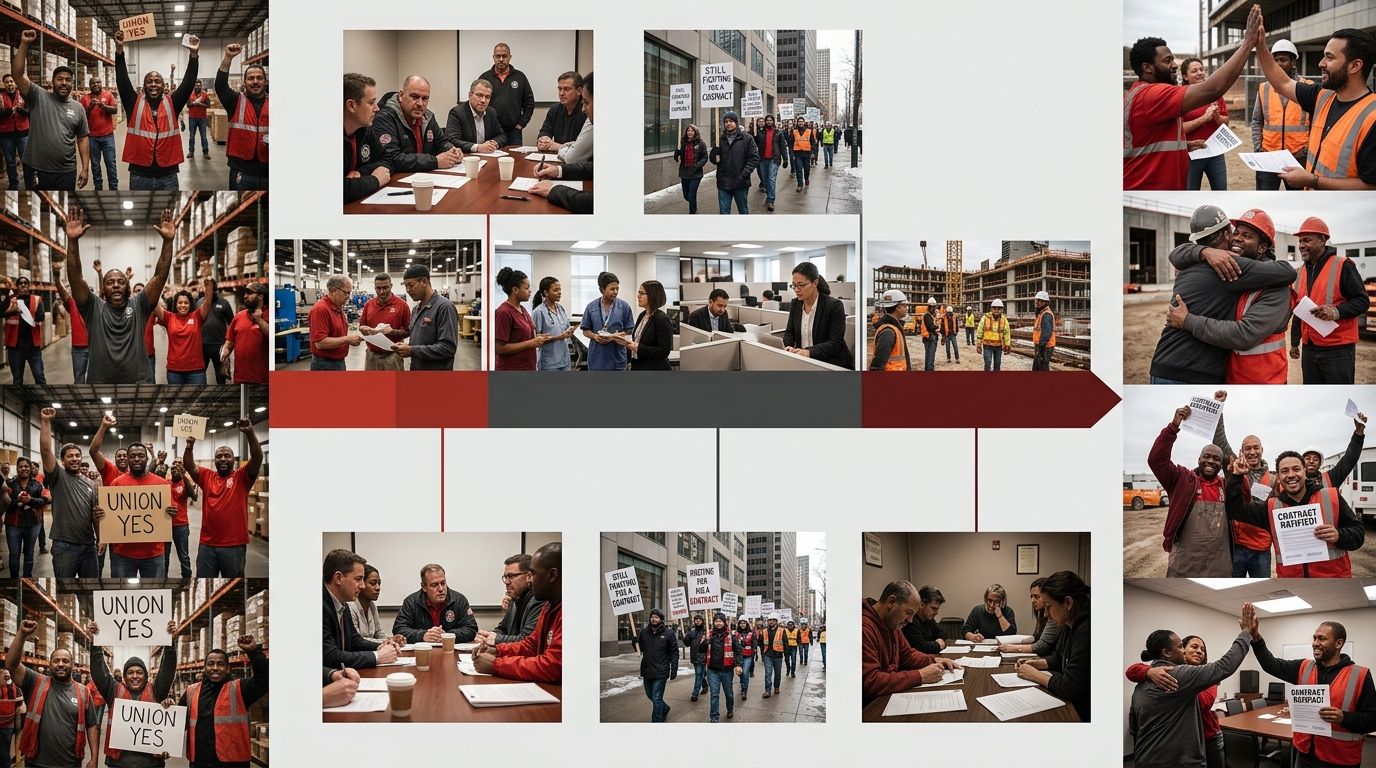
The PRO Act's first-contract mediation and arbitration provision addresses one of the most underdiscussed crises in American labor: the gap between winning recognition and actually getting a contract. Unions that win NLRB elections still face years of employer delay at the bargaining table. The typical pattern is well documented — employers drag out negotiations, rotate legal teams, make proposals they know are unacceptable, and wait for worker enthusiasm to fade.
First-contract arbitration is the provision that has the weakest organized opposition and the strongest emotional case. Every worker can understand: you voted for a union, you won, and two years later you still don't have a contract. That's the story playing out across industries right now, and understanding first-contract bargaining mistakes shows how the deck is structurally stacked against new units. Unlike right-to-work preemption, which triggers ideological opposition in half the country, first-contract enforcement reads as basic fairness. If an employer is legally required to bargain, there should be a mechanism that prevents indefinite stalling. Unions earn 16% more than non-union workers, according to proponents' estimates, but that premium means nothing if the first contract never materializes.
This provision, introduced as a standalone bill, could attract centrist Democrats who won't cosponsor the full PRO Act and business-oriented Republicans who claim to support the right to organize but object to other provisions. It reframes the debate from "expanding union power" to "enforcing existing election outcomes."
Prepare for federal union legislation to stay dead through 2028
The 119th Congress has a legislative agenda dominated by drug pricing, border security, and crime reform. Labor law reform doesn't appear in the administration's priority list, and the 2026 midterms will almost certainly not produce a filibuster-proof pro-labor Senate majority. The PRO Act failure pattern will repeat in 2027 and likely 2028, regardless of which party controls the chamber.
Accepting this timeline isn't defeatism. It's resource allocation. Every organizer, every political director, every union treasurer needs to plan around the assumption that federal labor law won't change meaningfully before 2029 at the earliest. That means state labor policy campaigns, administrative rulemaking at the state level, ballot measures, and direct action become the primary vehicles for advancing worker protections. The IAFF's approach — identifying specific, achievable legislative targets for the 119th Congress rather than staking everything on one bill — offers a template.
Unions that spent 2020 through 2024 waiting for the PRO Act to pass lost four years of potential state-level wins. The organizations that grew during the same period — UAW, SEIU healthcare locals, the NewsGuild — did so through organizing campaigns, strike actions, and contract fights, not by waiting for Congress.
When These Rules Deserve to Be Broken
Every rule above assumes the current political structure holds: the filibuster stays at 60 votes, NLRB appointments remain contested, and the administration treats labor as a second-tier priority. If any of those conditions change — a genuine filibuster reform push, a crisis that makes labor rights politically urgent, a Supreme Court decision that reshapes federal labor law — the calculus shifts dramatically. A version of the PRO Act could move through a reformed Senate in weeks.
But waiting for those conditions is what got labor into this position. The Taft-Hartley Act passed in 1947. Unions have been trying to undo its damage for 79 years. The National Labor Union's political party strategy failed in 1872, as the Bureau of Labor Statistics documented, because it relied on a single electoral vehicle instead of building power across multiple institutions. The parallel to today's PRO Act fixation is uncomfortable and precise.
The union movement's strength has never come primarily from legislation. It came from shop floors, picket lines, and the willingness to withhold labor until conditions changed. Federal law can protect and accelerate those gains, but it can't substitute for them. If the PRO Act passes in 2030, the unions best positioned to use it will be the ones that spent the intervening years building power through every other available channel — winning state fights, defending the NLRB, running ballot campaigns, and organizing workers who can't afford to wait for Congress to act.
The Union Edge Staff
Related Articles

Federal Workers Bargaining Rights Bill Explained
The Protect America's Workforce Act (H.R. 2550) passed the U.S. House on December 11, 2025, by a 231-195 bipartisan vote.

From Recognition to Results: The Post-Election Bargaining Roadmap Unions Get Wrong
Forty-four percent of newly certified unions between 1999 and 2004 never reached a first contract, according to a study of more than 8,000 successful elections by sociologist John-Paul Ferguson. The election was the easy part.

House Passes Binding Arbitration Bill for First Union Contracts as NLRB Moves Toward Republican Majority
The House of Representatives passed H.R. 5408 on June 9, 2026, legislation that would impose 10-day bargaining deadlines and binding arbitration for initial union contracts, while Republican NLRB nominee James Macy advanced toward confirmation in a June 10 hearing that could shift the Board's majori
Also in the paper