
WestJet Flight Attendants End Strike After Reaching Tentative Labor Agreement
WestJet and the Canadian Union of Public Employees local 8125 reached a tentative labor agreement at 4:15 a.m. Mountain time Monday, ending a strike by the airline's flight attendants that had suspended WestJet's 737 and 787 operations since just after midnight Sunday, according to Global News.

WestJet Flight Attendants End Strike After Reaching Tentative Labor Agreement
WestJet and the Canadian Union of Public Employees local 8125 reached a tentative labor agreement at 4:15 a.m. Mountain time Monday, ending a strike by the airline's flight attendants that had suspended WestJet's 737 and 787 operations since just after midnight Sunday, according to Global News.
The settlement marks a rapid resolution to a work stoppage that had threatened to strand passengers through August 6. Federal Jobs Minister Patty Hajdu welcomed the agreement in a statement posted to X, noting that "the federal government and Canadians welcome the news that the parties have reached a deal together, at the bargaining table."
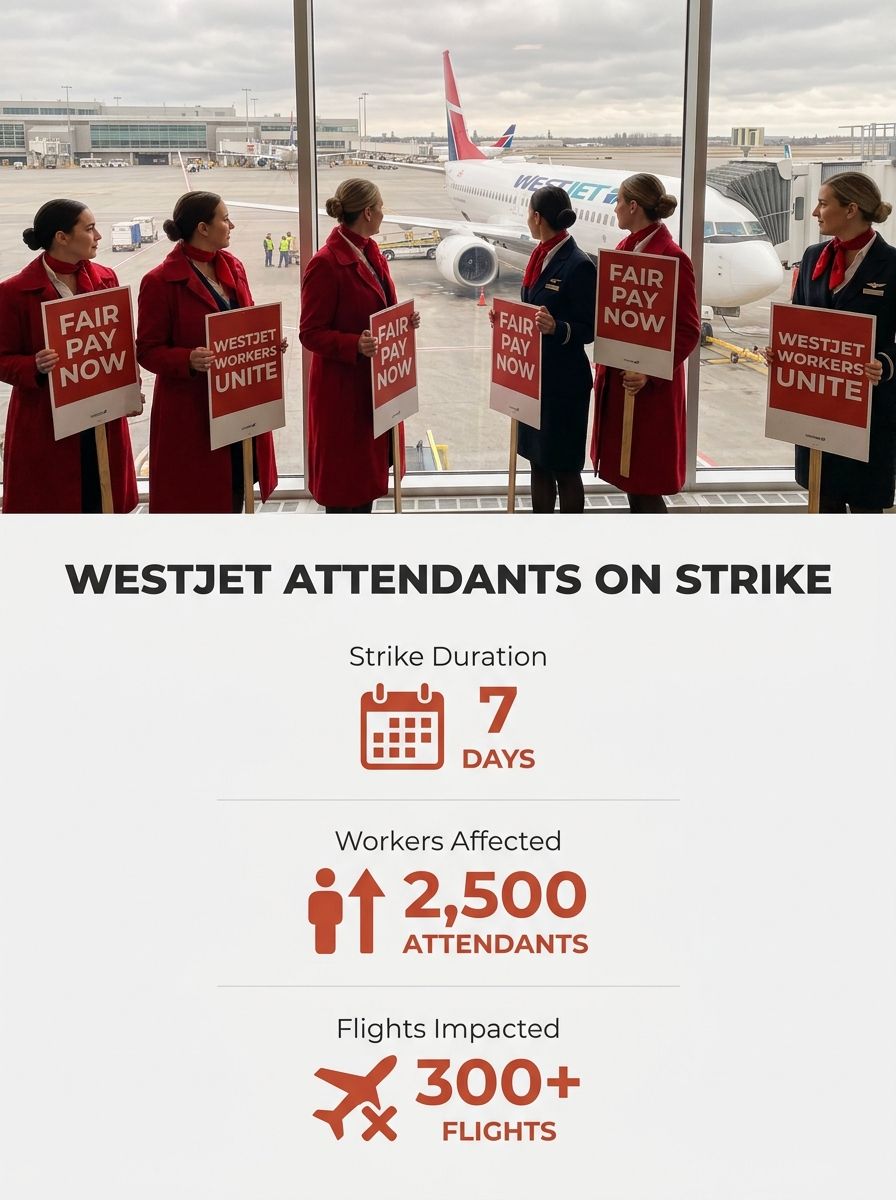
Strike Duration and Timeline
The work stoppage began just after midnight Mountain time Sunday, August 2, following the collapse of last-minute negotiations between WestJet management and CUPE local 8125. The union had issued strike notice earlier in the week with Sunday set as the earliest possible walkout date. WestJet responded with lockout notice, according to the company's statements.
Alia Hussain, president of CUPE local 8125, said in a Monday news release that the tentative agreement "represents meaningful progress" and was "achieved through collective bargaining at the negotiating table." The union represents flight attendants across WestJet's mainline operations.
WestJet CEO Alexis von Hoensbroech said the company was "pleased to have reached a tentative agreement that reflects the hard work and professionalism our cabin crew" demonstrate. Both parties declined to release specific details of the settlement terms pending ratification by union members.
Wage Dispute and Proposed Settlement Terms
The labor dispute centered primarily on compensation for work performed on the ground, including boarding passengers, completing mandatory safety checks, and managing flight delays. Flight attendants had argued that significant portions of their required duties were uncompensated under the previous contract structure.
WestJet released details Sunday of an offer the company said it had presented during negotiations. That proposal included a 13 percent pay increase effective October 1 and retroactive to January 1, 2026, followed by 2.5 percent annual increases through 2029.
The airline's offer also included what it termed a "duty pay premium"—defined as payment for all duty hours and described as "additional pay for all hours worked designed to solve the union's claim of unpaid work." WestJet characterized this premium as equivalent to another 12 percent salary increase on top of the base wage adjustments.
Hussain stated that the tentative agreement "evolves the flight credit system by recognizing more of the work cabin crew are required to perform and with general increases to compensation for that work." The union did not confirm whether the final settlement matched WestJet's publicly disclosed offer.
Operational Impact and Recovery
WestJet began winding down jet operations Saturday in anticipation of the strike and suspended all 737 and 787 flights Sunday. The airline had announced that the suspension would last at least until August 6, with the possibility of extension depending on bargaining outcomes.
Von Hoensbroech acknowledged Monday that the disruption "has been frustrating for our guests and WestJetters," adding that the airline's teams "are working hard to restore service and get our guests on their way to their destinations as quickly as possible." WestJet advised passengers to expect delays in the resumption of full service.
Toronto Pearson International Airport reported Monday morning that all WestJet flights out of the airport remained suspended as of 7 a.m. Eastern time. The airport directed passengers to contact WestJet directly for updated flight information.
Ian Lee, a professor of management at Carleton University's Sprott School of Business, told Global News that airlines cannot immediately resume normal operations following a strike. He noted that carriers are subject to "elaborate" safety rules requiring rechecks of every aircraft and its components before returning to service. Lee said work stoppages are "very, very disruptive because they incur all kinds of costs."
WestJet's regional carrier, WestJet Encore, continued operating throughout the strike. The tentative agreement must now be presented to CUPE local 8125 members for a ratification vote, with the union advising members to check their email for voting details and timelines.
Policy Implications
The WestJet settlement demonstrates the continued effectiveness of traditional collective bargaining even in time-sensitive industries where strikes carry immediate public impact. The agreement's focus on compensating ground work addresses a compensation structure common across the airline industry, where cabin crew historically received pay only for flight hours rather than total duty time.
The rapid resolution—achieved in under 48 hours of active work stoppage—suggests that both parties faced significant pressure to reach terms, with the airline confronting operational shutdown costs and the union weighing public perception in a consumer-facing industry. Federal officials' explicit praise for a "deal together, at the bargaining table" underscores government preference for negotiated settlements over legislated intervention in transportation labor disputes.
The tentative agreement's reported inclusion of duty pay premiums may establish precedent for how airlines structure compensation for non-flight work time, a model that could influence ongoing negotiations at other carriers where flight attendants are organizing or seeking contract improvements. The outcome provides a concrete case study for aviation workers considering unionization, demonstrating measurable wage gains achieved through collective action in a sector where individual bargaining power remains limited.
The Union Edge Staff
Related Articles
Qantas Ground Workers to Strike Over Pay and Safety as Airline Faces Labor Crisis
Approximately 600 Qantas ground workers will strike for 24 hours beginning September 23 across multiple Australian cities, demanding improved pay, job security, and safety standards following the airline's 2020 illegal termination of 1,800 workers, according to Travel Radar.
Virgin Australia Cancels 30 Flights as Cabin Crew Call in Sick During Contract Talks
Virgin Australia cancelled up to 30 flights over the weekend of September 21-22 after cabin crew called in sick amid ongoing contract negotiations, according to a report from Paddle Your Own Kanoo.

University of California Averts Strike With Last-Minute Deal for 40,000 Healthcare Workers
The University of California and AFSCME Local 3299 reached a tentative labor agreement late on May 13, preventing a planned strike by more than 40,000 healthcare and service workers hours before a May 14 walkout deadline, according to Bloomberg Law. The deal secures minimum wage increases to $30.10
Also in the paper