
Minimum Wage New York State 2024: Rates & Changes
New York State's minimum wage operates through a geographic tier system that splits the state into two wage zones, schedules $0.50 annual increases through 2026, and then hands rate-setting to an inflation index in 2027.

Minimum Wage New York State 2024: How the Tiered System Works
New York State's minimum wage operates through a geographic tier system that splits the state into two wage zones, schedules $0.50 annual increases through 2026, and then hands rate-setting to an inflation index in 2027. The structure affects roughly 1 million workers, with outsized impact on home care aides earning industry-specific premiums above the base rate.
Two Geographic Tiers, One State
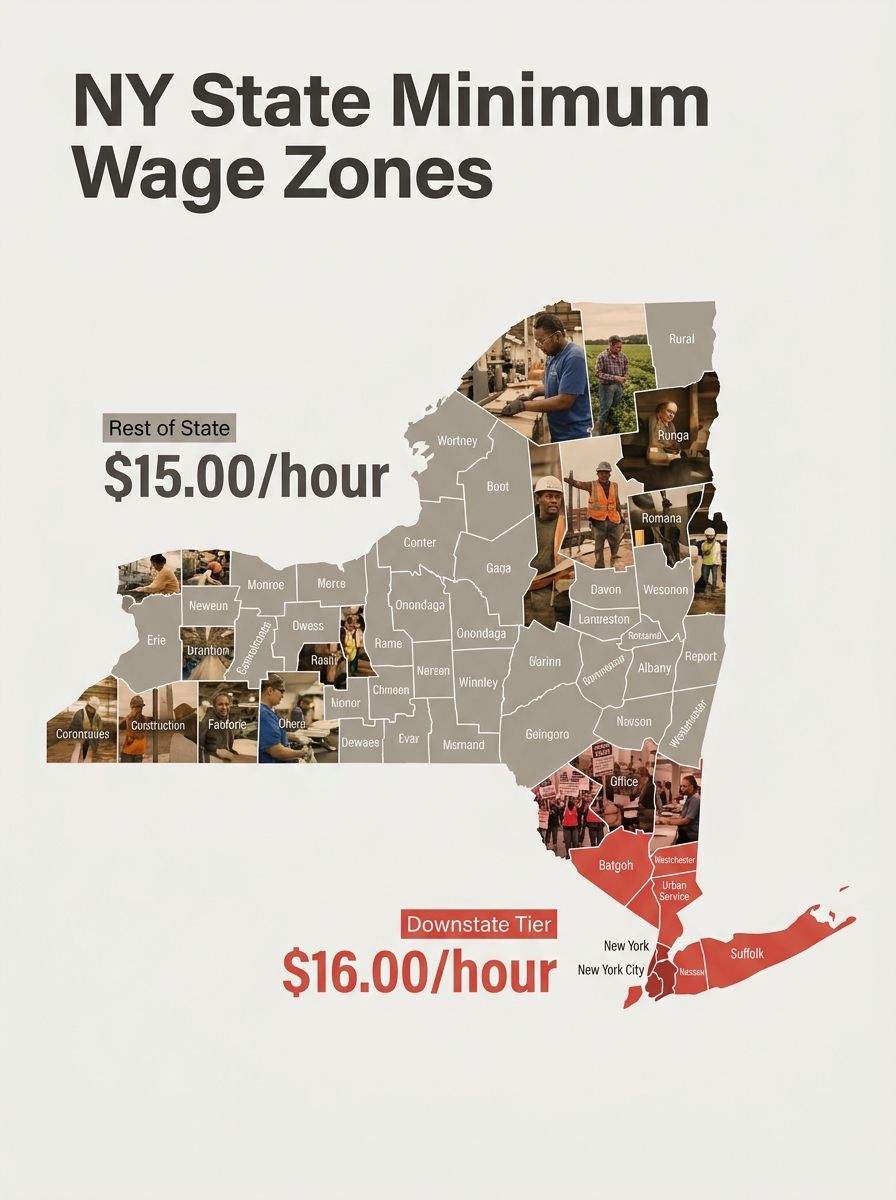
New York doesn't set a single statewide minimum wage. Section 652 of New York Labor Law divides the state into two zones with separate rates. As of January 1, 2024, the downstate zone, covering New York City, Nassau County, Suffolk County, and Westchester County, pays a minimum of $16.00 per hour. The rest of the state pays $15.00 per hour.
The downstate rate jumped from $15.00 to $16.00 on that date. The upstate rate jumped from $14.20 to $15.00. According to analysis from Greenberg Traurig LLP, the increase brought the rest-of-state rate from $14.20 to $15.00, marking the first time every county in New York reached the $15 floor. As the Democrat and Chronicle reported, "About 1 million New Yorkers who stock store shelves and hold other low-wage jobs" received a pay boost.
The tiered approach reflects cost-of-living differences across the state. Rent for a one-bedroom apartment in Manhattan averages over $3,500 per month; in counties like Allegany or Cattaraugus, that figure drops below $700. The wage tiers attempt to track this reality, though the Raise Up NY coalition has pushed for faster convergence. The NYC Comptroller's office noted that the Raise Up NY proposal called for $17.25 per hour in the city for 2024, well above the enacted $16.00.
The Scheduled Escalator: 2024 Through 2026
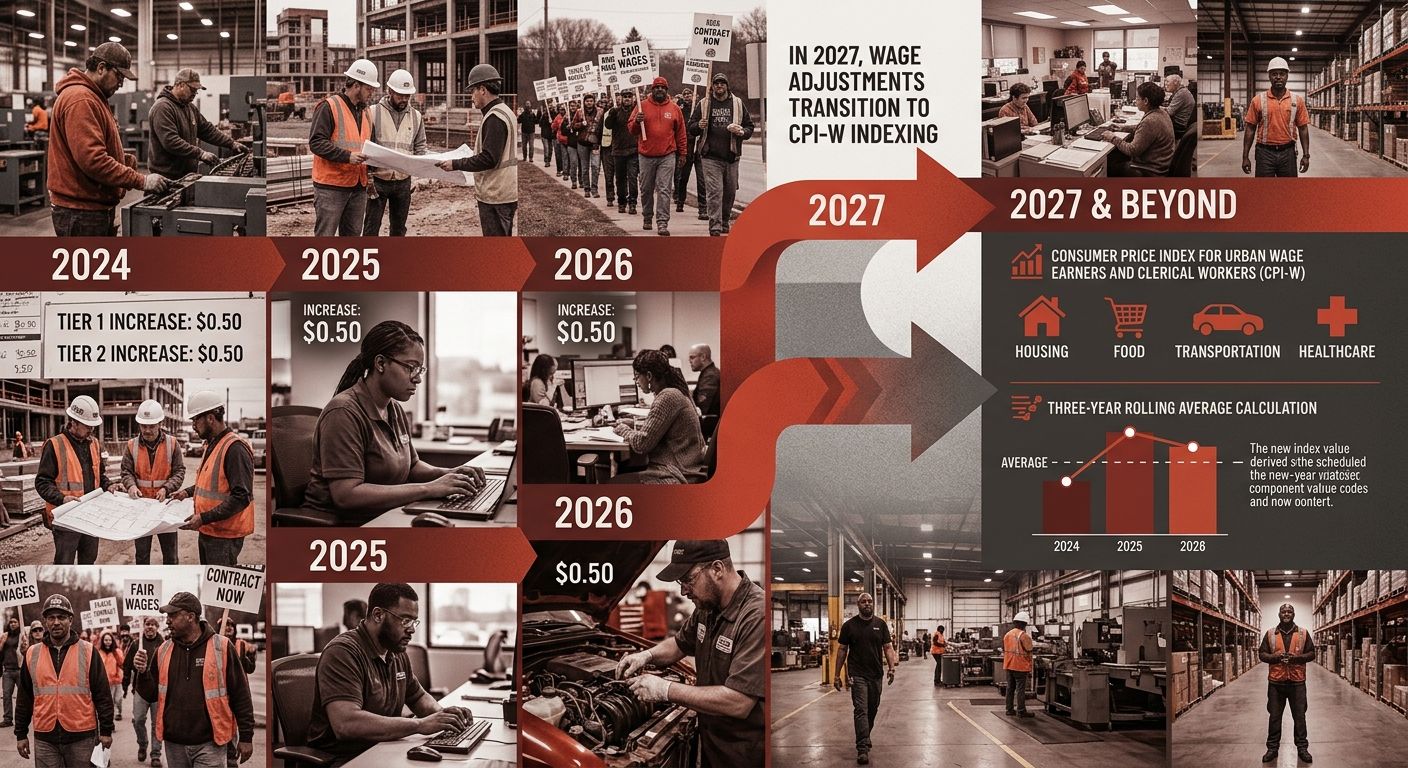
Both wage tiers follow a legislated schedule that adds $0.50 per hour on January 1 of each year through 2026. Gibney Anthony & Flaherty LLP confirmed that "both rates will increase by an additional $0.50 on both January 1, 2025 and January 1, 2026." The full table:
Year | NYC / Nassau / Suffolk / Westchester | Rest of State |
|---|---|---|
2024 | $16.00 | $15.00 |
2025 | $16.50 | $15.50 |
2026 | $17.00 | $16.00 |
By January 1, 2026, the rest of the state will reach $16.00, the same rate downstate hit two years earlier. The gap between zones stays fixed at $1.00 per hour throughout the escalator period.
The approach is structurally different from states like Texas, which adopted the federal $7.25 rate by reference and built legal barriers against any local increases. New York's legislature chose the opposite path: legislating specific dollar amounts years in advance, giving employers a predictable schedule and workers guaranteed raises. Compare this also with California's county-by-county minimum wage variation, which layers dozens of local ordinances on top of the state floor.
The NFIB, representing small business owners, flagged the increase schedule as a compliance concern for businesses operating across county lines. A restaurant chain with locations in both Westchester ($16.00) and Putnam ($15.00) must run two payroll tiers separated by a county border.
The CPI-W Indexing Mechanism Starting 2027
The most consequential feature of New York's minimum wage law activates after the legislated escalator ends. Beginning in 2027, the minimum wage will annually increase by the three-year moving average of the Consumer Price Index for Urban Wage Earners and Clerical Workers (CPI-W) for the Northeast Region. This removes the legislature from annual rate-setting and ties wages directly to measured inflation.
The CPI-W specifically tracks spending patterns of hourly and clerical workers, a narrower population than the broader CPI-U that dominates news coverage. The three-year moving average smooths out spikes from volatile categories like energy prices or pandemic-era supply shocks. Under the formula, the wage can stay flat or rise, it cannot decrease.
New York also built in what officials call an "off-ramp." If the state faces certain economic or budget conditions, the governor can suspend the automatic increase. This mirrors what Ohio did when voters embedded minimum wage indexing into the state constitution, though New York's version gives the executive branch more discretion to pause increases.
The indexing mechanism changes the political dynamics of wage policy. Without it, every increase requires a legislative fight, lobbying campaigns, and compromises that can delay action for years. With it, wages track inflation automatically unless someone in the governor's office acts to stop them.
Healthcare Workers and Industry-Specific Premiums
The minimum wage state of New York sets has particular significance for healthcare support workers, who make up one of the largest low-wage workforces in the state. Home care aides, the workers who help elderly and disabled New Yorkers bathe, eat, and manage medications, earn industry-specific minimum rates above the general floor.
As of 2024, home care aides in the downstate zone earn a minimum of $18.55 per hour, while upstate aides earn $17.55 per hour. These rates increase in tandem with the general minimum wage, reaching $19.65 and $18.65 respectively by 2026. The premium exists because New York's home care workforce faces chronic staffing shortages: turnover rates in the sector have exceeded 60% annually in recent years, and the state has struggled to attract workers to physically demanding jobs that require split shifts and travel between clients' homes.
For hospital systems and nursing homes, the state of New York minimum wage sets the floor for entry-level positions like patient transport, dietary services, and environmental services. When healthcare unions like 1199SEIU negotiate contracts, the statutory minimum serves as the baseline above which bargaining begins. A $0.50 statutory increase puts upward pressure on the entire wage scale, workers already earning $17 or $18 per hour expect adjustments to maintain their differential above new hires.
The push for physician unionization at University of California hospitals illustrates how wage pressure travels up the occupational ladder, though the dynamics differ sharply between hourly healthcare support staff and salaried professionals.
Tipped Workers, Fast Food, and the Cash-Wage Split
Tipped employees in New York's downstate zone must receive a minimum cash wage of $10.65 per hour, with employers claiming a tip credit of $5.35 per hour. In the rest of the state, the cash wage is $10.00 with a $5.00 tip credit. The total, cash wage plus tip credit, must equal or exceed the applicable minimum wage for that zone every pay period.
This matters for healthcare-adjacent workers more than you'd expect. Home health agencies sometimes classify companion care workers differently from home care aides, and the line between tipped service workers (like those in residential care dining facilities) and non-tipped healthcare staff can blur in practice. Misclassification exposes employers to back-pay claims covering the full minimum wage differential.
Fast food employees statewide earn a flat $15.00 per hour as of 2024, a rate set through a separate wage board process that predates the current tier system. The fast food minimum applies specifically to chains with 30 or more locations nationally and is distinct from the general minimum wage. Congressional proposals to eliminate the restaurant tip credit entirely would reshape this landscape across states, but New York's existing cash-wage requirements already provide tipped workers with significantly more protection than the federal tipped minimum of $2.13 per hour.
Exempt Employee Salary Thresholds
The minimum wage increase triggers a corresponding increase in the salary threshold for exempt employees, the annual pay below which a salaried worker must be treated as hourly and receive overtime. For "executive" and "administrative" employees in the downstate zone, the threshold rose to $62,400 per year ($1,200 per week) in 2024. Clifton Budd & DeMaria LLP documented the full schedule of exempt threshold changes alongside the minimum wage increase.
In the rest of the state, the threshold started at $58,458.40 per year ($1,124.20 per week) in 2024.
Year | Downstate Exempt Threshold (Annual) | Rest of State Exempt Threshold (Annual) |
|---|---|---|
2024 | $62,400 | $58,458.40 |
2025 | $64,350 | $60,405.80 |
2026 | $66,300 | $62,353.20 |
One gap stands out: the salary threshold for "professional" employees remains undefined under New York state law. Employers default to the federal standard of $684 per week for that category. So a medical office manager classified as "administrative" faces a $1,200/week threshold, while a clinician classified as "professional" faces a $684/week threshold, a difference of over $500 per week before overtime rules kick in. For healthcare employers, where administrative and clinical roles overlap constantly, this inconsistency creates real compliance risk.
Where the Mechanism Breaks
New York's tiered system carries structural weaknesses that its designers acknowledged by including the governor's off-ramp.
Border arbitrage is the most visible problem. Employers near county lines, the border between Westchester ($16.00) and Putnam ($15.00), for instance, face a $1.00 per hour cost difference for identical work performed a few miles apart. For healthcare providers operating home care agencies in multiple counties, this means managing different pay scales for aides whose client territories may span both zones. Some agencies report losing workers to competitors in higher-wage counties who can recruit with a $1.00/hour premium at no additional effort.
CPI-W lag is the second structural weakness. Because the index uses a three-year moving average, the 2027 increase will reflect inflation data from 2024 through 2026. If inflation spikes sharply in 2026, workers won't see the full adjustment until 2029 or later. The smoothing that protects against volatile swings also delays response to real cost-of-living increases, exactly the kind of increases that hit low-wage workers hardest.
The off-ramp itself is a vulnerability from a worker-protection standpoint. The governor's authority to suspend automatic increases means the CPI-W indexing is a default, not a guarantee. During a recession, when low-wage workers are most financially exposed, the mechanism designed to protect their purchasing power can be paused. Research on minimum wage impacts suggests that a 10% increase in minimum wage typically raises overall consumer prices by only 0.14 percentage points in the first year, with negligible long-term effects. The economic case for the off-ramp is weaker than it appears.
And the professional-employee threshold gap grows more problematic each year. At current trajectories, the federal professional threshold of $684/week will fall below what a full-time minimum-wage worker in the downstate zone earns ($640/week at $16.00, rising to $680 by 2026). By 2026, a "professional" employee in New York could be exempt from overtime at a salary barely above what minimum-wage workers earn for a 40-hour week.
Common Questions
Does the minimum wage in New York State apply to all workers?
The New York Department of Labor states that everyone working in New York State is entitled to receive the state's hourly minimum wage rates. Industry-specific rates for home care ($18.55/$17.55) and fast food ($15.00 statewide) set floors above the general minimum for covered workers in those sectors.
What's the difference between the minimum wage New York State sets and a separate NYC rate?
There is no separate NYC minimum wage. New York City falls within the downstate tier ($16.00 in 2024), which also covers Nassau, Suffolk, and Westchester counties. The NYC rates and requirements follow the same state-legislated schedule. NYC does not set its own municipal minimum wage independent of state law.
Will the state of New York minimum wage keep increasing after 2026?
Yes. Starting in 2027, increases are tied to the CPI-W three-year moving average for the Northeast Region. The rate can stay flat or rise under this formula, it cannot decrease. The governor retains authority to suspend increases during defined economic or budget emergencies through the off-ramp provision.
How does the minimum wage in New York State compare to the federal minimum?
The federal minimum wage has remained at $7.25 per hour since 2009. New York's lowest tier ($15.00 in 2024) is more than double the federal floor. When both a state and federal minimum wage apply, employers must pay the higher rate. Workers in states like Texas, where the $7.25 federal rate is the only floor, earn less than half what New York's lowest-paid workers receive.
Do home care aides earn the standard minimum wage?
No. Home care aides earn industry-specific premiums: $18.55 per hour downstate and $17.55 per hour upstate as of 2024. These rates increase alongside the general minimum wage schedule, reaching $19.65 and $18.65 by 2026. The premiums were established to address severe recruitment and retention challenges in a sector where annual turnover has exceeded 60%.
The Union Edge Staff
Frequently Asked Questions
- What is the minimum wage in New York State for 2024?
- New York has a two-tier system: $16.00 per hour in New York City, Nassau, Suffolk, and Westchester counties, and $15.00 per hour in the rest of the state as of January 1, 2024.
- How much will New York's minimum wage increase each year through 2026?
- Both wage tiers will increase by $0.50 per hour annually on January 1 of 2025 and 2026, bringing downstate wages to $16.50 in 2025 and $17.00 in 2026, while upstate reaches $15.50 and $16.00 respectively.
- What happens to New York's minimum wage after 2026?
- Starting in 2027, the minimum wage will increase automatically based on a three-year moving average of the Consumer Price Index for Urban Wage Earners and Clerical Workers (CPI-W) for the Northeast Region, though the governor can suspend increases during certain economic conditions.
- How much do home care aides earn in New York State?
- Home care aides earn industry-specific minimum rates of $18.55 per hour downstate and $17.55 per hour upstate as of 2024, which are higher than the general minimum wage to address high turnover rates in the sector.
- What is the tipped minimum wage in New York State?
- Tipped employees in downstate counties must receive a minimum cash wage of $10.65 per hour with a $5.35 tip credit, while upstate tipped workers receive $10.00 in cash wages with a $5.00 tip credit.
- What is the fast food minimum wage in New York State?
- Fast food employees at chains with 30 or more locations nationally earn a flat $15.00 per hour statewide as of 2024, set through a separate wage board process distinct from the general tiered minimum wage.
- How does New York's minimum wage compare to the federal minimum wage?
- New York's lowest tier of $15.00 per hour in 2024 is more than double the federal minimum wage of $7.25 per hour, which has remained unchanged since 2009.
- What are the exempt employee salary thresholds in New York State for 2024?
- For executive and administrative employees, the threshold is $62,400 annually ($1,200 per week) downstate and $58,458.40 annually ($1,124.20 per week) upstate in 2024, and these thresholds increase each year alongside minimum wage changes.
Related Articles

Minimum Wage in New York: Current Rates & Updates
Depending on where you clock in, the minimum wage in New York ranges from $16.00 to $17.00 per hour, set by a two-zone structure that completed its final scheduled $0.50 increase on January 1, 2026, and will hand future adjustments to an inflation formula in 2027.

New York State Minimum Wage: 2024 Rates & Requirements
The new york state minimum wage is a two-zone geographic system where workers in New York City, Long Island, and Westchester earn one hourly floor, and workers everywhere else in the state earn a lower one. As of January 1, 2024, those floors sat at $16.00 and $15.

Minimum Wage New York: 2024 Update
New York's minimum wage operates through a geographic tier system that pays workers in New York City, Long Island, and Westchester a different hourly rate than workers in the rest of the state. The 2024 update set those tiers at $16.00 and $15.
Also in the paper