
Minimum Texas Wage: What You Need to Know
Unlike 30 states that set independent minimum wage floors above the federal rate, Texas adopted the federal number by reference and then built a legal architecture that prevents any city or county from going higher. The result: the minimum wage in Texas has been $7.

Minimum Texas Wage: How the $7.25 Floor Actually Works
Unlike 30 states that set independent minimum wage floors above the federal rate, Texas adopted the federal number by reference and then built a legal architecture that prevents any city or county from going higher. The result: the minimum wage in Texas has been $7.25 per hour since July 24, 2009, and a three-layer locking mechanism keeps it there.
How Texas Adopted the Federal Floor
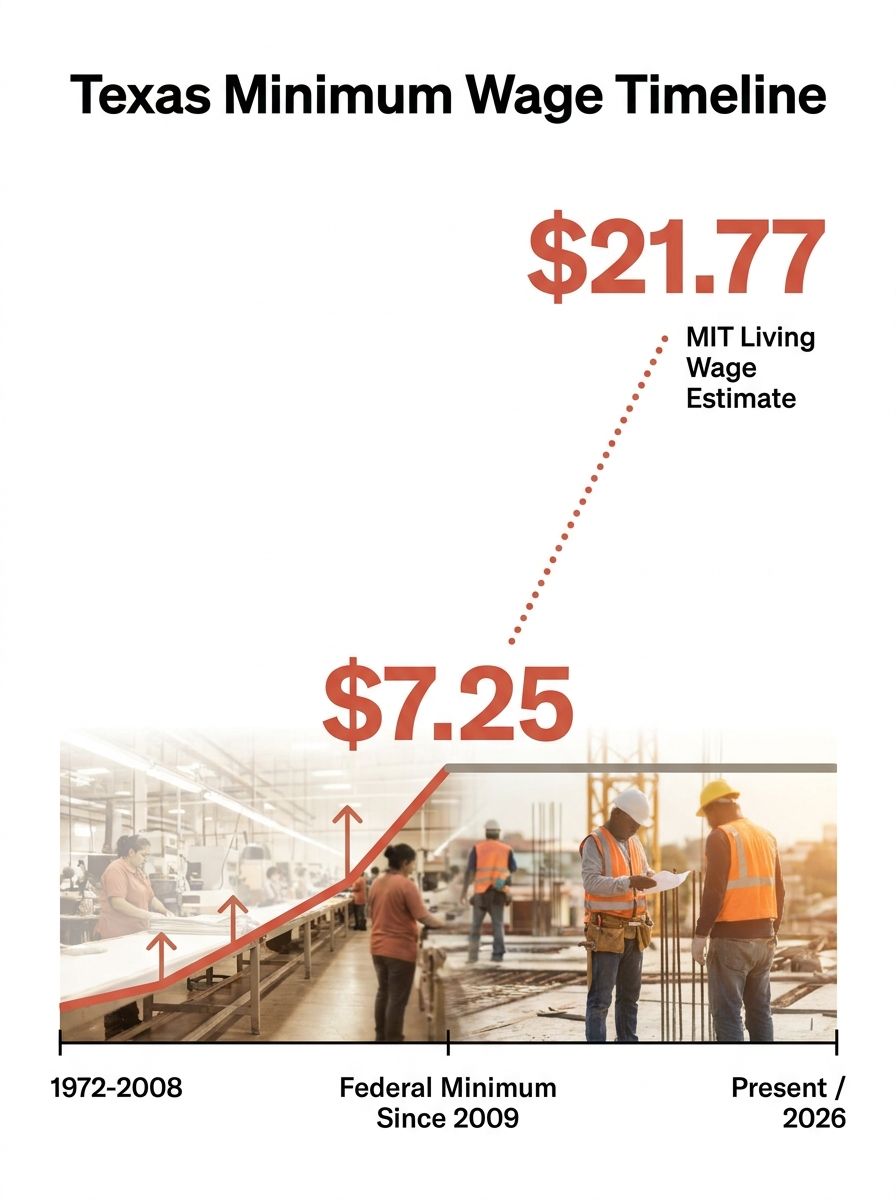
The Texas Workforce Commission administers Chapter 62 of the Texas Labor Code, which establishes the state's minimum wage. But the operative mechanism is a pass-through: the state minimum wage rate equals whatever Congress sets under the Fair Labor Standards Act (FLSA). When the FLSA rate went to $7.25 on July 24, 2009, the Texas rate moved with it. When Congress stopped raising the FLSA rate, Texas froze too.
This pass-through design means the Texas legislature doesn't vote on wage increases. FRED data from the Federal Reserve Bank of St. Louis tracks the state minimum wage rate for Texas from 1972 to 2026, and the line has been flat at $7.25 for 17 consecutive years. For healthcare support workers across the state, from home health aides to hospital custodial staff, that frozen floor has real consequences. MIT's Living Wage Calculator estimates a single adult in Texas needs $21.77 per hour to cover basic expenses, and the gap grows to $24.55 per hour in Austin's metro area.
That 3:1 ratio between what workers need and what the law requires is the largest sustained gap in the state's wage history.
The Three-Layer Wage Lock
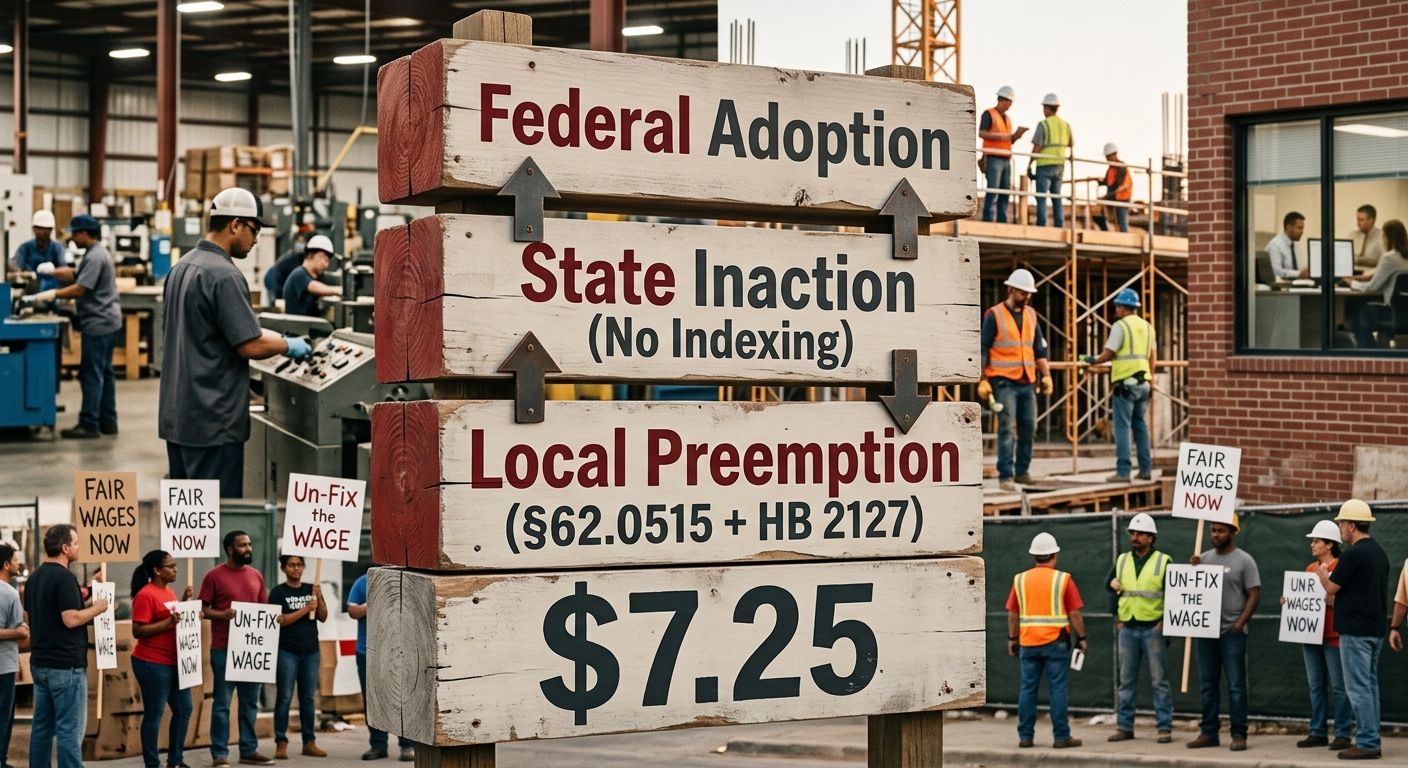
Understanding why the minimum texas wage stays frozen requires examining a structure we call the three-layer wage lock: federal adoption, state inaction, and local preemption. Each layer reinforces the others.
Layer 1: Federal adoption. Texas Labor Code Chapter 62 sets the state rate equal to the federal rate. The state legislature doesn't need to act for the rate to change, but this also means the legislature can remain passive. No independent mechanism exists to raise the minimum wage of texas above the federal floor.
Layer 2: State inaction. Texas has no automatic inflation indexing. States like Ohio, which we've covered in detail here, tie their minimum wage to the Consumer Price Index so the rate adjusts annually without a legislative vote. Texas built no such mechanism. The rate moves only through federal action.
Layer 3: Local preemption. Texas Labor Code § 62.0515, enacted in 2003, prohibits any city, county, or political subdivision from requiring private employers to pay above the state rate. This wasn't a theoretical safeguard. Austin's city council had been exploring a local wage ordinance, and the preemption statute blocked that path. Then in 2023, Governor Greg Abbott signed HB 2127, widely called the "Death Star" law, which broadened preemption across multiple regulatory domains and reinforced the wage prohibition.
The practical effect: as of 2026, no city or county in Texas sets a minimum wage above the state rate, so $7.25 applies everywhere from Brownsville to Amarillo. Compare that to California, where 38 local ordinances set binding wage floors above the state rate, creating dozens of distinct pay zones across the state. We've written about how California's layered wage system works and the difference in approach is stark.
Tipped Workers and the $2.13 Cash Wage
The minimum wage for texas includes a separate tipped employee provision that drops the required cash wage to $2.13 per hour. This mirrors the federal tip credit under the FLSA. The employer's obligation: if tips don't bring the worker's total compensation to at least $7.25 per hour in any given pay period, the employer must make up the difference.
That sounds like a safety net, but enforcement is thin. Workers in restaurants, bars, and hotels across Texas carry the burden of tracking their own tip income, and many don't know they're entitled to the makeup payment. According to Homebase's analysis of Texas wage law, the $2.13 cash wage has been unchanged since 1991, a 35-year freeze that predates even the current $7.25 standard rate.
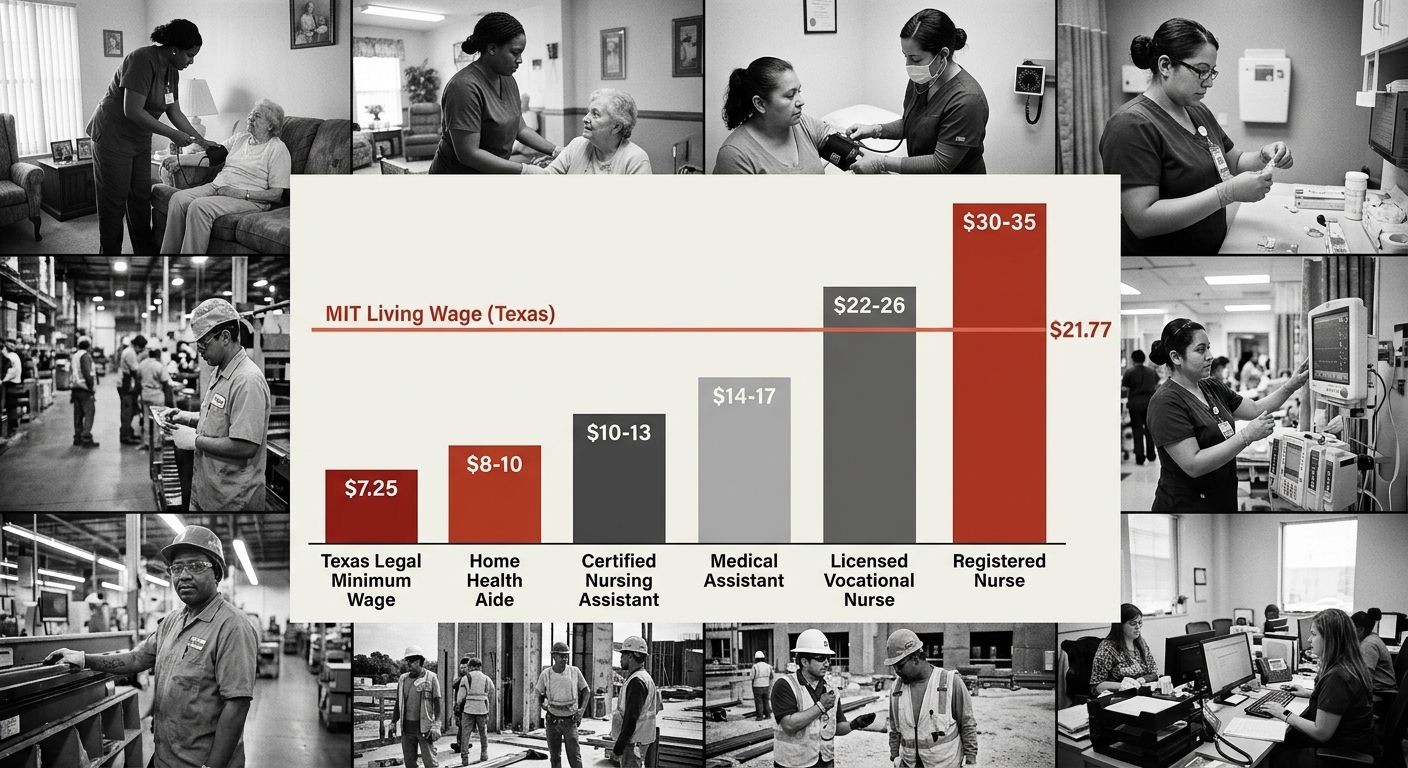
Healthcare workers face a related problem. Home health aides, certified nursing assistants, and hospital dietary staff in Texas are among the lowest-paid workers in the state. While they aren't tipped employees, many earn wages close to the $7.25 floor. A home health aide spending 40 hours a week with elderly patients earns $290 before taxes at the minimum rate. The MIT living wage data shows that same worker needs roughly $872 per week to cover basic needs in Texas, creating a $582 weekly shortfall that often gets filled by second jobs or public assistance programs like Medicaid and SNAP.
Sub-Minimum Exceptions Under Chapter 62
The Texas Labor Code carves out specific categories of workers who can legally be paid below $7.25 per hour. These exceptions are narrower than most workers realize, but they exist and affect vulnerable populations disproportionately.
According to the Texas Workforce Commission, sub-minimum wages are permitted for workers who are patients or clients of the Texas Department of State Health Services (DSHS), and for other individuals based on age or productivity impairments. This provision mirrors the FLSA Section 14(c) certificate program, which allows employers to pay disabled workers below minimum wage based on measured productivity relative to non-disabled peers performing the same job.
The age-based exception applies to workers under 20, who can be paid $4.25 per hour during their first 90 consecutive calendar days of employment. After 90 days, the full $7.25 applies. Full-time students in certain retail, service, agriculture, or college work-study programs can be paid 85% of minimum wage, or $6.16 per hour, under specific conditions.
For healthcare facilities, these exceptions matter. Sheltered workshops, rehabilitation programs, and some state health service facilities have historically used sub-minimum provisions. The intersection of disability rights and wage policy creates ongoing tension that Congressional efforts to raise the federal minimum wage have repeatedly confronted. The Democrats' $25 minimum wage bill, which we've covered in our reporting on the tip credit elimination proposal, would affect these sub-minimum provisions at the federal level.
What Employers Actually Pay vs. What the Law Requires
The texas minimum wage creates a legal floor, but market conditions in 2026 have pushed actual starting wages well above $7.25 in most sectors. Texas unemployment sits around 4.1%, and employers in retail, food service, logistics, and healthcare compete for workers by offering $15 to $22 per hour in major metros like Houston, Dallas-Fort Worth, San Antonio, and Austin.
This creates a paradox. The legal minimum is $7.25, but relatively few large employers actually pay it. The workers most likely to earn at or near the minimum are those with the least bargaining power: undocumented immigrants in informal employment, part-time workers at small businesses, home care workers in rural areas, and young workers in their first jobs. The minimum wage of texas functions less as a universal floor and more as a poverty anchor for the most vulnerable segments of the workforce.
For healthcare specifically, the gap between legal minimum and prevailing wages varies dramatically by role and geography. A registered nurse in Houston starts around $32 per hour. A certified nursing assistant at a rural nursing home outside Lubbock might start at $10, and a home health aide in the Rio Grande Valley might earn $8.50. The lower you go on the healthcare hierarchy, the closer wages sit to the legal floor, and the more the frozen $7.25 rate matters.
Where the Mechanism Breaks
The three-layer wage lock works as designed from a legislative standpoint. It keeps the minimum wage in texas static, uniform across jurisdictions, and insulated from local political pressure. But the mechanism produces outcomes that strain other parts of the state's fiscal and healthcare systems.
Public benefit costs shift to taxpayers. When full-time workers earn $7.25 per hour, they qualify for Medicaid, SNAP, housing assistance, and other programs funded by state and federal taxes. Texas's decision not to expand Medicaid under the Affordable Care Act compounds this: low-wage healthcare workers often can't afford the insurance offered by their employers but earn too much to qualify for traditional Medicaid and live in a state that didn't expand coverage. The cost of low wages doesn't disappear; it transfers to public systems.
Recruitment failures hit healthcare hardest. Rural hospitals and nursing homes across Texas report persistent staffing shortages. When the legal floor signals that $7.25 is an acceptable wage, employers that pay modestly above it, say $9 or $10, position themselves as competitive. But those wages still fall far short of what workers need, pushing potential healthcare aides and support staff toward retail and warehouse jobs that now start at $15 or more. The minimum wage acts as a gravitational anchor on wage expectations even when employers technically pay above it.
The preemption layer blocks local solutions. Cities like Austin, Houston, and San Antonio have populations, costs of living, and labor markets that differ enormously from rural West Texas. Under the three-layer lock, a city can't respond to local housing costs or healthcare staffing crises by raising its wage floor. The $7.25 rate in downtown Austin, where a one-bedroom apartment averages over $1,400 per month, operates under the same rules as a town of 2,000 in the Panhandle.
These breakdowns don't mean the mechanism is about to change. They mean workers absorb the consequences through poverty wages, benefit dependence, and constrained career choices in healthcare and other essential services.
Common Questions
Has the minimum wage in Texas ever been higher than the federal rate?
No. Texas has consistently adopted the federal minimum wage rate, and FRED data confirms the state rate has tracked the federal floor from 1972 through 2026. The state has never independently legislated a higher rate.
Can Texas cities like Austin or Houston set their own minimum wage?
They cannot. Texas Labor Code § 62.0515, enacted in 2003, prohibits any city, county, or political subdivision from requiring private employers to pay above the state rate of $7.25 per hour. HB 2127, signed in 2023, reinforced this prohibition across multiple regulatory categories. As of 2026, $7.25 applies uniformly statewide.
What is the tipped minimum wage in Texas?
The tipped employee cash wage in Texas is $2.13 per hour, matching the federal tip credit provision. Employers must ensure that tips bring total compensation to at least $7.25 per hour. If they don't, the employer is legally required to pay the difference. That $2.13 rate has been unchanged since 1991.
Does the Texas minimum wage adjust for inflation automatically?
It does not. Texas has no inflation-indexing mechanism. The rate changes only when Congress raises the federal minimum wage, which hasn't happened since July 24, 2009. States like Ohio have built automatic CPI adjustments into their wage laws; Texas chose a different path.
Who can legally be paid below $7.25 in Texas?
Under Chapter 62 of the Texas Labor Code, sub-minimum wages are permitted for workers under 20 during their first 90 days ($4.25/hour), certain full-time students ($6.16/hour), and individuals who are patients or clients of the Texas Department of State Health Services. These exceptions require specific conditions documented by the Texas Workforce Commission.
The Union Edge Staff
Frequently Asked Questions
- What is the minimum wage in Texas?
- The minimum wage in Texas is $7.25 per hour, which has remained unchanged since July 24, 2009. Texas adopted the federal minimum wage rate by reference and has no independent mechanism to raise it above the federal floor.
- Can Texas cities like Austin or Houston set their own minimum wage?
- No, Texas cities cannot set their own minimum wage. A 2003 preemption statute and the 2023 HB 2127 law prohibit any city, county, or political subdivision from requiring private employers to pay above the state rate of $7.25 per hour.
- What is the tipped minimum wage in Texas?
- The tipped employee cash wage in Texas is $2.13 per hour. Employers must ensure that tips bring total compensation to at least $7.25 per hour per pay period, and must make up any difference if tips fall short.
- Does Texas minimum wage adjust for inflation automatically?
- No, Texas has no automatic inflation-indexing mechanism. The state minimum wage changes only when Congress raises the federal rate, which has not occurred since 2009.
- Who can be paid below $7.25 per hour in Texas?
- Workers under 20 can be paid $4.25 per hour during their first 90 days of employment, full-time students can be paid $6.16 per hour under specific conditions, and certain individuals who are patients or clients of the Texas Department of State Health Services can be paid sub-minimum wages.
- How much does a home health aide earn at minimum wage in Texas?
- A home health aide working 40 hours per week at the Texas minimum wage of $7.25 earns $290 before taxes, while the MIT Living Wage Calculator estimates such a worker needs approximately $872 per week to meet basic living costs in Texas.
- Has Texas ever set a minimum wage higher than the federal rate?
- No, Texas has consistently adopted the federal minimum wage rate since 1972 and has never independently legislated a higher rate.
Related Articles

Minimum Wage Texas: Current Laws & Rates
Chapter 62 of the Texas Labor Code contains no independent wage figure. It copies the federal minimum wage by reference, which means the texas minimum wage has been $7.25 per hour since July 24, 2009, and won't change unless Congress acts.
What Is the State of Texas Minimum Wage
The Texas Minimum Wage Act contains no dollar amount. The statute adopts the federal minimum wage rate by reference, making the state of Texas minimum wage identical to the federal floor: $7.

What Is Minimum Wage in Texas: 2024 Guide
Texas does not set its own minimum wage dollar amount. The state's minimum wage law, administered by the Texas Workforce Commission, defers entirely to the federal Fair Labor Standards Act, which means workers in Texas earn a floor of $7.25 per hour, a rate unchanged since July 24, 2009.
Also in the paper