
The Organizing Model vs. Service Model: Which Strategy Actually Wins Contracts for Workers?
Maria Gonzalez, a warehouse steward in Northern California, waited three weeks for her union rep to call back before her contract expired. Her local had operated on a pure service model for more than a decade. Dues went in, and a staff representative was supposed to handle everything else.

The Organizing Model vs. Service Model: Which Strategy Actually Wins Contracts for Workers?
Maria Gonzalez, a warehouse steward in Northern California, waited three weeks for her union rep to call back before her contract expired. Her local had operated on a pure service model for more than a decade. Dues went in, and a staff representative was supposed to handle everything else. When bargaining time came, Maria's coworkers barely knew what was in their own contract, let alone what they should be fighting for. The result? A concessionary agreement that froze wages for two years.
Compare that to what happened ninety miles south. Dockworkers at a regional logistics hub built a shop-floor committee of forty stewards, ran weekly lunchroom conversations for three months before their contract opened, and presented management with a petition signed by 91 percent of the bargaining unit on day one of negotiations. They walked out of bargaining with a 14 percent raise over three years, stronger safety language, and a just-cause standard for discipline. Same industry. Same economic conditions. Radically different union strategy.
So what separates these two outcomes? The answer sits at the center of a debate that has defined the labor movement for the past three decades: the organizing model versus the service model. We've seen both up close, and we have strong opinions about which one actually delivers at the bargaining table. But the evidence is even more convincing than our opinions.
What the Service Model Actually Looks Like
The service model treats a union a lot like an insurance company. Workers pay dues, and in return, professional staff handle grievances, arbitration, and contract negotiations. Members are largely passive consumers of representation. The union's relationship with the employer tends to be managed, cordial, and transactional.
This isn't a caricature. The Massachusetts Nurses Association's comparison of the two models lays it out plainly: in the service model, maintaining a good relationship with management is the priority, the union structure is hierarchical, and the attitude toward members tends to be exclusive rather than inclusive.
For decades, this was the default. And it worked tolerably well in industries where pattern bargaining was strong, employer opposition was moderate, and union density was high enough to create market pressure. But those conditions have been eroding since the 1980s. When the British Trades Union Congress relied heavily on servicing throughout that decade, it failed to reverse declining membership or bargaining power, even as individual grievances got processed efficiently.
The core problem is structural. When a union is run as an organization that simply trades dues for services, it becomes significantly less powerful than a union built on active participation. A staff rep can file a grievance. A staff rep cannot generate the kind of collective pressure that forces an employer to move on economics.
What the Organizing Model Demands
The organizing model flips the equation. Instead of staff doing things for members, members do things for themselves, with staff providing training, coordination, and strategic support. It's built on one-on-one conversations, workplace committees, escalating collective actions, and deep member involvement in every phase of bargaining.
As researchers Heery, Simms, and others have documented, the organizing model cannot be effective without people to both implement it and carry it out. That's not a weakness. That's the point. The model's power comes from the fact that it requires broad participation, which in turn creates the very solidarity and pressure that wins at the table.
Here's what it looks like in practice:
Mapping the workplace. Organizers and stewards identify every worker in the unit, their concerns, their social networks, and their willingness to take action.
Building a representative committee. The bargaining committee reflects every shift, department, and demographic group in the shop. Nobody is invisible.
Running a contract campaign. Before proposals ever hit the table, the committee conducts surveys, holds meetings, and builds toward visible collective actions like petition deliveries, informational pickets, or work-to-rule campaigns.
Bargaining transparently. Members get real-time updates. They understand trade-offs. They vote on tentative agreements with full information.
The UC Berkeley Labor Center's research on high-participation negotiations confirms what organizers have known for years: workers who use the collective bargaining process with deep organizing and member-driven strategy achieve better contracts. Period. Not sometimes. Not in certain industries. Across the board.
The Numbers Don't Lie
We've talked to dozens of organizers and reviewed contract outcomes across industries. The pattern is unmistakable.
Unions that run real contract campaigns—with member engagement at every stage—consistently outperform unions that rely on professional negotiators working behind closed doors. The Teamsters' own bargaining manual emphasizes developing strategic plans that strengthen the union and pressure the employer, acknowledging that locals of all sizes have won when they followed this approach.
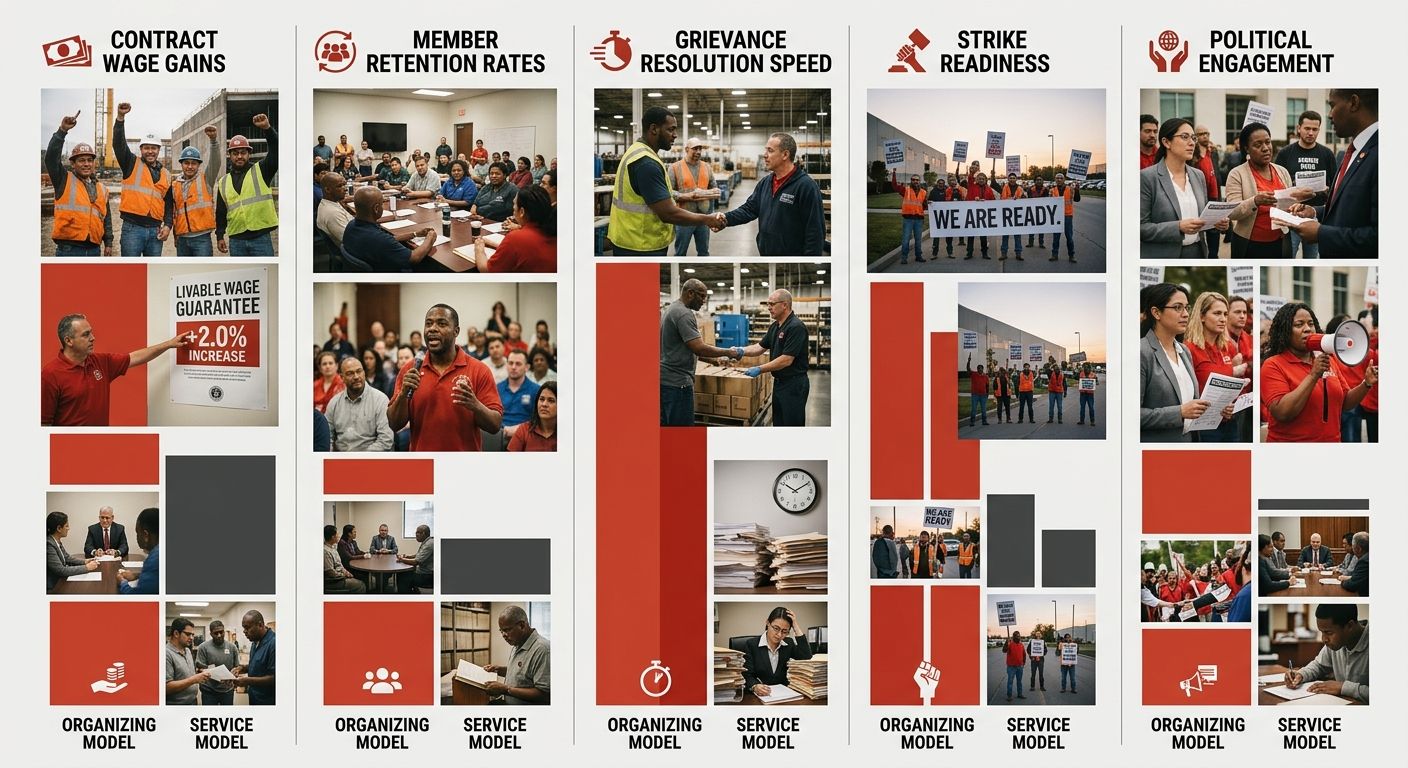
And it's not just about the initial contract. Organizing-model locals retain members at higher rates, process grievances faster (because stewards are trained and confident), and generate more political power in their communities. The AFL-CIO has consistently found that working people in unions have higher wages, better benefits, and safer workplaces, but those outcomes track most strongly with unions that maintain active member participation beyond the organizing drive.
Consider the airport workers organized by UNITE HERE who won recognition for 1,400 Prospect Airport Services and PrimeFlight Aviation Services employees. After building on minimum standards established through local ordinances, they secured a first collective bargaining agreement that exceeded those baseline requirements. That didn't happen because a lawyer made clever arguments. It happened because workers built power from the ground up.
Why the Service Model Persists
If the organizing model is so clearly superior, why does anyone still run a service model union? Honest answer: because organizing is hard, and the service model is comfortable.
The service model requires fewer staff hours per member. It doesn't demand that leaders share power. It doesn't create internal conflict when members disagree about priorities. And for union officers who've held their positions for years, shifting to an organizing model means fundamentally changing their jobs, often in ways that feel threatening.
Richard Hurd and other labor scholars have pointed out that transitioning to the organizing model creates more work than maintaining the service approach. Staff need retraining. Members need to be engaged in roles previously held by professionals. The process is messy, contentious, and slow.
But here's what we keep telling locals we work with: the service model's comfort is an illusion. A union that doesn't organize is a union that slowly dies. Membership declines. Bargaining power erodes. Employers get bolder. And eventually, the members who stayed loyal start asking why they're paying dues for representation that can't deliver.
If you're grappling with how to move your local from passive representation to active organizing, our field guide to union organizing campaigns breaks down the practical steps for building a campaign from first conversation to first contract.
The Hybrid Reality
We should be honest about something: very few unions operate a pure version of either model. The best locals we've seen combine strong service infrastructure with aggressive organizing tactics. They file grievances quickly AND they build shop-floor power. They maintain professional legal counsel AND they train rank-and-file members to lead bargaining.
British unions like the Transport and General Workers Union (T&G) demonstrated this with their "Justice for Cleaners" campaign, which organized workers in London's Canary Wharf financial district and won measurable wage improvements. The T&G selectively adopted organizing tactics like one-on-one recruitment, petitions, and demonstrations while maintaining its core service functions.
The key distinction isn't really "organizing vs. service." It's about where power sits. Does power sit with the members or with the staff? A union where members drive strategy and staff provide support will always outperform a union where staff drive strategy and members provide dues.
How to Build This in Your Shop
If you're a steward, officer, or rank-and-file member reading this and recognizing your union in the service model description, here's what you can do starting this week:
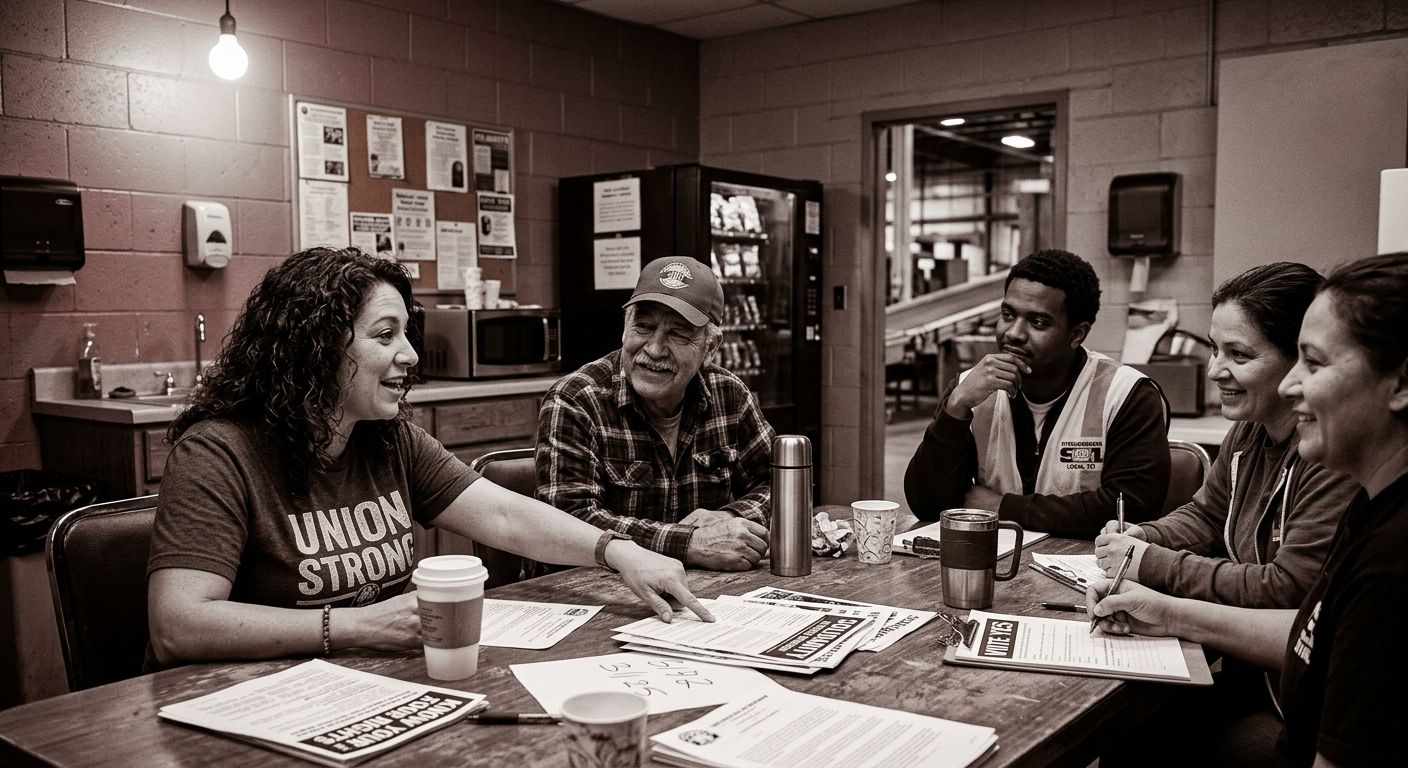
Start with conversations. The organizing model begins with talking to your coworkers about what matters to them. Not handing them a flyer. Not sending an email blast. Sitting down in the break room or parking lot and asking, "What would make this job better?" Document what you hear.
Build your committee before you need it. Don't wait until bargaining opens to recruit a committee. Identify natural leaders in every part of your workplace now. The community engagement strategies that win external campaigns work inside the shop too. Every department, every shift, every crew needs someone who's talking to their coworkers.
Run escalating actions. Start small. A group grievance. A petition about a safety concern. A delegation to the supervisor's office. Each action builds confidence and demonstrates collective power. By the time bargaining opens, your members have already practiced standing together, and management has already noticed.
Demand transparency in bargaining. If your negotiating committee disappears behind closed doors for weeks at a time, push back. Members who understand what's happening at the table are members who will hold the line when it matters. Regular updates, open bargaining sessions where possible, and honest assessments of proposals build the trust that wins ratification votes.
Connect bargaining to broader issues. The best contracts don't just address wages. They address safety standards, scheduling dignity, healthcare access, and equity. When your bargaining campaign touches on issues like how unions close the wage gap or why workplace safety standards matter, you give every member a personal reason to stay engaged.
The Verdict
We're not going to pretend this is a close call. The organizing model wins contracts. The evidence is overwhelming, and our experience confirms it. Unions that invest in member engagement, build shop-floor power, and run real contract campaigns consistently outperform unions that outsource representation to professional staff.
That doesn't mean you throw out your grievance procedure or stop paying for legal counsel. It means you recognize that those tools only work when they're backed by an organized, informed, and mobilized membership. The service model treats workers as clients. The organizing model treats workers as the union itself. And when workers are the union, they win.
Bob Carter, a labor scholar who has studied both approaches extensively, offered one of the most important cautions about this transition: a model premised on debate and involvement cannot be successfully introduced without discussion. You can't impose an organizing model from the top down. That defeats the entire purpose. The shift has to come from workers deciding they want more power and being willing to do the work to build it.
So here's our call to action. Talk to five coworkers this week. Ask them what they'd change about your contract if they could change one thing. Write down what they say. Bring those notes to your next union meeting. That's not a grand strategy. It's a conversation. But every contract campaign that ever won started with someone deciding to stop waiting for a phone call and start talking to the person next to them.
Maria Gonzalez figured that out. After the concessionary contract passed, she organized a steward training, recruited twelve new committee members, and spent the next two years building the kind of shop-floor infrastructure her local had never had. When the next contract opened, management sat down across the table from a committee that represented every corner of the warehouse, backed by a membership that had already voted on priorities. They won a 9 percent raise, enforceable safety language, and a ban on mandatory overtime beyond ten hours.
Nobody told her to sit tight this time.
The Union Edge Staff
Also in the paper