
Greece Extends Collective Bargaining Coverage to Over 400,000 Workers Through Sectoral Agreement Reforms
More than 400,000 workers in Greece now fall under collective bargaining agreement coverage following a series of sectoral agreements signed and extended across six industries in recent months, according to the Ministry of Labour's announcement on June 27. The expansion represents a significant incr

Greece Extends Collective Bargaining Coverage to Over 400,000 Workers Through Sectoral Agreement Reforms
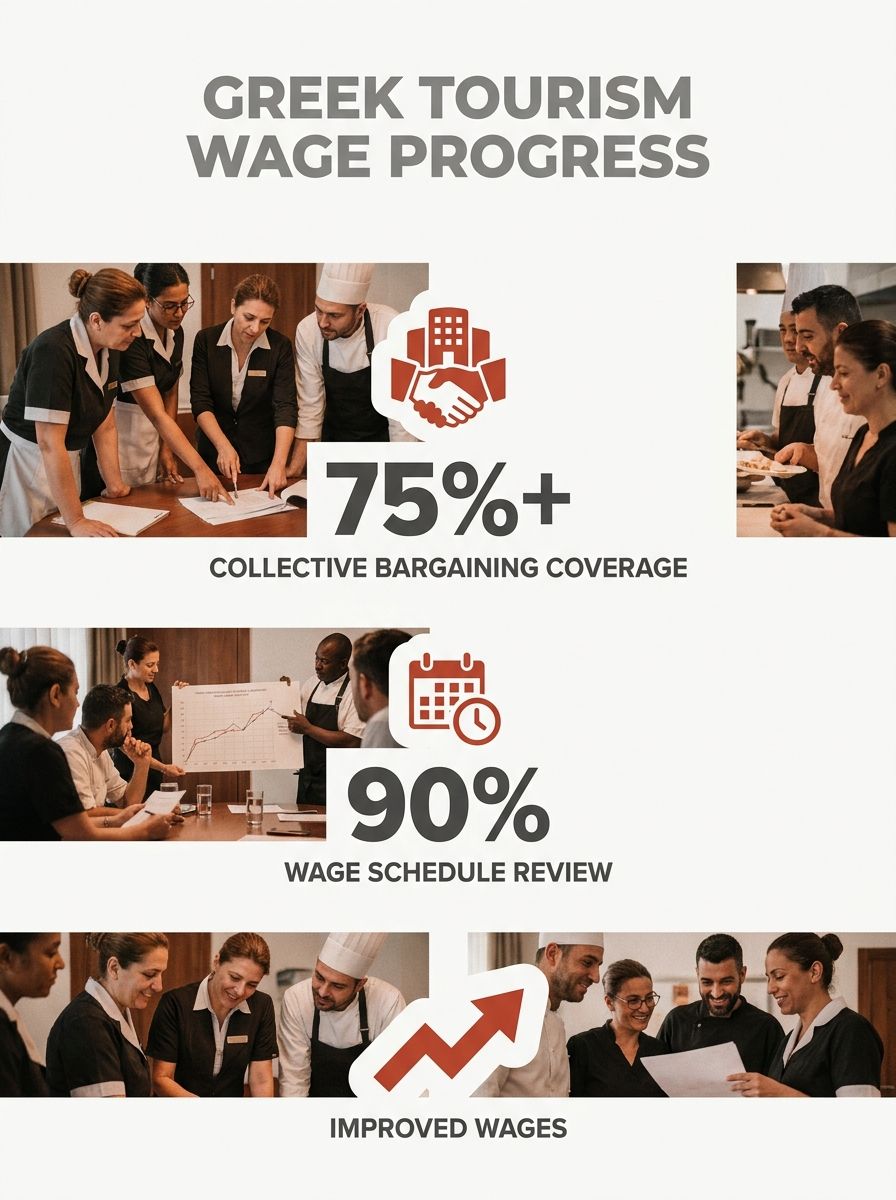
More than 400,000 workers in Greece now fall under collective bargaining agreement coverage following a series of sectoral agreements signed and extended across six industries in recent months, according to the Ministry of Labour's announcement on June 27. The expansion represents a significant increase in worker protections under the government's National Social Agreement initiative, with new contracts setting baseline wages between €930 and €1,100 in tourism and hospitality sectors alone.
Labour Minister Nikē Kerameos told the Athens News Agency-Macedonian Press Agency that strengthening collective bargaining remains central to ministry policy, with the agreements delivering both improved wages and enhanced business stability. The reforms mark Greece's most substantial expansion of sectoral bargaining coverage in over a decade, with tourism and hospitality accounting for the majority of newly covered workers.
Six Sectors Gain New Contract Coverage
The Ministry of Labour has signed and extended collective bargaining agreements in tourism, hospitality (food and beverage services), confectionery, bakery, and food technologist sectors, according to ministry data. Each agreement applies universally to all workers within the respective industry, regardless of union membership status.
Tourism and hospitality workers represent the largest group under the new agreements, with over 400,000 employees now covered. The confectionery sector saw coverage expand from approximately 6,000 to 23,000 workers through the extension mechanism. Food technologists and scientists—a workforce of more than 2,500—received their first collective bargaining agreement in 15 years, ministry records show.
The extension model allows sectoral agreements negotiated between employer associations and union representatives to apply industry-wide once approved by the Labour Ministry, a mechanism similar to collective bargaining structures used in other European countries but distinct from the enterprise-by-enterprise approach common in U.S. labor relations.
Wage Increases Range From 9.2% to €305 Over Contract Terms
The tourism and hospitality agreement establishes monthly base salaries between €930 and €1,100 with scheduled increases during the contract's validity period, ministry documents show. The contract includes allowances for seniority, Sunday and holiday shifts, and category-specific bonuses for certain employee classifications.
Confectionery workers will see cumulative salary increases reaching 9.2% by 2028 under their new agreement. The bakery sector contract includes similar wage progression provisions, though specific percentage increases were not disclosed in the ministry announcement. Food technologist and scientist positions received both salary increases and new allowance categories after operating without a collective agreement since 2011.
Piraeus Bank announced a separate enterprise-level agreement on June 27 that sets a €1,700 monthly minimum salary for employees, with increases totaling €305 per worker over the three-year period from 2027 through 2029. The bank contract adds €660 in supplementary benefits and introduces responsibility allowances alongside enhanced family support provisions.
Government Policy Prioritizes Expanding CBA Reach
"The National Social Agreement is already delivering tangible results—boosting wages and expanding worker protections," Minister Kerameos said in her statement to ANA-MPA. She emphasized that the ministry aims to steadily increase the number of workers covered by collective labour regulations while maintaining business stability through predictable contract terms.
The Greek government's approach centers on sectoral bargaining rather than enterprise-level negotiations, a structure that allows broader coverage with fewer individual contract cycles. Ministry officials stated the initiative has drawn recognition at the European level as Greece works to rebuild collective bargaining infrastructure weakened during the country's debt crisis period.
The reforms follow years of austerity measures that suspended or limited collective bargaining rights in Greece. Between 2010 and 2018, sectoral agreements largely disappeared as bailout conditions required labour market flexibility. The current government's restoration of automatic extension mechanisms represents a policy shift back toward coordinated wage-setting across entire industries.
What This Means for Union Members
Greece's sectoral bargaining expansion offers a case study in how extension mechanisms can rapidly increase collective agreement coverage beyond traditional union density rates. The 400,000-worker figure represents coverage growth achieved through six agreements rather than hundreds of individual workplace campaigns—a scale efficiency U.S. unions rarely access under the National Labor Relations Act's enterprise-by-enterprise certification model.
The wage floor approach embedded in these agreements establishes baseline standards across entire industries, preventing non-union employers from undercutting union shops through lower wage competition. This dynamic resembles successful collective bargaining outcomes in other coordinated bargaining systems, where sectoral agreements lift wages for both represented and unrepresented workers within the same industry classification.
For U.S. labor organizers watching international developments, the Greek model highlights an alternative architecture: negotiate once at the sector level, extend through government action, cover entire industries. Whether similar mechanisms could gain political traction in U.S. policy debates remains uncertain, but the 400,000-worker coverage increase demonstrates the potential reach of systems that separate contract coverage from individual workplace majority votes.
The Union Edge Staff
Related Articles

AFL-CIO Endorses Sectoral Bargaining for First Time as States Lead New Wave of Worker Organizing
The AFL-CIO passed a resolution at its July 2026 conference endorsing sectoral bargaining for the first time in the federation's history, according to a Time article published Wednesday.
House Passes Union Contract Bill as Worker Income Share Hits 79-Year Low
The U.S. House of Representatives passed the Faster Labor Contracts Act on September 15, legislation designed to expedite union contract negotiations for newly organized workplaces, according to an analysis published in the Las Vegas Sun.

Examples of Collective Bargaining Success
At nearly 3am on November 25, 2024, graduate workers at the University of Minnesota and university administrators finalized a tentative first collective bargaining agreement after more than 30 hours of continuous mediation over two days, according to UE News.
Also in the paper