
Healthcare Workers Claim Victory on Los Angeles County's Measure ER as Ballot Count Continues
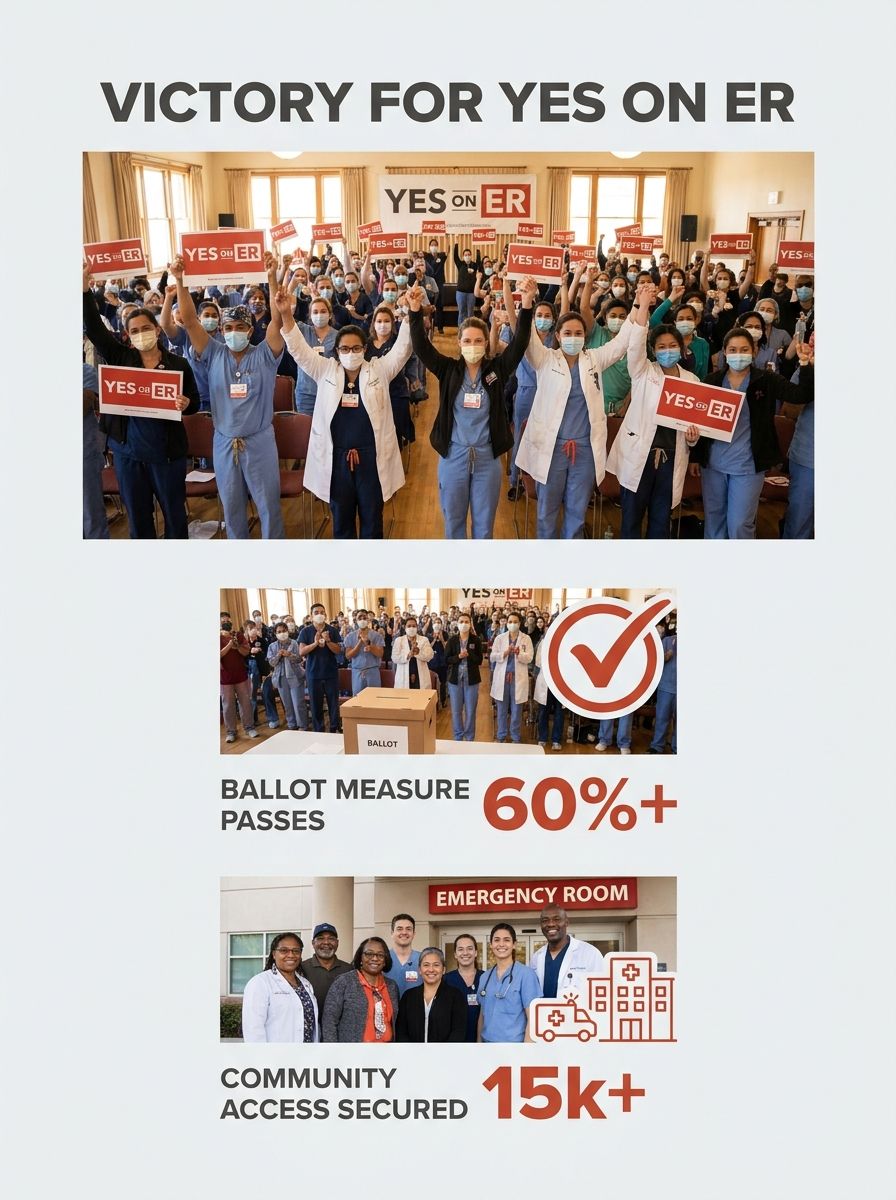
Healthcare workers declared victory on Measure ER as Los Angeles County continued counting ballots from the primary election, according to CBS Los Angeles. The ballot initiative, which healthcare labor organizations backed, appeared headed for passage as of June 11, though final certification remain

Healthcare Workers Claim Victory on Los Angeles County's Measure ER as Ballot Count Continues
Healthcare workers declared victory on Measure ER as Los Angeles County continued counting ballots from the primary election, according to CBS Los Angeles. The ballot initiative, which healthcare labor organizations backed, appeared headed for passage as of June 11, though final certification remained pending with thousands of mail ballots still uncounted. The measure represents a direct-democracy organizing tool that healthcare unions have increasingly deployed when contract negotiations and regulatory advocacy stall.
What Measure ER Does for Healthcare Workers
The ballot measure affects healthcare facilities across Los Angeles County, the nation's most populous county with more than 300 hospitals and medical centers. Healthcare worker organizations promoted the initiative as a labor standards measure, though detailed provisions have not been publicly itemized in initial victory statements. The measure reached the ballot through California's county-level initiative process, which requires signature gathering and vetting by the county registrar before placement.
Ballot measures offer healthcare workers an organizing path that bypasses employer-controlled workplace rule-making. Unlike contract negotiations, which require employer agreement, or state legislation, which faces lobbying opposition, county ballot measures go directly to voters. The strategy has gained traction in California healthcare over the past decade as unions seek to establish minimum standards that apply across all facilities, not just unionized workplaces.
Union-Backed Ballot Campaigns in Healthcare
Healthcare unions have used ballot measures to win staffing ratios, wage floors, and safety standards when employers resist changes through collective bargaining. Los Angeles County's healthcare sector employs more than 600,000 workers, including nurses, technicians, custodians, and administrative staff. Ballot initiatives create baseline standards that apply whether workers have union representation or not, making them particularly valuable in partially organized industries.
The vote-counting timeline reflects California's expanded vote-by-mail system, which has extended ballot certification periods. Counties accept mail ballots postmarked by election day for up to seven days after polls close, and verification of signatures and provisional ballots adds additional processing time. As of June 11, Los Angeles County had not released final vote totals or margin information, though healthcare worker organizations felt confident enough in preliminary returns to declare victory publicly.
Strategic Implications for Labor Campaigns
The apparent passage of Measure ER demonstrates healthcare workers' ability to mobilize voter support for workplace standards measures. Ballot campaigns require different organizing skills than workplace union drives—petition gathering, voter contact, media strategy, and coalition building with community groups. Healthcare unions have adapted by training organizers in electoral campaign methods and partnering with patient advocacy organizations to frame measures as quality-of-care issues rather than purely labor disputes.
This approach shifts the battlefield from the workplace, where employers control access and messaging, to the voting booth, where workers and community members hold equal standing. Employers must campaign publicly against measures rather than conducting closed-door captive audience meetings. The transparency requirement changes power dynamics, particularly when measures include patient safety provisions that employers find difficult to oppose openly.
Other healthcare unions have tracked Los Angeles County's initiative process as a potential model. Ballot measures require significant upfront investment in signature gathering and campaign spending, but they can establish standards across entire regions in a single election cycle. The strategy complements rather than replaces traditional organizing, giving workers multiple pressure points when employers resist bargaining demands.
Context and Outlook
Healthcare worker ballot initiatives represent a maturation of labor strategy beyond workplace-by-workplace organizing. By establishing county-wide standards, these measures force non-union employers to match conditions won through direct democracy, indirectly spreading union gains across the sector. The approach has proven particularly effective in California, where county-level ballot measures face lower signature thresholds than statewide initiatives but still cover major metropolitan populations.
The Measure ER campaign reflects broader trends in healthcare organizing as unions adapt to consolidated hospital systems that can outlast individual workplace strikes. Ballot measures allow labor organizations to use community support and reframe workplace issues as public health concerns. If final vote counts confirm passage, Los Angeles County's healthcare standards will provide a template for similar campaigns in other California counties and potentially other states with ballot initiative systems.
Healthcare employers have struggled to counter ballot measures effectively, particularly when unions frame initiatives around patient safety rather than worker compensation. The strategy's success in Los Angeles County will likely accelerate its adoption in regions where healthcare unions have strong community ties but uneven workplace representation. For workers in partially organized sectors, the ballot measure path offers a supplement to traditional organizing that can raise standards even in non-union facilities.
The Union Edge Staff
Related Articles

Leadership Density Over Card Counts: Why Union Authorization Metrics Fail and What Actually Predicts Organizing Success
Authorization cards measure interest, not resilience.

University of California Averts Strike With Last-Minute Deal for 40,000 Healthcare Workers
The University of California and AFSCME Local 3299 reached a tentative labor agreement late on May 13, preventing a planned strike by more than 40,000 healthcare and service workers hours before a May 14 walkout deadline, according to Bloomberg Law. The deal secures minimum wage increases to $30.10

UnityPoint Nurses Turn to Lawmakers After Employer Delays Union Certification
Nurses at UnityPoint Health in Des Moines, Iowa, met with state and federal lawmakers this week to discuss delayed union certification nearly one year after voting to join Teamsters Local 90, according to a statement from the union. The employer has filed objections that have prevented the National
Also in the paper