
How One Poultry Plant's Safety Committee Won LOTO Enforcement After Three Amputations — A Case Study in Grievance-to-Policy Conversion
OSHA's lockout tagout standard, 29 CFR 1910.147, has been federal law since 1989. Poultry plants still rank among its worst violators.

How One Poultry Plant's Safety Committee Won LOTO Enforcement After Three Amputations
OSHA's lockout tagout standard, 29 CFR 1910.147, has been federal law since 1989. Poultry plants still rank among its worst violators. The mechanism that converts shop-floor amputations into enforceable lockout tagout enforcement is the union grievance process, and it works through a specific four-stage pipeline that most safety committees never finish.
The LOTO Standard and Why Poultry Plants Keep Violating It
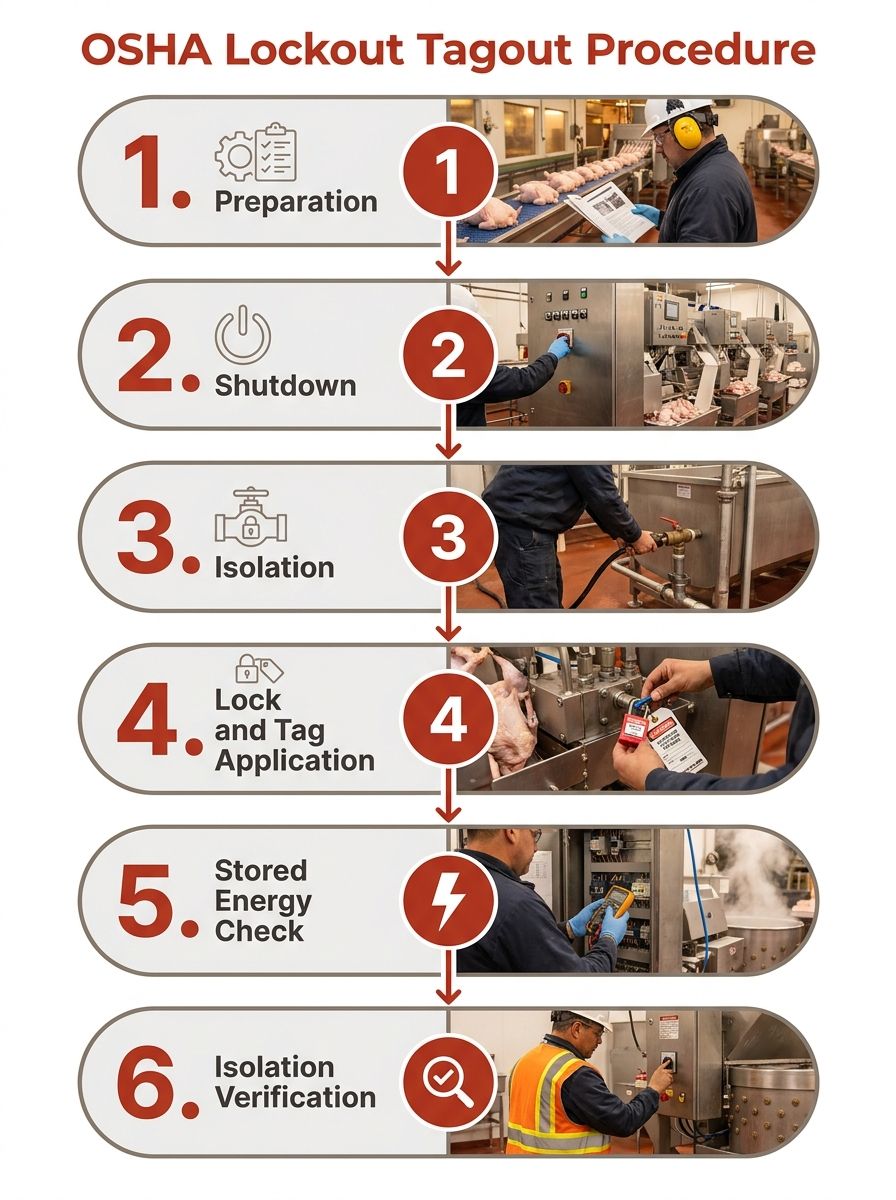
OSHA's lockout tagout standard requires employers to shut down machines and isolate every energy source before any worker performs maintenance or cleaning. The six-step LOTO procedure covers preparation, shutdown, isolation, lock/tag application, stored energy verification, and isolation verification. Each step must be documented. Each energy source (electrical, pneumatic, hydraulic, thermal, mechanical) must be addressed individually.
Poultry processing plants operate high-speed deboning lines, rotary knives, conveyor systems, and industrial mixers. OSHA's poultry processing hazards page identifies moving machine parts as a leading cause of "crushed fingers or hands, amputations, burns, or blindness." Workers in poultry processing face amputation hazards at three times the rate of workers in all other industries.
The gap between the written standard and what happens on the production floor is enormous. Line speeds create constant pressure to skip shutdown procedures. When a conveyor jams at 2 a.m. during a sanitation shift, the incentive is to clear it fast and keep moving. Without a union safety committee forcing compliance, that incentive wins every time.
OSHA's Region 4 Emphasis Program, covering the southeastern United States where most poultry processing is concentrated, tracked enforcement data at poultry facilities from FY 2012 through 2014. The program directive listed amputation hazards, caught-in-equipment injuries, and electrical shock among the top citation categories. Lockout tagout violations appeared repeatedly across facilities.
What Happened in Gainesville
In January 2018, the U.S. Department of Labor cited Koch Foods, a poultry processing company in Gainesville, Georgia, for serious and repeat violations. OSHA cited Koch with a repeat violation for exposing employees to amputation hazards by failing to provide machine guarding. The proposed penalties totaled $208,977.
"Repeat violation" in OSHA's enforcement language means the company had already been cited for the same hazard and failed to fix it. Workers kept getting hurt on the same types of machines for the same reasons. The company knew the danger existed, received a prior citation, and still didn't adequately guard the equipment.
This is the environment where grievance to policy conversion becomes necessary. Individual workers filing one-off complaints won't change a company's cost calculation. As one industry compliance analysis documented, a facility in Pennsylvania was cited for "not fully addressing all hazardous energy sources at the facility through its lockout/tagout procedures." That phrase, "not fully addressing," appears over and over in OSHA enforcement records. Partial compliance is the norm in the industry. Full compliance requires sustained, organized pressure from the people who work on those machines every day.
Stage One: Documenting Every Incident, Every Near-Miss
The grievance to policy pipeline starts with documentation. Safety committees at unionized plants hold responsibility for recording every injury, every near-miss, and every instance where LOTO procedures were skipped or done wrong.
The American Postal Workers Union describes local safety committees as bodies that "provide a mechanism to document and address safety concerns that may later become formal grievances if left unresolved," according to the APWU's guidance on safety committees. Documentation is the raw material. Without it, grievances have no foundation.
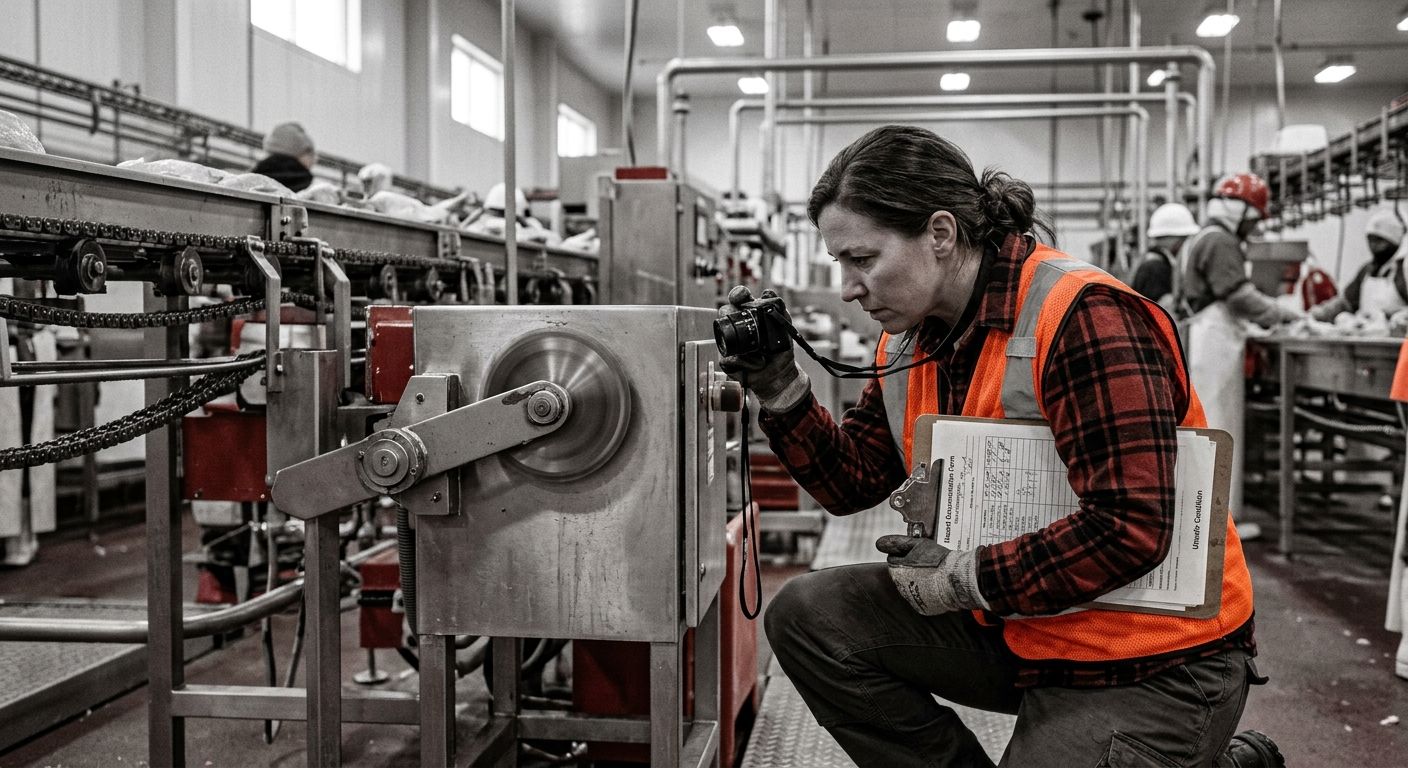
Good documentation in a poultry plant means recording the date, time, shift, machine number, supervisor on duty, and names of witnesses each time a worker observes an unguarded machine, a missing lockout device, or a supervisor ordering someone to clear a jam without shutting down the line. It means photographing the equipment. It means keeping copies of written work orders or maintenance logs.
This step sounds straightforward. In practice, it's a major barrier. Workers face retaliation for reporting hazards. Many employees speak languages other than English. In plants where productivity tracking functions as a discipline system, workers fear that slowing down to document a hazard will trigger an automated warning. And poor communication across multilingual workplaces means reports sometimes never get collected at all. Safety committee members in poultry plants often need to gather information in Spanish, Haitian Creole, Marshallese, and other languages spoken on the production floor.
Stage Two: Filing Grievances That Build a Pattern
Individual grievances are building blocks. The pattern they create is what generates real bargaining power. UFCW Local 951, which represents food processing workers, states on its grievance filing page that "the grievance procedure is at the very core of the union contract because it ensures workers are treated fairly, and it provides a method for day-to-day enforcement of the contract."
Each grievance filed over a LOTO violation creates a record. Three grievances about the same unguarded deboning line create a pattern. Ten grievances across multiple machines create evidence of systemic failure. This is where the machine guarding union strategy takes shape: through a stack of documented complaints proving management knows about the hazard and refuses to fix it.
The key is consistency. Every time a worker sees a machine running without proper lockout during maintenance, a grievance goes in. Every time a supervisor tells someone to reach into a conveyor without shutting it down, a grievance goes in. Every time a lock or tag is missing from a control panel, a grievance goes in. The safety committee tracks these by machine, by shift, and by supervisor.
When the safety committee holds 15 or 20 grievances all pointing to the same category of violation, the union's position shifts from "we have a complaint" to "we have proof of willful noncompliance." That distinction matters enormously at the bargaining table and in any future OSHA proceeding.
Stage Three: OSHA Citations as an Escalation Lever
OSHA citation union pressure enters the picture when the company refuses to resolve grievances at the plant level. The union can file an OSHA complaint at any point, but that complaint carries far more weight when it arrives backed by months of documented grievances the company refused to address.
The Occupational Safety and Health Act of 1970, as the OSHA Education Center's historical analysis describes, "gave the federal government power to enforce health and safety rules in the workplace." Unions helped pass this law. They remain its most effective enforcement mechanism at the plant level.
Here's how the escalation works. The safety committee files grievances. Management either ignores them or offers token fixes. The committee then files a formal OSHA complaint with all of its documentation attached. OSHA inspects. If OSHA finds violations, the resulting citation becomes third-party validation of everything the union has been arguing.
Koch Foods' $208,977 penalty in Gainesville is a concrete example. A repeat citation for failing to provide machine guarding told the world that OSHA came, found the problem, told the company to fix it, came back, and found the same problem still there. That kind of enforcement record strengthens the union's bargaining position enormously.
But OSHA enforcement alone won't solve the problem long-term. Federal resources are badly stretched. In some states, as few as six inspectors cover 60,000 workplaces. Federal enforcement cannot maintain a constant presence at any single plant. The union has to translate OSHA's findings into permanent, contractually binding policy.
Stage Four: Writing LOTO Requirements Into the Contract
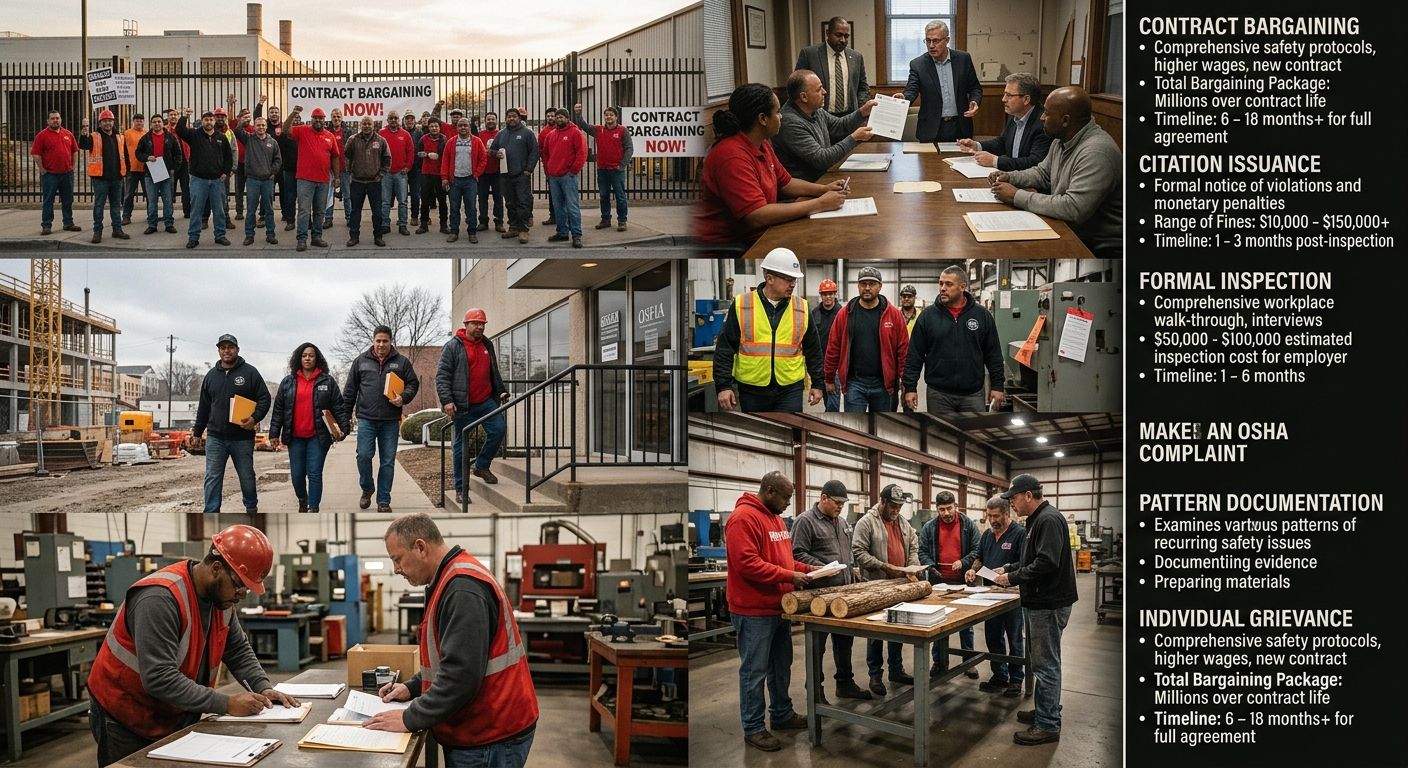
This is where grievance to policy conversion becomes real and binding. The safety committee takes the stack of grievances, the OSHA citation, and the documented injury record to the bargaining table. The goal: contract language that makes specific LOTO procedures mandatory and enforceable through arbitration.
Effective lockout tagout enforcement language in a union contract goes beyond repeating OSHA's general standard. Strong contract provisions specify which machines require lockout before any maintenance or cleaning. They name who is authorized to perform lockout. They require the company to provide individual locks and tags to every authorized employee, at the company's expense. They create a joint labor-management audit schedule, typically quarterly. They set consequences for supervisors who order workers to bypass LOTO. And they guarantee that any worker who refuses to work on an unguarded or unlocked machine cannot be disciplined.
The contract language converts what was a management discretion issue into a binding obligation with teeth. If the company violates the LOTO provisions, the union files a grievance under the new language and can push it to arbitration. The arbitrator rules based on what the contract says, not on management's excuses about production schedules or staffing shortages.
The Four-Stage Grievance Stack
The mechanism described above follows a repeatable structure. We call it the Grievance Stack:
Stage | Action | Output | Typical Timeline |
|---|---|---|---|
1. Document | Record every LOTO violation, near-miss, and injury with dates, witnesses, photos | Hazard log with 10+ entries | 3-6 months |
2. Grieve | File individual grievances for each documented violation | Pattern of 15-20 unresolved grievances | 2-4 months |
3. Escalate | File OSHA complaint backed by grievance documentation | OSHA inspection, potential citation, penalties up to $156,259 per willful violation | 1-6 months |
4. Codify | Bargain specific LOTO enforcement language into the contract | Binding, arbitrable contract provisions with quarterly audits | Next contract cycle |
Each stage feeds the next. Skip documentation and your grievances lack evidence. Skip grievances and your OSHA complaint lacks proof that management was notified internally. Skip OSHA escalation and your bargaining argument loses its external validation. Skip codification and the whole cycle repeats at the next contract, with nothing locked in.
The timeline from first documentation to contract language typically spans 12 to 24 months. That's too long for workers losing fingers right now. But it creates permanent protection rather than temporary compliance that fades after the OSHA inspector leaves.
Unions that have built sustained organizing campaigns understand this timeline. The safety committee's work isn't a sprint to the next inspection. It's a multi-year effort to change how the plant operates at a structural level.
Where the Grievance Stack Breaks Down
The model fails in predictable places. Knowing them in advance helps safety committees prepare.
The most common failure point is Stage 1. Workers in poultry plants face intense production pressure, often processing 140 birds per minute on a single line. Many are immigrants who fear retaliation or, in the worst cases, threats involving their immigration status. Documenting hazards requires time, basic literacy in the reporting language, and a degree of protection that not every local union can provide. Where the steward network is thin or new, documentation doesn't happen.
The second failure point sits between Stage 3 and Stage 4. OSHA issues a citation, the company pays the fine or contests it, and nothing changes in the contract. This happens when the safety committee treats the OSHA citation as an endpoint rather than as evidence to bring to bargaining. A $208,977 fine means little to a company processing millions of birds per year if the underlying contract language doesn't change.
The third failure point is enforcement after codification. New contract language is only as strong as the union's willingness to grieve every violation going forward. If the safety committee filed 20 grievances to win the language and then files zero to enforce it, management learns the provision is decorative.
Poultry plant safety depends on whether workers have the organizational depth to sustain all four stages over years, not months. Where that infrastructure exists, through strong safety committees, trained stewards in every department, and unions willing to back grievances all the way to arbitration, the Grievance Stack produces lasting change. Where it doesn't, the fines get paid, the press releases go out, and the machines keep running unguarded while the next amputation waits to happen.
The Union Edge Staff
Related Articles

How to Run a Workplace Safety Audit Before OSHA Shows Up: A Step-by-Step Union Guide
Unions that run their own workplace safety audits catch hazards months before OSHA inspectors arrive, build airtight documentation for grievances, and shift power over working conditions back to the shop floor.

Workplace Safety Moments That Save Lives
Three formats dominate how employers run workplace safety moments before shifts: management-scripted toolbox talks, worker-led peer discussions, and joint safety committee programs backed by union contracts.

Essential Workplace Safety: 10 Topics Every Business Needs
Fall protection has topped OSHA's most-cited violations list for over a decade, and the same ten health and safety topics in the workplace appear in the agency's enforcement data year after year, accounting for the bulk of preventable worker injuries and deaths across American industries.
Also in the paper