
Minimum Wage New Jersey 2024: Rates & Updates
New Jersey's minimum wage for most employees reached $15.13 per hour on January 1, 2024, completing a legislated climb from $8.85 in 2019 and triggering a permanent CPI-indexed adjustment formula. The rate doesn't come from annual legislative votes anymore.

Minimum Wage in New Jersey 2024: Rates, Mechanism, and What Workers Need to Know
New Jersey's minimum wage for most employees reached $15.13 per hour on January 1, 2024, completing a legislated climb from $8.85 in 2019 and triggering a permanent CPI-indexed adjustment formula. The rate doesn't come from annual legislative votes anymore. An automatic mechanism built into state law now recalculates it every year, and understanding how that mechanism works is critical for the workers it's supposed to protect.
The Law That Built the Ladder
Governor Phil Murphy signed New Jersey's minimum wage legislation in February 2019, creating a staggered increase schedule that raised the floor by $1.00 per hour each January 1 until it hit $15.00 on January 1, 2024. The starting point was $10.00 per hour on July 1, 2019. By the time the ladder reached its final rung, the Consumer Price Index had already pushed the actual 2024 rate 13 cents above the $15.00 target, landing at $15.13 per hour.
This structure matters for workers who need to know their rights. The law didn't create a single minimum wage. It created four separate wage tracks, each with its own timeline and rate, depending on employer size, industry, and whether the worker receives tips. Employers who misclassify workers into lower-rate categories are committing wage theft, and the multi-track structure makes that misclassification easier to hide.
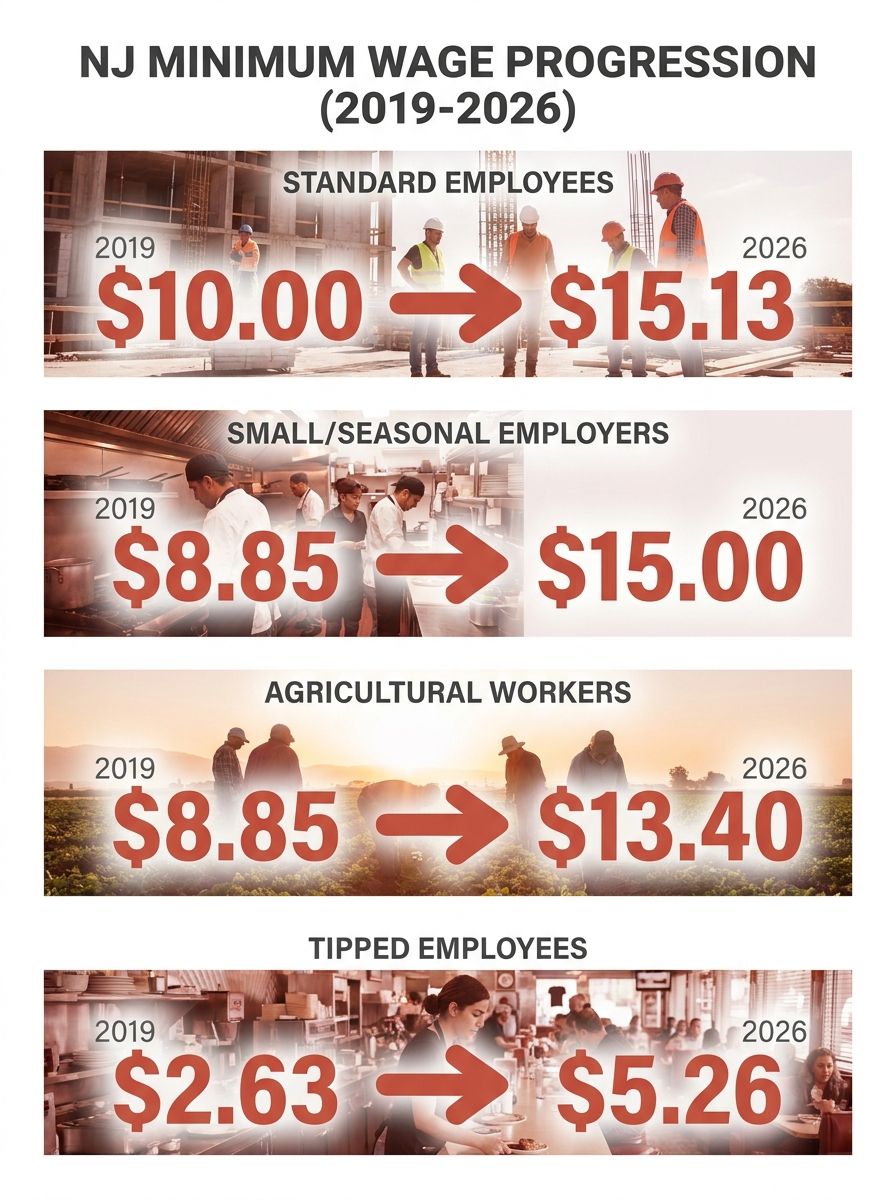
The Four Wage Tracks for 2024
The minimum wage in New Jersey isn't a single number. The 2024 rates break down across four categories, and the differences are significant enough that workers in each group face distinct economic pressures.
Worker Category | 2024 Rate | 2025 Rate | 2026 Rate | Full Parity Target |
|---|---|---|---|---|
Standard employees (6+ workers) | $15.13/hr | $15.49/hr | $15.92/hr | Already at standard |
Small employers (5 or fewer) / Seasonal | $13.73/hr | $14.53/hr | $15.49/hr | 2028 |
Agricultural workers | $12.81/hr | $13.40/hr | $14.01/hr | 2030 |
Tipped employees (base cash wage) | $5.26/hr | $5.62/hr | $5.62/hr | Ongoing tip credit model |
The gap between the standard rate and the agricultural worker rate was $2.32 per hour in 2024. For a full-time farmworker, that's roughly $4,825 less per year than a retail worker at a mid-size employer doing the same number of hours. Agricultural workers won't reach parity with the standard minimum wage until 2030, according to the New Jersey Department of Labor.
How the CPI Adjustment Mechanism Works
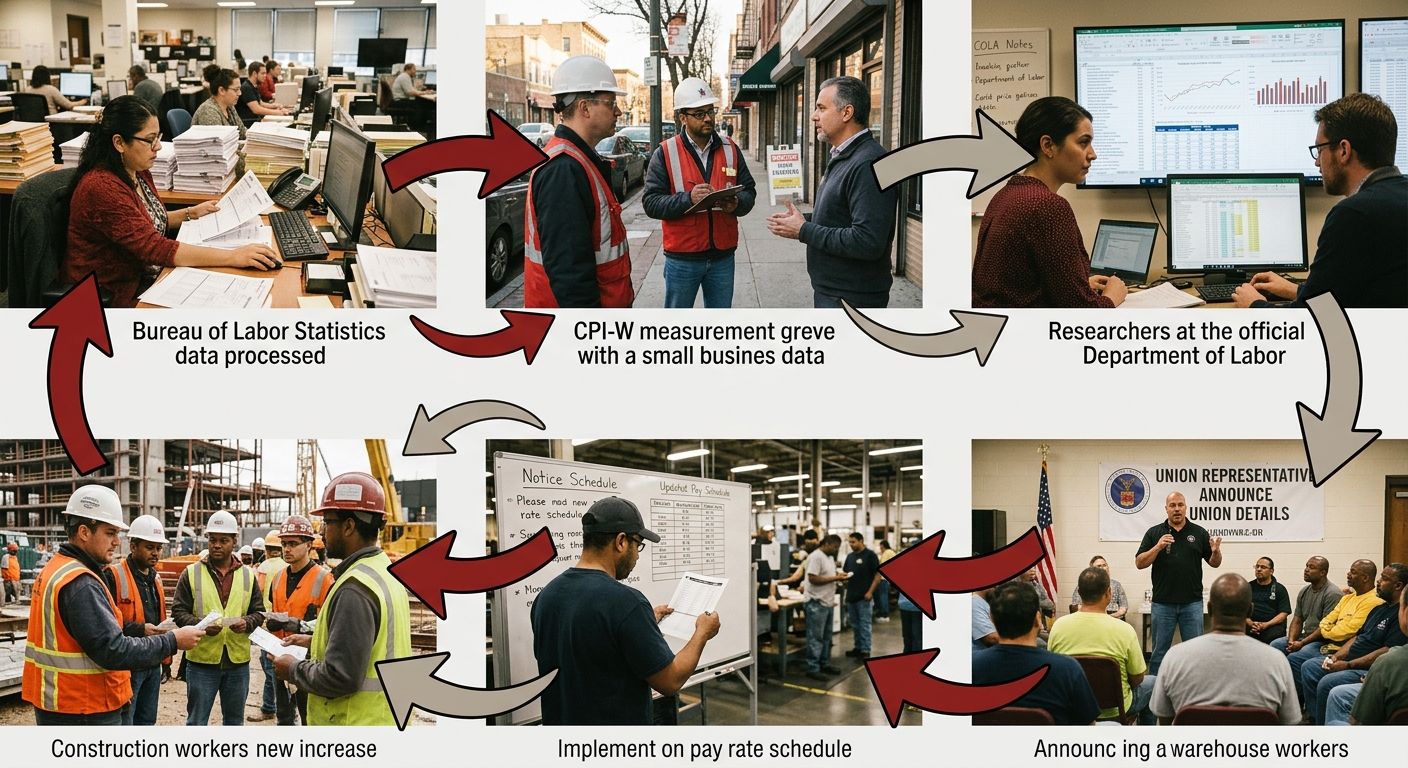
Once New Jersey's minimum wage hit the $15.00 legislative target in 2024, the annual increase formula shifted from fixed $1.00 bumps to a Consumer Price Index calculation. The state uses the CPI-W (Consumer Price Index for Urban Wage Earners and Clerical Workers) to measure inflation, then applies that percentage to the current rate each September or October. The New Jersey Department of Labor announces the new rate in the fall, and it takes effect the following January 1.
This is the mechanism that produced the $15.13 rate for 2024 (the $15.00 target plus CPI adjustment), the $15.49 rate for 2025, and the $15.92 rate for 2026. The 2026 increase of $0.43 reflects a roughly 2.7% CPI adjustment.
The formula has a floor but no ceiling. Wages can't decrease even if the CPI drops, but there's no cap on how much they can rise in a high-inflation year. During 2022 and 2023, when inflation ran above 5%, the fixed $1.00 annual increases actually fell short of what a CPI formula would have produced. Workers were effectively subsidizing inflation during those years, receiving flat-dollar raises that didn't keep pace with rising costs.
Tipped Workers and the Tip Credit Gap
The tipped employee structure is where the minimum wage for New Jersey gets complicated and where wage theft risk is highest. Tipped workers received a base cash wage of $5.26 per hour in 2024, with employers claiming a tip credit of up to $9.87 per hour. The combined total of base wage plus tips must equal or exceed $15.13 per hour. If it doesn't, the employer is legally required to make up the difference.
That "make up the difference" requirement is where enforcement breaks down. Workers who don't track their own tips hour by hour have no way to verify whether their employer is calculating the tip credit correctly. And employers who short the difference by even $1.00 per hour on a full-time tipped worker are stealing approximately $2,080 per year from that employee.
The tipped wage model also creates a workplace safety problem that doesn't show up in most wage discussions. Tipped workers who depend on customer generosity to reach the minimum wage are economically pressured to tolerate hostile or unsafe customer behavior. Reporting a belligerent patron can mean losing the tips that bring your hourly pay above $5.26. That dynamic is well-documented in restaurant and hospitality sectors, and similar pressures show up in healthcare settings where understaffing and violence intersect with wage issues.
Wage Floors and Workplace Safety
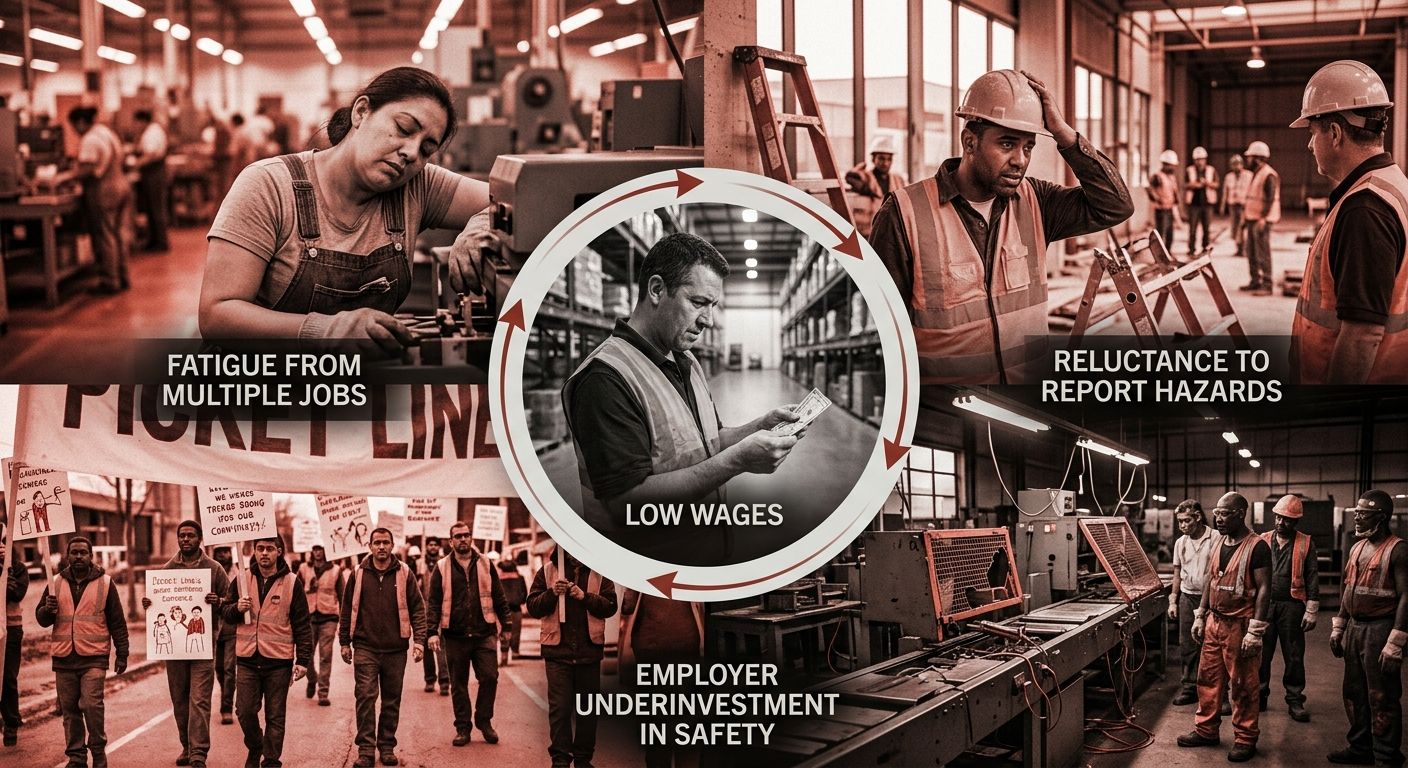
The connection between minimum wage rates and worker safety is direct, measurable, and underexamined. Workers earning at or near the minimum wage in New Jersey are concentrated in food service, retail, warehousing, and agriculture, four of the state's highest-injury-rate industries. The Bureau of Labor Statistics consistently reports that workers in the lowest wage quartile experience injury rates 2 to 3 times higher than workers in the highest quartile.
Low wages compound safety risk through several pathways. Workers holding two or three minimum-wage jobs to cover rent accumulate fatigue that increases accident probability. Workers who can't afford to lose a $15.13/hour job are less likely to report hazardous conditions, file OSHA complaints, or refuse unsafe tasks. And employers paying minimum wage are, statistically, less likely to invest in safety training, protective equipment, and adequate staffing levels.
New Jersey's gig economy adds another layer of complexity. The state's new gig worker classification rule follows California's ABC test model, which determines whether a worker qualifies as an employee entitled to minimum wage protections or an independent contractor who gets none. Misclassified gig workers don't receive the $15.13 floor, and they're excluded from workers' compensation if they're injured on the job.
The structural connection runs in both directions. States with higher minimum wages tend to see lower rates of workplace injury underreporting, because workers with a stronger wage floor feel marginally more secure in raising safety concerns. This is one reason why understanding the minimum wage structure in neighboring states like Virginia and Ohio matters for regional labor organizing.
Where the Mechanism Breaks
New Jersey's CPI-indexed minimum wage is one of the better-designed wage floor systems in the country. It removes the political gridlock that keeps states like Texas frozen at the $7.25 federal rate. But the mechanism has real limitations that affect the workers who depend on it.
The first fracture point is the multi-track system itself. Four separate wage floors mean four separate compliance requirements, four separate enforcement challenges, and an incentive structure that rewards employers for classifying workers into lower-rate categories whenever possible. A seasonal employer with six employees in July and four in November faces different minimum wage obligations across those months. The complexity is a compliance burden for good-faith employers and a loophole for bad-faith ones.
The second weakness is the CPI-W index the formula uses. CPI-W measures spending patterns of urban wage earners and clerical workers nationally, not New Jersey specifically. Housing costs in Newark, Jersey City, or Hoboken have outpaced national CPI-W consistently. A wage floor that tracks national inflation will always lag behind the actual cost of living in New Jersey's most expensive labor markets.
The third limitation is enforcement capacity. The New Jersey Department of Labor's Wage and Hour Division handles complaints, but the volume of minimum wage violations across hundreds of thousands of covered employers far exceeds the division's staffing. Workers who file complaints face investigation timelines that can stretch months. And workers without documentation or with immigration-related fears often don't file at all, even when employers pay below the legal minimum.
The broader pattern of labor law enforcement gaps shows up across multiple New Jersey industries, from cannabis to construction, wherever wage and labor protections exist on paper but lack adequate enforcement infrastructure.
Common Questions
Does the minimum wage in New Jersey apply to all workers?
No. New Jersey's minimum wage law excludes certain categories, including some full-time students, certain disabled workers under specific Department of Labor subminimum wage certificates, and workers covered by federal minimums under different statutes. Independent contractors are also excluded, which is why worker classification rules are so consequential for coverage.
What happens if an employer doesn't pay the correct minimum wage?
The New Jersey Department of Labor can investigate complaints, order back pay, and impose penalties. Workers can also file private lawsuits. Under New Jersey's Wage Theft Act, employers who violate minimum wage requirements can face treble damages (three times the amount of unpaid wages) plus attorney's fees. Filing a complaint with the state's Wage and Hour Division is the most common first step.
How does New Jersey's minimum wage compare to the federal minimum?
The federal minimum wage remains $7.25 per hour, unchanged since 2009. New Jersey's 2024 rate of $15.13 per hour is more than double the federal floor. When a state minimum wage exceeds the federal rate, the higher state rate applies to all covered workers within the state.
Will New Jersey's minimum wage keep going up automatically?
Yes. The CPI-indexed adjustment formula is written into state law and operates without requiring any new legislation. The rate increased to $15.49 in 2025 and $15.92 in 2026, and will continue rising each January 1 based on inflation as measured by the CPI-W. The legislature would have to pass a new law to change or eliminate the formula.
Are small business employees permanently stuck at a lower rate?
No. Workers at businesses with five or fewer employees are on a slower schedule, but their rate converges with the standard minimum wage by 2028. The agricultural worker rate reaches parity by 2030. After convergence, all covered workers will be on the same CPI-adjusted track.
The Union Edge Staff
Frequently Asked Questions
- What is the minimum wage in New Jersey for 2024?
- New Jersey's minimum wage for standard employees is $15.13 per hour as of January 1, 2024. However, the rate varies by worker category: tipped workers earn a base of $5.26/hour, small/seasonal employers pay $13.73/hour, and agricultural workers earn $12.81/hour.
- How much will New Jersey minimum wage increase in 2025?
- New Jersey's minimum wage will rise to $15.49 per hour on January 1, 2025 for standard employees, with increases also for other worker categories: tipped workers to $5.62/hour, small/seasonal employers to $14.53/hour, and agricultural workers to $13.40/hour.
- Is New Jersey minimum wage automatically adjusted for inflation?
- Yes, since reaching the $15.00 legislative target in 2024, New Jersey's minimum wage is automatically adjusted each January 1 using a Consumer Price Index formula rather than requiring legislative action. The state uses CPI-W to measure inflation and applies that percentage to the current rate.
- What should tipped workers in New Jersey know about minimum wage?
- Tipped workers in New Jersey have a base cash wage of $5.26/hour in 2024, and employers can claim a tip credit of up to $9.87/hour. However, if total compensation (base wage plus tips) falls below $15.13/hour in any pay period, the employer must make up the difference. Workers should document their tips independently to protect themselves.
- When will agricultural workers in New Jersey reach the standard minimum wage?
- Agricultural workers in New Jersey will reach parity with the standard minimum wage by 2030. As of 2024, they earn $12.81/hour compared to the standard rate of $15.13/hour, a gap of $2.32 per hour.
- What are the penalties for paying below minimum wage in New Jersey?
- Employers who violate New Jersey's minimum wage requirements can face investigations by the Department of Labor Wage and Hour Division, be ordered to pay back wages, and face penalties. Under the Wage Theft Act, workers can also file private lawsuits for treble damages (three times the unpaid wages) plus attorney's fees.
- How does New Jersey's minimum wage compare to the federal minimum wage?
- New Jersey's 2024 minimum wage of $15.13 per hour is more than double the federal minimum wage of $7.25 per hour. When a state minimum wage exceeds the federal rate, the higher state rate applies to all covered workers in that state.
- Do small businesses in New Jersey have to pay a lower minimum wage permanently?
- No, workers at businesses with five or fewer employees are on a slower wage increase schedule, but the rate converges with the standard minimum wage by 2028. After convergence, all covered workers will be on the same CPI-adjusted track.
Related Articles

State of New Jersey Minimum Wage: 2024 Guide
The state of New Jersey minimum wage operates through a Consumer Price Index escalator that adjusts automatically every January 1. The current rate is $15.92 per hour for most workers as of January 1, 2026, and that figure will climb again next year based on inflation data from the U.S.

minimum wage for new jersey
The gap between the highest and lowest minimum wage rate inside New Jersey's own borders is $9.87 per hour. Standard employees at businesses with six or more workers earn $15.92, while tipped workers receive a cash wage of just $6.05 (with a tip credit making up the difference). A third tier, $15.

Minimum Wage New York: 2024 Update
New York's minimum wage operates through a geographic tier system that pays workers in New York City, Long Island, and Westchester a different hourly rate than workers in the rest of the state. The 2024 update set those tiers at $16.00 and $15.
Also in the paper