
India Minister Links Workplace Safety to Women's Workforce Participation at National POSH Act Conference
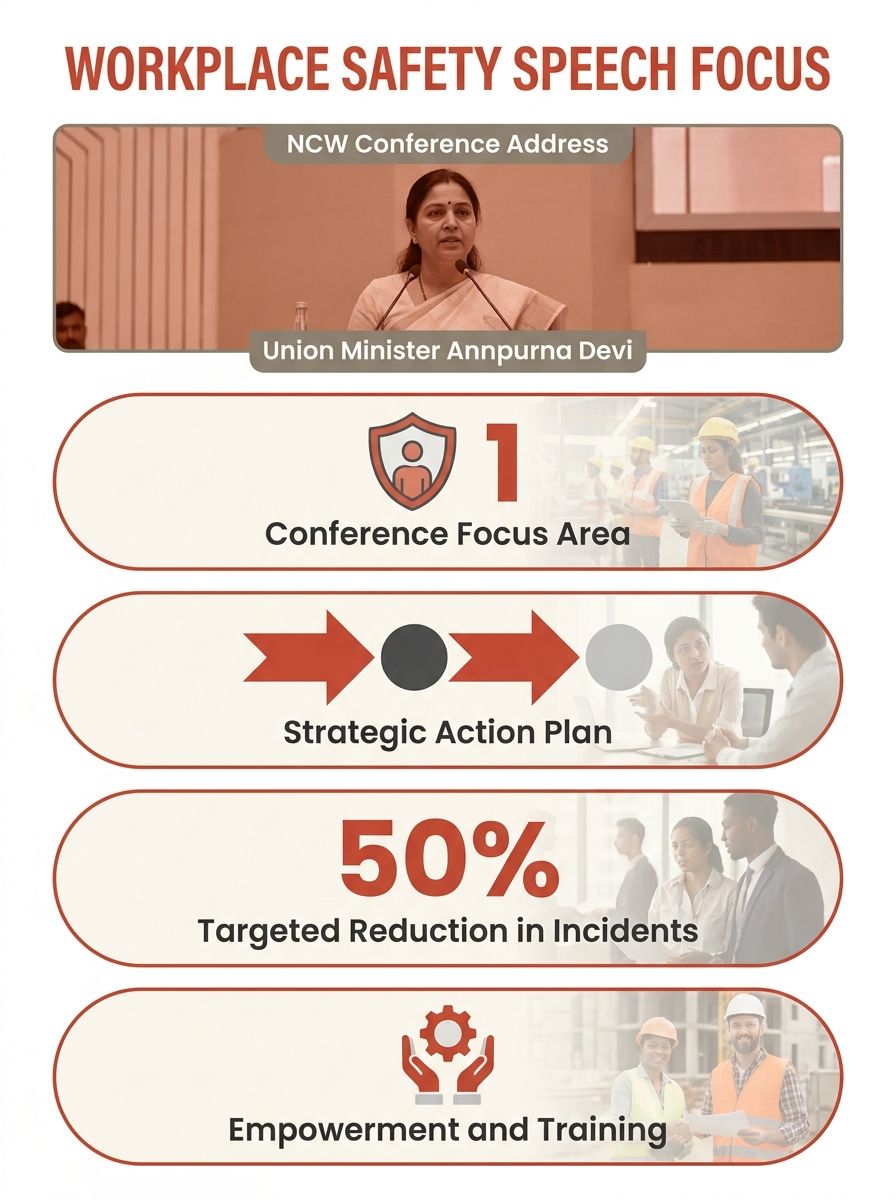
Union Minister for Women and Child Development Annpurna Devi declared workplace safety "fundamental to increasing women's participation in the workforce" at a National Commission for Women event in New Delhi on Friday, according to The Economic Times.

India Minister Links Workplace Safety to Women's Workforce Participation at National POSH Act Conference
Union Minister for Women and Child Development Annpurna Devi declared workplace safety "fundamental to increasing women's participation in the workforce" at a National Commission for Women event in New Delhi on Friday, according to The Economic Times. Devi addressed a two-day national awareness program on the Sexual Harassment of Women at Workplace Act, 2013, telling the audience that safe, dignified workplaces are essential for women-led development.
The National Commission for Women launched the program at Vigyan Bhawan on July 17, 2026, focusing on implementation of the POSH Act—India's framework for preventing and addressing sexual harassment in workplaces. The commission released a procedural booklet for Internal Committees and Local Committees charged with investigating complaints under the law.
"Every woman has the right to work with dignity and without fear, and creating a safe work environment is a shared responsibility of governments, employers and institutions," Devi said at the conference.
National Training Campaign Reaches 126 Districts
NCW Chairperson Vijaya Rahatkar reported that the commission has conducted 40 awareness workshops across India since 2023, reaching nearly 5,700 participants. Since May 2025, approximately 1,900 members of internal and local committees from 126 districts have received specialized training on POSH Act procedures, Rahatkar said.
"From Leh to Itanagar, Mizoram to Punjab, and from the Supreme Court to private organizations, this campaign has steadily expanded," Rahatkar told the gathering. "These are not just numbers; they reflect a changing workplace culture and growing confidence in the system."
The POSH Act requires employers with 10 or more workers to establish Internal Committees to handle sexual harassment complaints. District-level Local Committees serve workplaces that fall below that threshold or lack formal structures. Both types of committees conduct inquiries under procedures outlined in the 2013 law.
Digital Platform Handles Time-Bound Complaints
Devi highlighted the SHe-Box portal—a government digital platform for filing workplace sexual harassment complaints—as evidence of institutional commitment to women's safety. The minister said the portal facilitates time-bound resolution of complaints and reflects the government's effort to build a robust ecosystem for workplace protections.
The minister called on employers and institutional leadership to demonstrate greater accountability, stating that every organization must build a culture of dignity, sensitivity, and zero tolerance for sexual harassment. Devi emphasized that evolving workplace formats require continuous strengthening of institutional responses, including fair inquiry procedures, privacy protections, and adherence to natural justice principles.
Inquiry Booklet Provides Procedural Framework
The NCW released a booklet on inquiry procedures for Internal Committees and Local Committees under the POSH Act. The guide is intended to eliminate procedural uncertainty when committees receive complaints, according to Rahatkar.
"Its purpose is to ensure that when a committee receives its first complaint, there is no uncertainty about the procedure to be followed," Rahatkar said. "Every inquiry should be fair, every decision should be time-bound, and every woman should have confidence in the justice delivery process."
Rahatkar described the POSH Act as "not merely a law to prevent sexual harassment" but "a powerful mechanism to safeguard women's dignity, ensure equal opportunity and guarantee their right to a safe workplace." She said no woman should have to choose between livelihood and safety.
Changing Work Environments Drive Policy Adaptation
Rahatkar cited digital workplaces, hybrid work arrangements, remote work, and artificial intelligence as factors creating new challenges for workplace safety enforcement. The NCW chairperson said institutions and implementation mechanisms must evolve continuously to address these shifting conditions.
"Safe workplaces are built not only through legislation, but also through awareness, sensitivity and a shared sense of responsibility," Rahatkar said.
The conference will continue on Saturday with a national consultation designed to gather recommendations for strengthening POSH Act implementation based on input from participants nationwide. Rahatkar said the two-day program represents the commission's larger effort to expand both awareness and enforcement capacity.
Similar concerns about workplace safety protections have driven policy discussions internationally, particularly regarding vulnerable worker populations. In the United States, more than two-thirds of Ohio nurses reported experiencing workplace violence in a 2026 survey, highlighting persistent enforcement gaps across different national frameworks.
Policy Implications
The Indian government's emphasis on workplace sexual harassment enforcement signals recognition that protection frameworks directly influence workforce participation rates among women. The NCW's training expansion—reaching 1,900 committee members across 126 districts in 14 months—reflects an institutional investment in complaint-handling capacity that extends beyond legislation alone.
For union organizers and workers' rights advocates, the POSH Act model illustrates both the potential and limitations of complaint-driven enforcement systems. The framework requires Internal Committees at worksites with 10 or more employees but relies on employer compliance and worker willingness to file complaints through official channels. The SHe-Box portal attempts to reduce reporting barriers, yet the minister's call for "greater accountability" from employers suggests persistent gaps between statutory requirements and workplace practice.
The convergence of traditional workplace safety concerns with emerging challenges posed by hybrid work, remote arrangements, and AI-mediated employment creates enforcement complexity that mirrors debates in other national contexts. As India expands women's workforce participation—a stated policy priority—the effectiveness of POSH Act implementation will serve as a test case for whether complaint-based systems can function without parallel enforcement mechanisms such as proactive inspections, penalty structures for non-compliance, or independent worker representation in oversight bodies.
The Union Edge Staff
Related Articles

National Commission for Women Documents Systematic Harassment at TCS Nashik Unit
A National Commission for Women investigation documented systematic workplace harassment, religious discrimination, and deliberate targeting of young female employees at Tata Consultancy Services' Nashik unit, according to a report released May 12, 2026.

Workplace Safety Failures Kill 30 Workers Across Three Countries in Four-Day Span
At least 30 workers died in workplace accidents across Greece, China, and the United States between July 9 and July 12, 2026, prompting regulators to impose safety penalties exceeding half a million dollars and order operational shutdowns at facilities in three countries, according to enforcement fi

10 Essential Safety Suggestions for Modern Workplaces
Workplace safety suggestions fall into three categories: compliance-only programs that meet OSHA's legal minimum, technology-driven systems that use data and wearables to track hazards, and worker-led safety committees where employees identify and fix risks themselves.
Also in the paper