
10 Essential Safety Suggestions for Modern Workplaces
Workplace safety suggestions fall into three categories: compliance-only programs that meet OSHA's legal minimum, technology-driven systems that use data and wearables to track hazards, and worker-led safety committees where employees identify and fix risks themselves.

10 Essential Safety Suggestions for Modern Workplaces: Three Approaches That Produce Very Different Results
Workplace safety suggestions fall into three categories: compliance-only programs that meet OSHA's legal minimum, technology-driven systems that use data and wearables to track hazards, and worker-led safety committees where employees identify and fix risks themselves. Each covers different ground, and most workplaces rely too heavily on the first while ignoring the third.
The Compliance-Only Approach: Checking Boxes, Missing Hazards
OSHA's worker rights page makes the baseline obligation clear: "Your employer must keep the workplace free from known safety and health hazards." Under Section 5(a)(1) of the OSH Act, this duty exists whether or not a specific OSHA standard covers the hazard in question. For many employers, that baseline is also the ceiling.
A compliance-only program typically means posting OSHA's "Job Safety and Health" poster, maintaining the OSHA 300 log of recordable injuries, running annual fire drills, and providing personal protective equipment under 29 CFR 1910.132. These steps prevent some injuries. But they treat safety as a legal task rather than an operational priority.
The numbers show where this breaks down. On average, 2.8 out of every 100 U.S. workers are injured on the job each year. Slips, trips, and falls alone account for roughly 25% of all workplace injury claims and cost employers between $10.5 billion and $11 billion annually. Most of those incidents happen in workplaces that technically meet OSHA standards.
Here's what compliance-only programs typically cover from the standard ten safety suggestions for the workplace:
PPE protocols based on written hazard assessments (29 CFR 1910.132)
Fire safety and emergency response, including the RACE protocol (Rescue, Alarm, Contain, Extinguish/Evacuate)
Electrical safety and lockout/tagout (LOTO) procedures for equipment producing arc flashes that can reach 35,000°F
Hygiene and housekeeping schedules enforcing 5S protocols with regular cleanliness audits
These four categories cover roughly 40% of what most safety consultants recommend. They're necessary, and they save lives when enforced. They're also the easiest items for management to check off without changing how work actually gets done.
The structural weakness is who controls the process. Compliance programs are written by managers, reviewed by lawyers, and audited by outside firms. Workers attend mandatory trainings, sign attendance sheets, and go back to the floor. Concentra's own occupational health guidance puts it plainly: "The foundation for a safe work environment is an effective accident prevention and wellness program." The question is whether workers have any say in what "effective" means at their specific site, or whether they're handed a binder someone else wrote.
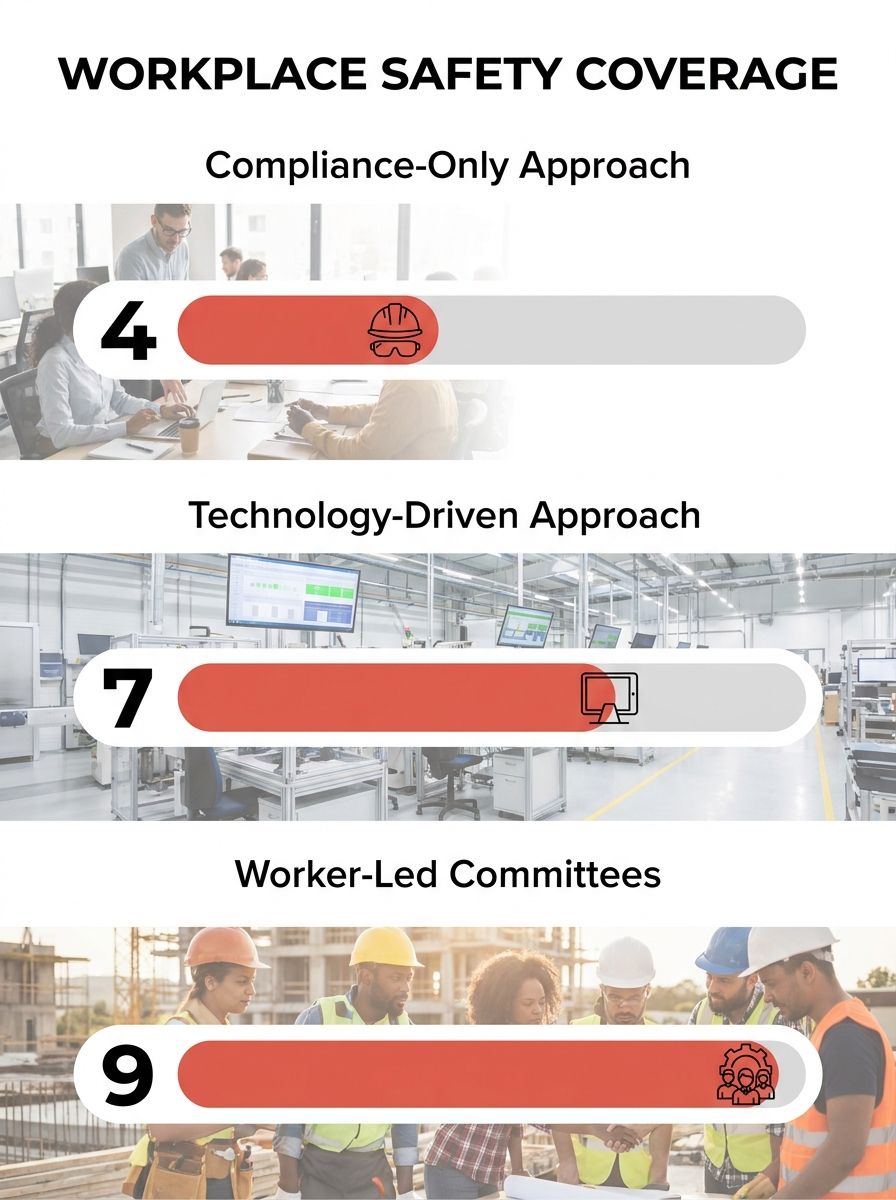
If your workplace operates with compliance alone, you're covering the legal floor for about 4 of the 10 essential safety categories. The remaining 6 require either better data, better worker involvement, or both.
The Technology-Driven Approach: Better Data, Blind Spots Intact
Why do some well-funded safety programs still miss critical hazards? Because data collection and data interpretation are different skills, and technology handles only the first.
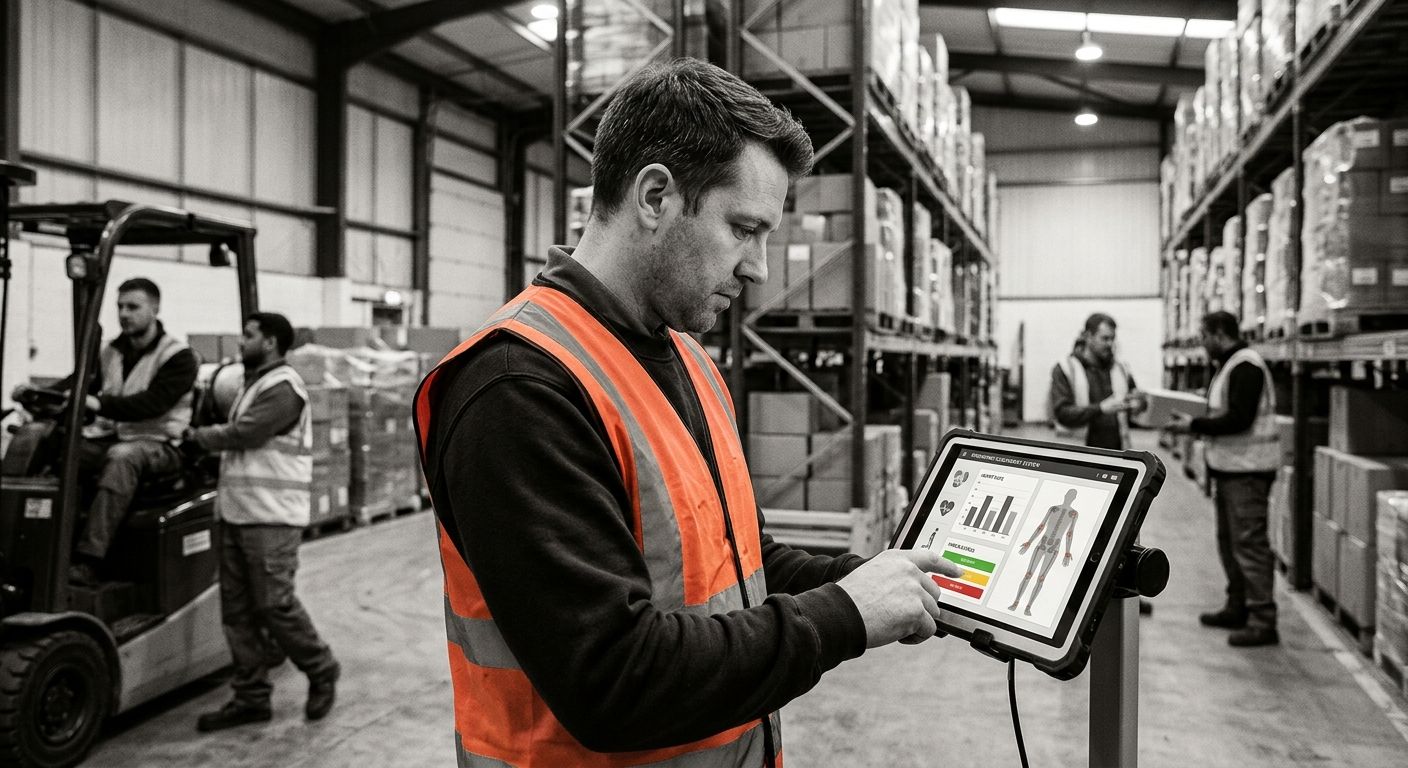
Technology-driven safety programs add a second layer to the compliance floor. They use wearable sensors to monitor worker fatigue and posture. They deploy VR and AR simulations for hazard training. They run predictive analytics on injury logs to spot patterns before the next incident.
The appeal is real. Voxel AI's research on safety trends notes that VR training allows employees to "safely practice their responses without real-world risks, gaining practical experience and confidence" in controlled environments. For hazards like chemical spills, confined-space rescues, and equipment malfunctions, simulated training is measurably better than watching a video in a break room.
This approach extends workplace safety suggestions into categories that compliance alone ignores:
Ergonomic assessments using sensor data to flag repetitive-motion risks before they become injuries. Research from the Corporate Wellness Magazine confirms that "ergonomically designed furniture and equipment reduce the strain on the body and promote better posture, which can reduce stress and anxiety."
Mental health monitoring through survey tools and workload analytics, treating psychosocial stress as a safety variable
Predictive injury modeling that uses leading indicators (near-miss reports, overtime hours, equipment age) rather than lagging indicators (injury counts after the fact)
Between compliance and tech-driven programs, you now cover about 7 of the 10 essential workplace safety suggestions. Ergonomics, mental health integration, and data-driven continuous improvement join the list. That's a real upgrade from four.
But there's a blind spot that technology can't fix: worker trust. When productivity tracking systems double as discipline tools, every wearable sensor and every monitoring dashboard carries a second meaning. Workers start asking whether the fatigue sensor exists to protect them or to flag them as slow. Whether the near-miss reporting app will generate write-ups instead of fixes. Whether the ergonomic assessment will lead to job cuts disguised as "workflow optimization."
The Insurance Information Institute recommends that employers "include workplace safety training as part of employee onboarding and offer refresher training on a regular basis" alongside first-aid instruction. That's solid advice. It's also advice that assumes workers will engage honestly with training materials. In workplaces where monitoring feels punitive, honest engagement drops. Workers stop reporting near-misses. They hide minor injuries. The data that feeds the predictive models becomes incomplete, and the whole system degrades quietly.
Technology-driven safety is powerful when workers trust it. Without that trust, it's an expensive dashboard showing you incomplete information.
The Worker-Led Approach: Safety Committees With Real Authority
A joint labor-management safety committee at a poultry processing plant in the southeastern United States spent 18 months fighting for proper lockout/tagout enforcement after three workers lost fingers to unguarded machinery. The company had a compliance program. It had posted the OSHA standards. What it didn't have was a system where workers could force a response. That story, documented in detail as a case study in grievance-to-policy conversion, shows what changes when workers gain actual authority over safety decisions.
Worker-led safety committees add the final three categories to a complete set of workplace safety suggestions:
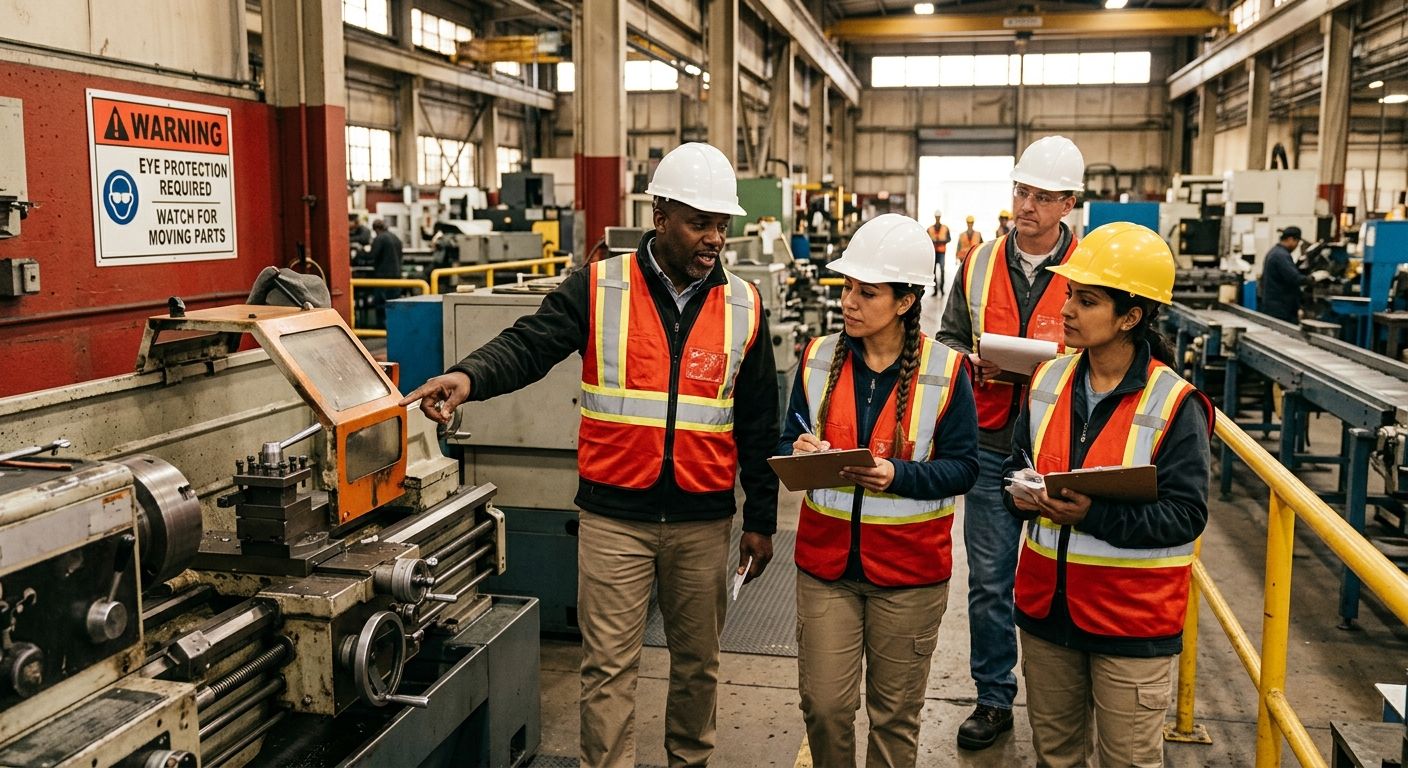
Participatory hazard identification, where frontline employees conduct walk-throughs and flag risks that managers and consultants miss
Role-specific, microlearning training designed with input from the workers who do the job, using short modules (5 to 10 minutes) tailored to actual task hazards rather than generic slide decks
Open reporting systems for near-misses and unsafe conditions, protected by anti-retaliation provisions in collective bargaining agreements or, at minimum, by Section 11(c) of the OSH Act
The evidence for this approach is consistent. OSHA's own guidance documents emphasize that safety programs work best when employees participate in identifying hazards and developing solutions. Research on body mechanics training confirms that "teaching workers proper body mechanics and eliminating at-risk behaviors or tasks reduces the likelihood of worker injuries, which can carry a heavy mental toll for those affected." That training lands differently when workers helped design it.
Worker-led committees also solve the trust problem that undermines technology-driven programs. When the safety committee controls the near-miss reporting process, workers report at higher rates. When union representatives sit on ergonomic assessment teams, the data stays honest. When workers negotiate protected time for safety walk-throughs (typically 2 to 4 hours per month in strong contracts), hazards get identified 3 to 5 times faster than in annual audit cycles.
This approach requires structural support that many employers resist. Protected committee time costs payroll hours. Anti-retaliation provisions limit management discretion. Worker veto power over unsafe assignments slows production schedules. These are real costs. They're also smaller than the $10.5 billion annual bill for slip-and-fall injuries alone, or the lost-time costs of a single serious equipment accident.
The history of the American labor movement shows this pattern repeating across decades: the workplaces with the lowest injury rates are consistently the ones where workers have contractual authority to stop unsafe work. OSHA enforcement matters, and how that enforcement actually works determines whether standards on paper translate to conditions on the floor. But enforcement from the outside will always lag behind what workers can catch from the inside.
All 10 Suggestions, Mapped to Each Approach
Safety Suggestion | Compliance-Only | Tech-Driven | Worker-Led |
|---|---|---|---|
1. PPE protocols (29 CFR 1910.132) | ✓ Covered | ✓ Covered | ✓ Covered |
2. Fire safety / emergency response (RACE) | ✓ Covered | ✓ Covered | ✓ Covered |
3. Electrical safety / LOTO procedures | ✓ Covered | ✓ Covered | ✓ Covered |
4. Hygiene and housekeeping (5S) | ✓ Covered | ✓ Covered | ✓ Covered |
5. Ergonomic assessments | ✗ Rare | ✓ Sensor-driven | ✓ Worker-informed |
6. Mental health as safety variable | ✗ Missing | ✓ Survey tools | ✓ Peer support |
7. Data-driven continuous improvement | ✗ Missing | ✓ Core strength | ✓ With committee input |
8. Participatory hazard identification | ✗ Missing | ✗ Management-run | ✓ Core strength |
9. Role-specific microlearning training | ✗ Generic only | ✓ Partial | ✓ Worker-designed |
10. Open near-miss reporting systems | ✗ Fear of reprisal | ✗ Trust gap | ✓ Protected process |
The pattern is clear. Compliance programs cover 4 of 10 categories. Technology adds 3 more but struggles with the final 3, which depend on worker participation and trust. Worker-led committees can reach all 10, and they make the technology layer work better by providing honest data.
The Honest Answer: Which Approach Fits Your Workplace
The best set of workplace safety suggestions for any given site depends on one question: how much power do workers have to shape the program?
If workers have no organized voice, compliance-only is likely your ceiling, and you're exposed on 6 of the 10 essential categories. Your injury rate will track close to the national average of 2.8 per 100 workers, and your slip-and-fall costs will eat into margins every quarter.
If management is willing to invest in technology but keeps full control, you'll reach 7 of 10 categories. Ergonomic sensors and VR training will reduce some injuries. But near-miss reporting will stay incomplete, and the gaps in your data will be invisible until the next serious incident.
If workers have contractual authority through a safety committee with protected time, anti-retaliation provisions, and real escalation power, all 10 categories become reachable. The technology layer performs better because workers trust it. The compliance layer stays current because workers flag violations in real time rather than waiting for the annual OSHA inspection cycle.
The verdict isn't complicated. Every workplace needs all three layers. But the layer that determines whether the other two actually function is the one where workers lead. If you're choosing where to invest first, invest there. Talk to your coworkers about forming a safety committee, contact your local OSHA area office to request a free consultation, and if you have a union, bring these 10 categories to your next bargaining session as a written proposal. The safest workplaces in this country didn't get that way because management cared more. They got that way because workers organized until management had no choice.
The Union Edge Staff
Related Articles

Workplace Safety Moments That Save Lives
Three formats dominate how employers run workplace safety moments before shifts: management-scripted toolbox talks, worker-led peer discussions, and joint safety committee programs backed by union contracts.
Safety Topics for Workplace: 10 Must-Know Guidelines
Slips, trips, and falls account for 25% of all injury claims filed each year and cost employers more than $10.5 billion annually. This guide covers ten critical safety topics for the workplace, each with a concrete action you can take and a way to verify you've done it right.

Essential Workplace Safety: 10 Topics Every Business Needs
Fall protection has topped OSHA's most-cited violations list for over a decade, and the same ten health and safety topics in the workplace appear in the agency's enforcement data year after year, accounting for the bulk of preventable worker injuries and deaths across American industries.
Also in the paper