
Minimum Wage at Florida: 2024 Guide & Updates
Amendment 2 to Florida's constitution, approved by voters on November 3, 2020, hardwired a $1.00-per-year minimum wage escalator into state law that bypasses the legislature entirely. That mechanism set the minimum wage in Florida at $13.

Minimum Wage at Florida: 2024 Guide, Current Rates & the Constitutional Mechanism Behind Every Increase
Amendment 2 to Florida's constitution, approved by voters on November 3, 2020, hardwired a $1.00-per-year minimum wage escalator into state law that bypasses the legislature entirely. That mechanism set the minimum wage in Florida at $13.00 per hour for the period beginning September 30, 2024, with the current rate at $14.00 and the amendment's $15.00 ceiling arriving September 30, 2026.
What Florida's Constitutional Minimum Wage Actually Is
Florida's minimum wage is defined in Article X, Section 24 of the state constitution, first added by a 2004 ballot measure and fundamentally rewritten by the 2020 amendment. The Florida Department of Economic Opportunity confirmed the 2024 rate at $13.00 per hour, effective September 30, 2024. The distinction matters: because the minimum wage for Florida sits in the constitution rather than in a statute, repealing or freezing it requires another constitutional amendment, a statewide ballot initiative needing 60% approval. The governor can't veto it. The legislature can't vote it down.
This constitutional status makes Florida's wage floor mechanism fundamentally different from most states, where legislatures set and modify wage floors through ordinary bills. Florida voters chose to remove that power from Tallahassee, twice. First in 2004 when they created a CPI-indexed state minimum wage, and again in 2020 when 60.82% of voters replaced the CPI formula with fixed $1.00 annual jumps toward a $15.00 target. Workers who want the full picture of how Florida's rate changes have unfolded over time should understand this constitutional foundation, because it's what makes every scheduled increase legally enforceable regardless of who holds office.
The $1.00 Annual Escalator and Its September 30 Trigger
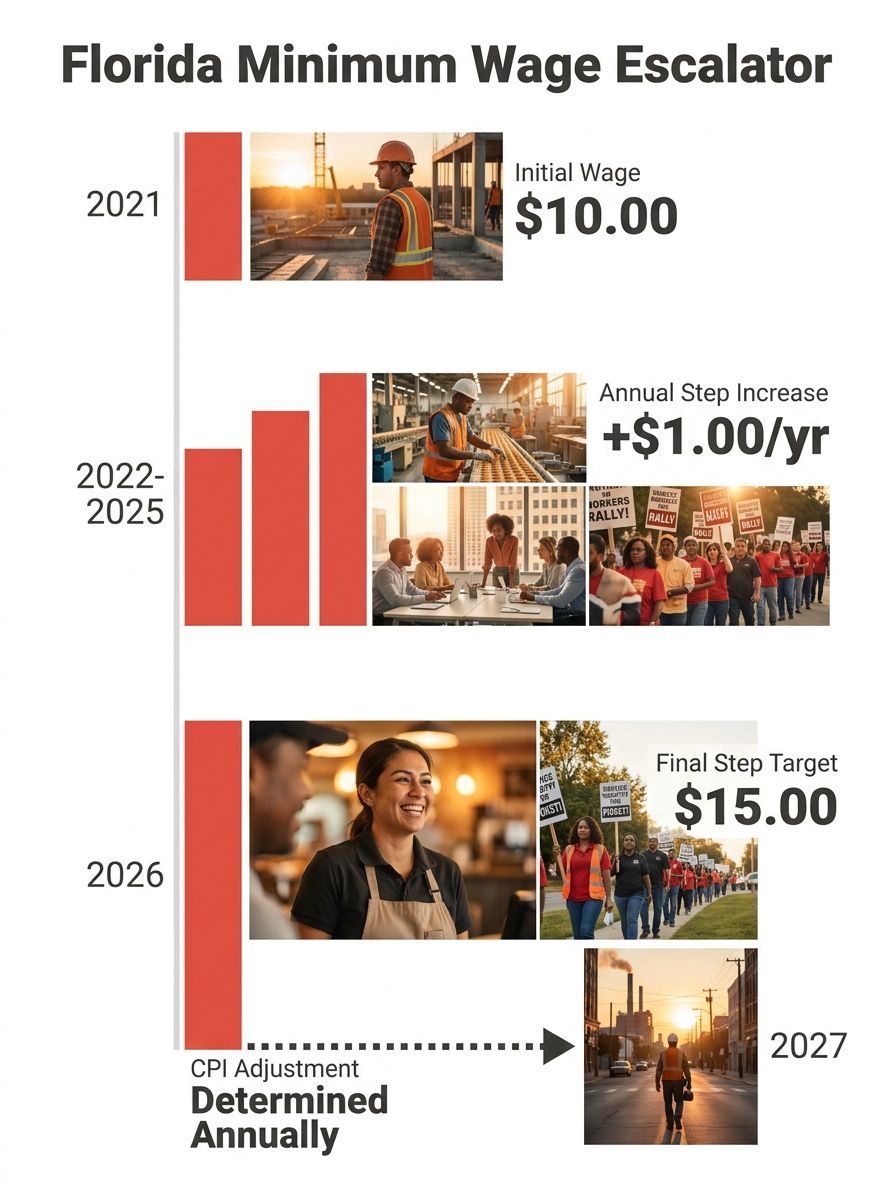
Each increase takes effect on September 30, not January 1 like most state wage changes. The schedule, locked into the constitution by the 2020 amendment, follows a rigid path with no discretionary review:
Effective Date | Standard Rate | Tipped Rate | Tip Credit |
|---|---|---|---|
Sept 30, 2021 | $10.00 | $6.98 | $3.02 |
Sept 30, 2022 | $11.00 | $7.98 | $3.02 |
Sept 30, 2023 | $12.00 | $8.98 | $3.02 |
Sept 30, 2024 | $13.00 | $9.98 | $3.02 |
Sept 30, 2025 | $14.00 | $10.98 | $3.02 |
Sept 30, 2026 | $15.00 | $11.98 | $3.02 |
The September 30 date creates a compliance trap for employers who budget on calendar years. A worker earning $13.00 per hour on September 29, 2025, was legally owed $14.00 per hour the following day. Every payroll system in the state had to process that mid-cycle adjustment, and the Florida Department of Economic Opportunity's official notice to employees requires employers to post the current rate in a conspicuous location at every worksite. Failure to update that poster is itself a violation.
The $1.00 increments are absolute, not indexed to inflation or any other economic indicator. That was a deliberate design choice by the amendment's framers. Whether the Consumer Price Index rises 2% or 8%, the wage goes up by exactly one dollar each September 30 until it hits the $15.00 cap. This predictability benefits both workers and employers who plan ahead, but it also means the raises don't accelerate during periods of high inflation, as workers discovered during the 2021-2023 price surge when real purchasing power of each increase was partly eaten by rising costs.
How the Tipped Employee Calculation Runs
"Why do I get a different rate?" is the single most common question workers in Florida's hospitality sector ask about the minimum Florida wage. The answer involves a parallel wage structure baked into the same constitutional amendment.
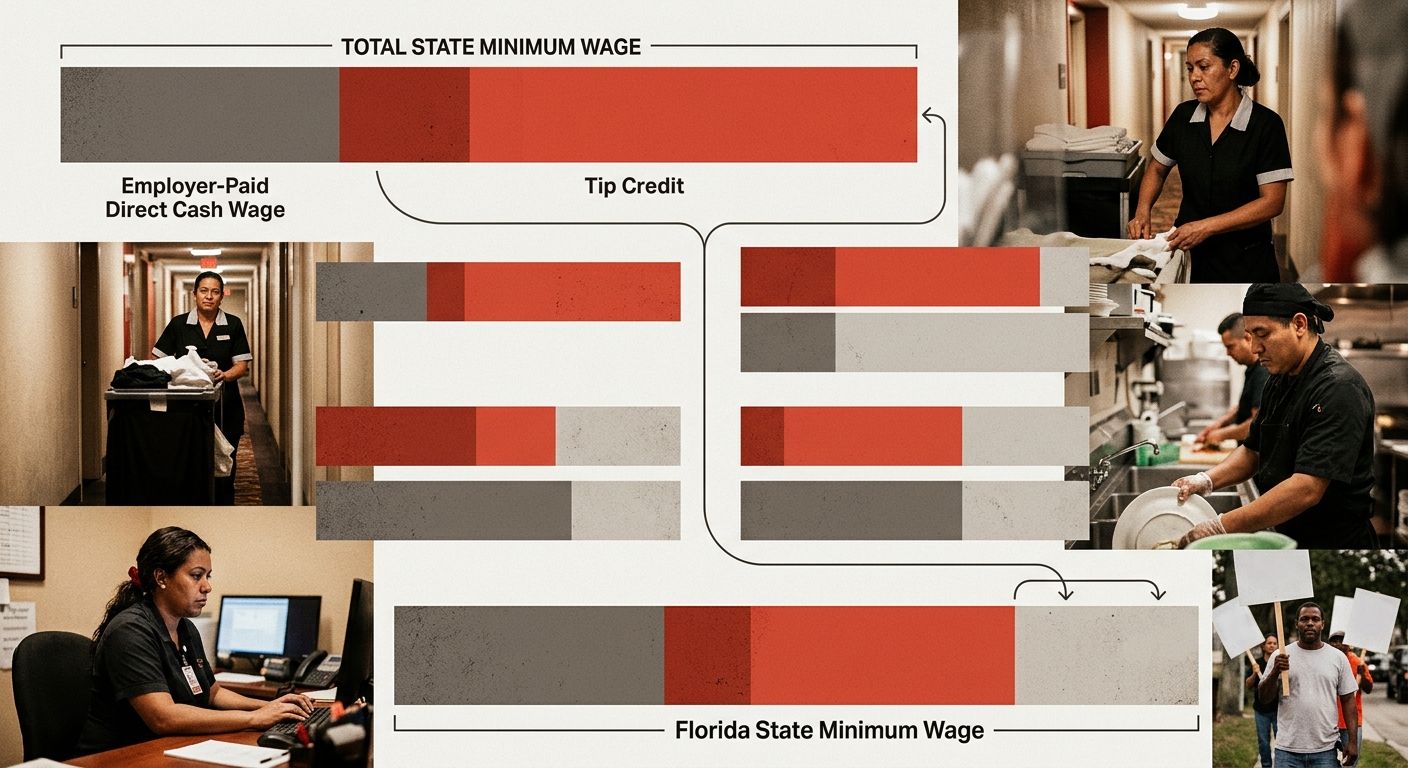
Florida law permits employers to apply a tip credit of $3.02 per hour against the standard minimum wage. For the 2024 period (September 30, 2024 through September 29, 2025), that meant tipped workers received a direct cash wage of $9.98 per hour. The current tipped rate, effective September 30, 2025, is $10.98 per hour. When the standard rate reaches $15.00, the tipped rate will be $11.98.
The critical legal obligation here is straightforward: if a tipped employee's combined hourly cash wage plus tips does not equal or exceed the full state minimum wage of Florida for every hour worked, the employer must make up the difference. An employer who pays $10.98 per hour and ignores a slow Tuesday lunch shift where a server earned $1.50 in tips owes that worker the gap between $12.48 ($10.98 + $1.50) and $14.00 for those hours.
The Florida Restaurant & Lodging Association has publicly opposed the $15.00 per hour minimum, calling the trajectory toward that rate a "drastic increase" that threatens hospitality businesses. But the constitutional mechanism doesn't respond to industry lobbying. The rate is locked in by the voters who put it there, and workers who understand how their rights function under this structure are better positioned to check their own paystubs against the legal floor.
Florida's Rate vs. the Federal Floor and Local Preemption
The federal minimum wage has been $7.25 per hour since July 24, 2009, making it 17 years without an increase as of this writing. Florida's minimum wage at $14.00 per hour is nearly double that federal floor. Under the Fair Labor Standards Act, when a state minimum wage exceeds the federal rate, employers in that state must pay the higher amount. The federal rate is functionally irrelevant for workers here.
But there's a structural dimension to Florida's minimum wage$ Florida workers should understand. State law prohibits cities and counties from setting their own local minimum wages. A Miami-Dade County commissioner can't pass a $16.00 ordinance for hotel workers. A Tampa city council can't create an industry-specific wage floor for construction laborers. That preemption strips local governments of a tool that cities in other states have used aggressively to push wages above state minimums. Compare this with how New York City maintains separate, higher wage rates than the rest of New York State.
This preemption explains why the 2020 constitutional amendment route was the only viable path for raising the minimum wage in Florida. When the legislature won't act and local governments are legally barred from acting, a citizen-initiated constitutional amendment becomes the mechanism of last resort. And the 60.82% approval rate, exceeding the 60% threshold by less than a single percentage point, shows how close that mechanism came to failing.
The CPI Handoff After September 2026
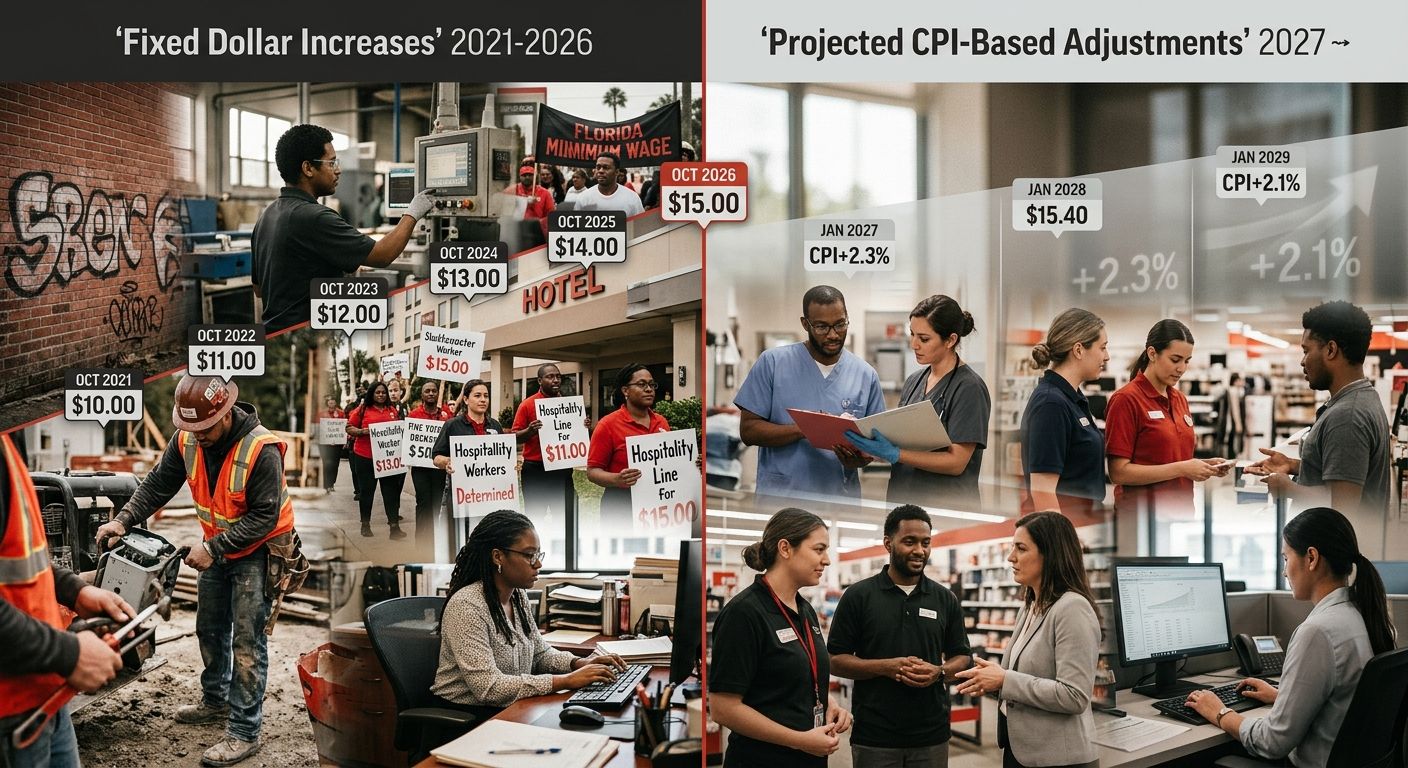
The $1.00 annual escalator ends when Florida's minimum wage reaches $15.00 on September 30, 2026. After that date, the constitutional amendment switches to a different mechanism: annual adjustments based on the Consumer Price Index for Urban Wage Earners and Clerical Workers (CPI-W) in the South region.
This is the same indexing formula Florida used between its first minimum wage amendment in 2004 and the 2020 rewrite. Under CPI indexing, the September 2027 rate will reflect the percentage change in the CPI-W over the previous 12-month measurement period. If inflation runs at 3%, the minimum wage would rise from $15.00 to approximately $15.45. If inflation is flat or negative, the wage floor holds at $15.00 and cannot decrease.
The CPI-W for the South region tends to track slightly below the national CPI-U that dominates headlines. Between 2015 and 2024, the South region CPI-W averaged about 0.2 percentage points below the national urban index in most years, though the gap widened during the 2021-2023 inflation surge. Workers should expect post-2026 adjustments to be modest in typical years. The shift from dollar-sized increases to cents-sized adjustments will feel abrupt for workers who've grown accustomed to a $1.00 bump every September. For context on how other states handle similar minimum wage structures, Washington and Oregon have used CPI-indexing for years and typically see annual adjustments between $0.15 and $0.75, depending on inflationary conditions.
Where the Constitutional Mechanism Falls Short
The amendment's design has real gaps that affect workers daily, and no amount of constitutional language eliminates them.
No local wage authority. The $15.00 floor will be identical in Jacksonville, where median rents are lower, and in Miami Beach, where they're dramatically higher. Florida's preemption of local wage ordinances means the constitutional minimum is both the floor and the ceiling of what any level of government can require. Workers in high-cost metro areas are stuck with a statewide number that doesn't reflect local economic reality. Understanding how to recognize and push back against employer resistance becomes more urgent when the legal wage floor doesn't keep up with housing costs.
Exemptions survive the amendment. The constitutional wage floor doesn't cover everyone. Student workers in certain work-study programs, some agricultural laborers, and workers with disabilities holding special minimum wage certificates from the U.S. Department of Labor can legally be paid below what Florida's minimum wage requires for most employees. These carve-outs existed before Amendment 2, and the amendment didn't eliminate them.
The tip credit is fixed, not proportional. The $3.02 tip credit stays constant at every wage level. When the standard rate was $10.00, the tip credit represented 30.2% of the wage. At $15.00, it drops to 20.1%. The declining proportion helps tipped workers over time, but the static dollar amount means the gap between tipped and standard rates never fully closes under this mechanism.
Enforcement depends on individual complaints. Florida has no state department of labor that proactively investigates wage violations. Workers who believe they haven't received the lawful minimum wage must file complaints through the state attorney general's office or pursue private legal action. The official employee notice states workers can assert their constitutional rights, but the burden of initiating that process falls entirely on the individual worker. Collective action through unions and worker organizations fills this gap by replacing individual complaint-filing with organized enforcement pressure, and the workers who succeed at holding employers accountable are almost always the ones who understood how contract timelines and legal processes actually work before they needed to use them.
Record-keeping requirements have teeth, but limited reach. Employers must maintain wage and hour records for at least three years. If a worker files a claim and the employer can't produce records, the legal presumption shifts in the worker's favor. That's a meaningful protection, but workers who don't know about it can't use it. Awareness of this rule should be part of every new-hire orientation in the state, and too often, it isn't.
Common Questions
Does the minimum wage in Florida change on January 1?
No. Florida's minimum wage changes on September 30 each year, per the constitutional amendment. This differs from most states. Employers must adjust payroll by September 30, and the new rate applies to all hours worked from that date forward through September 29 of the following year.
Can my city or county set a higher minimum wage than the state?
Florida law prohibits local governments from establishing their own minimum wage rates. The state constitutional rate is the only applicable minimum. Workers in high-cost cities like Miami or Fort Lauderdale receive the same minimum as workers in lower-cost rural areas.
What happens to Florida's minimum wage after it hits $15.00 in 2026?
Starting in 2027, the minimum wage will adjust annually based on the Consumer Price Index for Urban Wage Earners and Clerical Workers (CPI-W) in the South region. The rate can increase with inflation but cannot decrease below $15.00. These adjustments will likely be significantly smaller than the $1.00 annual jumps workers have experienced since 2021.
Does the tip credit change each year?
The tip credit itself remains fixed at $3.02 per hour throughout the entire escalator period. What changes is the tipped employee's direct cash wage, which rises by $1.00 each year alongside the standard rate. The current tipped minimum (effective September 30, 2025) is $10.98 per hour, rising to $11.98 on September 30, 2026.
Who is exempt from Florida's minimum wage?
Certain categories of workers can legally be paid below the state minimum: students in approved work-study programs, some agricultural laborers, and workers with disabilities who hold special certificates issued by the U.S. Department of Labor. All other full-time and part-time workers in Florida must receive at least the full constitutional minimum wage for every hour worked, regardless of industry or employer size.
The Union Edge Staff
Frequently Asked Questions
- What is the current minimum wage in Florida for 2024?
- Florida's minimum wage is $13.00 per hour effective September 30, 2024. The rate increases to $14.00 on September 30, 2025, and will reach $15.00 on September 30, 2026.
- When does Florida's minimum wage increase each year?
- Florida's minimum wage increases on September 30, not January 1 like most states. This date is fixed in the state constitution by Amendment 2, which was approved by voters in 2020.
- How much is the tip credit in Florida?
- Florida allows employers to apply a tip credit of $3.02 per hour against the standard minimum wage. For 2024, tipped employees receive a direct cash wage of $9.98 per hour, but employers must ensure tips plus cash wages equal at least the full minimum wage of $13.00.
- Can cities or counties in Florida set their own minimum wage?
- No, Florida law prohibits cities and counties from establishing their own minimum wage rates. The state constitutional minimum wage is the only applicable floor, regardless of local economic conditions.
- What will happen to Florida's minimum wage after it reaches $15 in 2026?
- After September 30, 2026, Florida's minimum wage will adjust annually based on the Consumer Price Index for Urban Wage Earners and Clerical Workers (CPI-W) in the South region. The rate can increase with inflation but cannot decrease below $15.00.
- How did Florida's minimum wage get locked into the state constitution?
- Amendment 2, approved by 60.82% of Florida voters on November 3, 2020, established a fixed $1.00 annual minimum wage increase through September 2026, bypassing the legislature entirely. This constitutional status means repealing or freezing it requires another constitutional amendment with 60% voter approval.
- What workers are exempt from Florida's minimum wage?
- Students in approved work-study programs, some agricultural laborers, and workers with disabilities who hold special certificates from the U.S. Department of Labor can legally be paid below Florida's minimum wage. All other employees must receive the full constitutional minimum.
Related Articles

Minimum Wage in Florida: 2024 Rate Changes
Before 2004, Florida had no state minimum wage at all. Voters fixed that twice through constitutional amendments, the second of which created a fixed $1.00-per-year escalator that brought the minimum wage in Florida to $13.00 per hour on September 30, 2024, with a $15.

What Is the State of Florida Minimum Wage
Amendment 2, ratified by Florida voters in November 2020, embedded a minimum wage escalator directly into Article X of the state constitution, removing the rate from legislative control entirely. The current floor is $14.00 per hour for non-tipped workers and $10.

What is the Minimum Wage in Florida
Unlike most state wage floors, which legislatures can freeze or repeal at will, Florida's minimum wage is locked into the state constitution. The current rate is $14.00 per hour, climbing to $15.
Also in the paper