
Private Detention Operator Settles California Workplace Safety Case, Establishing Protections for Immigrant Detainees
California and the GEO Group reached a settlement this week affirming that state workplace safety laws apply to immigrant detainees who perform work at private detention facilities, resolving a three-year legal dispute over whether detainees qualify as employees under labor protections, according to

Private Detention Operator Settles California Workplace Safety Case, Establishing Protections for Immigrant Detainees
California and the GEO Group reached a settlement this week affirming that state workplace safety laws apply to immigrant detainees who perform work at private detention facilities, resolving a three-year legal dispute over whether detainees qualify as employees under labor protections, according to the Los Angeles Times.
The Florida-based private prison company withdrew its legal challenges and agreed to pay $104,510 in fines originally issued in 2023 by California's Division of Occupational Safety and Health. The settlement covers the Adelanto ICE Processing Center and four other GEO Group facilities in California.
"Individuals who perform work in these facilities are entitled to workplace safety protections, and this settlement reinforces Cal/OSHA's commitment to enforcing those protections and safeguarding vulnerable workers," said Denisse Gómez, spokesperson for Cal/OSHA.
The Original Violations and Fines
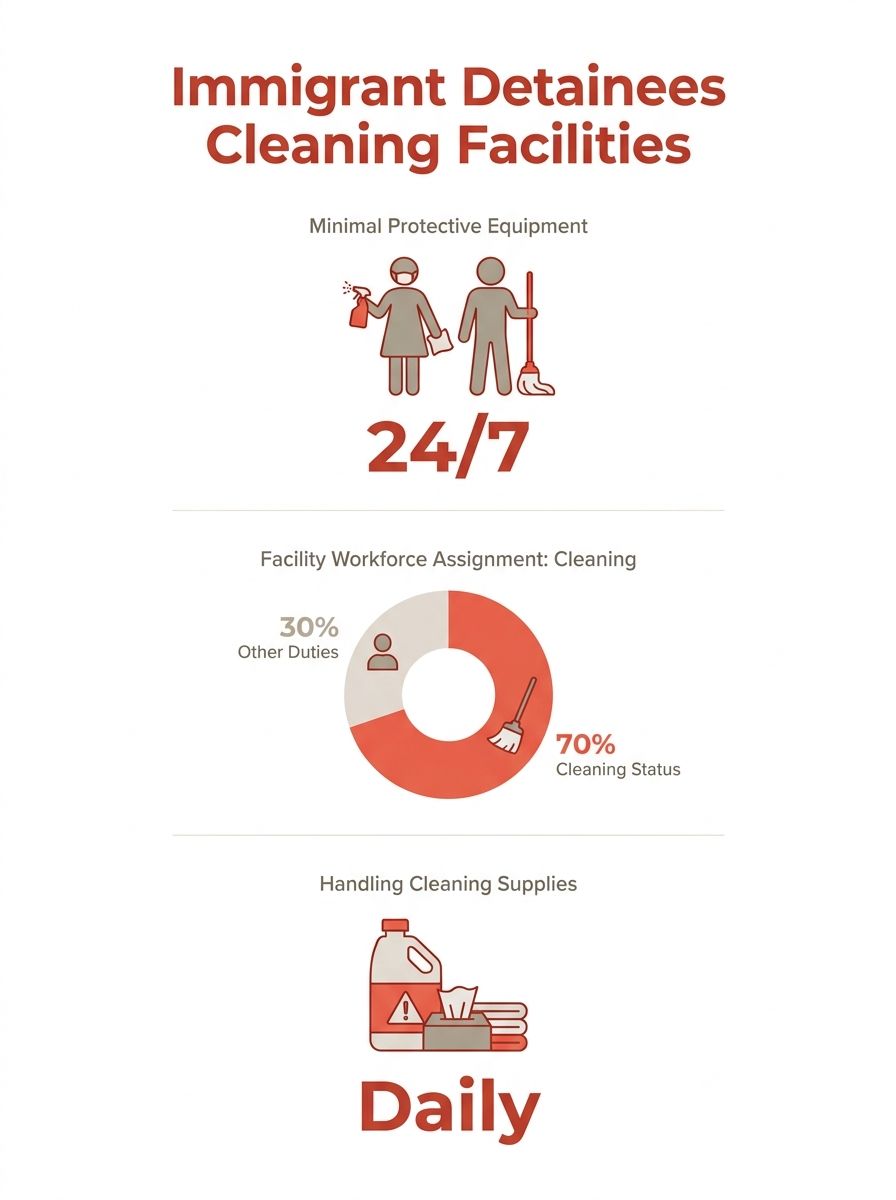
Cal/OSHA issued the $104,510 penalty in 2023 after detainees at a GEO Group facility complained about inadequate protective equipment and training while cleaning the facility for $1 per day. The investigation documented six violations of state code.
Detainees reported routinely wiping black mold off shower walls, observing black dust from air vents, and using cleaning solutions without proper instructions during the COVID-19 pandemic. The largest single fine addressed the company's failure to establish written procedures reducing employee risk of aerosol transmissible disease exposure.
The core legal question centered on whether detainees participating in voluntary work programs qualify as "employees" under California law. The classification determines whether state worker protection statutes apply to detention facility operations.
Three Years of Legal Challenges
The GEO Group initially appealed Cal/OSHA's enforcement action, arguing that detainees participating in ICE's voluntary work program make their own schedules and therefore aren't employees. The company contended that hazard exposure couldn't occur "as a result of assigned duties" as California law requires, and claimed insufficient evidence of actual hazard exposure.
The state's Occupational Safety and Health Appeals Board rejected the company's position in early 2025, ruling that detainees should be classified as "affected employees" under California occupational safety regulations.
The GEO Group then sued in California Superior Court. Three days before a scheduled May hearing, the company and Cal/OSHA reached the settlement announced July 8.
Settlement Terms and Facility-Wide Changes
Under the agreement, the GEO Group must draft aerosol transmission prevention plans for 12 secure and reentry facilities in California, including five detention centers housing immigrants. The settlement states that "GEO ensures detainees are afforded the necessary tools, equipment, and personal protective equipment ... to safely and effectively perform any necessary tasks."
The settlement preserves the appeals board's ruling allowing civil immigration detainees who participate in work programs to file complaints anonymously, acknowledging retaliation risks when individuals raise workplace safety concerns.
Labor advocates view the settlement as establishing legal precedent extending California workplace protections to vulnerable immigrant worker populations beyond traditional employment relationships.
Federal Standards Contradict State Settlement
One month before the settlement announcement, U.S. Immigration and Customs Enforcement released revised national detention facility standards. The June update explicitly states that "detainee volunteers participating in the voluntary work program are not considered facility and/or government employees" and are therefore not entitled to labor regulation protections.
The timing raised questions among labor attorneys about coordination between the private operator and federal immigration authorities. Mariel Villarreal, an attorney with the California Collaborative for Immigrant Justice, described the federal standards update as "a reaction to this very settlement."
The Department of Homeland Security and the GEO Group did not respond to requests for comment on the settlement or the June standards revision. Neither agency addressed whether the federal position preempts California's workplace safety enforcement in private detention facilities operating under federal contracts.
The conflicting positions between California's settlement and federal detention standards leave unresolved tension over which labor protections apply to immigrant detainees performing work at privately operated facilities across the country.
The Takeaway
This settlement establishes a workable enforcement model for extending workplace safety protections to populations traditionally excluded from labor law coverage. California regulators demonstrated that existing occupational safety statutes reach workers in detention facilities when those individuals perform services for private operators, regardless of their immigration status or nominal "volunteer" classification.
The legal precedent matters beyond the five California facilities covered by this settlement. Organizers and labor advocates now have a documented case where state regulators successfully classified detainees as employees entitled to safety protections, hazard reporting rights, and anonymous complaint procedures—all enforceable through financial penalties against private operators.
The simultaneous federal pushback through ICE's revised standards signals ongoing resistance to these protections at the national policy level. Labor advocates working with immigrant populations should track whether California's enforcement approach spreads to other states or whether federal preemption arguments ultimately block state-level workplace safety oversight in detention facilities operating under federal immigration contracts.
The Union Edge Staff
Related Articles

University of California Averts Strike With Last-Minute Deal for 40,000 Healthcare Workers
The University of California and AFSCME Local 3299 reached a tentative labor agreement late on May 13, preventing a planned strike by more than 40,000 healthcare and service workers hours before a May 14 walkout deadline, according to Bloomberg Law. The deal secures minimum wage increases to $30.10

California Prevailing Wage: Complete Legal Guide
California's Director of Industrial Relations sets prevailing wage rates for every county and trade classification in the state, drawing primarily from collectively bargained union agreements.

Lyft Agrees to $272.5 Million Settlement Over Driver Misclassification in California
Lyft Inc. agreed to pay $272.5 million to settle wage theft allegations filed by San Francisco and other California jurisdictions, according to Local News Matters.
Also in the paper