
New York City Minimum Wage: 2024 Updates & What Changed
New York City's minimum wage is the legal hourly floor every employer in the five boroughs must pay, and on January 1, 2024, it climbed from $15.00 to $16.00 per hour. That dollar increase was the first move in a three-year legislated schedule that reaches $17.

New York City Minimum Wage: 2024 Updates and What Changed
New York City's minimum wage is the legal hourly floor every employer in the five boroughs must pay, and on January 1, 2024, it climbed from $15.00 to $16.00 per hour. That dollar increase was the first move in a three-year legislated schedule that reaches $17.00 by 2026 and transitions to automatic inflation indexing in 2027, fundamentally changing how the wage floor adjusts going forward.
The Rate Increase That Took Effect January 1, 2024
On January 1, 2024, the minimum hourly wage increased from $15.00 to $16.00 in New York City, Nassau, Suffolk, and Westchester counties, according to Greenberg Traurig's analysis of the state's wage schedule. The rest of New York State moved from $14.20 to $15.00 per hour on the same date. For a full-time worker clocking 40 hours per week in the city, the increase translated to an additional $2,080 in gross annual earnings before taxes.
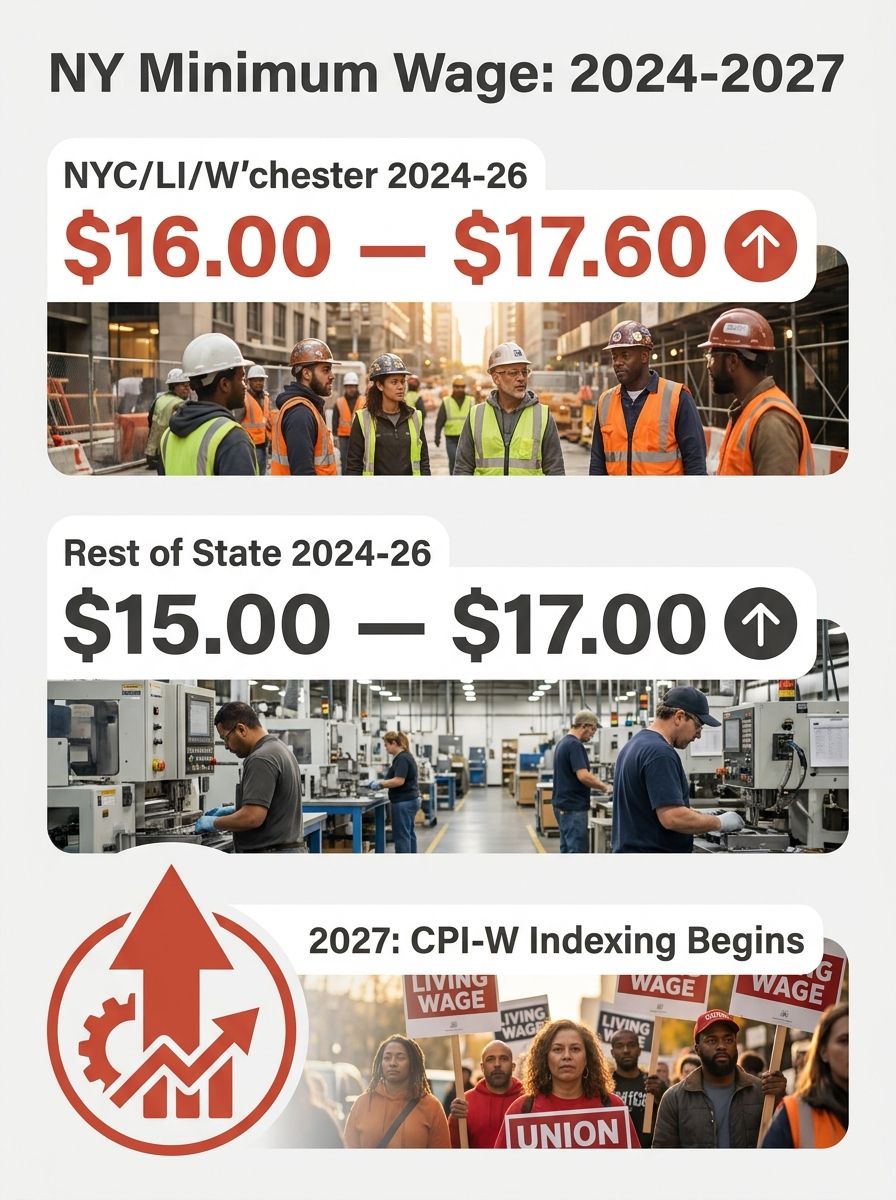
The 2024 bump wasn't an isolated event. The state legislature built it as part of a phased schedule: $16.00 in 2024, $16.50 in 2025, and $17.00 in 2026 for the New York City region. Outside the metro area, the schedule runs $15.00, $15.50, and $16.00 across those same years. By structuring the increases over three years, lawmakers avoided a single sharp spike while guaranteeing workers wouldn't have to wait for another political battle to see their pay adjust upward.
Geographic Tiers and Why Your Zip Code Sets Your Rate
New York doesn't operate on a single statewide minimum wage. The state government's official rate schedule splits the state into two tiers, each reflecting the vastly different costs of living between the metropolitan core and the rest of the state. Tier one covers New York City, Long Island (Nassau and Suffolk counties), and Westchester County. Tier two covers every remaining county.
Year | NYC / Long Island / Westchester | Rest of New York State |
|---|---|---|
2024 | $16.00/hr | $15.00/hr |
2025 | $16.50/hr | $15.50/hr |
2026 | $17.00/hr | $16.00/hr |
2027+ | CPI-W indexed | CPI-W indexed |
The gap between tiers has narrowed over the legislative schedule. In 2024, the difference was $1.00 per hour. By 2026, it's still $1.00. But when CPI-W indexing kicks in starting 2027, both tiers will rise by the same percentage, meaning the dollar gap will likely grow again as percentages are applied to different base rates. Workers in Syracuse or Buffalo will continue earning less per hour than their counterparts doing identical work in Queens, even as both groups see annual adjustments.
This geographic split matters for organizing. When workers at a restaurant chain operating in both Rochester and Brooklyn discover they're doing the same job at different pay floors, that information becomes a concrete talking point during contract negotiations. Understanding how collective bargaining wins function at the local level starts with knowing the wage floor you're building on top of.
App-Based Delivery Workers and the $19.56 Floor
The most aggressive wage floor change in 2024 didn't come from the state legislature. It came from the New York City Department of Consumer and Worker Protection (DCWP), which enforced a minimum pay rate of $18.96 per hour for app-based delivery workers in December 2023, rising to $19.56 by April 1, 2024. For the roughly 60,000 delivery workers across the city, the DCWP estimated the change produced approximately $16.3 million in additional weekly pay, a 165% increase in earnings for the affected workforce.
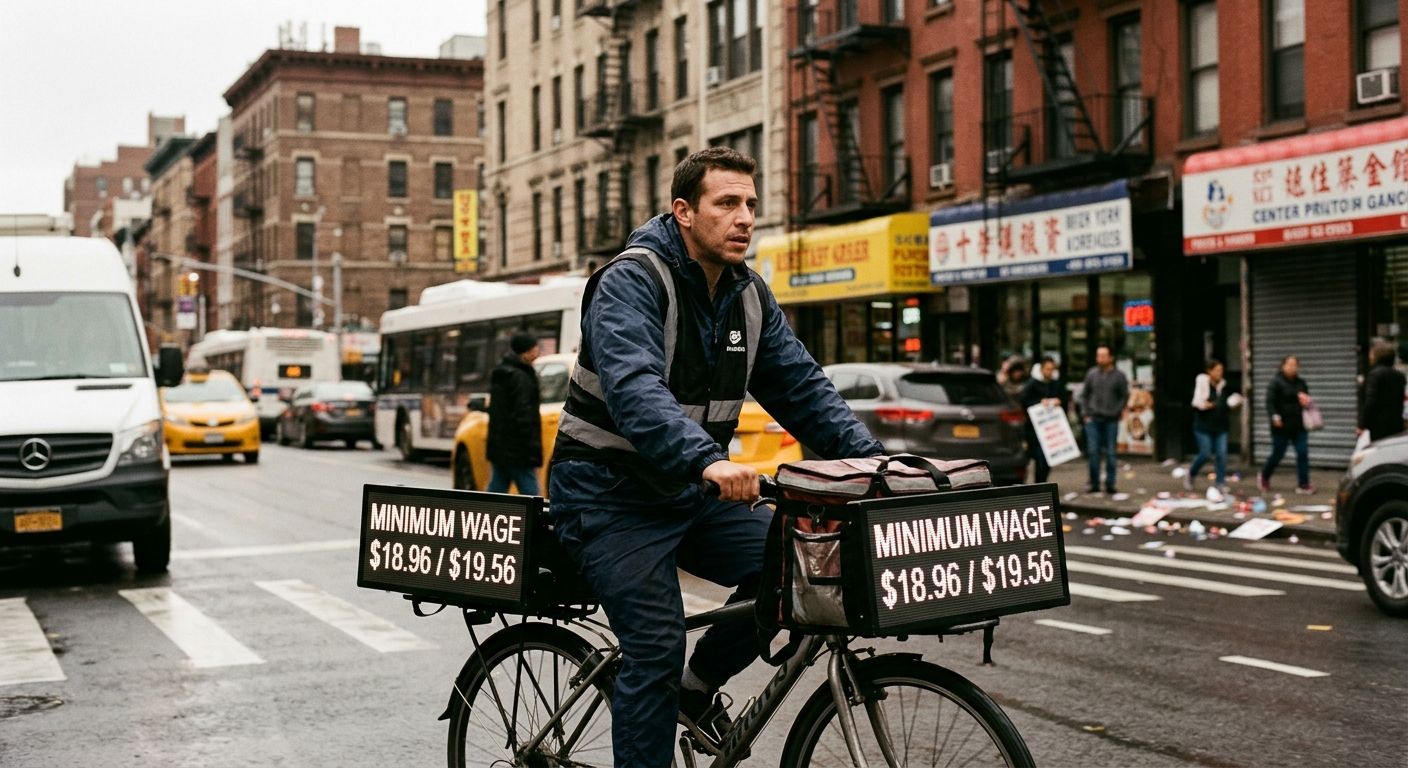
That rate sits well above the standard $16.00 minimum wage, and it exists because app-based delivery platforms classified workers as independent contractors, which exempted them from minimum wage protections entirely. The DCWP rule created a parallel wage floor specifically for this workforce. The delivery worker minimum functions as an hourly rate calculated from the time a worker accepts an order to the time they complete it, excluding tips.
This mechanism matters for workers beyond the delivery sector. It demonstrates that municipal agencies can establish occupation-specific minimum pay rates even when state law sets a general floor. Workers in other gig classifications across the city have pointed to the delivery worker rule as a model for their own campaigns, and the precedent connects directly to broader labor policy discussions about how wage protections adapt to non-traditional employment structures.
Exempt Salary Thresholds Changed Too
A less-publicized 2024 update reshaped who qualifies as a salaried exempt employee. Effective March 13, 2024, the weekly salary threshold for exempt employees rose to $1,300, or $67,600 annually, to comply with pay frequency requirements under New York law. This threshold determines whether a worker can be classified as exempt from overtime protections.
For executive and administrative exemptions specifically in New York City, the threshold held at $1,200 per week ($62,400 annually) through the end of 2024, then rose to $1,237.50 per week ($64,350 annually) on January 1, 2025. The distinction between the general $1,300 pay-frequency threshold and the $1,200 exemption-specific threshold confused many employers and workers alike.
Here's why this matters in practical terms: if an employer pays a worker a salary of $63,000 per year and classifies them as exempt, that worker is locked out of overtime pay. If the threshold rises above their salary, the employer must either raise the salary to meet the new threshold or reclassify the worker as non-exempt and start paying overtime for every hour over 40. When employers try to dodge these reclassifications, they're engaging in tactics that workers should learn to recognize and counter through organized collective action.
Tipped Workers and the Cash Wage Calculation
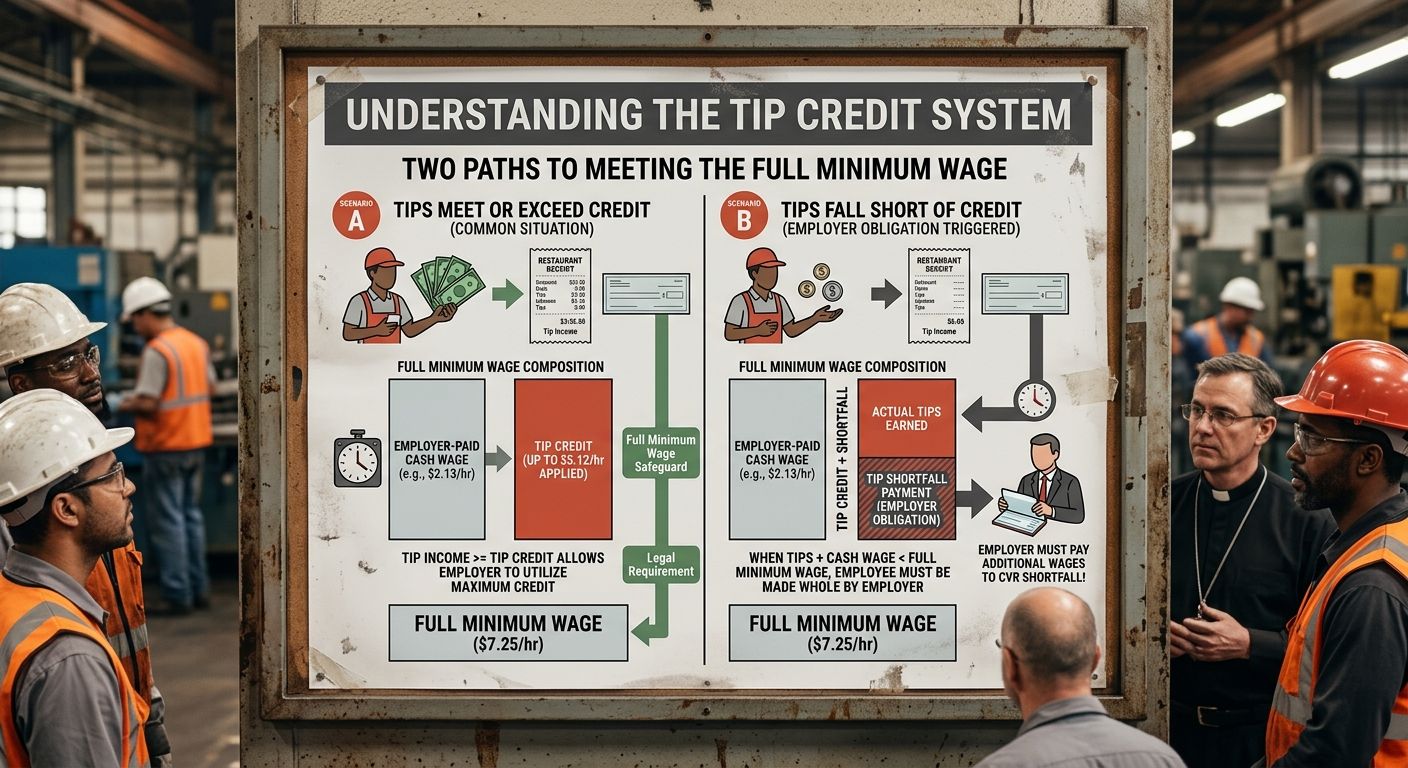
The new york city minimum wage for tipped food service workers operated under a different formula in 2024. Employers were required to pay a cash wage of at least $10.65 per hour, with a tip credit of $5.35 per hour, so long as the combined total reached or exceeded the $16.00 floor. By 2025, the cash wage floor for tipped workers in food service rose to approximately $11.00, with a $5.50 tip credit.
The tip credit mechanism works like this: an employer pays a base cash wage below the full minimum wage, and the difference is supposed to be made up by customer tips. If tips don't cover the gap in any given pay period, the employer is legally obligated to pay the difference. In practice, enforcement of that make-up-pay requirement has been inconsistent, and wage theft remains one of the most persistent problems in tipped industries across the city.
Workers in nail salons, car washes, and other tipped service industries face a separate calculation. The service industry tip credit structure differs from the food service formula, with different cash wage minimums depending on the establishment type. This patchwork of rates within rates creates confusion that benefits employers far more than workers.
The 2027 Inflation Indexing Mechanism
Starting in 2027, the minimum wage across New York State will shift from legislated annual increases to automatic adjustments tied to inflation. The New York Department of Labor has confirmed the formula: annual increases will be based on the three-year moving average of the Consumer Price Index for Urban Wage Earners and Clerical Workers (CPI-W) for the Northeast Region.
The three-year average smooths out short-term spikes. If one year sees abnormally high inflation followed by a correction, the moving average prevents the minimum wage from lurching up and then stagnating. The CPI-W specifically tracks spending patterns of hourly wage earners rather than all urban consumers, which makes it a closer match to the population the minimum wage is designed to protect.
The law also includes an "off-ramp" provision. If certain economic or budget conditions arise, the state can pause or modify the scheduled increase. The specific triggers for this off-ramp aren't fully detailed in the public statute, which means workers will need to watch carefully whether future administrations use economic downturns as a pretext to freeze wage growth. Organized workplaces with active union representation will be better positioned to push back against off-ramp activation than individual workers navigating the system alone.
Where the System Falls Short
The three-year schedule and the 2027 indexing formula represent genuine structural progress, but the mechanism has real gaps.
The off-ramp has no worker input requirement. The provision allowing minimum wage freezes during certain economic conditions doesn't mandate consultation with labor representatives, workforce advisory boards, or any public comment process specific to the wage decision. If a governor decides economic conditions warrant a freeze, workers affected by that freeze have no formal seat at the table.
Geographic tiers don't capture neighborhood-level cost variation. A worker in the South Bronx and a worker in midtown Manhattan earn the same $16.00 floor, even though their housing, childcare, and transportation costs differ dramatically. The two-tier system is better than a single statewide rate, but it treats all of New York City as one economic reality.
Enforcement remains complaint-driven. The New York State Department of Labor investigates minimum wage violations primarily when workers file complaints. Workers who fear retaliation, who don't know their rights, or who work for cash often never file. The mechanism assumes workers will police their own protections, which shifts the burden onto the people with the least power.
The tip credit system obscures the actual wage. The make-up-pay requirement sounds protective in theory, but documenting that tips fell short in a given pay period requires meticulous record-keeping from both sides. Workers who organize collectively through their first union contract can negotiate tip credit elimination or higher cash wage floors that remove this ambiguity entirely.
CPI-W indexing can lag behind housing inflation. The Consumer Price Index for wage earners weights housing costs, but it doesn't fully capture the rental market acceleration in New York City's most expensive neighborhoods. Workers whose rent jumps 8% in a year may see a 3% wage adjustment based on the three-year CPI-W average.
Common Questions
Does the $16.00 rate apply to all workers in New York City?
The $16.00 rate (as of January 1, 2024) applies to all workers in the five boroughs regardless of employer size, industry, or immigration status. New York eliminated the separate small-employer rate years ago. The same rate also covers Long Island and Westchester County. As of January 1, 2026, the rate for these areas is $17.00 per hour.
Do tipped workers earn the full minimum wage?
Tipped food service workers in New York City received a cash wage below the full minimum in 2024, with the expectation that tips would make up the difference. If tips fell short, the employer was legally required to pay the gap. Workers in other tipped industries had slightly different formulas. The full $16.00 (now $17.00) applied as the combined floor across all tipped categories.
What happens to the minimum wage after 2026?
Beginning in 2027, the minimum wage will increase annually based on the three-year moving average of the CPI-W for the Northeast Region. The state can pause increases under certain economic or budget conditions through an off-ramp provision written into the law.
Are app-based delivery workers covered by the standard minimum wage?
App-based delivery workers in New York City operate under a separate, higher minimum pay rate set by the Department of Consumer and Worker Protection. That rate reached $19.56 per hour by April 2024, well above the general $16.00 minimum wage. The two systems exist in parallel.
Does the minimum wage increase apply to salaried workers?
The minimum wage itself applies to hourly workers, but related exempt salary thresholds rose alongside it. Salaried workers classified as exempt must earn at least $1,300 per week ($67,600 annually) as of March 2024. Workers earning below that threshold may be entitled to overtime pay and should verify their classification with their employer or the New York State Department of Labor.
The Union Edge Staff
Frequently Asked Questions
- What is the New York City minimum wage in 2024?
- The New York City minimum wage is $16.00 per hour as of January 1, 2024, up from $15.00 per hour. This increase is part of a three-year legislated schedule that will reach $17.00 by 2026.
- How much more will full-time workers earn with the 2024 minimum wage increase?
- A full-time worker earning 40 hours per week will earn an additional $2,080 in gross annual earnings before taxes from the increase to $16.00 per hour.
- What is the minimum wage for app-based delivery workers in New York City?
- App-based delivery workers in New York City must earn at least $19.56 per hour as of April 1, 2024, which is significantly higher than the standard minimum wage and is enforced by the Department of Consumer and Worker Protection.
- When does New York's minimum wage become tied to inflation?
- Starting in 2027, New York's minimum wage will increase automatically each year based on the three-year moving average of the Consumer Price Index for the Northeast Region, eliminating the need for repeated legislative action.
- What is the minimum wage for tipped food service workers in New York City?
- Tipped food service workers must receive a cash wage of at least $10.65 per hour plus a tip credit of $5.35 per hour, totaling the $16.00 minimum wage floor as of 2024. Employers must make up any shortfall if tips don't reach the full minimum.
- Does the $16.00 minimum wage apply to all workers in New York City?
- The $16.00 minimum wage applies to all workers in the five boroughs regardless of employer size, industry, or immigration status. New York eliminated separate small-employer rates years ago.
- What is the exempt salary threshold for salaried workers in New York?
- As of March 2024, salaried workers classified as exempt must earn at least $1,300 per week ($67,600 annually). Workers earning below this threshold may be entitled to overtime pay and should verify their exemption classification.
Related Articles

Minimum Wage in NYC: 2024 Rates & Requirements
Section 652 of New York's Labor Law sets the minimum wage in NYC at $16.00 per hour as of January 1, 2024. That headline number hides a tiered system of tip credits, industry-specific floors, and geographic zones that can reduce a worker's guaranteed cash wage to $10.

Minimum Wage NYC: 2024 Rates & Requirements
NYC's minimum wage operates through a system of geographic zones, industry-specific tip credits, and exempt salary thresholds that together produce at least five different legal pay floors. The base rate is $17.

Minimum Wage New York: 2024 Update
New York's minimum wage operates through a geographic tier system that pays workers in New York City, Long Island, and Westchester a different hourly rate than workers in the rest of the state. The 2024 update set those tiers at $16.00 and $15.
Also in the paper