
Minimum Wage NYC: 2024 Rates & Requirements
NYC's minimum wage operates through a system of geographic zones, industry-specific tip credits, and exempt salary thresholds that together produce at least five different legal pay floors. The base rate is $17.

Minimum Wage NYC: How the Multi-Tier Pay Floor Actually Works
NYC's minimum wage operates through a system of geographic zones, industry-specific tip credits, and exempt salary thresholds that together produce at least five different legal pay floors. The base rate is $17.00 per hour as of January 1, 2026, but a tipped food service worker's guaranteed cash wage can sit as low as $11.35 per hour under the state's tip credit formula.
The FY 2024 Budget Agreement and the Three-Step Escalator
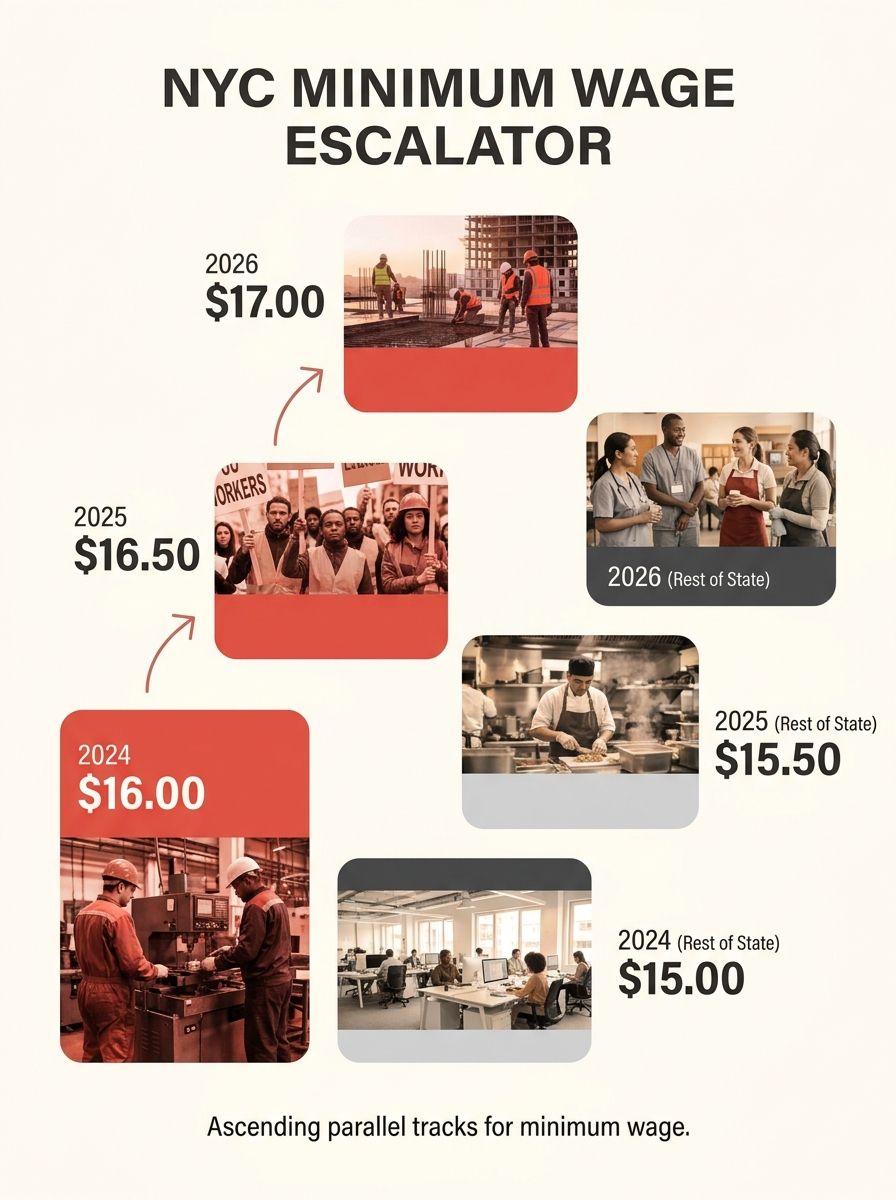
Governor Hochul's FY 2024 budget locked in a fixed schedule of $0.50 annual increases for the minimum wage in NYC, applying equally to New York City, Nassau County, Suffolk County, and Westchester County. The state's minimum wage page confirms the progression: $16.00 effective January 1, 2024, $16.50 effective January 1, 2025, and $17.00 effective January 1, 2026. The rest of New York State followed a parallel track from $15.00 in 2024 to $15.50 in 2025 to $16.00 in 2026.
This distinction matters enormously for healthcare support staff. Home health aides, hospital dietary workers, certified nursing assistants, and clinic custodians represent one of the largest concentrations of minimum-wage employment in New York City. A $0.50 annual raise on a 40-hour workweek translates to roughly $1,040 per year before taxes. For a home health aide working split shifts across two boroughs, that increase determined whether rent math worked month to month.
The escalator replaced what had been years of legislative stalemate. Before the FY 2024 agreement, the NYC minimum wage had been frozen at $15.00 since December 31, 2018, as noted by Greenberg Traurig's analysis of the increase. Five years of wage stagnation during a period when the NYC metro area's consumer prices climbed sharply eroded real purchasing power. The NYC Comptroller's office has estimated that without adjustment, the real value of the $15.00 wage dropped below $13.00 in 2019-adjusted dollars by the time the first increase kicked in.
Geographic Tiers and Where the Work Happens
The minimum wage in NYC is determined by where the employee physically performs work, not where the employer is incorporated or headquartered. An upstate staffing agency sending a certified nursing assistant to a Manhattan nursing home must pay the NYC rate for every hour worked in the city. A Brooklyn-based home care company dispatching an aide to a patient's house in Yonkers (Westchester County) owes the same $17.00 rate because Westchester falls within the higher-wage zone.
This geographic split creates two distinct tiers across New York State:
Region | 2024 Rate | 2025 Rate | 2026 Rate |
|---|---|---|---|
NYC, Nassau, Suffolk, Westchester | $16.00 | $16.50 | $17.00 |
Rest of New York State | $15.00 | $15.50 | $16.00 |
The New York Department of Labor's wage lookup tool helps workers and employers identify the applicable rate by location and industry. For healthcare workers who travel between regions during a single shift, the rate for each segment of the day corresponds to where those hours were worked. Payroll systems that assign a single flat rate based on the employer's office address are, by definition, out of compliance for any hours performed in a different wage zone.
Understanding how New York City's minimum wage has changed over time gives context for why the geographic tier system exists: the cost of living in the five boroughs and surrounding suburban counties is measurably higher than in upstate and western New York, and the wage floor reflects that gap.
How the Tip Credit Formula Reduces Cash Wages
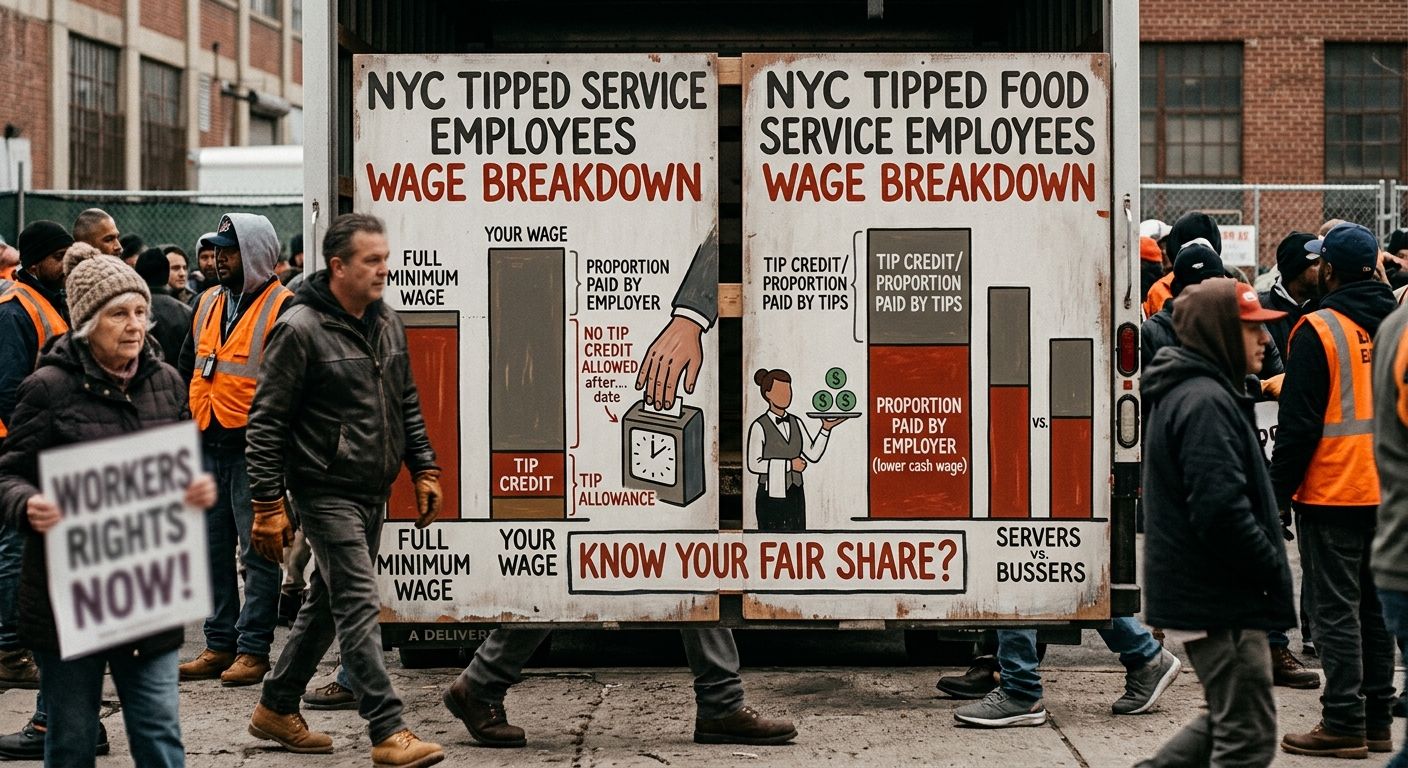
The tip credit is the mechanism by which New York State allows hospitality employers to pay a cash wage below the full minimum wage, provided that tips bring the employee's total hourly compensation up to or above the minimum. As of 2026, the NYC Business portal confirms two tipped-worker categories with different credit structures:
Worker Category | Cash Wage | Tip Credit | Total Must Equal |
|---|---|---|---|
Tipped service employees (e.g., hotel staff, salon workers) | $14.15/hr | $2.85/hr | $17.00/hr |
Tipped food service employees (e.g., servers, bartenders) | $11.35/hr | $5.65/hr | $17.00/hr |
The employer bears the legal risk. If an employee's tips during any pay period don't bring their effective hourly rate to $17.00, the employer must make up the full difference in cash. This "make-whole" obligation is enforceable through the New York Department of Labor, and violations carry liquidated damages equal to 100% of the underpayment.
The practical impact falls heaviest on food service workers, whose $11.35 cash wage means employers are paying only 66.8% of the full minimum wage out of pocket. For healthcare-adjacent hospitality workers like dietary staff in hospitals that operate cafeterias or cafes open to the public, the classification question matters. Workers performing food service duties within a healthcare facility may be classified differently depending on whether the facility is considered a "hospitality industry" employer under New York's tipped worker regulations.
Congressional efforts to eliminate the tip credit entirely gained momentum in 2024 and 2025, with federal legislation proposing to end the restaurant tip credit at the national level. New York's sub-minimum tipped wage remains legal under state law regardless of federal proposals, but the legislative pressure reflects growing recognition that the tip credit system shifts labor costs from employers to customers.
Exempt Salary Thresholds and the Overtime Connection
The minimum wage doesn't function in isolation. It drives a second, less visible pay floor: the salary threshold that determines whether an employee qualifies as "exempt" from overtime under New York's executive and administrative exemptions. As of January 1, 2026, employees in NYC must earn at least $1,275.00 per week ($66,300 per year) to be classified as exempt. That threshold rose from $1,200.00 per week in 2024 and $1,237.50 in 2025.
Any salaried healthcare worker classified as exempt who earns below that threshold is legally entitled to overtime pay at 1.5 times their effective hourly rate for all hours exceeding 40 in a workweek. This catches a significant number of clinical coordinators, billing supervisors, and administrative staff at smaller healthcare practices and home care agencies. Misclassifying these workers as exempt when their salary falls short of the threshold is one of the most common wage violations in New York City's healthcare sector.
The connection is mechanical: as the minimum wage increases, the exempt salary threshold increases proportionally. Employers who adjusted base wages in January 2024 but didn't revisit exempt salaries at the same time may have inadvertently reclassified previously exempt employees as overtime-eligible, creating back-pay liability for every week the salary fell short.
The CPI-W Indexation Engine Arriving in 2027
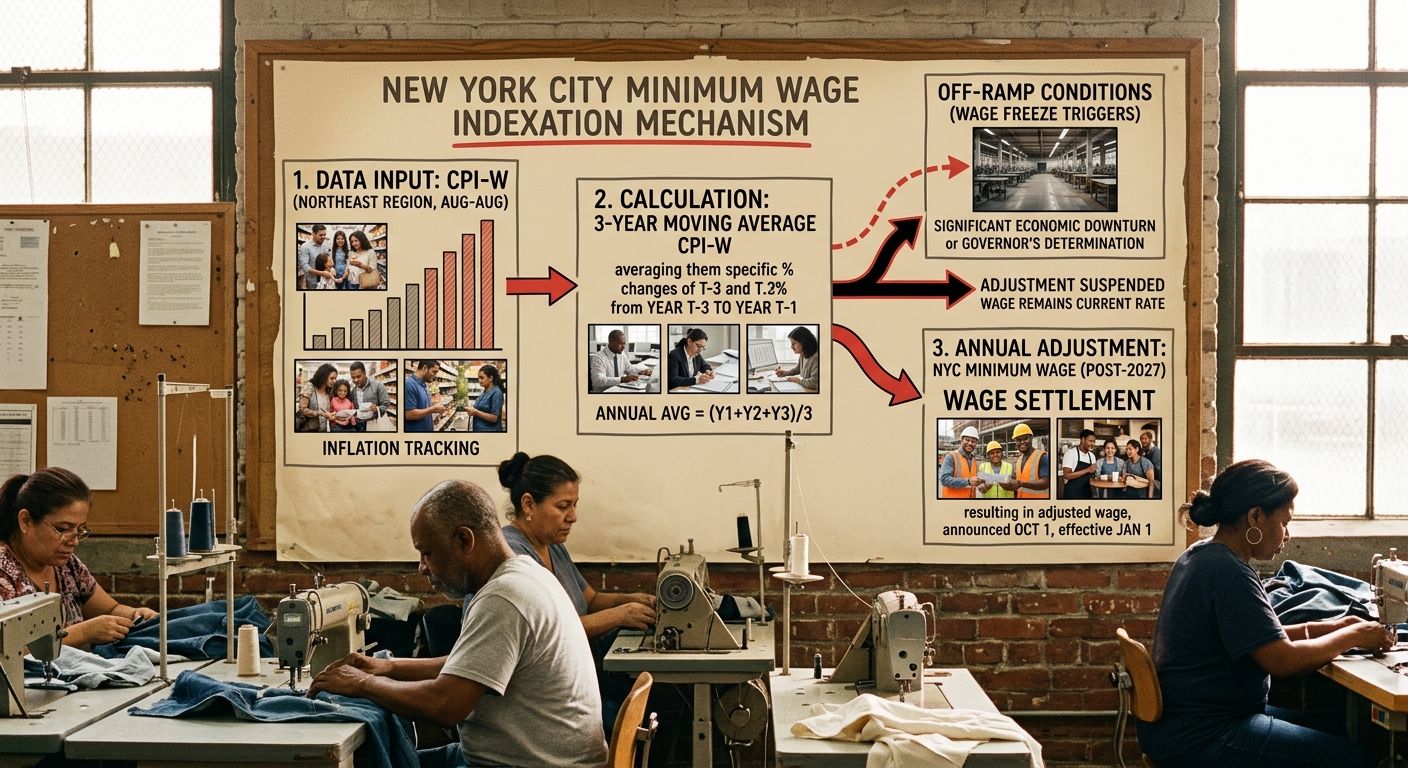
The three-step escalator ending at $17.00 in 2026 was designed as a bridge to a permanent adjustment mechanism. Starting in 2027, New York's minimum wage will increase annually based on a three-year moving average of the Consumer Price Index for Urban Wage Earners and Clerical Workers (CPI-W) for the Northeast Region. The Governor's office announcement confirmed that the indexation formula includes "off-ramps" allowing the state to pause or reduce scheduled increases if specific economic indicators signal a downturn.
This formula matters for two reasons. First, it removes the political negotiation cycle that left the wage frozen at $15.00 for five years. Automatic adjustments tied to regional inflation data mean the purchasing power of the minimum wage will track the cost of living without requiring new legislation each time. Second, the three-year moving average smooths out short-term price spikes, preventing a single high-inflation quarter from triggering an outsized wage jump.
For healthcare employers budgeting labor costs, the shift from predictable $0.50 increases to formula-driven adjustments introduces planning uncertainty. An employer who could calculate exact January payroll costs two years in advance under the fixed escalator will now depend on CPI data released in the fall of the prior year. Empirical analysis suggests that a 10% minimum wage increase typically raises the overall Consumer Price Index by only 0.14 percentage points in the first year, meaning wage-driven inflation is far smaller than critics typically claim.
States like Florida have adopted similar constitutional indexing mechanisms tied to CPI, and the early evidence from those states shows that automatic adjustments reduce the frequency of prolonged wage stagnation periods.
Where the Model Breaks
The NYC minimum wage system has at least three structural weak points that workers and organizers should understand.
The fast food carve-out creates confusion. Fast food employees were previously covered by a separate, higher wage order. The convergence of the general minimum wage with the fast food rate has blurred the lines, and workers in quick-service restaurants attached to hospitals, airports, and transit hubs often don't know which rate applies to them.
Enforcement relies on complaints, not proactive auditing. The New York Department of Labor investigates wage violations primarily through worker-filed complaints. Workers in healthcare settings who depend on employer-sponsored housing, visa sponsorship, or continued patient assignments face enormous pressure not to file. The system works on paper and fails for the workers with the least power to use it.
The CPI-W off-ramps are undefined in practice. The 2027 indexation formula includes provisions to pause increases during economic downturns, but the specific triggers and decision-making process remain vague. If a recession coincides with high inflation in essential costs like healthcare and housing, workers could face a freeze in their nominal wage while their real costs continue climbing. The Raise Up NY bill (S3062D/A7503C), which proposed rates as high as $21.25 by 2026, reflected labor advocates' concern that even the indexed floor would lag behind actual cost-of-living increases in the city.
And for workers who want to push for wages above the legal floor, understanding how to recognize and counter employer resistance during organizing campaigns is essential. The minimum wage is a floor, not a ceiling, and collective bargaining remains the most effective mechanism for raising pay above the statutory minimum.
Common Questions
Does the NYC minimum wage apply to all workers regardless of immigration status?
Yes. New York's minimum wage laws apply to all workers performing labor within the state, regardless of immigration or documentation status. Employers cannot pay undocumented workers less than the applicable minimum wage, and workers can file complaints with the Department of Labor without disclosing their immigration status.
Can my employer count my uniform allowance or meal credits toward the minimum wage?
No. The minimum wage must be paid entirely in cash wages (plus tip credit for eligible tipped workers). Meal credits, uniform allowances, lodging deductions, and other non-cash compensation cannot reduce an employee's cash wage below the applicable minimum. The only exception is the tip credit for qualifying tipped workers in the hospitality industry.
What happens to the minimum wage in NYC if there's a recession in 2027 or later?
The CPI-W indexation formula includes off-ramp provisions that could pause or reduce scheduled increases during economic downturns, but the specific triggers haven't been fully defined through regulation yet. Workers should monitor Department of Labor announcements each fall for the following year's rate. Even during a pause, the minimum wage cannot decrease below its current level.
I work for a home care agency based in Westchester but visit patients in both NYC and Rockland County. Which rate applies?
You're owed the NYC/Westchester rate ($17.00 in 2026) for hours worked in NYC or Westchester, and the rest-of-state rate ($16.00 in 2026) for hours worked in Rockland County. Your employer must track hours by location and pay the corresponding rate for each. If your employer pays a flat rate based on their office location, check whether it meets the minimum for every county where you actually perform work.
How do I file a wage complaint if my employer isn't paying the correct minimum wage?
File online through the New York Department of Labor's wage complaint portal, by phone, or by mail. You can file on behalf of yourself or a group of coworkers. The Department investigates complaints confidentially, and retaliation against workers who file wage complaints violates New York Labor Law Section 215, which provides for reinstatement and back pay if an employer retaliates.
The Union Edge Staff
Frequently Asked Questions
- What is the NYC minimum wage in 2026?
- The NYC minimum wage is $17.00 per hour as of January 1, 2026, following a three-step increase from $16.00 in 2024 to $16.50 in 2025 to $17.00 in 2026.
- How much can food service workers be paid in cash in NYC?
- Tipped food service employees in NYC can be paid as low as $11.35 per hour in cash wages under the tip credit formula, provided tips bring their total hourly compensation to at least $17.00.
- Does NYC minimum wage apply if I work in multiple counties?
- Yes, the minimum wage you're owed depends on where you physically work each hour. Workers traveling between NYC, Westchester, Suffolk, or Nassau County must be paid the higher $17.00 rate for those hours, and the rest-of-state rate of $16.00 for hours worked elsewhere.
- What is the exempt salary threshold in NYC for 2026?
- Employees in NYC must earn at least $1,275.00 per week ($66,300 per year) to be classified as exempt from overtime as of January 1, 2026. Those earning below this threshold are entitled to overtime pay at 1.5 times their effective hourly rate.
- When does NYC minimum wage switch to automatic increases?
- Starting in 2027, NYC minimum wage will increase annually based on a three-year moving average of the Consumer Price Index for Urban Wage Earners and Clerical Workers (CPI-W) for the Northeast Region, replacing the fixed $0.50 annual increases.
- Can employers deduct meal credits or uniforms from minimum wage?
- No, the minimum wage must be paid entirely in cash wages. Meal credits, uniform allowances, lodging deductions, and other non-cash compensation cannot reduce an employee's cash wage below the applicable minimum wage.
- How do I file a wage complaint with the New York Department of Labor?
- You can file online through the New York Department of Labor's wage complaint portal, by phone, or by mail on behalf of yourself or coworkers. The Department investigates complaints confidentially, and retaliation against workers who file is illegal.
- Does NYC minimum wage apply to undocumented workers?
- Yes, New York's minimum wage laws apply to all workers regardless of immigration or documentation status, and workers can file complaints with the Department of Labor without disclosing their immigration status.
Related Articles

New York City Minimum Wage: 2024 Updates & What Changed
New York City's minimum wage is the legal hourly floor every employer in the five boroughs must pay, and on January 1, 2024, it climbed from $15.00 to $16.00 per hour. That dollar increase was the first move in a three-year legislated schedule that reaches $17.

Minimum Wage in NYC: 2024 Rates & Requirements
Section 652 of New York's Labor Law sets the minimum wage in NYC at $16.00 per hour as of January 1, 2024. That headline number hides a tiered system of tip credits, industry-specific floors, and geographic zones that can reduce a worker's guaranteed cash wage to $10.

Minimum Wage in New York: Current Rates & Updates
Depending on where you clock in, the minimum wage in New York ranges from $16.00 to $17.00 per hour, set by a two-zone structure that completed its final scheduled $0.50 increase on January 1, 2026, and will hand future adjustments to an inflation formula in 2027.
Also in the paper