
Minimum Wage New York: 2024 Update
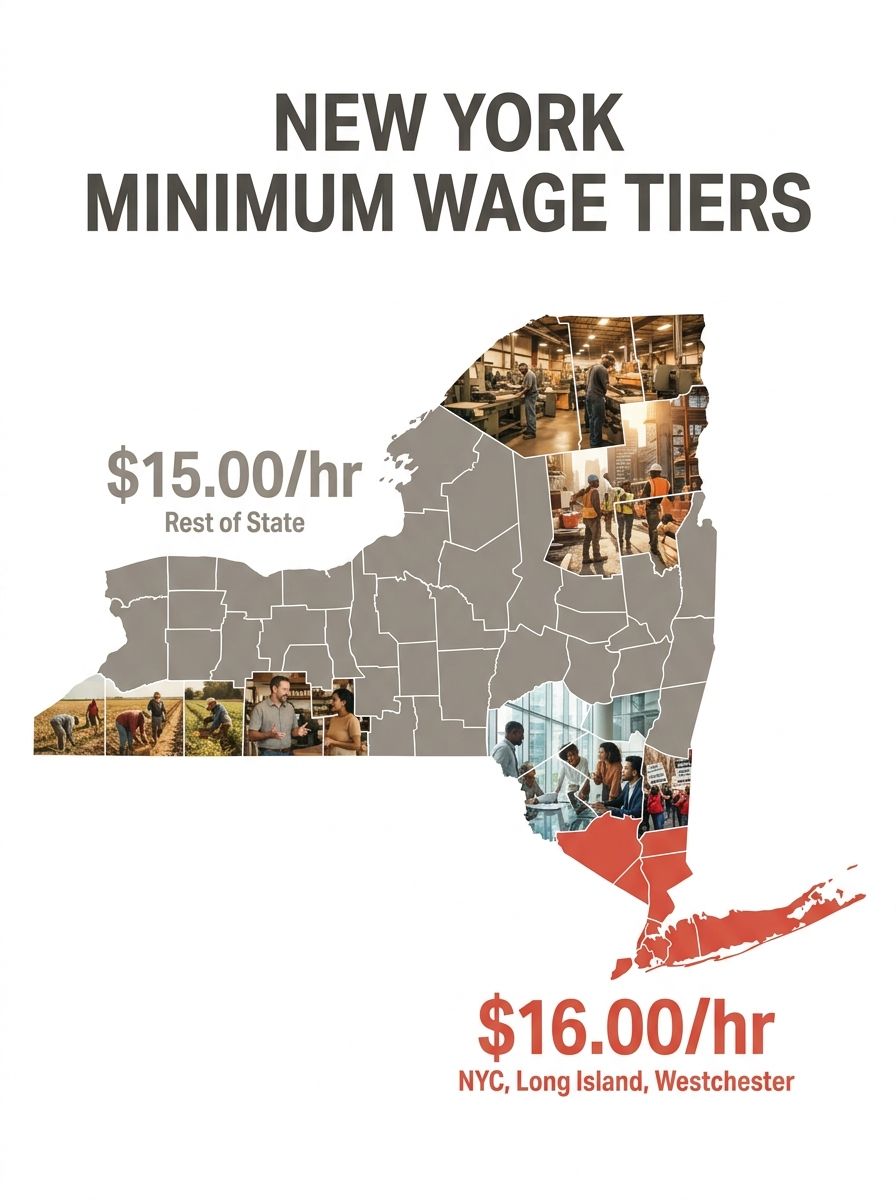
New York's minimum wage operates through a geographic tier system that pays workers in New York City, Long Island, and Westchester a different hourly rate than workers in the rest of the state. The 2024 update set those tiers at $16.00 and $15.

Minimum Wage in New York: The 2024 Update and How the Tiered System Actually Works
New York's minimum wage operates through a geographic tier system that pays workers in New York City, Long Island, and Westchester a different hourly rate than workers in the rest of the state. The 2024 update set those tiers at $16.00 and $15.00 per hour respectively, launching a three-year escalator that reaches $17.00 and $16.00 in 2026 before switching to automatic inflation indexing in 2027. Understanding each layer of this mechanism is a workplace rights issue: if you don't know which tier applies to your job, you can't know whether your employer is paying you legally.
The Geographic Tier System That Splits the State in Two
New York doesn't have a single minimum wage. It has two base rates determined by where the work is performed, according to the New York State Department of Labor. Workers in New York City, Nassau County, Suffolk County, and Westchester County fall under the higher-cost-of-living tier. Everyone else falls under the lower tier.
This geographic split has been a feature of New York's wage law since 2016, when then-Governor Cuomo signed legislation creating separate trajectories for different parts of the state. The reasoning was straightforward: rent in Manhattan and rent in Utica bear almost no resemblance to each other, and a single statewide rate would either overshoot rural labor markets or leave downstate workers unable to cover basic expenses.
The split also reflects where wage theft complaints concentrate. Downstate counties generate the majority of New York's wage-and-hour violations, and a higher floor in those regions provides a clearer legal standard for enforcement. If you're working in the five boroughs and your employer is paying you the "rest of state" rate, that employer is breaking the law, period.
The 2024-2026 Escalator: Three Fixed Steps
Governor Hochul's FY 2024 budget agreement created a three-year schedule of predetermined increases, each taking effect on January 1. The Governor's announcement framed the deal as a compromise between labor advocates pushing for faster raises and business groups arguing for stability.
Here's the full escalator:
Effective Date | NYC / Long Island / Westchester | Rest of New York State |
|---|---|---|
January 1, 2024 | $16.00/hr | $15.00/hr |
January 1, 2025 | $16.50/hr | $15.50/hr |
January 1, 2026 | $17.00/hr | $16.00/hr |
Each step is a $0.50 increase across both tiers. The simplicity is intentional: employers can't claim confusion about the rate, and workers can verify their pay stubs against a publicly posted schedule. The New York State government's minimum wage page publishes these rates prominently.
But the "Raise Up NY" coalition, which includes several unions and worker centers, pushed for faster and higher increases than what the final budget delivered. Their proposal would have brought the statewide floor to $21.25 for New York City by 2026. The enacted schedule represents roughly half that pace. For workers whose rent increased by more than $0.50 per hour's worth of take-home pay between 2024 and 2025, the raises didn't keep up.
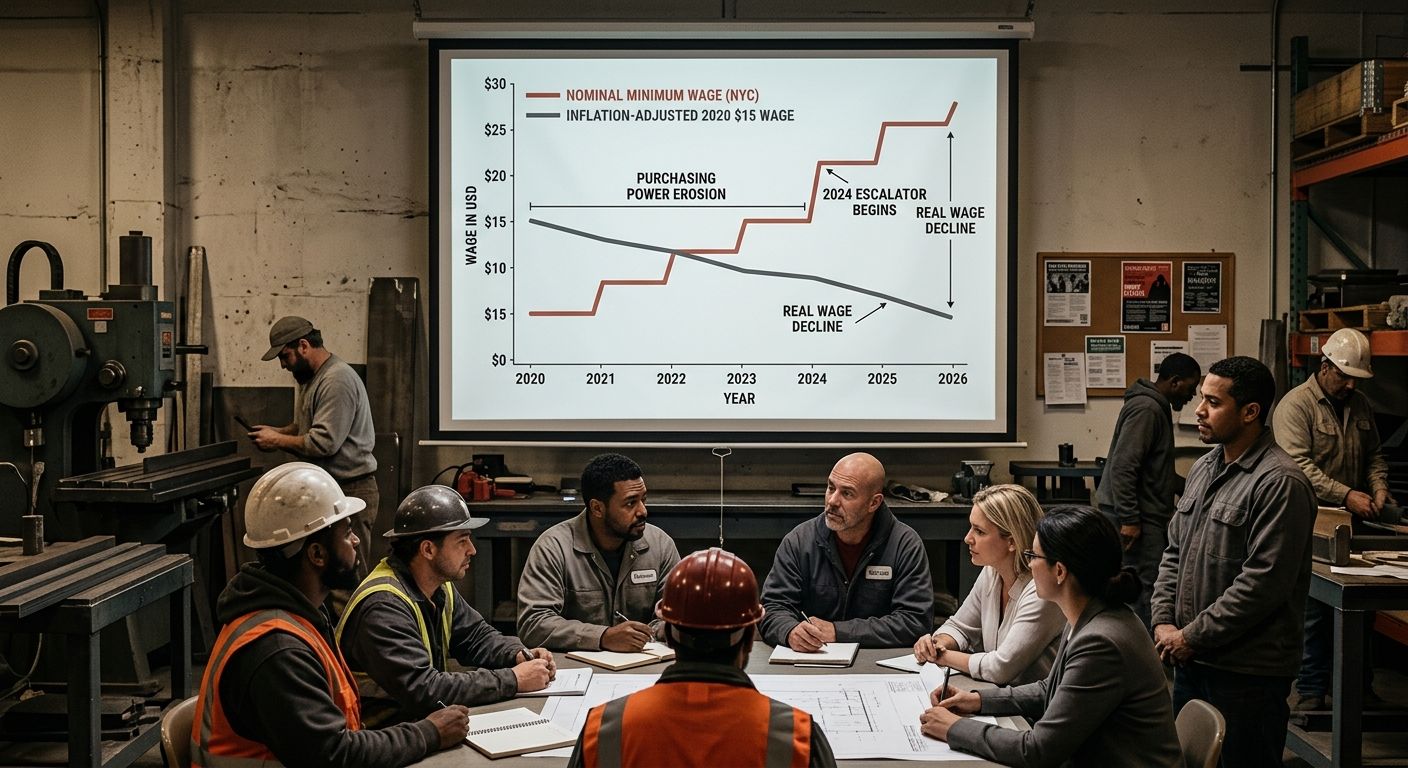
A February 2023 NYC Comptroller report drove home why these increases were urgent at all: inflation had eroded the real purchasing power of the $15.00 minimum wage established in 2020, projecting its inflation-adjusted value to drop below $13.00 by 2023. The scheduled increases are corrective. They don't represent new ground so much as recovered ground.
Tipped Workers and the Cash Wage Gap
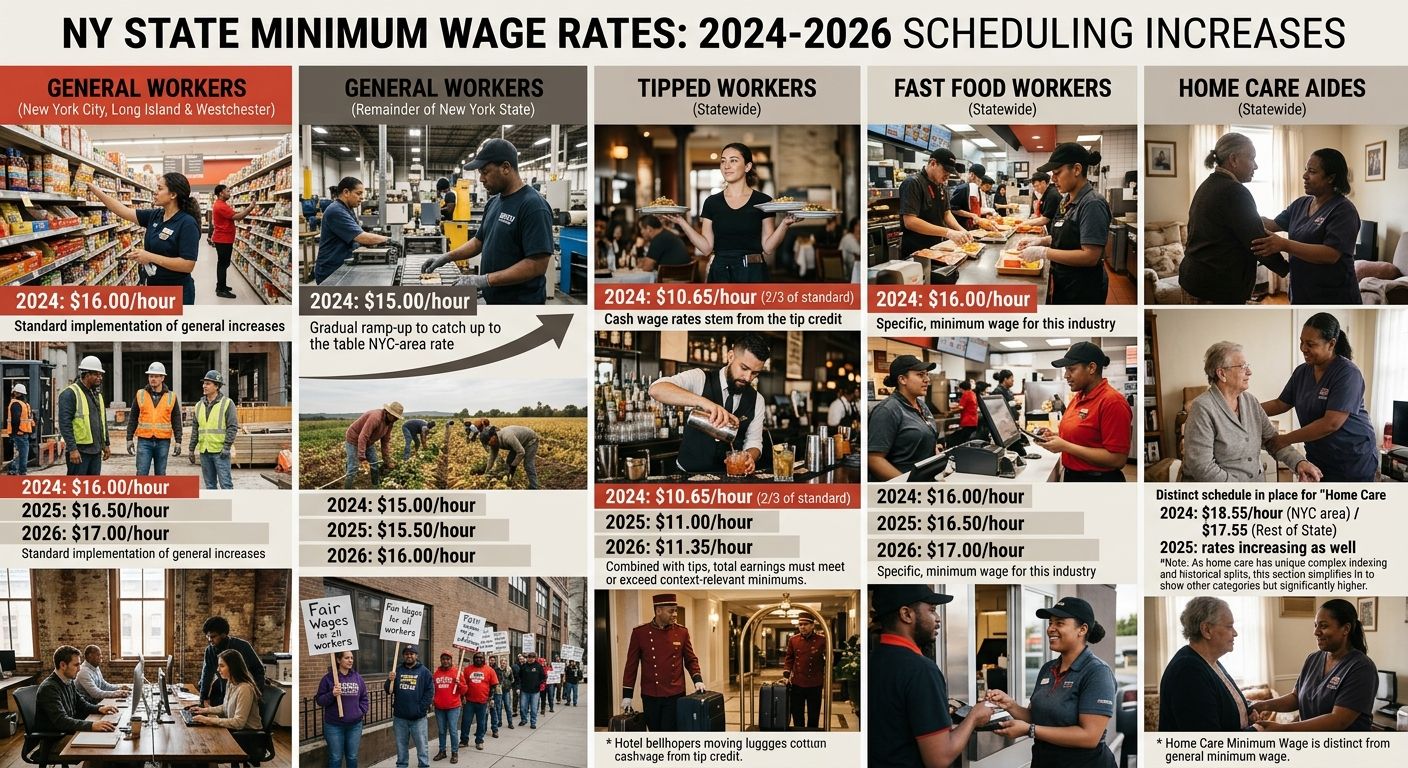
The minimum wage for New York workers gets more complicated when tips enter the picture. Tipped employees in the "rest of state" tier receive a cash wage of $12.50 per hour with a $2.50 tip credit, according to the NYC Bar Association's wage guide. The employer pays $12.50 directly; tips are expected to cover the remaining $2.50 to reach the $15.00 minimum. If tips fall short in any given week, the employer must make up the difference.
That "make up the difference" requirement is where the system breaks down in practice. Workers in tipped positions often report that employers don't track tip shortfalls accurately, or pressure workers not to report slow nights. The weekly tip threshold for service employees outside New York City was $8.40 per hour as of 2024. A server whose tips averaged $7.00 per hour in a given week is legally owed the gap from their employer. Many never see that money.
This gap between law and practice is why labor advocates have long argued for eliminating the tip credit entirely and paying all workers the full minimum wage before tips. The current system places the burden of wage enforcement on the workers least equipped to challenge their employers. We've seen the same dynamic in Florida's minimum wage structure, where tipped worker provisions create similar enforcement gaps.
Fast Food and Home Care: Industry-Specific Floors
New York has carved out separate minimum wage floors for two industries where low wages and high turnover intersect with public interest: fast food and home care.
The fast food minimum wage applies to any employee of a fast food establishment, defined under 12 NYCRR § 146-3.13 as a business that primarily serves food or drinks, offers limited or no table service, and is part of a chain with 30 or more locations nationally. That definition captures the major national chains but exempts independent restaurants. As of January 1, 2026, the fast food worker minimum wage has risen above the general minimum, reflecting the separate legislative track that accelerated fast food wages ahead of the broader floor.
Home care aides represent the other carve-out. Their wages reached $18.55 per hour downstate and $17.55 per hour upstate in 2024, with further increases to $19.65 and $18.65 respectively by 2026. These rates sit well above the general minimum wage, a recognition that home care work involves physical demands, irregular hours, and responsibilities that the broader labor market has chronically undervalued. The raises also responded to a staffing crisis: agencies across New York couldn't retain aides at previous pay levels, and patients were going without care.
These industry-specific floors matter for organizing. When workers at a fast food chain know they're entitled to a rate above the general minimum, that knowledge becomes a tool. We've documented how recognizing employer tactics helps workers protect their rights during campaigns, and knowing your wage floor is the most basic version of that protection.
How CPI-W Indexing Will Work Starting in 2027
The 2024-2026 escalator ends on December 31, 2026. Starting January 1, 2027, New York's minimum wage shifts to an automatic adjustment mechanism tied to the Consumer Price Index for Urban Wage Earners and Clerical Workers for the Northeast Region, using a three-year moving average.
Here's what that means in practice. The Bureau of Labor Statistics publishes CPI-W data monthly. The Northeast Region CPI-W tracks price changes for goods and services purchased by hourly and clerical workers across the northeastern states. New York will take the average annual change in that index over the previous three years and apply it as a percentage increase to the minimum wage.
The three-year moving average is a smoothing mechanism. It prevents the minimum wage from spiking in a single year of high inflation (like 2022, when CPI-W surged above 9%) or stalling in a deflationary dip. If CPI-W for the Northeast Region rose 4% in year one, 3% in year two, and 2% in year three, the minimum wage increase for the following January would be approximately 3%.
Governor Hochul's office described this indexing as ensuring "the minimum wage keeps pace with the cost of living." The mechanism eliminates the need for workers and advocates to fight a new legislative battle every few years to restore purchasing power that inflation has already eaten.
But indexing to CPI-W rather than a broader inflation measure is a specific policy choice. CPI-W captures the spending patterns of wage earners and clerical workers, which skews toward food, transportation, and housing costs. It does not capture the spending patterns of salaried professionals or retirees. For minimum wage workers, whose budgets are dominated by exactly those categories, CPI-W is a closer fit than the all-items CPI. That said, the three-year averaging means the wage adjustment always lags behind current inflation by at least a year. Workers feel price increases immediately but don't see the wage correction until the average catches up.
This structure mirrors what some other states have done. As we've covered in examining Florida's wage escalator tied to its state constitution, indexing mechanisms vary widely in how they protect purchasing power depending on the specific index used and whether there's a floor or cap on annual adjustments. New York's law doesn't currently include a cap, which means in a sustained high-inflation environment, the minimum wage would continue rising. It also doesn't include a floor, meaning in a deflationary year, the three-year average could theoretically produce a very small increase or even zero.
Where the Model Breaks
New York's tiered system has real blind spots. The geographic boundary between tiers creates cliff effects. A worker in Westchester County earns $17.00 per hour in 2026; a worker doing the identical job a few miles north in Putnam County earns $16.00. The cost-of-living difference between those two counties is negligible, but the wage difference is a full dollar per hour, or roughly $2,080 per year for a full-time worker.
The tip credit system, as described above, relies on employer honesty and worker documentation in an industry where neither is guaranteed. Studies of wage theft in New York's restaurant industry have consistently found that tip credit violations are among the most common, and the workers most affected are disproportionately immigrants and women of color.
The CPI-W indexing mechanism, while an improvement over legislative inaction, has its own limitation: it doesn't account for regional variation within the two tiers. Housing costs in Buffalo and housing costs in Albany are meaningfully different, but both cities fall into the same "rest of state" tier. The two-tier model that was meant to reflect cost-of-living differences is itself too coarse a tool for a state as economically varied as New York.
And the fast food carve-out creates a classification problem. Workers at a 29-location chain are paid the general minimum wage; workers at a 30-location chain get the fast food premium. That single-location threshold means a growing regional chain's workers can see their wage floor change based on corporate expansion decisions they have no part in.
The exempt salary threshold is another area of confusion. When the minimum wage rises, the salary floor for "executive" and "administrative" exempt employees rises with it. Employers who reclassify workers as exempt to avoid overtime obligations must ensure the salary meets the updated threshold. Workers who suspect misclassification should check the current threshold with the NYSDOL.
For workers in any of these edge cases, documented evidence of hours worked, tips received, and pay stubs is the single most important tool for protecting your rights. If you're building a workplace organizing campaign, wage floor violations are often the issue that gets co-workers to sign cards.
Common Questions
Does the minimum wage of New York apply to all workers, including undocumented immigrants?
Yes. New York's minimum wage applies to all workers regardless of immigration status. The New York State Department of Labor has stated this explicitly. Employers who pay undocumented workers below the minimum wage are violating state law, and those workers have the legal right to file wage complaints without fear of the Department sharing their immigration status with federal authorities.
What happens if my employer pays me the wrong tier rate?
If you work in New York City, Long Island, or Westchester and your employer pays you the "rest of state" rate, you're owed the difference for every hour worked. File a wage complaint with the NYSDOL online or by calling 833-910-4378. Keep copies of your pay stubs and any records of hours worked. The Department can investigate and recover back wages on your behalf.
Is the minimum wage for New York going to keep rising after 2026?
Yes, but through a different mechanism. Starting January 1, 2027, annual increases will be calculated automatically based on the three-year moving average of the CPI-W for the Northeast Region. The size of each year's increase will depend on how much prices rose in the preceding three years, so the exact dollar amount won't be known until the BLS publishes the relevant data.
Do small businesses get an exemption from New York's minimum wage?
No. New York's minimum wage applies regardless of business size. There is no small-business exemption. The only variations are geographic (which tier the workplace falls in), industry-specific (fast food and home care), and tip-related (the cash wage for tipped employees). Every employer in New York State must pay at least the applicable minimum wage rate for their location and industry.
How does New York's minimum wage compare to the federal minimum wage?
The federal minimum wage has been $7.25 per hour since 2009. New York's lowest tier ($16.00 for the rest of the state in 2026) is more than double the federal floor. When state and federal rates differ, employers must pay whichever is higher. In New York, the state rate governs in every case.
The Union Edge Staff
Frequently Asked Questions
- What is the minimum wage in New York in 2024?
- New York has two geographic tiers: $16.00 per hour for New York City, Long Island, and Westchester County, and $15.00 per hour for the rest of the state, effective January 1, 2024.
- How much will New York's minimum wage increase by 2026?
- New York's minimum wage will increase by $0.50 annually from 2024 through 2026, reaching $17.00 per hour in the higher tier and $16.00 per hour in the rest of state tier by January 1, 2026.
- Do tipped workers in New York get the full minimum wage?
- Tipped workers in the rest of state tier receive a $12.50 cash wage with a $2.50 tip credit, and employers must make up any shortfall if tips don't bring total compensation to the $15.00 minimum. Tipped workers should document daily tips and file complaints with the NYSDOL if shortfalls aren't paid.
- What is the minimum wage for fast food workers in New York?
- Fast food workers in New York have a separate industry-specific minimum wage floor that has risen above the general minimum wage. As of January 1, 2026, fast food workers earn more than the general minimum wage tier for their geographic region.
- How will New York's minimum wage be adjusted after 2026?
- Starting January 1, 2027, New York's minimum wage will automatically adjust annually based on a three-year moving average of the Consumer Price Index for Urban Wage Earners and Clerical Workers (CPI-W) for the Northeast Region.
- Does New York's minimum wage apply to undocumented immigrants?
- Yes, New York's minimum wage applies to all workers regardless of immigration status, and the NYSDOL will not share workers' immigration information with federal authorities when wage complaints are filed.
- What should I do if my employer pays me the wrong minimum wage tier?
- File a wage complaint with the New York State Department of Labor online or by calling 833-910-4378, and keep copies of your pay stubs and records of hours worked so the Department can investigate and recover back wages.
- Are small businesses exempt from paying New York's minimum wage?
- No, New York's minimum wage applies to all businesses regardless of size, with variations only by geographic tier, industry (fast food and home care), and tip-related cash wages.
Related Articles

Minimum Wage in NYC: 2024 Rates & Requirements
Section 652 of New York's Labor Law sets the minimum wage in NYC at $16.00 per hour as of January 1, 2024. That headline number hides a tiered system of tip credits, industry-specific floors, and geographic zones that can reduce a worker's guaranteed cash wage to $10.

New York City Minimum Wage: 2024 Updates & What Changed
New York City's minimum wage is the legal hourly floor every employer in the five boroughs must pay, and on January 1, 2024, it climbed from $15.00 to $16.00 per hour. That dollar increase was the first move in a three-year legislated schedule that reaches $17.

New York State Minimum Wage: 2024 Rates & Requirements
The new york state minimum wage is a two-zone geographic system where workers in New York City, Long Island, and Westchester earn one hourly floor, and workers everywhere else in the state earn a lower one. As of January 1, 2024, those floors sat at $16.00 and $15.
Also in the paper