
Digital Organizing Gone Wrong: 5 Critical Mistakes Unions Make When Deploying Technology Tools
"We spent $40,000 on a new platform, and six months later, our stewards were still texting each other on their personal phones to track grievances.

Digital Organizing Gone Wrong: 5 Critical Mistakes Unions Make When Deploying Technology Tools
"We spent $40,000 on a new platform, and six months later, our stewards were still texting each other on their personal phones to track grievances." That's Maria, a building trades organizer in Ohio, describing what happened when her local rushed into a union organizing software purchase without a real plan. She isn't alone. We hear versions of this story almost weekly from organizers, local presidents, and staff reps across every sector.
Here's the uncomfortable truth: technology doesn't organize workers. Workers organize workers. But the right tools, deployed the right way, can make that organizing faster, sharper, and more durable. The wrong tools, or the right tools deployed badly, can drain treasuries, frustrate members, and actually set campaigns back. We've watched too many locals and internationals make the same preventable errors when it comes to union tech adoption. So we're naming them.
These are the five most damaging mistakes we see unions make when rolling out digital tools, and what you can do instead.
Buying Software That Looks Good on Paper but Is Miserable to Use
A slick sales demo is not a usability test. We can't say this loudly enough. Union leaders sit through a polished 45-minute presentation, see every feature box get checked, and sign a multi-year contract. Then the tool lands in the hands of a 58-year-old shop steward working night shift at a food processing plant, and the whole thing falls apart.
As one buyer's guide from Union Impact puts it bluntly: "A system that checks every box on paper but is clunky to use will fail in practice. If the system feels confusing in a demo, it will feel worse in real life."
That's exactly right. Your membership isn't a group of software engineers. They're nurses, electricians, warehouse workers, teachers, and machinists. Many are accessing tools on older phones with cracked screens during a 15-minute break. If your member engagement technology requires a tutorial video just to log in, you've already lost.
What to Do Instead
Before signing anything, put the tool in front of your least tech-savvy steward. Seriously. If they can't figure out the basics in ten minutes without help, walk away. Build usability testing into your evaluation process the same way you'd test safety equipment before approving it for the shop floor.
And prioritize mobile. According to research on member engagement tools, mobile apps have become the single most effective channel for driving engagement in membership organizations. Your digital organizing strategy needs to meet workers where they already are, which is on their phones.
Treating Technology Like a Replacement for Relationships
This one cuts deep because it gets at the philosophical heart of organizing. We've seen locals purchase sophisticated organizing campaign management platforms and then reduce their field program. The logic goes something like: "Now that we can text 5,000 workers at once, we don't need as many one-on-one conversations."
That logic is dead wrong.
Technology is a multiplier, not a substitute. A mass text can remind 500 members about a ratification vote. It cannot build the trust that makes someone willing to stand up to their boss. It cannot read body language during a house visit. It cannot hold someone's hand in a disciplinary hearing.
The research backs this up. Studies on digital labor and organizing challenges consistently find that the decentralized, digitally-mediated nature of modern work makes solidarity harder to build, not easier. Platforms can help workers come together and discuss problems, but the connection has to start somewhere real.
If you're running an organizing campaign, the fundamentals haven't changed. You still need face-to-face conversations, house visits, and organic leaders identified from within the workforce. We've written extensively about why getting into the community remains essential for winning campaigns. No app replaces that. The difference between organizing models and service models isn't which software you buy. It's whether your members are active participants or passive recipients.
What to Do Instead
Use technology to support and track relationship-building, not to bypass it. The best use of a digital platform during a campaign is logging one-on-one conversations, tracking assessment levels, identifying organic leaders, and coordinating follow-up. Think of it as the map, not the territory.
Set a rule: for every digital communication you send, your organizers should be having at least three face-to-face conversations. If the ratio flips, your campaign is in trouble.
Skipping Training and Expecting Adoption to Happen by Magic
We once talked to a local that purchased a full-featured union management platform, sent a single email to staff saying "here's the new system," and then wondered why nobody was using it three months later. The IT coordinator told us, with genuine bewilderment, "We gave them the login information. What else were they supposed to need?"
Everything. They needed everything else.
Change management is not a corporate buzzword. It's the difference between a tool that transforms your operations and a tool that collects digital dust. As one analysis of digital labor adoption found, "Chaotic adoption can undermine your entire workforce. Most organizations treat digital labor like a technology rollout when it actually requires workforce transformation."
Unions are, ironically, sometimes worse at this than the employers they bargain with. We fight hard for training provisions in contracts under Section 7 of the National Labor Relations Act, which protects workers' rights to act collectively, but we don't always apply that same standard to our own internal operations. Under OSHA's General Duty Clause (Section 5(a)(1)), employers must train workers on new equipment. Shouldn't we hold ourselves to the same standard when we roll out new systems for our own staff and stewards?

What to Do Instead
Build a training plan before you purchase the software. Not after. Your plan should include:
Designated champions at every level: at least one tech-comfortable steward or staff person per worksite or local who can troubleshoot and encourage adoption.
Live training sessions scheduled across shifts so night and weekend workers aren't excluded.
Simple written guides with screenshots, not 50-page manuals nobody reads.
A 90-day check-in where you evaluate adoption rates and address barriers honestly.
Ongoing support access from your vendor, not just a help desk email that takes three days to respond.
If your vendor doesn't offer real onboarding support, that tells you something about how they'll treat you as a partner down the road.
Using Consumer Tools for Union-Critical Communications
WhatsApp groups. Personal Gmail accounts. Facebook Messenger threads. We get it. They're free, everyone already has them, and they work right now. But "works right now" is a dangerous standard for communications that involve protected concerted activity under the NLRA.
Here's what can go wrong. A steward uses a personal Facebook group to coordinate a work action. The employer's management team is monitoring social media. Names get identified. Retaliation follows. Or a WhatsApp group chat about bargaining strategy gets screenshot and shared with someone who shouldn't have seen it. Or a personal email account gets hacked, and years of grievance communications are exposed.
Consumer tools weren't built for union work. They lack audit trails, secure document storage, dues tracking, and compliance safeguards. Research from the Journal of Labor Research has long documented that technological changes disrupt labor-management relations in unpredictable ways. Using tools that weren't designed for your specific needs is one of those disruptions.
Under Section 8(a)(1) of the NLRA, employers are prohibited from interfering with workers' organizing rights. But you make it easier for bad-faith employers to surveil your activities when you conduct union business on platforms designed to harvest and monetize user data.
What to Do Instead
Invest in purpose-built union platforms that offer encrypted communications, member databases, and organizing tools in one place. Dedicated union management software can consolidate membership information, dues processing, grievance tracking, and campaign communications into a single secure system. Yes, it costs money. But it costs less than a compromised campaign.
If budget is genuinely a barrier, at minimum use Signal (which is end-to-end encrypted and nonprofit) for sensitive communications, and establish clear written policies about what can and cannot be discussed on consumer platforms.
No Strategic Plan Beyond "Get the Software"
This is the mistake that enables all the others. A local sees another union using a new platform. Leadership gets excited. Someone approves a purchase. The software arrives. Then what?
Without a digital organizing strategy that connects technology to concrete goals, you're just adding complexity to an already stretched-thin operation. We've seen unions purchase sophisticated campaign management tools and then use them only for sending meeting reminders. That's like buying a printing press and using it as a paperweight.
Your organizing campaign from first conversation to first contract has specific, measurable milestones. Your technology deployment should too.
The Yale Journal on Regulation's analysis of unions and technology documents how unions like SAG-AFTRA are approaching tech strategically, building contract language around AI use and committing to ongoing monitoring. That's the level of strategic thinking every local needs to bring to its own tech decisions.
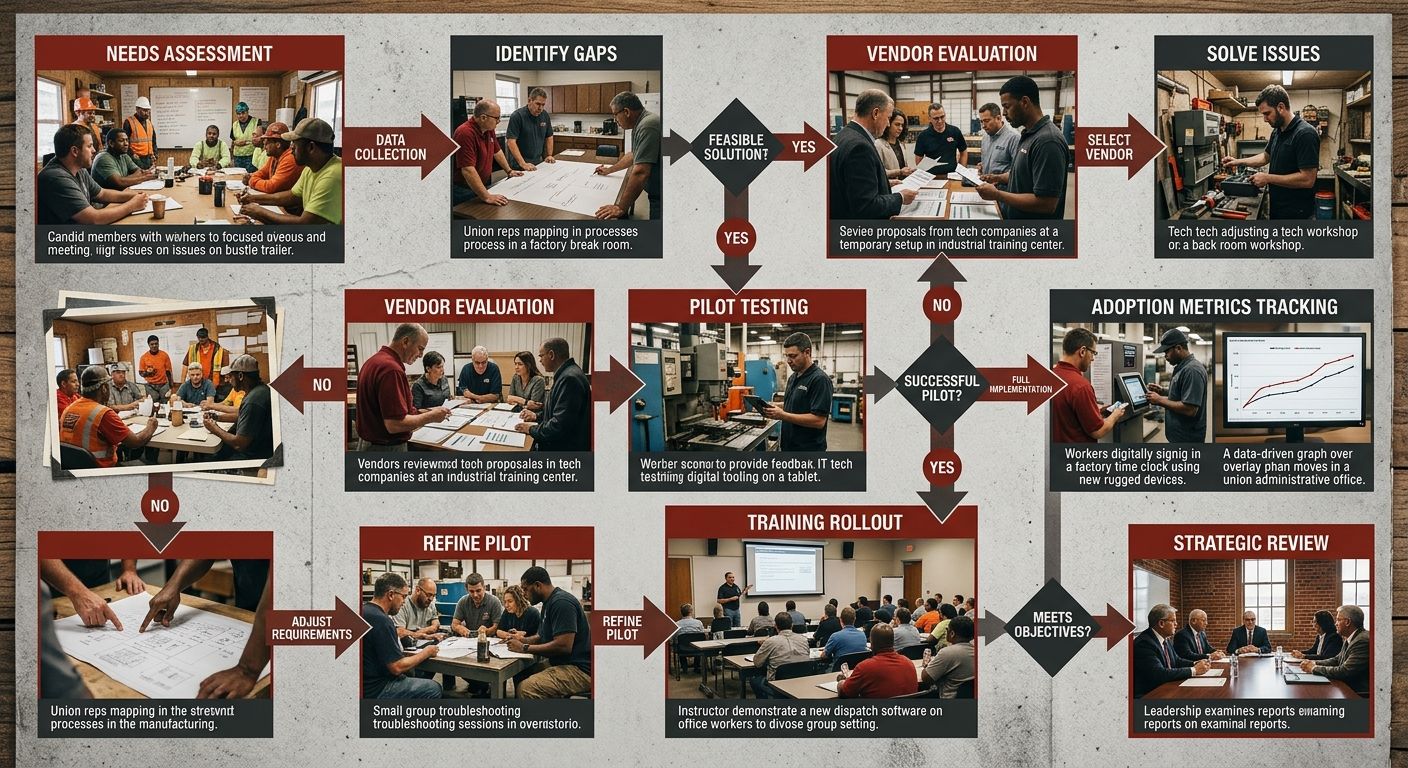
What to Do Instead
Before you spend a dollar, answer these five questions in writing:
What specific problem are we trying to solve? (Not "modernize" or "get better." Be concrete. "Reduce grievance processing time from 6 weeks to 2 weeks." "Increase meeting attendance by 40%." "Track assessments for 3,000 unorganized workers across 12 worksites.")
Who will use this tool daily, and have we consulted them?
What does success look like at 90 days, 6 months, and 1 year?
What are we willing to stop doing to make room for this new system?
What happens if the vendor goes under or raises prices 300%? Do we own our data?
That last question matters more than most unions realize. Your member data is an organizational asset. If it lives on a platform you don't control, with export restrictions you didn't read in the contract, you're vulnerable. Negotiate data portability and ownership clauses before you sign.
Technology Serves the Mission
Every one of these mistakes shares a common root. They all happen when unions treat technology as a product to buy rather than a capacity to build. Buying software is easy. Building the organizational culture, training infrastructure, and strategic clarity to actually use it well is hard.
We've spent our careers studying what the NLRB says about workers' rights and watching how those rights play out on the ground. Section 7 of the NLRA guarantees workers the right to self-organize and bargain collectively. That guarantee means nothing if the tools we use to exercise it are poorly chosen, badly deployed, or actively undermining our security.
The labor movement is at an inflection point. Union approval ratings are near historic highs. New organizing is happening in sectors that were unthinkable a decade ago. The workers reaching out to unions right now are younger, more digitally fluent, and more impatient with clunky processes. They expect their union to communicate with the same immediacy and polish as every other organization in their lives.
Meeting that expectation doesn't require the most expensive platform on the market. It requires intentionality. It requires treating your digital organizing strategy with the same rigor you bring to contract negotiations. And it requires remembering, always, that the purpose of every tool is to make human connection easier, faster, and more powerful.
What to Do This Week
If you're a local officer, organizer, or staff rep reading this, here's where to start:
Audit your current tools. List every platform, app, and communication channel your union uses. Identify which ones are consumer-grade and which are purpose-built for union work.
Talk to your stewards. Ask them what's working and what isn't. Their frustration is your roadmap.
Write down your goals before you shop. If you're considering new organizing campaign management software, define success metrics first.
Demand demos with real users. Don't let the vendor control the narrative. Put the tool in front of your people and watch what happens.
Budget for training, not just licenses. Allocate at least 25% of your technology budget to onboarding, training, and ongoing support.
The tools exist. The workers are ready. The only question is whether we're going to be strategic enough to put those pieces together. We owe it to every member paying dues and every worker waiting for a union to show up.
Don't let bad tech deployment be the reason your next campaign falls short. Organize the technology the same way you organize the shop: with a plan, with your people, and with solidarity at the center of every decision.
The Union Edge Staff
Also in the paper