
What Is Prevailing Wage? Legal Definition & Requirements
A prevailing wage is the minimum hourly rate, including fringe benefits, that contractors and subcontractors must pay workers on government-funded projects, as determined by the U.S. Department of Labor or a state equivalent.

What Is Prevailing Wage? Legal Definition, Calculation Methods, and Why Enforcement Shapes Every Dollar
A prevailing wage is the minimum hourly rate, including fringe benefits, that contractors and subcontractors must pay workers on government-funded projects, as determined by the U.S. Department of Labor or a state equivalent. The rate varies by job classification, county, and project type, and it's anchored to what unionized and non-union workers in a given area actually earn.
The Federal Legal Framework
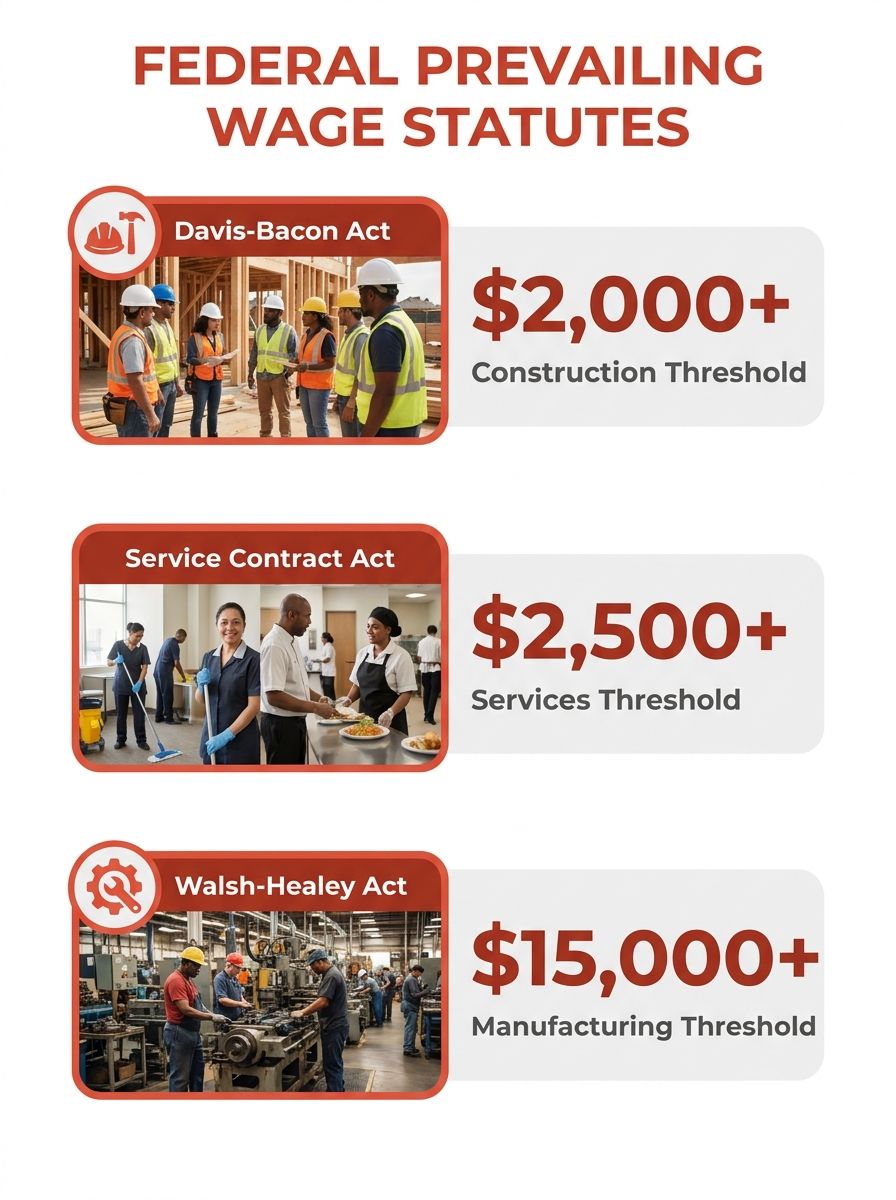
The Davis-Bacon Act of 1931 is the backbone of federal prevailing wage law. It applies to contracts over $2,000 for construction, alteration, or repair of public buildings and public works funded by the federal government. The U.S. Department of Labor administers the law and publishes wage determinations, which are official schedules listing the required hourly rate and fringe benefits for each labor classification in each geographic area.
Davis-Bacon doesn't stand alone. The McNamara-O'Hara Service Contract Act requires prevailing wage rates and fringe benefits for service employees on federal contracts exceeding $2,500, covering custodians, security guards, food service workers, and dozens of other classifications. The Walsh-Healey Public Contracts Act covers manufacturing supply contracts above $15,000. Together, these three statutes define prevailing wage meaning at the federal level and cover millions of workers across construction, services, and manufacturing.
A wage determination, as published on SAM.gov, is a set of wages, fringe benefits, and work rules the DOL has ruled to be prevailing for a given labor category in a given locality. Contractors don't get to negotiate below these rates. They're the floor.
How the DOL Calculates the Rate
The calculation formula determines whether the prevailing wage reflects actual union scale or gets diluted by low-bid contractors importing cheaper labor. In 2023, the DOL introduced a restored three-step method for federal prevailing wage determinations.
Step one: if more than 50% of workers surveyed in a classification earn the same wage, that rate becomes the prevailing wage, known as the "majority wage" rule. Step two: if no single rate captures a majority, the DOL applies the "30% rule," setting the prevailing wage at the rate earned by at least 30% of workers. Step three: if neither threshold is met, the DOL falls back to a weighted average of wages paid, adjusted by the number of workers employed at each rate.
This three-step approach reversed a Reagan-era policy that had defaulted to weighted averages in most cases, pulling prevailing wages below negotiated union rates for decades. The restoration means that in areas where organized labor has established strong wage standards, those standards are more likely to set the floor for public projects.
But on June 24, 2024, a federal court temporarily blocked specific provisions of the 2023 updates, including rules extending coverage to material suppliers and delivery truck drivers. The core wage determination methodology remains in effect, though the legal challenge created uncertainty that contractors and workers alike are still navigating. For a deeper look at what that means on the ground, we've written about how enforcement determines whether these laws carry real weight.
Thirty-Two States Run Their Own Systems
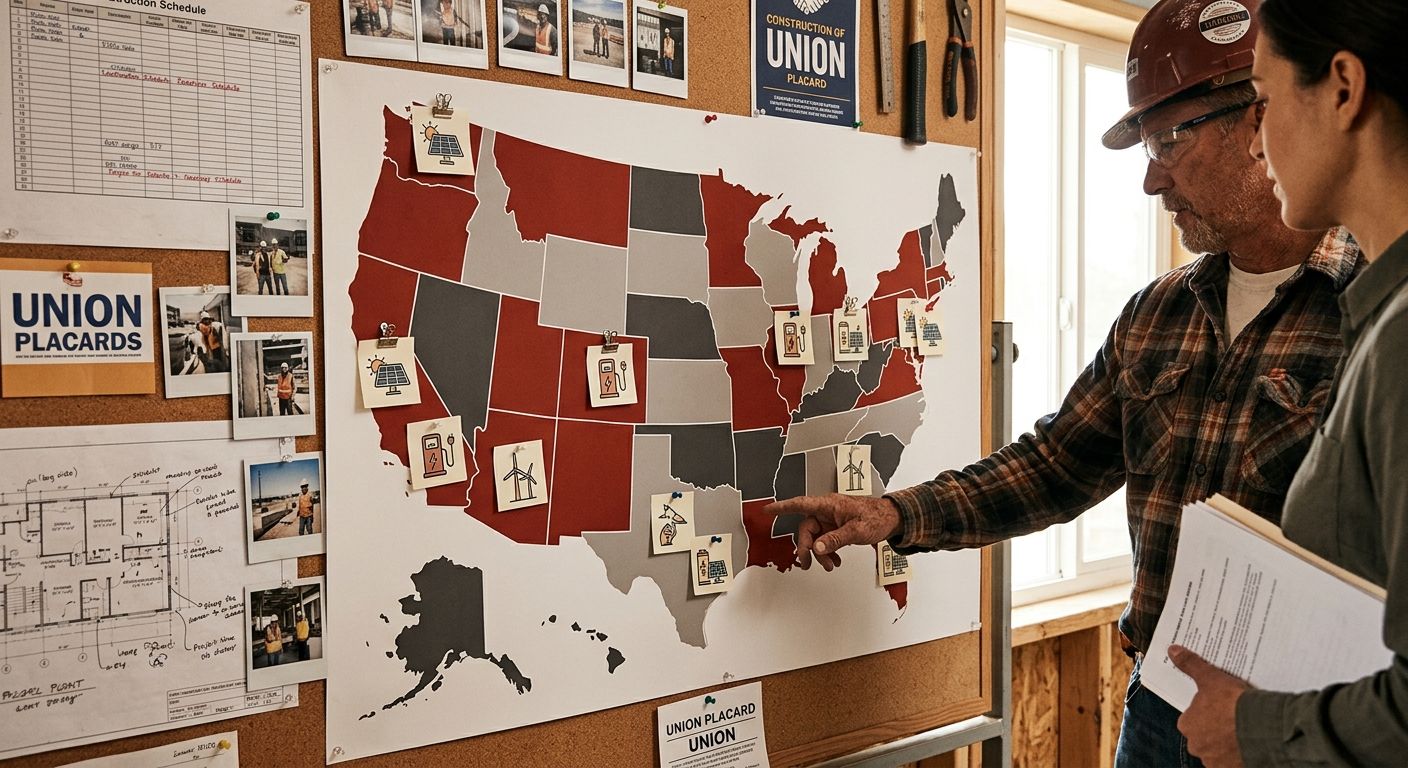
To define prevailing wage fully, you have to account for the patchwork of state-level statutes known as "Little Davis-Bacon" laws. As of 2025, 32 states enforce their own prevailing wage requirements for state-funded construction. The rates, thresholds, and covered occupations vary enormously.
Maine, for instance, amended its laws in 2019 to require prevailing wages on all construction projects of $50,000 or more funded "in whole or in part" by state funds, a broad trigger that captures projects many states would exclude. New Jersey municipalities have enacted requirements covering building service workers at government-owned or government-leased properties, extending prevailing wage protections well beyond traditional construction trades.
Washington state's RCW 39.04.260 defines covered work as any construction, alteration, repair, or improvement, other than ordinary maintenance, that a state or municipal entity causes to be performed by a private party, including contracts to rent, lease, or purchase at least 50% of a project. The state's prevailing wages are determined and enforced by the Department of Labor and Industries based on collective bargaining agreements in each county.
Geographic complications pile up fast. A project drawing from both federal and state funding sources can trigger both Davis-Bacon and a state prevailing wage law simultaneously. Multi-state projects may require compliance with different wage standards in each jurisdiction. Workers who cross county lines within a single state can find their required rate shifting mid-project.
Dimension | Federal (Davis-Bacon) | State ("Little Davis-Bacon") |
|---|---|---|
Governing body | U.S. Department of Labor | State labor departments |
Construction threshold | $2,000+ | Varies: $50,000 (Maine) to $500,000+ |
Covered work | Federally funded/assisted construction | State/municipally funded projects |
Rate basis | DOL three-step survey method | Varies: collective bargaining, survey, hybrid |
Number of jurisdictions | Nationwide | 32 states as of 2025 |
Service worker coverage | Service Contract Act (separate statute) | Some states extend, most don't |
Clean Energy and the IRA's New Wage Mandate
The Inflation Reduction Act of 2022 created a powerful new enforcement channel. Clean energy projects seeking the full value of federal tax credits for solar, wind, battery storage, and other qualifying technologies must pay prevailing wages and use registered apprentices. Projects that skip these requirements receive tax credits at roughly one-fifth the full value.
The IRS issued final regulations implementing these provisions in June 2024. The practical effect: billions of dollars in clean energy construction now carry prevailing wage obligations that didn't exist before 2022. For construction unions, the IRA represents one of the largest expansions of prevailing wage coverage in decades, linking wage standards directly to the tax code rather than to annual appropriations.
Where Enforcement Breaks Down
Penalties for prevailing wage violations can reach $13,508 per violation as of 2025, assessed per worker per pay period. Contractors face debarment from future federal contracts for up to three years. Those sound like serious consequences. In practice, enforcement depends heavily on whether anyone is watching.
Certified payroll reporting is the primary compliance mechanism. Contractors submit weekly reports documenting each worker's classification, hours, and fringe benefits using the WH-347 form (updated in January 2025 for enhanced fringe benefit reporting). The problem is that these are self-reported. A contractor who misclassifies a journeyman electrician as a general laborer, paying the lower rate, may never get caught unless a worker or a union files a complaint.
Worker-led monitoring programs have emerged as the most effective supplement to government oversight. Volunteers trained through the Los Angeles Joint Labor Compliance Monitoring Program are authorized to inspect work sites and talk directly to workers about compliance. Multnomah County, Oregon, is piloting a similar program on public works construction sites. Seattle and San Francisco have partnered with community organizations to enforce labor standards, bridging the gap between what the law requires and what actually happens on the job.
These worker-led programs deserve attention from organizers everywhere. If your local is building bargaining power through first contracts, prevailing wage enforcement gives you a concrete tool: documented violations become evidence in broader campaigns for accountability.
The Most Common Violation Is Misclassification
Worker misclassification causes more prevailing wage violations than outright underpayment. Contractors record workers under lower-paid categories than the actual duties they perform. A worker operating as a skilled carpenter gets logged as a general laborer. The payroll report looks clean. The worker loses thousands of dollars over the course of a project.
Accurate classification must be based on actual duties performed, not job titles. If you're doing journeyman electrical work, you're entitled to the journeyman electrician's prevailing wage rate for that county, regardless of what your contractor writes on the WH-347 form. Unions that help members understand their correct classification and document their actual daily tasks create the paper trail that turns a suspected violation into an enforceable claim. The same documentation discipline that helps organizers file effective unfair labor practice charges applies here: specifics win, generalities don't.
The Economic Case Against "Costs Too Much"
Opponents of prevailing wage laws have pushed the same talking point for decades: these mandates inflate construction costs, waste taxpayer money, and price out small contractors. The data says otherwise.
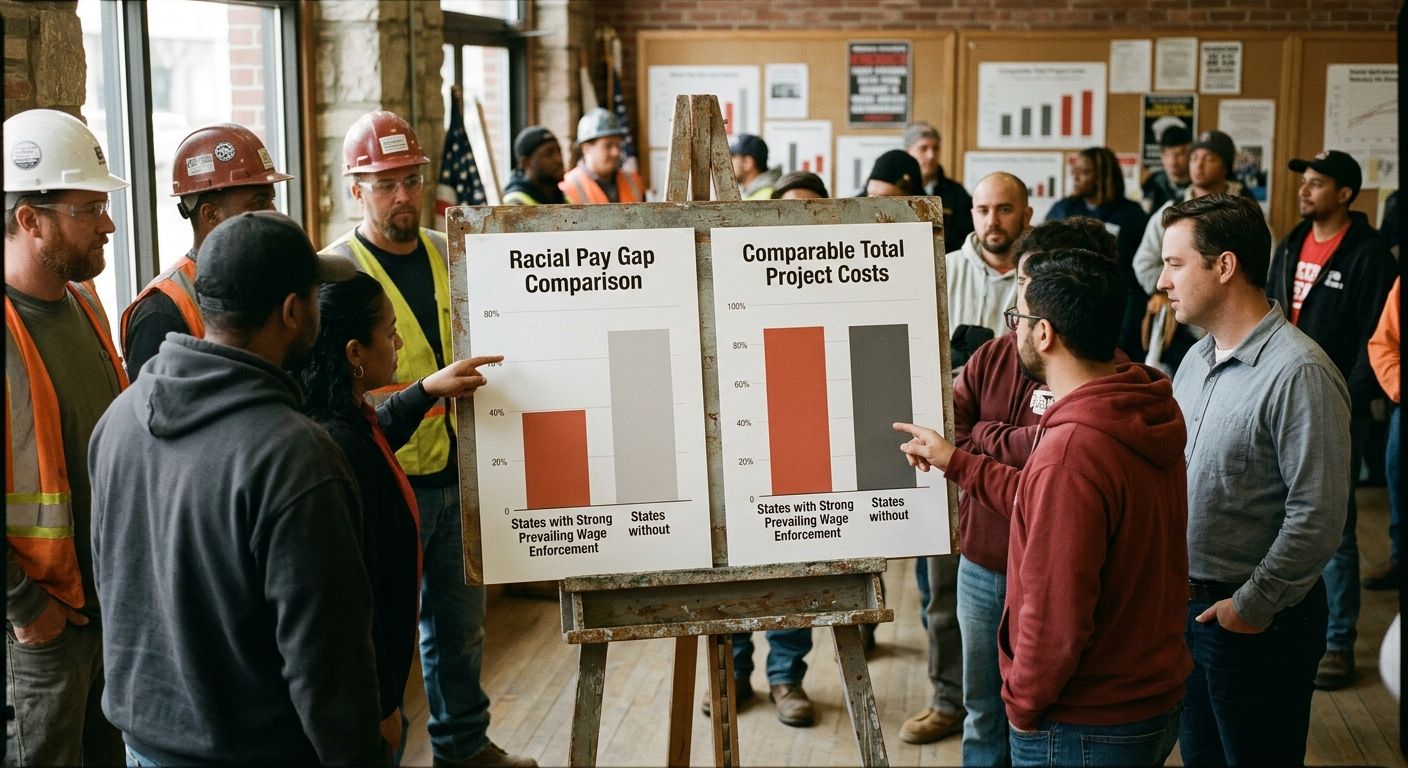
Research on prevailing wage laws' economic effects indicates they help close racial pay gaps, potentially reducing the white-Black income gap in construction by 7 percentage points. That's a measurable reduction in a structural inequality that has persisted across the industry for generations.
Studies also challenge the cost inflation claim directly. Prevailing wage requirements don't significantly raise total project costs because higher wages correlate with higher productivity, lower turnover, and fewer workplace injuries, all of which reduce indirect costs. The argument that cutting wages saves taxpayers money ignores the downstream expenses: increased reliance on public assistance for underpaid workers, higher injury rates on low-bid projects, and the economic drag of depressed local purchasing power.
When SoFi Stadium hospitality workers moved toward a strike vote over pay disputes, part of the underlying tension traced back to exactly this dynamic: public investment in a venue where the workers building and servicing it weren't sharing in the returns. Prevailing wage enforcement on public projects is one mechanism for ensuring that tax-funded work supports the communities doing that work.
What the Numbers Still Can't Answer
The data on prevailing wage laws is stronger than it was a decade ago. The 7-point reduction in racial pay gaps is well-documented. The 32-state coverage map is expanding. The IRA's linkage of tax credits to wage standards has created new financial incentives for compliance. Penalties of $13,508 per violation per pay period provide theoretical deterrence.
But several questions remain unresolved. How many prevailing wage violations go unreported because workers fear retaliation, lack information, or don't know the complaint process exists? The DOL doesn't publish violation data broken down by industry, geography, and contractor size, which means we can identify the legal framework but can't measure the gap between law and practice.
The expansion of worker-led compliance monitoring in Los Angeles, Multnomah County, Seattle, and San Francisco suggests a path forward, but these programs cover a tiny fraction of the roughly $400 billion in annual public construction spending. Scaling them would require funding, legal authorization, and political will that varies wildly across the 32 states with prevailing wage statutes.
And the 2024 federal court injunction on portions of the DOL's 2023 updates leaves open the question of how far the restored calculation methodology will ultimately reach. The core three-step method stands for now. Whether it survives further legal challenges will shape how courts, agencies, and workers define prevailing wage in practice for the next decade. The numbers tell us these laws work when someone enforces them. What the numbers can't yet tell us is how many workers on public projects never see the benefit because no one has shown up to check.
The Union Edge Staff
Related Articles

How Prevailing Wage Laws Actually Work — and Why Enforcement Determines Whether They Mean Anything
The Davis-Bacon Act requires contractors on federal construction projects to pay locally determined wage rates. It has done so since 1931.

California Prevailing Wage: Complete Legal Guide
California's Director of Industrial Relations sets prevailing wage rates for every county and trade classification in the state, drawing primarily from collectively bargained union agreements.
Prevailing Wage for California: Complete Guide
Prevailing wage for California is the legally mandated minimum hourly compensation, base pay plus fringe benefits, that every worker on a qualifying public works project must receive, as determined by the Director of the Department of Industrial Relations (DIR).
Also in the paper